IB Mathematics: Analysis and Approaches SL/HL — Topic 1 Number and algebra
Financial Mathematics
Connect sequences to interest, depreciation and buying power, then solve financial problems by hand or with your TI-Nspire CX.
Learning goal
Model financial growth and decay; find a balance, deposit, rate or time and interpret the answer.
Syllabus link
AA SL/HL: SL 1.4. Financial applications of geometric sequences and series: compound interest and annual depreciation.
Big idea
A fixed amount gives an arithmetic model. A fixed percentage gives a geometric model.
Key relationship
Start at \(u_0\). After \(m\) periods, \(u_m=u_0q^m\), where \(q\) is the multiplier per period.
Time zero: fixed amounts or fixed percentages?
The principal is the initial amount invested, \(u_0\). The term \(u_n\) is its value after \(n\) completed periods, where \(n=0,1,2,\ldots\). A period might be one year or one month.
Arithmetic sequence: add a fixed amount
\[\begin{gathered}u_n=u_0+nd\\[4pt](n=0,1,2,\ldots).\end{gathered}\]
Booklet: not given in this form. Section 1.2 gives \(u_n=u_1+(n-1)d\); here we start at \(u_0\).
From \(u_0\) to \(u_n\), add the common difference \(d\) exactly \(n\) times.
Simple interest is calculated from the initial principal each year. At \(5\%\) simple interest on $1000, \(d=1000(0.05)=50\): \[\begin{gathered}1000,\quad1050,\quad1100,\quad1150,\ldots\\[4pt]u_n=1000+50n.\end{gathered}\] At an annual rate of \(r\%\), \(d=u_0r/100\), so \(u_n=u_0(1+nr/100)\).
Booklet: the simple-interest formulas are not given separately.
Geometric sequence: multiply by a fixed factor
\[\begin{gathered}u_n=u_0\times r^n\\[4pt](n=0,1,2,\ldots).\end{gathered}\]
Booklet: not given in this form. Section 1.3 gives \(u_n=u_1r^{n-1}\); here we start at \(u_0\).
Here \(r\) is the common ratio: there are \(n\) multiplications from \(u_0\) to \(u_n\).
Compound interest is calculated from the current balance, including earlier interest. At \(5\%\) compounded annually, the multiplier is \(1.05\): \[\begin{gathered}1000,\quad1050,\quad1102.50,\quad1157.625,\ldots\\[4pt]u_n=1000(1.05)^n.\end{gathered}\] The second year’s interest is $52.50, since \(0.05(1050)=52.50\).
Booklet notation. In finance, the booklet uses \(r\) for the annual percentage rate. From now on, write \(q\) for the multiplier: \(u_n=u_0q^n\). Thus \(r=5\) gives \(q=1.05\) for annual compounding.
A balance is one term, not a sum of successive balances
Use \(u_n\) for the final balance. With no extra transactions, interest earned is \(u_n-u_0\). Adding balances counts the same money repeatedly. Partial sums are reviewed in Appendix A.
Compound interest: annual and shorter periods
Assume a constant rate and no extra deposits, withdrawals, fees or taxes unless stated. Keep full precision in calculations; round money only at the end.
Worked example 1 | Annual compounding
Question
$3000 is invested at \(4.5\%\) per year, compounded annually. Find (a) the value after five years and (b) the interest earned, both to the nearest cent.
Solution
(a) Use booklet formula 1.4 with \(k=1\). The annual multiplier is \(q=1.045\): \[u_5=3000(1.045)^5=3738.545812\ldots\approx\$3738.55.\] (b) Interest earned \(=u_5-u_0=738.545812\ldots\approx\$738.55\).
The nominal annual rate is the quoted rate before allowing for compounding within the year. At \(r\%\), compounded \(k\) times a year, each period earns \(r/k\%\).
The formula booklet: match the rate, time and periods
\[\mathrm{FV}=\mathrm{PV}\left(1+\frac{r}{100k}\right)^{kn}.\]
Booklet: given in section 1.4, in both the AA SL and HL booklets.
| \(r\) | Nominal annual rate (%) | \(k\) | Compounding periods per year |
| \(n\) | Time in years; may be fractional | \(m=kn\) | Total compounding periods |
\(q=1+r/(100k)\) is the multiplier per period, so \(\mathrm{FV}=u_m=u_0q^m\). PV and FV here are positive balances; the Finance Solver uses signed cash flows.
Worked example 2 | Monthly compounding
Question
$5000 is invested for three years at a nominal annual rate of \(4.8\%\), compounded monthly. Find: (a) the final balance and (b) the interest earned, both to the nearest cent.
Solution
(a) Use \(r=4.8\), \(k=12\) and \(n=3\). The monthly multiplier is \(q=1.004\); there are \(m=kn=12(3)=36\) months. \[\mathrm{FV}=5000\left(1+\frac{4.8}{100(12)}\right)^{36} =5772.762169\ldots\] The final balance is \(\boxed{\$5772.76}\). (b) Interest earned \(=5772.762169\ldots-5000\approx\$772.76\).
| Compounding | \(k\) | Rate per period | Periods in \(n\) years |
|---|---|---|---|
| Annually | 1 | \(r\%\) | \(n\) |
| Half-yearly | 2 | \(r/2\%\) | \(2n\) |
| Quarterly | 4 | \(r/4\%\) | \(4n\) |
| Monthly | 12 | \(r/12\%\) | \(12n\) |
Video tutorial | Compound interest
See the compound-interest formula used for annual and monthly compounding.
Match the units. A monthly multiplier needs a number of months in the exponent. For example, \(n=2.5\) years gives \(m=12(2.5)=30\) months.
Annual depreciation: geometric decay
Depreciation means a decrease in an asset’s value. If it loses \(p\%\) of its current value each year, it retains \((100-p)\%\). The common ratio is less than \(1\).
The same geometric formula, with a decreasing multiplier
\[\begin{gathered}q=1-\frac p{100},\\[4pt]u_n=u_0q^n=u_0\left(1-\frac p{100}\right)^n.\end{gathered}\]
Booklet: not given separately; adapt the geometric model in section 1.3.
Here \(u_0\) is the initial value and \(n\) counts completed years. For \(0<p<100\), we have \(0<q<1\).
Worked example 3 | A car’s value
Question
A car costs $24000 and depreciates by \(15\%\) of its current value each year. Find:
its value after four years;
the total value lost.
Solution
(a) It retains \(85\%\) each year, so \(q=0.85\). Using \(u_n=u_0q^n\), \[u_4=24000(0.85)^4=\$12528.15.\] (b) Value lost \(=u_0-u_4=24000-12528.15=\$11471.85\).

Worked example 4 | Find a depreciation rate
Question
A machine falls from $20000 to $14580 over three years. Its annual percentage depreciation is constant. Find this percentage.
Solution
Use \(u_n=u_0q^n\), where \(q=1-p/100\): \[\begin{aligned} 14580&=20000q^3,\\ q^3&=\frac{14580}{20000}=0.729,\\ q&=\sqrt[3]{0.729}=0.9. \end{aligned}\] It retains \(90\%\), so it loses \(100\%-90\%=10\%\) each year.
The annual depreciation rate is \(10\%\).
A fixed percentage loss is not a fixed monetary loss
Losing \(15\%\) each year means multiplying by \(0.85\) repeatedly, not subtracting \(4\times15\%=60\%\) of the original price over four years. A fixed amount lost each year would give an arithmetic sequence.
Inflation: what can the money actually buy?
Inflation is an increase in general prices. A balance may rise while its buying power falls. The nominal value is the amount of money shown; the real value expresses its buying power in today’s money. Why divide? If a basket costing $100 today costs $110 later, prices have multiplied by \(1.10\). Then $110 later has today’s buying power of \(110/1.10=\$100\).
Two steps: grow the investment, then allow for price growth
1. Find the nominal future value using the stated interest rate and compounding frequency: \(\mathrm{FV}=u_0(1+r/(100k))^{kn}\).
2. Divide by the price multiplier. With constant annual inflation \(h\%\), \[\text{real value}=\frac{\mathrm{FV}}{(1+h/100)^n}.\]
Booklet: not given; divide the future balance by the price multiplier.
Use the same time \(n\) in years for both steps. Prices grow geometrically with annual multiplier \(1+h/100\).
Worked example 5 | Balance growth versus buying power
Question
$10000 earns \(4\%\) per year, compounded annually, for five years. Inflation is \(2.5\%\) per year. Find, to the nearest cent:
the nominal final balance;
its real value in today’s money;
the gain in buying power.
Solution
(a) Use \(u_n=u_0q^n\), with \(q=1.04\): \[u_5=10000(1.04)^5=12166.529024\approx\$12166.53.\]
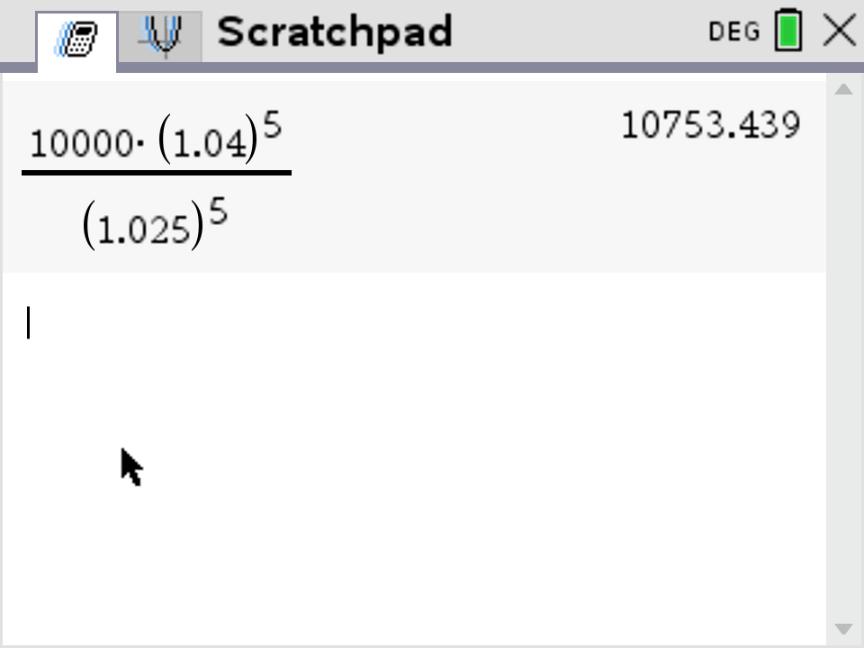
(b) Adjust for inflation.
Prices have been multiplied by \(1.025^5\), so divide the nominal balance by this multiplier: \[\frac{10000(1.04)^5}{(1.025)^5}=10753.438843\ldots\] In Scratchpad (or a Calculator page), enter the fraction and press Enter. The screen rounds the display to \(10753.439\); to the nearest cent, the real value is \(\boxed{\$10753.44}\).
(c) The gain in buying power is \(10753.438843\ldots-10000\), or $753.44. The nominal gain of $2166.53 overstates this gain.
Real annual growth (not given in the booklet). The annual multiplier is \(1.04/1.025=1.014634146\ldots\), so buying power grows by about \(1.46\%\) per year. Subtracting \(4-2.5=1.5\%\) is only an approximation.
Sequence connection (annual compounding). Real values have annual ratio \(q_{\mathrm{real}}=(1+r/100)/(1+h/100)\). If \(r<h\), then \(q_{\mathrm{real}}<1\): buying power falls.
Inflation divides; depreciation multiplies
Undo \(2.5\%\) annual inflation by dividing by \(1.025^n\), not multiplying by \(0.975^n\). With more frequent interest, compare actual annual growth with inflation, rather than comparing the nominal rate alone.
Calculator signs: follow the money
The Finance Solver records the direction of a cash flow. We always use our point of view. Ask: is this money leaving us or coming to us?
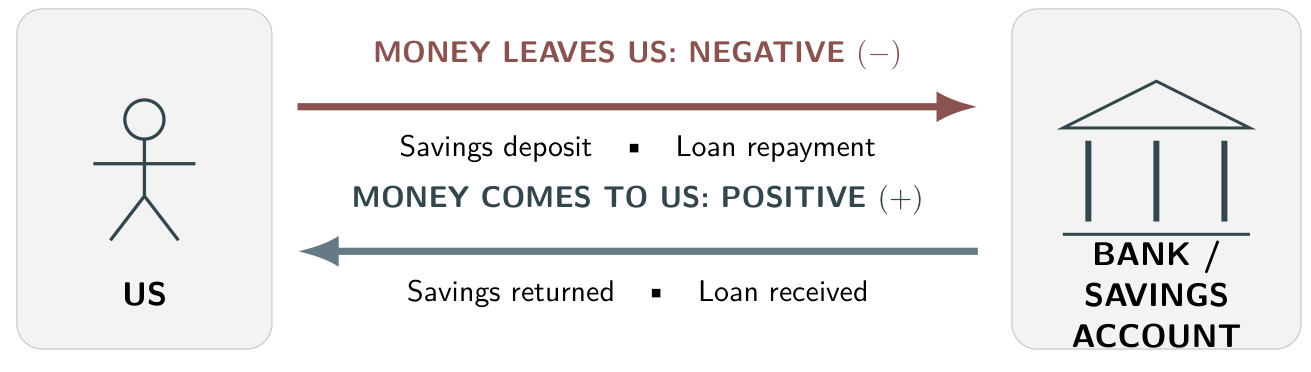
Savings: one deposit now, one payment back later
If we invest $5000 now and receive our savings at the end: \[\begin{gathered}\underbrace{\mathrm{PV}=-5000}_{\text{we pay into the account}}\\[4pt]\\[4pt]\underbrace{\mathrm{FV}>0}_{\text{the account pays us back}}.\end{gathered}\] Even if the money stays invested, FV represents what we could receive if we withdrew the balance then. With no regular payments, \(\mathrm{Pmt}=0\).
| Transaction | Calculator sign | Reason |
|---|---|---|
| Deposit $5000 into savings | \(-5000\) | Money leaves us. |
| Receive $5772.76 from savings | \(+5772.76\) | Money comes to us. |
| Receive a loan of $12000 | \(+12000\) | The bank pays us. |
| Repay $300 to the bank | \(-300\) | We pay the bank. |
A minus sign is a direction, not a loss
\(\mathrm{PV}=-5000\) does not mean our account has a negative balance or that we have lost $5000. It means the initial payment leaves us. For a single investment with \(\mathrm{Pmt}=0\), PV and FV must have opposite signs.
Formula versus calculator. In \(u_m=u_0q^m\), \(u_0\) and \(u_m\) are positive balances. In the Finance Solver, PV and FV are signed cash flows. Do not substitute a negative calculator PV into the balance formula and report a negative savings balance.
TI-Nspire CX: the Finance Solver
Open the Finance Solver
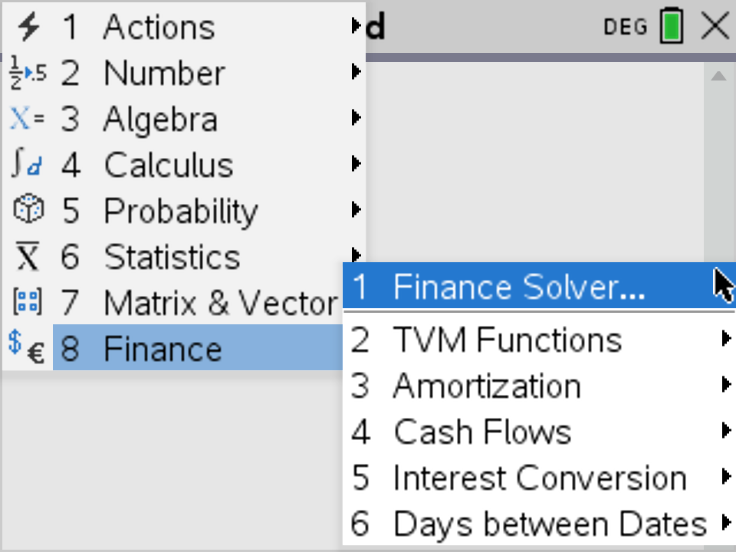
Open a Calculator page.
Press the Menu button.
Choose 8: Finance, then
1: Finance Solver.
Use Tab to move through the fields below. Once all known values are entered, place the cursor inside the unknown field and press Enter to calculate it.
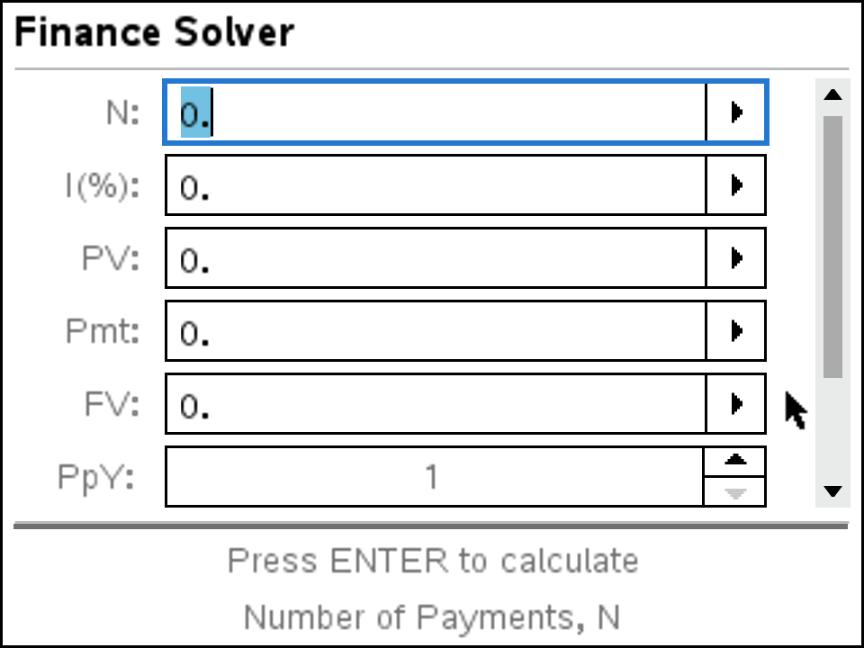
Default view: upper fields.
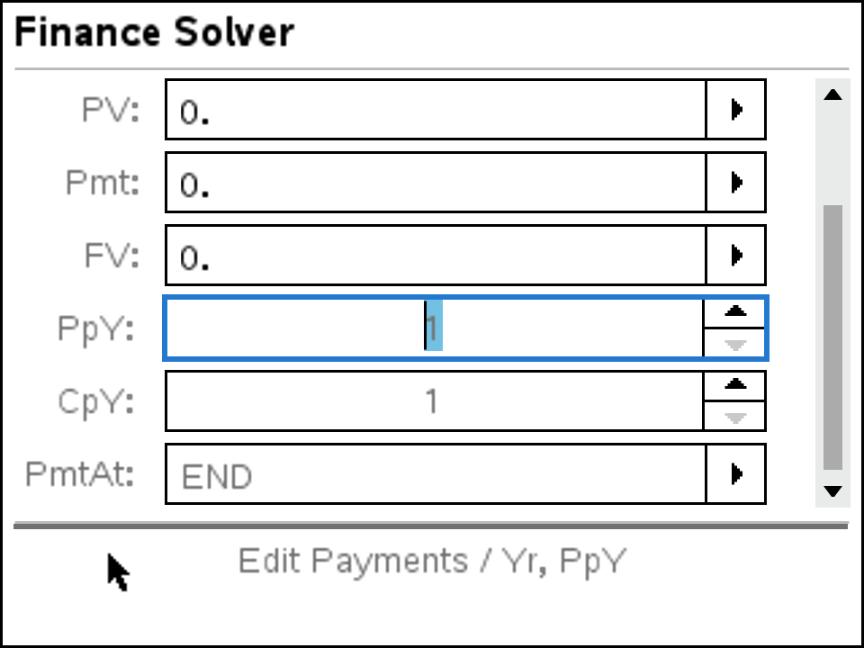
Scroll down: CpY and PmtAt.
| Field | Meaning and convention used here |
|---|---|
| N | Total periods. Choose \(\mathrm{PpY}=k\), so \(N=kn=m\). |
| I(%) | The booklet rate \(r\). Enter \(4.8\) for \(4.8\%\), not \(0.048\) or \(0.4\). |
| PV | Present cash flow; negative for our savings deposit. |
| Pmt | Regular payment per period; \(0\) for these single-deposit examples. |
| FV | Future cash flow; positive when savings return to us. |
| PpY | Payments per year. With Pmt \(=0\), this sets the period unit; choose \(k\). |
| CpY | Compounding periods per year; choose \(k\). |
| PmtAt | END. Timing has no effect when Pmt \(=0\). |
Check every field before solving
These default views show PpY \(=1\) and CpY \(=1\). Change both to \(12\) for monthly compounding in the next example. Previous entries may remain when you reopen the solver. Scroll down to check the lower fields too.
Booklet \(n\) and calculator N have different meanings
The booklet’s \(n\) counts years; N counts the periods set by PpY. With PpY \(=\) CpY \(=12\), N \(=12n\) counts months; with both set to \(4\), N \(=4n\) counts quarters. Pmt \(=0\) means there are no regular payments.
Finance Solver in action
Worked example 2 revisited | Use the Finance Solver
Question
$5000 is invested for three years at a nominal annual interest rate of \(4.8\%\), compounded monthly. Use the Finance Solver to find, to the nearest cent:
the final balance;
the total interest earned.
Solution
This is the monthly investment from section 2, now solved using technology.
(a) The booklet values are \(r=4.8\), \(k=12\) and \(n=3\). Find FV as follows.
1. Enter the known values
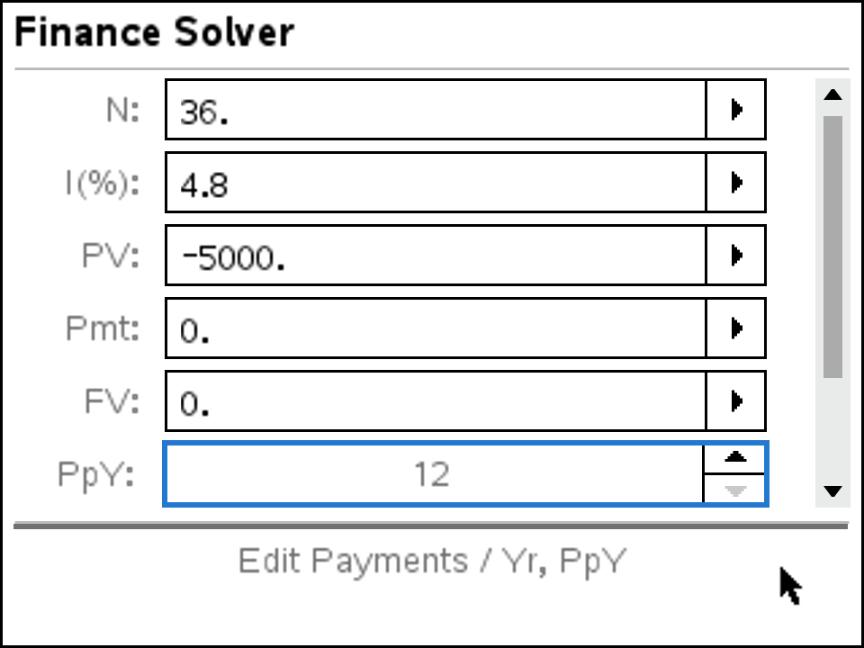
N \(=12(3)=36\) months; I(%) \(=4.8\) is the annual rate. PV \(=-5000\) records our deposit; Pmt \(=0\) means no further payments. Set PpY \(=12\). FV still shows its default \(0\); it has not been solved.
2. Check the lower settings
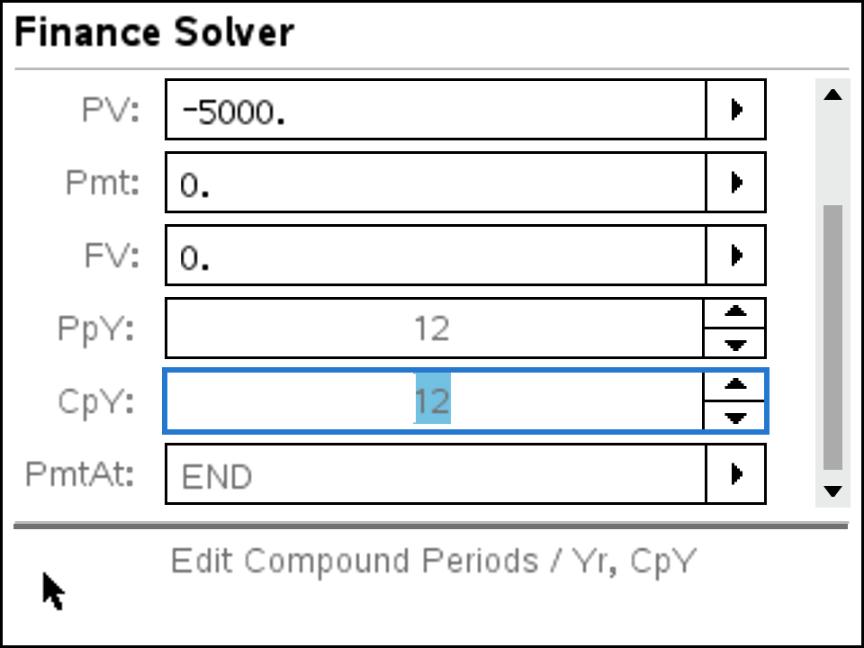
Set CpY \(=12\): interest compounds monthly. Check that PpY is also \(12\), so N counts months. Leave PmtAt at END; with Pmt \(=0\), payment timing has no effect. N and I(%) are above the visible area.
3. Select the unknown: FV
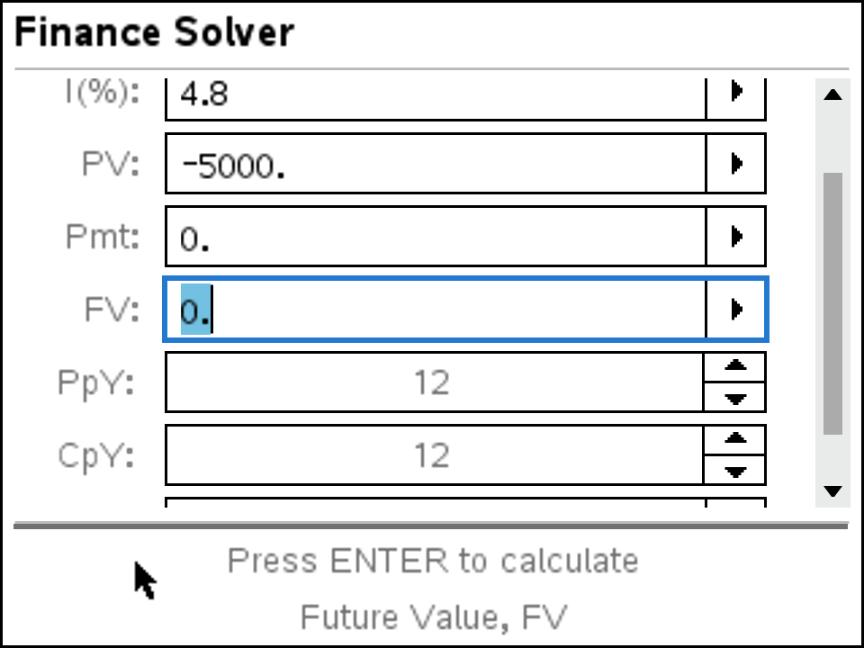
After entering and checking all other values, use Tab to place the cursor inside the FV cell. Then press Enter to calculate FV. The selected \(0\) is a starting value, not the answer.
4. Read and interpret the result
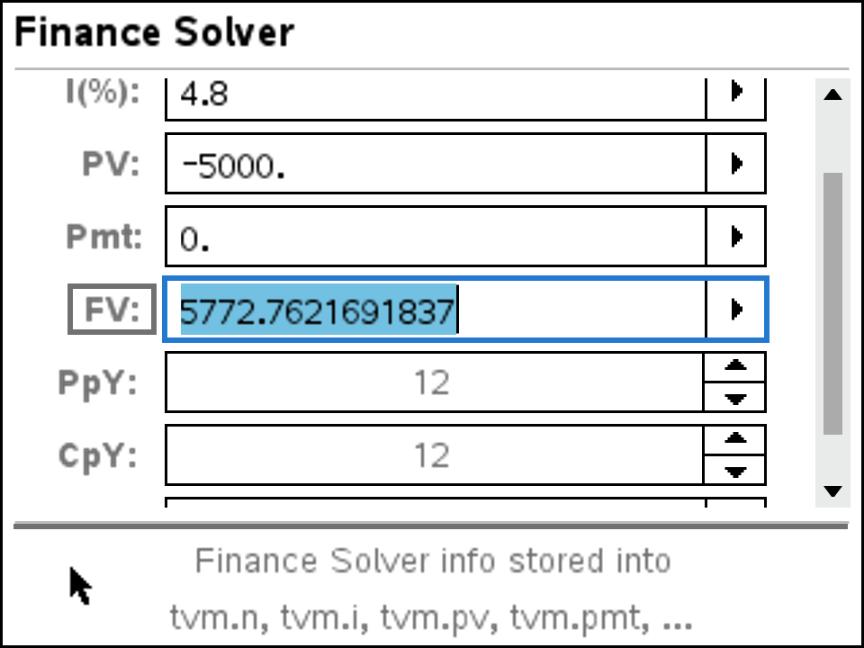
FV \(=5772.7621691837\). Its positive sign represents money coming back to us. The balance is $5772.76 to the nearest cent. The message below confirms that the solver values have been stored.
Check (a): \(5000(1+4.8/1200)^{36}=5772.762169\ldots\), matching the solver.
(b) Interest earned \(=5772.762169\ldots-5000\approx\boxed{\$772.76}\).
Work backwards: find the initial deposit
Worked example 6 | Find the initial deposit
Question
An investment must grow to $8000 in five years. The nominal annual rate is \(3.6\%\), compounded quarterly. Find the initial deposit to the nearest cent.
Solution
Choose either method below. Both find the same deposit; you do not need to complete both unless asked.
Method 1 | By hand: rearrange the formula
There are \(m=kn=4(5)=20\) quarters. The multiplier is \(q=1+3.6/(100\times4)=1.009\). Using the geometric model \(u_m=u_0q^m\), \[8000=u_0(1.009)^{20} \quad\Rightarrow\quad u_0=\frac{8000}{1.009^{20}}=6687.544151\ldots\] Initial deposit: $6687.54. Booklet: this deposit expression is not given; rearrange formula 1.4.
Method 2 | Use the Finance Solver
Enter the known values, check the settings, then solve directly for PV.
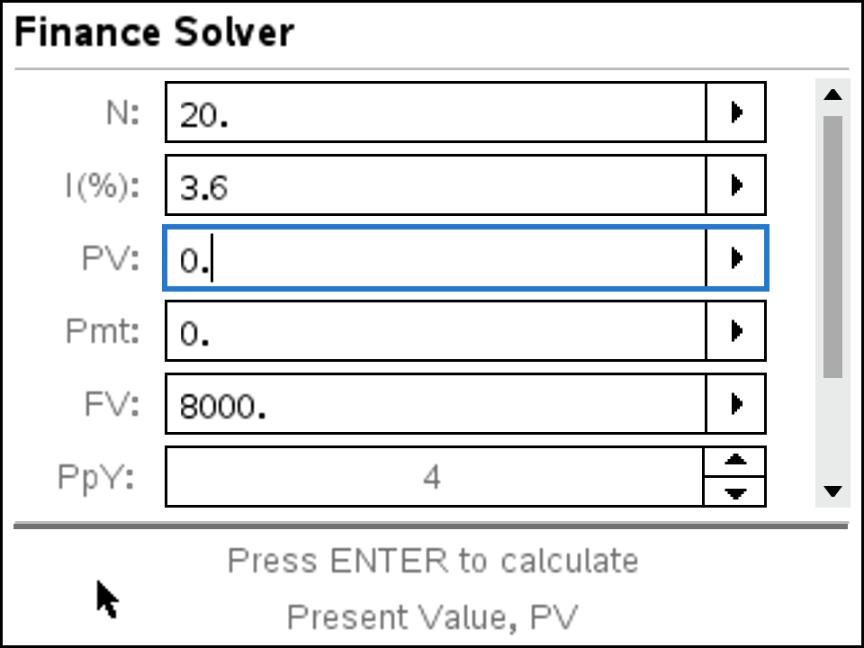
1. Enter the known values.
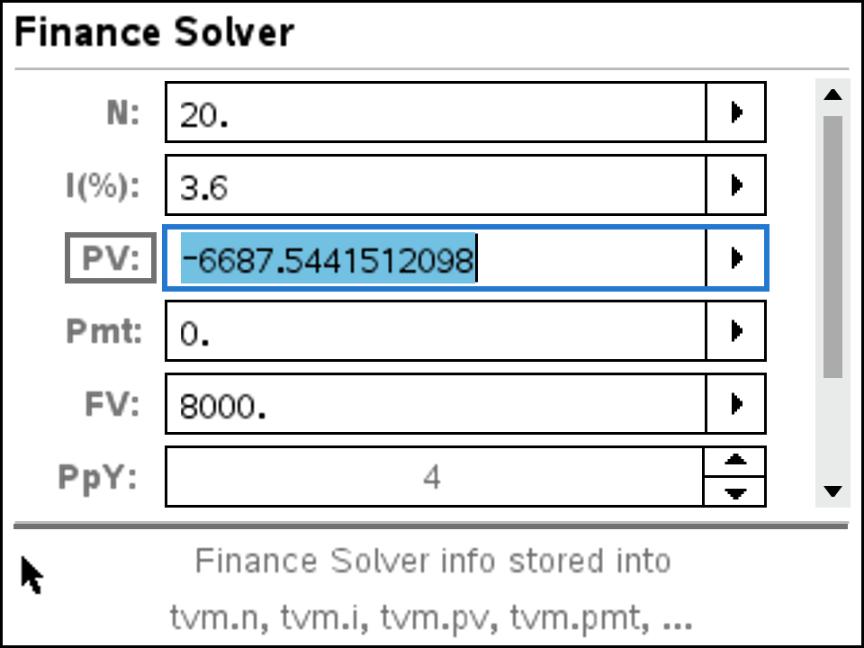
N \(=20\) quarters; I(%) \(=3.6\) is the annual rate. Set Pmt \(=0\), FV \(=+8000\) and PpY \(=4\). The positive FV is money we will receive. PV is the unknown: the displayed \(0\) has not been solved.
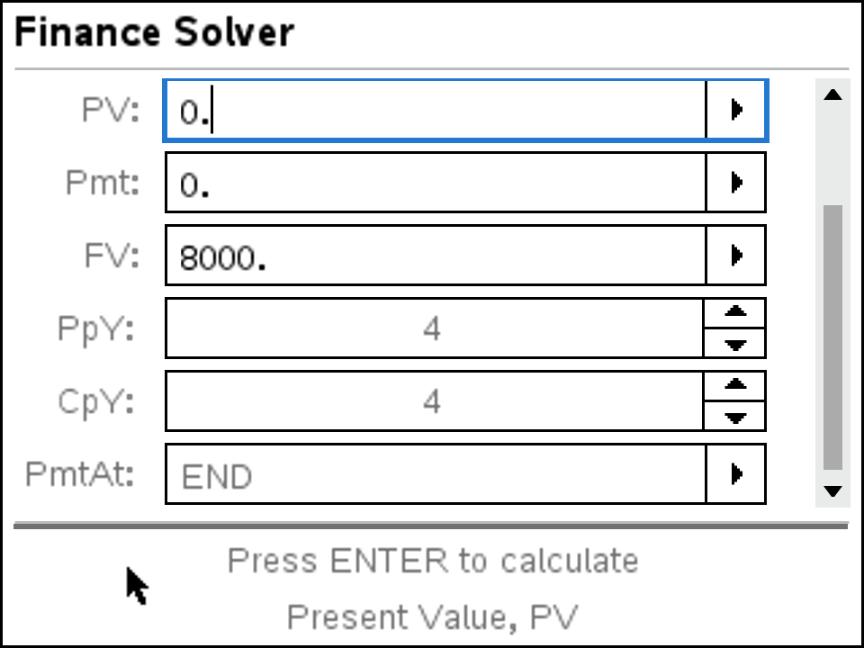
2. Check the lower settings.
PpY \(=4\) and CpY \(=4\): N counts quarters and interest compounds quarterly. Leave PmtAt at END; with Pmt \(=0\), timing has no effect. Once all other entries are complete, place the cursor inside the PV cell and press Enter.
3. Interpret the result.
PV \(=-6687.5441512098\). Its negative sign means that the deposit leaves us to enter the account. The amount deposited is positive: \(\boxed{\$6687.54}\), agreeing with Method 1.
Work backwards: finding the interest rate
Worked example 7 | Find the nominal annual rate
Question
$6000 grows to $7000 in three years with monthly compounding. Find the nominal annual rate to three significant figures.
Solution
Choose either method. Both find the same annual percentage rate.
Method 1 | By hand: rearrange the formula
Use \(u_m=u_0q^m\), with \(m=12(3)=36\) months and \(q=1+r/1200\): \[7000=6000\left(1+\frac{r}{1200}\right)^{36} \quad\Rightarrow\quad 1+\frac{r}{1200}=\left(\frac{7000}{6000}\right)^{1/36}.\] \[r=1200\left[\left(\frac{7000}{6000}\right)^{1/36}-1\right]=5.149372839\ldots\] Nominal annual rate: \(5.15\%\) (3 s.f.). Booklet: this rate expression is not given; rearrange formula 1.4.
Method 2 | Use the Finance Solver
Enter the known values, check the settings, then solve directly for I(%).
1. Enter the known values.
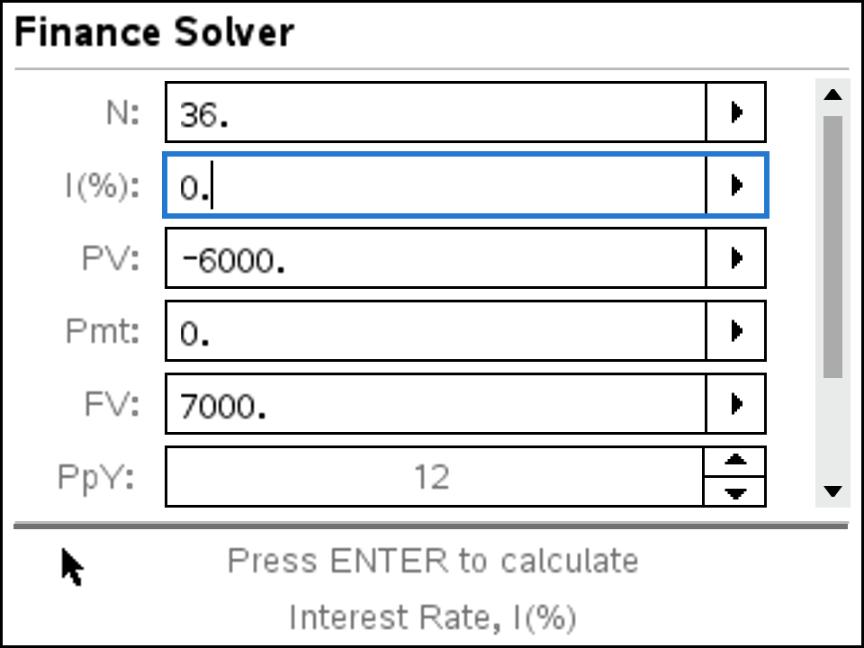
N \(=36\) months; PV \(=-6000\) records our deposit; Pmt \(=0\); FV \(=+7000\) is the money we will receive. Set PpY \(=12\). I(%) is the unknown. The selected \(0\) is a starting value, not the calculated rate.
2. Check the settings; then solve.
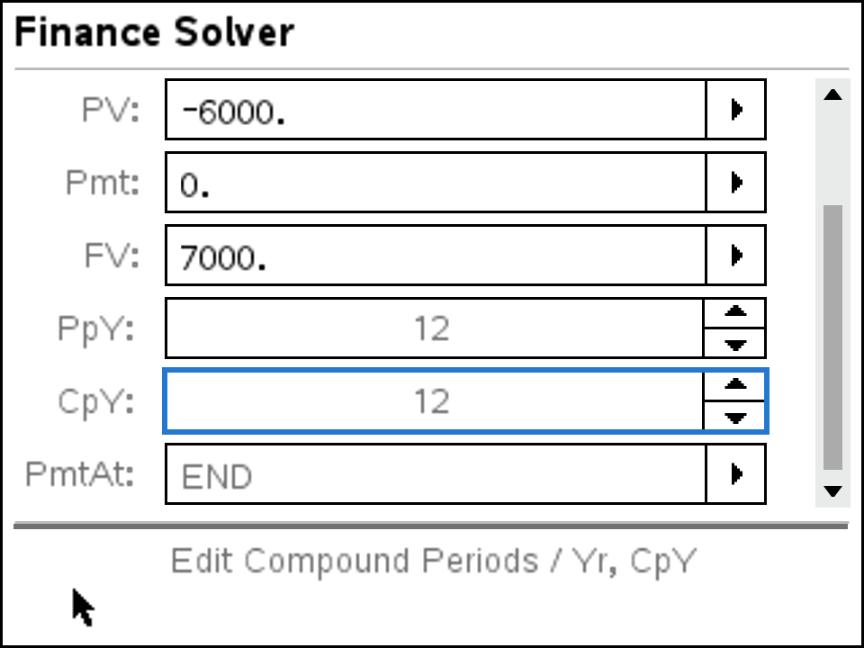
Set PpY \(=12\) and CpY \(=12\) for monthly periods and compounding. Leave PmtAt at END. Once all other values are entered and checked, return to the I(%) cell, place the cursor inside it and press Enter.
3. Interpret the result.
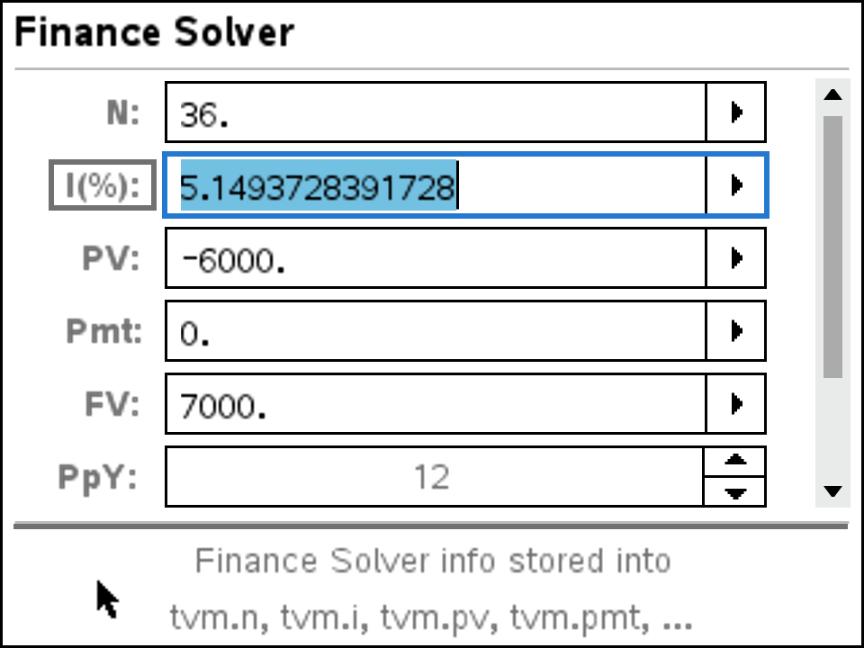
I(%) \(=5.1493728391728\). This is the nominal annual percentage rate, even though N counts months. Report \(\boxed{5.15\%\text{ per year}}\) to three significant figures. No further multiplication by \(12\) or \(100\) is needed.
Find the time: count complete periods
Worked example 8 | The first month a target is reached
Question
$6000 is invested at a nominal annual rate of \(4.5\%\), compounded monthly. Interest is credited at each month-end. Find the minimum number of complete months for the balance to reach at least $8000.
Solution
Choose either method below.
The monthly multiplier is \(q=1+0.045/12=1.00375\). We need the smallest integer \(m\) with \(6000(1.00375)^m\geq8000\). Solve the boundary equality first:
Method 1 | By hand using logarithms (once studied)
Booklet: the log power rule is given in 1.7; the time expression below is rearranged, not given.
\[\begin{gathered} (1.00375)^m=\frac{8000}{6000} \quad\Rightarrow\quad m\ln(1.00375)=\ln\left(\frac{8000}{6000}\right),\\[3pt] m=\frac{\ln(8000/6000)}{\ln(1.00375)}=76.85897062\ldots \end{gathered}\] Since \(q>1\), we need \(m\geq76.85897062\ldots\): at least 77 complete months.
Method 2 | Use the Finance Solver
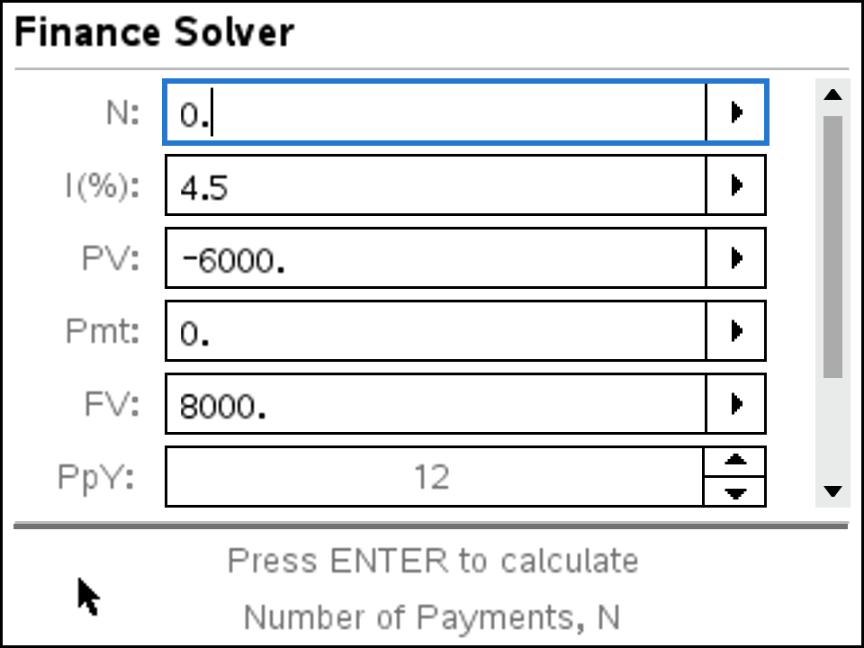
1. Enter the known values.
I(%) \(=4.5\), PV \(=-6000\), Pmt \(=0\), FV \(=+8000\), PpY \(=12\). N is the unknown; its initial \(0\) is not the answer.
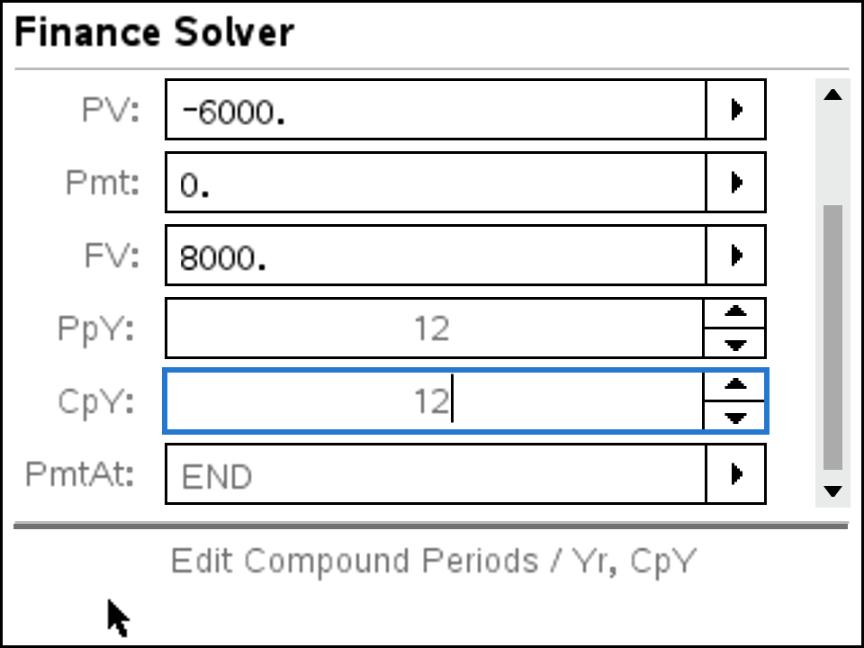
2. Check the settings; then solve.
Set CpY \(=12\); leave PmtAt at END. After checking all other fields, return to the N cell, place the cursor inside it and press Enter.
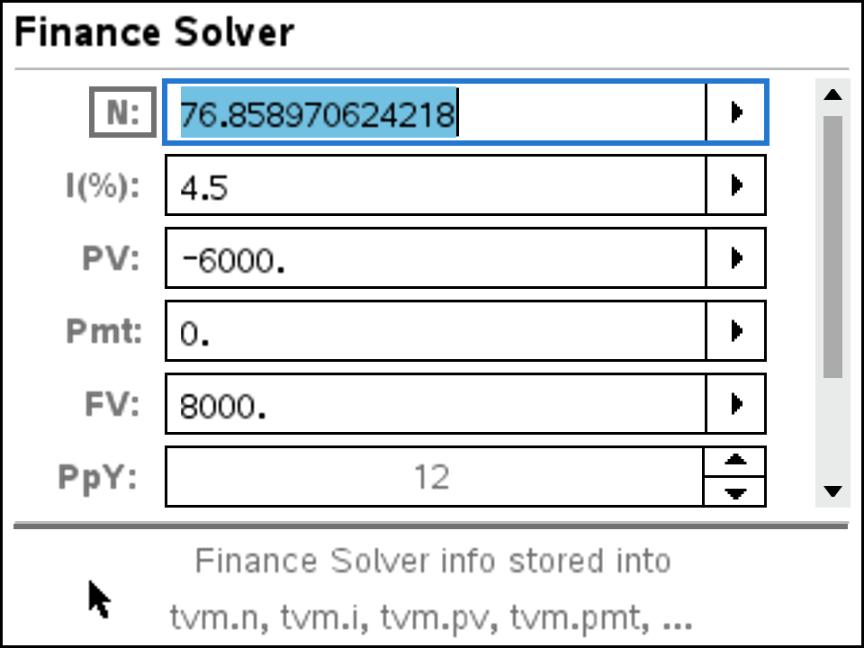
3. Interpret the output in months.
N \(=76.858970624218\). With PpY \(=12\), this counts months, not years. We need a whole month-end: month 76 is too early, so round up to \(\boxed{77\text{ complete months}}\), or \(6\) years and \(5\) months.
Check the neighbouring balances: \[\begin{aligned} u_{76}&=6000(1.00375)^{76}\approx\$7974.32<\$8000,\\ u_{77}&=6000(1.00375)^{77}\approx\$8004.22>\$8000. \end{aligned}\] Rounding rule. For the first complete period when an increasing balance reaches a target, round a non-integer boundary up, not to the nearest integer. Keep full precision before deciding.
Compare accounts using actual annual growth
Different compounding frequencies make quoted rates hard to compare. Start with the same deposit in each account and ask: what percentage does it actually gain in one year?
Worked example 9 | Which account grows faster?
Question
$5000 is invested for three years. Account A pays \(4.85\%\) per year, compounded annually. Account B pays a nominal annual rate of \(4.8\%\), compounded monthly. There are no further transactions or charges.
Find each balance after one year, then each percentage gain over that year. Which account grows faster?
Find each final balance and the difference, to the nearest cent.
Solution
(a) Grow the deposit for one year. A multiplies by \(1.0485\) once; B multiplies by \(1+0.048/12=1.004\) twelve times: \[\begin{gathered}\text{A: }5000(1.0485)=\$5242.50,\\[4pt]\text{B: }5000(1.004)^{12}=5245.351037\ldots\approx\$5245.35.\end{gathered}\] Express each gain as a percentage of the deposit. Keep unrounded balances: \[\begin{gathered}\text{A: }\frac{5242.50-5000}{5000}\times100\%=4.85\%,\\[4pt]\text{B: }\frac{5245.351037\ldots-5000}{5000}\times100\%\approx4.90702\%.\end{gathered}\] These one-year percentage gains are the effective annual rates. B grows faster, despite its lower quoted rate: monthly interest itself earns further interest during the year.
(b) Grow the original deposit for three years: \[\begin{gathered}\mathrm{FV}_{A}=5000(1.0485)^3\approx\$5763.35,\\[4pt]\mathrm{FV}_{B}=5000(1.004)^{36}\approx\$5772.76.\end{gathered}\] Using unrounded balances, B exceeds A by \(5000(1.004)^{36}-5000(1.0485)^3\approx\boxed{\$9.41}\). B’s final balance matches worked example 2.
From the example to a general rule
For B, \(1.004^{12}\approx1.04907\): the balance is \(104.907\%\) of the original deposit, a gain of \(4.907\%\). So subtract \(1\) from the multiplier, then multiply by \(100\).
In general, at a nominal annual rate of \(r\%\), compounded \(k\) times per year, the multiplier \(1+r/(100k)\) is applied \(k\) times in one year. Thus: \[\text{effective annual rate}=100\left[\left(1+\frac{r}{100k}\right)^k-1\right]\%.\]
Booklet: not given; this follows from the compound-interest formula in section 1.4.
This is a shortcut for the example’s steps. When \(k=1\), it equals the quoted rate \(r\%\).
Connect annual growth to inflation
The real annual multiplier is \(q_{\mathrm{real}}=\dfrac{1+g/100}{1+h/100}\), where \(g\%\) is effective annual growth and \(h\%\) is annual inflation.
Booklet: not given; compare annual investment growth with annual price growth.
Buying power rises if \(g>h\), stays the same if \(g=h\), and falls if \(g<h\). Compare inflation with effective annual growth, not a nominal rate compounded more frequently.
Compare before rounding. Close rates may round to the same value. Use unrounded values, the same time period and the same assumptions about fees and transactions.
Practice | Sequences and core skills
Use a calculator where needed. Give money to the nearest cent and rates to three significant figures unless stated. Show the model before calculating. Assume no extra transactions, fees or taxes.
Start at zero.
A sequence has \(u_0=120\) and \(d=15\). Write \(u_n\) and find \(u_4\).
A sequence has \(u_0=200\) and \(r=1.08\). Write \(u_n\) and find \(u_4\).
Appendix A review. Find the sum of the first four terms of each sequence. State the final index and write each sum using our \(S_n\) notation.
Appendix A review. How many terms are in \(S_4=u_0+u_1+\cdots+u_4\)? Find \(S_4\) for the arithmetic sequence in part (a).
Simple or compound? $2500 is invested for three years at \(4\%\) per year.
Find the final value with simple interest. State the common difference.
Find the final value with annual compounding. State the common ratio.
Find how much more interest is earned with compound interest.
Monthly compounding. $4200 is invested for \(2.5\) years at a nominal annual rate of \(6\%\), compounded monthly.
State the monthly multiplier and the number of periods.
Find the final balance and the total interest earned.
Give the solver inputs for N, I(%), PV, Pmt, PpY and CpY.
Work backwards. An account pays a nominal annual rate of \(3.2\%\), compounded quarterly. Find the initial deposit that grows to $9000 in four years. State the sign of the calculator PV.
See answer 4Unknown rate. $4500 grows to $5400 in four years with annual compounding. Find the annual interest rate.
See answer 5A whole-year target. $3000 earns \(5.5\%\) per year, compounded annually, with interest credited at year-end. Find the first complete year-end at which the balance is at least $4000. Check the balances on either side of the boundary.
See answer 6Depreciation.
A laptop initially worth $1800 loses \(18\%\) of its current value each year. Find its value after three years.
A machine falls from $16000 to $10125 in four years. Find its constant annual percentage depreciation.
Choose the model first
Fixed amount per period \(\rightarrow u_n=u_0+nd\). Fixed percentage \(\rightarrow u_n=u_0q^n\).
Total distinct payments without interest accumulation \(\rightarrow S_n\).
One account’s final balance \(\rightarrow u_n\). A total paid is not a future value after interest.
Practice | Compare, interpret and combine
Compare two accounts. $7000 is invested for three years. A pays \(4.7\%\) per year, compounded annually. B pays a nominal annual rate of \(4.6\%\), compounded monthly.
Find each final balance, keeping unrounded values for comparison.
Which gives the greater final balance, and by how much?
Find B’s effective annual rate. Explain why the nominal annual rate alone does not tell the whole story.
Allow for inflation. $8000 is invested at \(3.5\%\) per year, compounded annually, for four years. Inflation is \(2.2\%\) per year.
Find the nominal final balance.
Find its real value in today’s money and the gain in buying power.
Find the annual percentage increase in buying power.
First complete month. $9000 earns a nominal annual rate of \(4.2\%\), compounded monthly. Interest is credited at each month-end.
Use the solver to find the boundary N for a target of $10500. State the inputs and the units of N.
Find the minimum number of complete months to reach the target. Explain your rounding and verify it.
A rate changes. $12000 earns \(3\%\) per year for two years, then \(4.2\%\) per year for the next three years. Interest is compounded annually throughout. Inflation stays at \(2.5\%\) per year.
Find the nominal balance after five years.
Find its real value in today’s money.
Explain why a single constant-ratio geometric sequence does not describe the nominal balances over all five years.
Explain the mistake. Correct each statement.
“My savings deposit has PV \(=-6000\), so I have lost $6000.”
“A loan I receive should have a negative PV because I owe the bank.”
“The first five terms starting at \(u_0\) are \(u_0\) through \(u_5\).”
“If $6000 earns \(2\%\) per year while inflation is \(3\%\), I am better off after four years because my balance is larger.” Support your correction with calculations, assuming annual compounding.
Keep precision until the final line
Store unrounded results when comparing accounts or adjusting for inflation. A tiny difference can disappear if intermediate rates are rounded too early.
Answers | Sequences and core skills
1. Start at zero
(a) \(u_n=u_0+nd=120+15n\), so \(u_4=180\).
(b) \(u_n=u_0r^n=200(1.08)^n\), so \(u_4=272.097792\).
(c) The first four terms end at \(u_3\), so both sums are labelled \(S_3\): \[\begin{gathered}S_3^{\text{arith}}=\frac{3+1}{2}[2(120)+3(15)]=570,\\[4pt]S_3^{\text{geom}}=\frac{200(1.08^{3+1}-1)}{1.08-1}=901.2224.\end{gathered}\] (d) There are \(4+1=5\) terms: \(S_4=\frac{4+1}{2}[2(120)+4(15)]=750\).
2. Simple or compound?
(a) \(d=2500(0.04)=100\); \(u_3=2500+3(100)=\$2800.00\).
(b) \(q=1.04\); \(u_3=2500(1.04)^3=\$2812.16\).
(c) Extra interest \(=2812.16-2800=\$12.16\).
3. Monthly compounding
(a) \(q=1+0.06/12=1.005\), and \(m=12(2.5)=30\).
(b) \(u_{30}=4200(1.005)^{30}=4877.880348\ldots\approx\$4877.88\). Interest earned \(=u_{30}-4200\approx\$677.88\).
(c) N \(=30\), I(%) \(=6\), PV \(=-4200\), Pmt \(=0\), PpY \(=12\), CpY \(=12\); use END and solve FV.
4. Required deposit
\(9000=u_0(1+0.032/4)^{16}\), so \(u_0=9000/1.008^{16}=7922.714309\ldots\approx\$7922.71\). Calculator PV is negative: approximately \(-7922.714309\).
5. Unknown annual rate
\(5400=4500(1+r/100)^4\), so \[r=100\left[\left(\frac{5400}{4500}\right)^{1/4}-1\right]=4.663513939\ldots\] The rate is \(4.66\%\) per year (3 s.f.).
6. A whole-year target
We need \(3000(1.055)^n\geq4000\). Solving the boundary equality gives \(n=5.373140673\ldots\). The first qualifying year-end is after \(\boxed{6\text{ years}}\). \(u_5\approx\$3920.88<\$4000\) and \(u_6\approx\$4136.53>\$4000\).
7. Depreciation
(a) \(u_3=1800(0.82)^3=992.4624\approx\$992.46\).
(b) \(10125=16000q^4\), so \(q=(10125/16000)^{1/4}\). Annual loss \(=100(1-q)\%=10.809466\ldots\%\approx10.8\%\).
Answers | Compare, interpret and combine
8. Compare two accounts
(a) A: \(7000(1.047)^3=8034.115761\approx\$8034.12\). B: \(7000(1+0.046/12)^{36}=8033.709071\ldots\approx\$8033.71\).
(b) A is greater by \(8034.115761-8033.709071\ldots\approx\$0.41\).
(c) B’s effective annual rate is \(100[(1+0.046/12)^{12}-1]\%=4.698233319\ldots\%\) (\(4.70\%\) to 3 s.f.). Monthly compounding raises the actual growth above \(4.6\%\), but it is still just below A’s \(4.7\%\). Keep the unrounded rate to compare.
9. Allow for inflation
(a) Nominal value \(=8000(1.035)^4=9180.184005\approx\$9180.18\).
(b) Real value \(=8000(1.035/1.022)^4\approx\$8414.88\). Gain in buying power \(\approx\$414.88\).
(c) Annual real increase \(=100(1.035/1.022-1)\%\approx1.27\%\).
10. First complete month
(a) I(%) \(=4.2\), PV \(=-9000\), Pmt \(=0\), FV \(=10500\), PpY \(=12\), CpY \(=12\), PmtAt \(=\) END. Solve N: \(44.12008184\ldots\) months.
(b) The first qualifying month-end is month \(\boxed{45}\). At month 44, \(9000(1.0035)^{44}\approx\$10495.60\); at month 45 the balance is approximately $10532.33. Rounding to 44 leaves it below the target.
11. A rate changes
(a) Multiply by the appropriate ratio during each stage: \[u_5=12000(1.03)^2(1.042)^3\approx\$14403.20.\] (b) Real value \(=12000(1.03)^2(1.042)^3/1.025^5\approx\$12730.33\).
(c) The annual ratio changes from \(1.03\) to \(1.042\). Each stage is geometric, but the full sequence does not have one constant common ratio.
12. Explain the mistake
(a) Negative PV records money leaving us to enter savings, not a loss.
(b) A loan received is positive: the bank pays us. Repayments are negative.
(c) The first five terms are \(u_0,u_1,u_2,u_3,u_4\), and their sum is \(S_4\). Through \(u_5\) there are six terms, whose sum is \(S_5\).
(d) Nominal value \(=6000(1.02)^4\approx\$6494.59\), but real value \(=6000(1.02/1.03)^4\approx\$5770.36\). Buying power has fallen by about $229.64: prices grew faster than the investment.
Reference basis. Supplied IB Mathematics: analysis and approaches guide, SL 1.4 (shared SL/HL content). Formula notes were checked against the IB AA SL and HL formula booklets, sections 1.2–1.4 and 1.7. Calculator method checked against Texas Instruments Finance Solver guidance. Menu, default solver and worked examples 2 and 5–8 screenshots supplied by the teacher.
John Radford | RadfordMathematics.com
Reference | Partial sums starting at \(u_0\)
Review of syllabus 1.2 and 1.3: \(u_n\) is one value; the partial sum \(S_n\) adds every term from \(u_0\) through \(u_n\). We use the same final index \(n\) for both.
Our convention: \(S_n\) includes every term from \(u_0\) to \(u_n\)
\[\begin{gathered}S_n=u_0+u_1+\cdots+u_n=\sum_{j=0}^{n}u_j,\\[4pt]n=0,1,2,\ldots\end{gathered}\] There are \(\boxed{n+1\text{ terms}}\), because counting starts at index \(0\). For example, \(S_0=u_0\), while \(S_3=u_0+u_1+u_2+u_3\).
Arithmetic sum, starting from \(u_0\)
Using \(u_n=u_0+nd\) and sum = number of terms \(\times\) average of first and last, \[S_n=\frac{n+1}{2}(u_0+u_n) =\frac{n+1}{2}(2u_0+nd).\]
Booklet: not given in this form. Adapt section 1.2 to \(n+1\) terms starting at \(u_0\).
Question
Four annual fees are $200, $220, $240 and $260. Find the total paid.
Solution
These are \(u_0,u_1,u_2,u_3\): the final index is \(n=3\), so the total is \(S_3\). With \(u_0=200\) and \(d=20\), \[S_3=\frac{3+1}{2}\bigl(2(200)+3(20)\bigr)=\$920.\]
Geometric sum, starting from \(u_0\)
\[S_n=\frac{u_0(1-r^{n+1})}{1-r} =\frac{u_0(r^{n+1}-1)}{r-1}\quad(r\ne1).\]
Booklet: not given in this form. Adapt section 1.3 to \(n+1\) terms starting at \(u_0\).
If \(r=1\), \(\boxed{S_n=(n+1)u_0}\): count the equal terms (not given in the booklet).
Question
Four annual charges start at $100 and increase by \(10\%\) each year. Find their total.
Solution
The four charges run from \(u_0\) to \(u_3\). With \(u_0=100\), \(r=1.10\) and final index \(n=3\), \[S_3=\frac{100(1.10^{3+1}-1)}{1.10-1}=\$464.10.\] This is \(100+110+121+133.10\). If all four charges were $100, then \(r=1\) and \(S_3=(3+1)(100)=\$400\).
Distinguish the final index from the number of terms
| What is being added? | Our notation | Number of terms |
|---|---|---|
| Terms from \(u_0\) through \(u_n\) | \(S_n\) | \(n+1\) |
| The first \(n\) terms, ending at \(u_{n-1}\) | \(S_{n-1}\) | \(n\), for \(n\geq1\) |
For an arithmetic sequence, the familiar expression \(\frac n2[2u_0+(n-1)d]\) therefore gives \(S_{n-1}\), the sum of the first \(n\) terms under our convention.
What does the sum represent? Total separate fees or charges, without interest accumulation. Do not add successive account balances: a final balance is one term, \(u_n\).