IB Mathematics: Analysis and Approaches HL — Topic 2: Functions
Straight Lines
Find, sketch and interpret equations of straight lines.
Learning goal
Find, sketch and interpret equations of straight lines.
Syllabus link
AA HL: SL 2.1. Gradients, intercepts, three equation forms, parallel and perpendicular lines.
Big idea
A non-vertical straight line has a constant gradient: equal changes in \(x\) produce equal changes in \(y\).
Key relationship
\(m=\dfrac{y_2-y_1}{x_2-x_1}\), for \(x_2\ne x_1\).
Gradient: how steep is the line?
The gradient measures the change in \(y\) for each increase of one unit in \(x\). Between \(A(x_1,y_1)\) and \(B(x_2,y_2)\),
Gradient = change in output \(\div\) change in input
\[\boxed{\begin{aligned}m&=\frac{\text{change in }y}{\text{change in }x}\\&=\frac{y_2-y_1}{x_2-x_1}\end{aligned}}\quad(x_2\ne x_1).\] The changes are signed: a downward change in \(y\) is negative. The word slope, used in the tutorials, means the same as gradient.
Worked example 1 | Read the gradient from two points
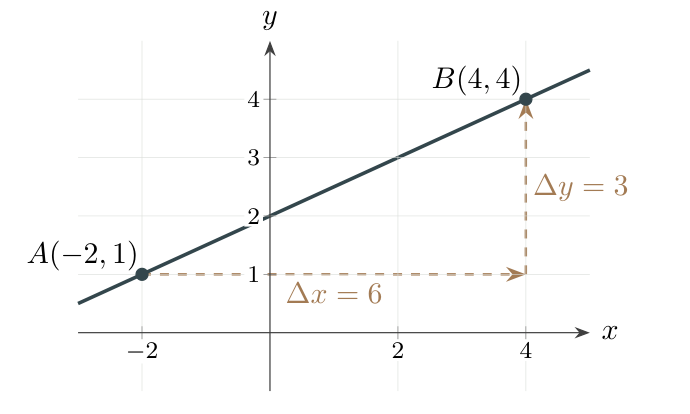
Find the gradient of the line through \(A(-2,1)\) and \(B(4,4)\).
Solution
Use the coordinates in the same order: \[\begin{aligned} m&=\frac{y_2-y_1}{x_2-x_1}\\[2pt]&=\frac{4-1}{4-(-2)}\\&=\frac{3}{6}\\&=\boxed{\frac12}. \end{aligned}\] Moving \(6\) units right gives a rise of \(3\) units. For each unit right, the line rises by \(\tfrac12\) unit.
Positive, negative, zero or undefined?
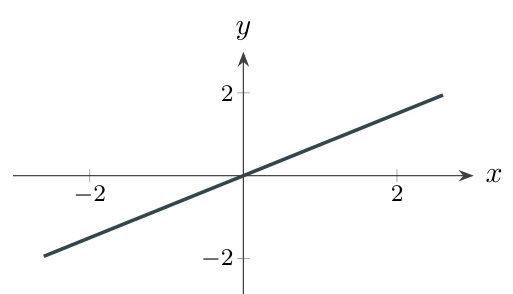
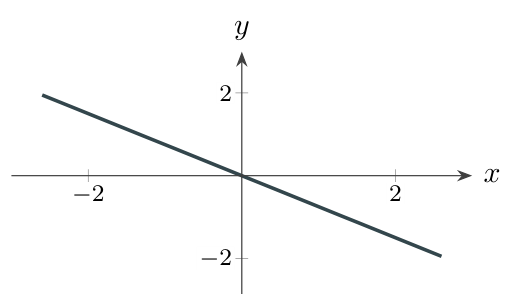
Read non-vertical lines from left to right. Their direction tells us the sign of the gradient.
Worked example 2 | Negative coordinates and a negative gradient
Find the gradient through \(P(-3,5)\) and \(Q(5,-1)\).
Solution
\[\begin{aligned}m&=\frac{y_2-y_1}{x_2-x_1}\\&=\frac{-1-5}{5-(-3)}\\&=\frac{-6}{8}\\&=\boxed{-\frac34}.\end{aligned}\] The line falls by \(3\) units for each increase of \(4\) units in \(x\). Reversing both subtractions gives the same result: \[\begin{aligned}\frac{5-(-1)}{-3-5}&=\frac{6}{-8}\\&=-\frac34.\end{aligned}\]
Why are horizontal and vertical lines different?
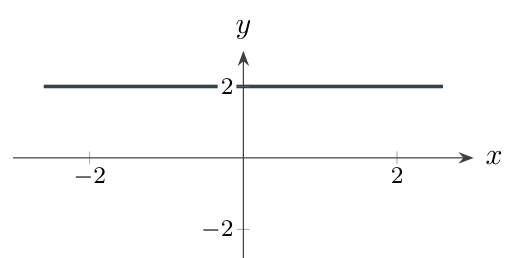
For a horizontal line through \((-1,2)\) and \((3,2)\), \[\begin{aligned}m&=\dfrac{2-2}{3-(-1)}\\&=0\end{aligned}.\]
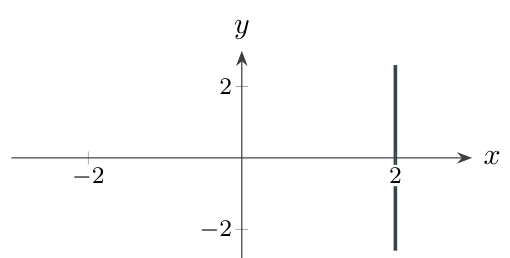
For a vertical line through \((2,-1)\) and \((2,3)\), the calculation would be \(\dfrac{3-(-1)}{2-2}=\dfrac40\). Division by zero is undefined: do not write \(m=\infty\).
From a line equation to its graph
A point lies on a line when its coordinates satisfy the equation. To draw a straight line, find and plot two distinct points, then join them with a straight edge.
Gradient–intercept form: \(y=mx+c\)
\[\boxed{y=mx+c}\] Here \(m\) is the gradient and \(c\) is the \(y\)-intercept value. The graph meets the \(y\)-axis at the point \((0,c)\) because \(x=0\) on that axis.
Find intercepts: set \(x=0\) for the \(y\)-intercept; set \(y=0\) for the \(x\)-intercept.
Worked example 3 | Read the equation and sketch the line
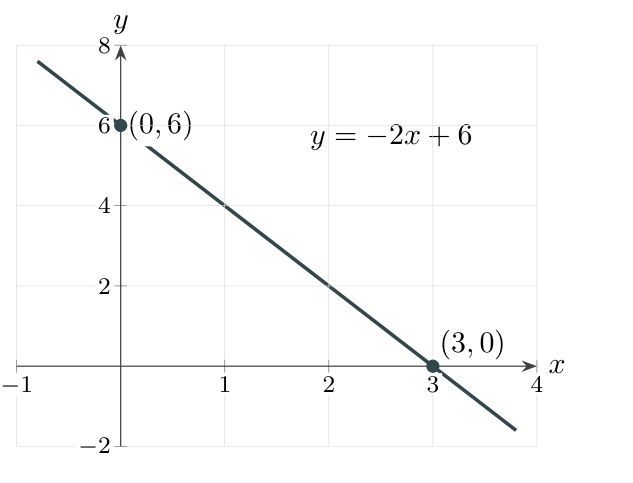
For \(y=-2x+6\), state the gradient, find both axis intercepts and sketch the line.
Solution
Comparing with \(y=mx+c\) gives \(m=-2\) and \(c=6\).
\(y\)-intercept: set \(x=0\). \[\begin{aligned}y&=-2(0)+6\\&=6.\end{aligned}\] The point is \((0,6)\).
\(x\)-intercept: set \(y=0\). \[\begin{aligned} 0&=-2x+6\\2x&=6\\x&=3. \end{aligned}\] The point is \((3,0)\).
Plot these two points and draw the straight line through them, extending it in both directions.
Worked example 4 | What if both intercepts are the origin?
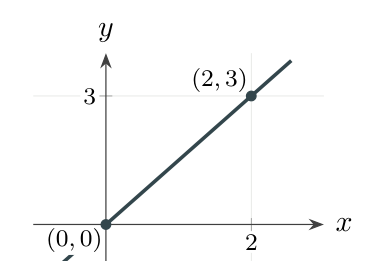
Sketch \(y=\tfrac32x\). Explain why finding the two axis intercepts is not enough.
Solution
Setting \(x=0\) or \(y=0\) gives the same point, \((0,0)\). Two intercepts have provided only one point.
Choose \(x=2\), so \[\begin{aligned}y&=\tfrac32(2)\\&=3\end{aligned}.\] Plot \(\boxed{(0,0)\text{ and }(2,3)}\), then draw the straight line through them.
From two points to a line equation
We now reverse the previous task. Instead of starting with an equation and finding points, we start with points and build the equation.
Find the two unknowns in \(y=mx+c\)
1. Find \(m\): use \(m=\dfrac{y_2-y_1}{x_2-x_1}\) for two points with different \(x\)-coordinates.
2. Find \(c\): substitute \(m\) and the coordinates of one point into \(y=mx+c\).
3. Write the equation: put the values of \(m\) and \(c\) back into \(y=mx+c\).
Worked example 5 | Find both the gradient and the intercept
Find the equation of the line through \(A(-2,5)\) and \(B(4,1)\) in the form \(y=mx+c\).
Solution
Step 1: calculate the gradient. \[\begin{aligned}m&=\frac{y_2-y_1}{x_2-x_1}\\&=\frac{1-5}{4-(-2)}\\&=\frac{-4}{6}\\&=-\frac23.\end{aligned}\] The equation is therefore \(y=-\tfrac23x+c\). We still need to find \(c\).
Step 2: substitute a known point. Using \(A(-2,5)\) gives Replace \(x\) by \(-2\) and \(y\) by \(5\)\[5=-\frac23(-2)+c\]A negative times a negative is positive\[5=\frac43+c\]\[\begin{aligned}c&=5-\frac43\\&=\frac{15}{3}-\frac43\\&=\frac{11}{3}.\end{aligned}\] Step 3: write the equation with \(x\) and \(y\) as variables. \[\boxed{y=-\frac23x+\frac{11}{3}}.\] Check with the other point: at \(x=4\), \[\begin{aligned}y&=-\tfrac83+\tfrac{11}{3}\\&=1\end{aligned}.\] The line passes through \(B\), as required.
A point on the line is not necessarily an intercept
The point \((-2,5)\) has \(y\)-coordinate \(5\), but this does not mean \(c=5\). The value \(c\) is the output when \(x=0\). Here \(c=\tfrac{11}{3}\).
Check for a vertical line before dividing
If two distinct points have the same \(x\)-coordinate, do not divide by zero. For example, the line through \((3,-2)\) and \((3,5)\) is simply \(\boxed{x=3}\).
Point–gradient form: a shorter route
With a gradient and one point, we can write the equation directly in point–gradient form, also called point–slope form.
One point and one gradient determine a line
For a non-vertical line through \((x_1,y_1)\), take \(x\ne x_1\) and rearrange: \[\begin{gathered}m=\frac{y-y_1}{x-x_1} \\ \Longrightarrow \boxed{y-y_1=m(x-x_1)}.\end{gathered}\] Keep \(x\) and \(y\) as variables; the final equation also holds at \((x_1,y_1)\).
Worked example 6 | A point with a negative coordinate
Find the line through \((2,-1)\) with gradient \(3\), in gradient–intercept form.
Solution
Use \(y-y_1=m(x-x_1)\) with \(x_1=2\), \(y_1=-1\) and \(m=3\): Insert the known values\[y-(-1)=3(x-2)\]Expand the brackets\[y+1=3x-6\]Subtract 1 from both sides.\[y=\boxed{3x-7}\] Check: at \(x=2\), \[\begin{aligned}y&=3(2)-7\\&=-1\end{aligned},\] as required.
Worked example 7 | The same two points, using point–gradient form
Find the line through \(A(-2,5)\) and \(B(4,1)\) using point–gradient form.
Solution
As before, \[\begin{aligned}m&=\dfrac{1-5}{4-(-2)}\\&=-\dfrac23\end{aligned}.\] Use \(A(-2,5)\): \[\begin{aligned} y-5&=-\frac23\bigl(x-(-2)\bigr)\\&=-\frac23(x+2)\\ y&=-\frac23x-\frac43+5\\&=\boxed{-\frac23x+\frac{11}{3}}. \end{aligned}\] Both methods give the same line. Choose one method; you do not need to carry out both in every question. Point–gradient form avoids finding \(c\) separately.
Subtract the coordinate, including its sign
For a point \((-2,5)\), the bracket is \(x-(-2)=x+2\). For a point \((2,-1)\), the left-hand side is \(y-(-1)=y+1\).
General form: read, sketch and rearrange
A line can be written in several equivalent ways. Rearranging its equation changes the form, while the points on the line stay the same.
General form (called standard form in the tutorial)
\[\begin{gathered}\boxed{ax+by+d=0}\\\Longleftrightarrow\quad\boxed{ax+by=c},\\c=-d.\end{gathered}\] Both are equivalent forms, with \(a\) and \(b\) not both zero. In \(ax+by=c\), the constant \(c\) is not necessarily the \(y\)-intercept.
Worked example 8 | Convert, find the intercepts and sketch
For \(3x+2y-12=0\), find the gradient and both intercepts, sketch the line, then write the equation in point–gradient form using the \(x\)-intercept.
Solution
Isolate \(y\): \[\begin{aligned} 3x+2y-12&=0\\2y&=-3x+12\\y&=-\frac32x+6. \end{aligned}\] The gradient is \(\boxed{-\tfrac32}\).
Find the intercepts:
When \(x=0\): \(2y=12\), so \(y=6\).
When \(y=0\): \(3x=12\), so \(x=4\).
The points are \((0,6)\) and \((4,0)\).
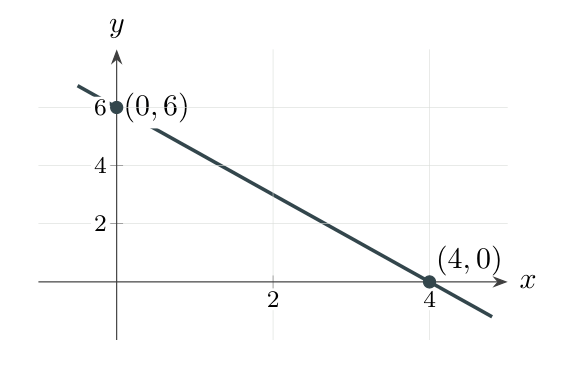
Using \((4,0)\) in \(y-y_1=m(x-x_1)\) gives \(\boxed{y-0=-\tfrac32(x-4)}\).
Worked example 9 | Convert back to general form
Write \(y=-\tfrac32x+\tfrac53\) in general form with integer coefficients.
Solution
Multiply every term by \(6\), the lowest common multiple of \(2\) and \(3\): \[\begin{gathered}6y=-9x+10 \\ \Longrightarrow \boxed{9x+6y-10=0}.\end{gathered}\] Adding \(10\) to both sides gives the equivalent form \(\boxed{9x+6y=10}\). To go back to \(9x+6y-10=0\), subtract \(10\) from both sides.
General form includes vertical lines
If \(b=0\), then \(ax+d=0\) is vertical: \(x=-d/a\). It cannot be written as \(y=mx+c\). If \(a=0\), the line is horizontal: \(y=-d/b\).
Parallel lines have equal gradients
Sometimes a question gives the direction of another line instead of giving the required gradient directly. A parallel line has the same direction.
Parallel lines
For two non-vertical parallel lines, \[\boxed{m_1=m_2}.\] Distinct lines with the same gradient are parallel: they never meet. If their \(y\)-intercepts are also equal, they are the same line (coincident).
Worked example 10 | A parallel line through a given point
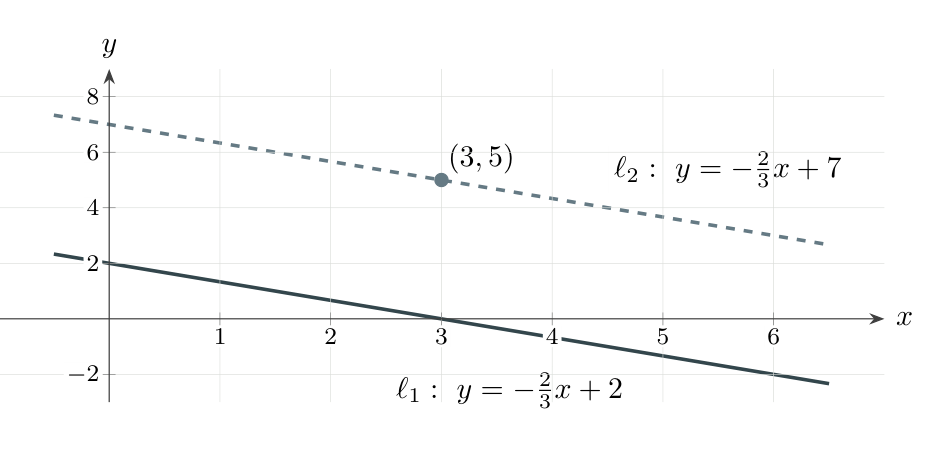
The line \(\ell_1\) has equation \(2x+3y-6=0\). Find the equation of the line \(\ell_2\) through \((3,5)\) that is parallel to \(\ell_1\).
Solution
Step 1: find the gradient of \(\ell_1\). \[\begin{gathered}2x+3y-6=0 \\ \Longrightarrow 3y=-2x+6 \\ \Longrightarrow y=-\frac23x+2.\end{gathered}\] Hence \(m_1=-\tfrac23\).
Step 2: use the same gradient. The parallel line has \[\begin{aligned}m_2&=m_1\\&=-\tfrac23\end{aligned}.\]
Step 3: use the point \((3,5)\). \[\begin{aligned} y-y_1&=m_2(x-x_1)\\y-5&=-\frac23(x-3)\\y-5&=-\frac23x+2\\y&=\boxed{-\frac23x+7}. \end{aligned}\] Both gradients are \(-\tfrac23\), but the \(y\)-intercepts are different: \(2\) and \(7\).
Horizontal and vertical parallel lines
All distinct horizontal lines are parallel to each other. All distinct vertical lines are parallel to each other, even though their gradients are undefined.
Perpendicular lines meet at a right angle
A perpendicular line turns the direction through \(90^\circ\). First find its gradient, then use the given point to write its equation.
Take the negative reciprocal
For two perpendicular lines with finite, non-zero gradients, \[\boxed{m_1m_2=-1}\qquad\text{or}\qquad\boxed{m_2=-\frac{1}{m_1}}.\] For example, if \(m_1=\tfrac43\), then \(m_2=-\tfrac34\): invert the fraction and change its sign.
Worked example 11 | A perpendicular line through a point
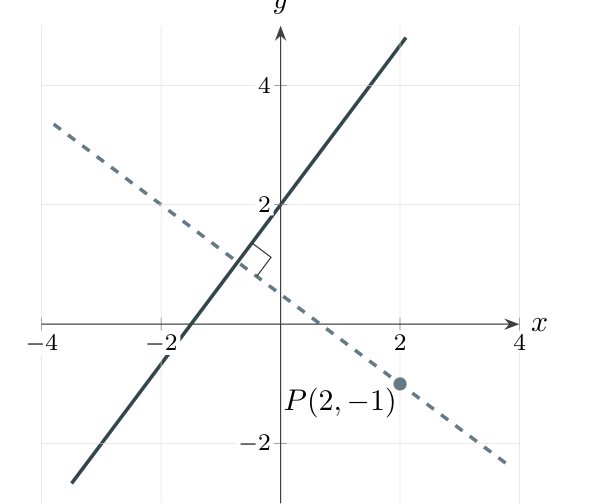
Find the equation of the line through \(P(2,-1)\) perpendicular to \(4x-3y+6=0\).
Solution
First rearrange the given equation: \[\begin{gathered}4x-3y+6=0 \\ \Longrightarrow 3y=4x+6 \\ \Longrightarrow y=\frac43x+2.\end{gathered}\] The given gradient is \(m_1=\tfrac43\). The required gradient is \[\begin{aligned}m_2&=-\frac{1}{m_1}\\&=-\frac{1}{4/3}\\&=-\frac34.\end{aligned}\] Use \(P(2,-1)\) in point–gradient form: \[\begin{aligned} y-(-1)&=-\frac34(x-2)\\y+1&=-\frac34x+\frac32\\y&=\boxed{-\frac34x+\frac12}. \end{aligned}\] Check: \(\tfrac43(-\tfrac34)=-1\), and at \(x=2\) the new equation gives \(y=-1\).
Changing only the sign is not enough
The perpendicular gradient to \(\tfrac43\) is \(-\tfrac34\), not \(-\tfrac43\).
To check, multiply the two gradients. Their product must be \(-1\).
Horizontal \(\perp\) vertical
A horizontal line and a vertical line are perpendicular.
For example, the line through \((2,-1)\) perpendicular to \(y=4\) is \(\boxed{x=2}\).
The product rule cannot be applied here because the vertical gradient is undefined.
Using gradients and line equations in context
The meaning of a gradient depends on the axes. Its units are \[\frac{\text{units on the vertical axis}}{\text{units on the horizontal axis}}.\]
Worked example 12 | Gradient of a ramp
A straight ramp rises \(0.45\,\text{m}\) over a horizontal distance of \(6.0\,\text{m}\). Find its gradient and express this as a percentage.
Solution
\[\begin{aligned}m&=\frac{\text{vertical rise}}{\text{horizontal run}}\\&=\frac{0.45}{6.0}\\&=0.075.\end{aligned}\] This means a rise of \(0.075\,\text{m}\) per horizontal metre. \[\begin{aligned}\text{Percentage gradient}&=100m\\&=\boxed{7.5\%}.\end{aligned}\] Both distances must use the same units when calculating a percentage gradient.
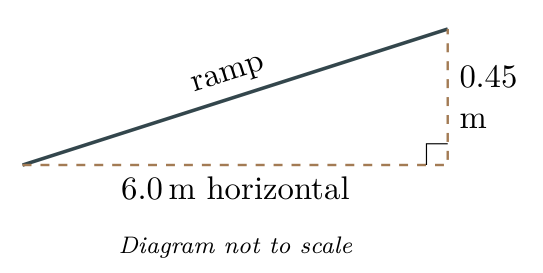
Do not divide by the sloping length of the ramp: the gradient uses the horizontal distance.
Worked example 13 | Interpret a linear cost model
A bicycle hire company uses a linear price model. Hiring a bicycle for \(4\) hours costs €\(18\); hiring it for \(10\) hours costs €\(33\). Let \(C\) be the cost in euros for \(t\) hours. Find \(C\) in terms of \(t\), interpret the gradient and intercept, and find the cost for \(8\) hours.
Solution
The two points are \((t,C)=(4,18)\) and \((10,33)\). \[\begin{aligned}m&=\frac{\text{change in cost}}{\text{change in time}}\\&=\frac{33-18}{10-4}\\&=\frac{15}{6}\\&=2.5\ \text{euros per hour}.\end{aligned}\] Using point–gradient form, \[\begin{gathered}C-18=2.5(t-4) \\ \Longrightarrow C-18=2.5t-10 \\ \Longrightarrow \boxed{C=2.5t+8}.\end{gathered}\] The gradient is a charge of €\(2.50\) per hour. The intercept represents a fixed hire charge of €\(8\) in this model.
For \(t=8\), \[\begin{aligned}C&=2.5(8)+8\\&=\boxed{\text{€}28}\end{aligned}.\]
Choose a method, then check your equation
The forms below describe the same line. Choose the form that makes the information in the question easiest to use. Multiplying an entire equation by any non-zero constant also leaves the line unchanged.
Three forms, one line: the point–gradient tutorial example
The tutorial uses \((3,8)\) and \((9,4)\), giving \[\begin{aligned}m&=\tfrac{4-8}{9-3}\\&=-\tfrac23\end{aligned}.\] Use \((3,8)\) in point–gradient form, then expand and rearrange.
| Form | Same example | Useful when… |
|---|---|---|
| Point–gradient | \(y-8=-\tfrac23(x-3)\) | A point and gradient are known. |
| Gradient–intercept | \(y=-\tfrac23x+10\) | Reading the gradient or \(y\)-intercept. |
| General | \(2x+3y-30=0\) or \(2x+3y=30\) | Working with an equation in \(x\) and \(y\). |
Start with the information you are given
| Given information | A useful route |
|---|---|
| Gradient and \(y\)-intercept | Substitute directly into \(y=mx+c\). |
| A point and a gradient | Use \(y-y_1=m(x-x_1)\), or substitute into \(y=mx+c\) to find \(c\). |
| Two points | Find \(m\) first, then use either route above. Check for a vertical line before dividing. |
| A parallel or perpendicular line | Read its gradient first; keep it for a parallel line or take the negative reciprocal for a perpendicular line. Then use the known point. Handle horizontal and vertical pairs separately. |
| An equation to sketch | Find two distinct points. Axis intercepts are often convenient. |
A quick final check
Substitute the given point or points into your equation. Check that the gradient has the required sign or relationship. A vertical line has equation \(x=a\); a horizontal line has equation \(y=b\).
Tutorial index
The embedded videos in the relevant sections and the links below open the same tutorials.
Graphing a line from its equation (section 3).
youtu.be/SOYNPDvhiNcFinding an equation through two points (section 4).
youtu.be/F9iCcShDXZ0Point–gradient form and conversions (section 5; recap in section 10).
youtu.be/EPo0Tjw2Dc0General/standard form and conversions (section 6).
youtu.be/JiQWoFZBRFE
Practice: build confidence, then combine ideas
Work on separate paper. Give exact answers unless a decimal is requested. Show your method and include coordinates for axis intercepts.
Find the gradient through each pair of points.
(a) \((-2,3)\) and \((4,6)\)
(b) \((-3,4)\) and \((5,-2)\).State the gradient, or explain why it is undefined, for each line.
(a) \(y=5\)
(b) \(x=-3\)
(c) \(y=-\tfrac54x+2\).For \(y=3x-6\), state the gradient, find both intercepts and sketch the line.
A line has gradient \(-\tfrac25\) and passes through \((5,1)\). Find its equation in gradient–intercept form.
Find the equation through \((-1,4)\) and \((3,-2)\). Give your answer in both gradient–intercept form and general form.
The line \(\ell\) has equation \(4x+5y-20=0\).
(a) Find its gradient and both intercepts.
(b) Write its equation in point–gradient form using its \(x\)-intercept.Find the equation of the line through \((2,-3)\) parallel to \(3x-2y+4=0\).
Find the equation of the line through \((-2,1)\) perpendicular to \(y=-\tfrac23x+5\).
Find the equation of the line through \((4,-2)\) that is:
(a) parallel to \(x=1\);
(b) perpendicular to \(x=1\).The points \(A(-2,3)\), \(B(4,k)\) and \(C(7,0)\) are collinear (on the same straight line). Find \(k\).
A straight path rises \(1.2\,\text{m}\) over a horizontal distance of \(15\,\text{m}\).
(a) Calculate its gradient and percentage gradient.
(b) Assuming the gradient is constant, find the rise over \(40\,\text{m}\) horizontally.A delivery service models cost \(C\) (euros) by \(C=md+c\), where \(d\) is distance (kilometres). A \(3\,\text{km}\) delivery costs €\(11\) and a \(7\,\text{km}\) delivery costs €\(19\).
(a) Find the model and interpret \(m\) and \(c\).
(b) Find the distance corresponding to a cost of €\(25\).For \(k\ne0\), the lines \(kx+2y-1=0\) and \(3x-ky+5=0\) have gradients \(m_1\) and \(m_2\). Can they be perpendicular for any real value of \(k\)? Justify your answer.
Consider \(\ell_1:2x-3y+6=0\), \(\ell_2:4x-6y+12=0\) and \(\ell_3:2x-3y-9=0\). Which two lines are coincident? Which line is parallel to, but distinct from, the others? Explain.
Before you turn to the answers
Check signs, distinguish \(x\)- and \(y\)-intercepts, and test each equation with a known point. A vertical line needs an equation of the form \(x=a\).
Worked answers: questions 1–8
1. Gradients from two points
Use \(m=(y_2-y_1)/(x_2-x_1)\): \[\begin{gathered}\text{(a) }m=\frac{6-3}{4-(-2)}=\boxed{\frac12};\\\text{(b) }m=\frac{-2-4}{5-(-3)}=\boxed{-\frac34}.\end{gathered}\]
2. Gradient and special lines
(a) \(y=5\) is horizontal, so \(\boxed{m=0}\). (b) \(x=-3\) is vertical: its gradient is undefined, since \(\Delta x=0\). (c) Compare with \(y=mx+c\): \(\boxed{m=-\tfrac54}\).
3. Intercepts and sketch
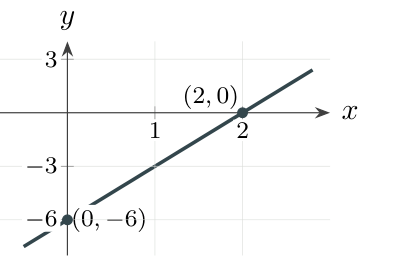
For \(y=3x-6\), \(\boxed{m=3}\).
Set \(x=0\): \(y=-6\), giving \(\boxed{(0,-6)}\).
Set \(y=0\): \(3x=6\), so \(x=2\), giving \(\boxed{(2,0)}\).
The sketch is a rising straight line through these intercepts, as shown.
4. Given a point and gradient
Use \(y-y_1=m(x-x_1)\): \[\begin{aligned}y-1&=-\tfrac25(x-5)\\&=-\tfrac25x+2\end{aligned},\] so \(\boxed{y=-\tfrac25x+3}\).
5. Two points; two equation forms
\[\begin{aligned}m&=\dfrac{-2-4}{3-(-1)}\\&=-\dfrac32\end{aligned}.\] Using \((-1,4)\) gives \(y-4=-\tfrac32(x+1)\), so \[\boxed{y=-\frac32x+\frac52}.\] Multiply by \(2\): \(2y=-3x+5\). Thus general form is \(\boxed{3x+2y-5=0}\).
6. Read and rewrite general form
(a) \[\begin{gathered}4x+5y-20=0\\ \Longrightarrow y=-\tfrac45x+4\end{gathered},\] so \(\boxed{m=-\tfrac45}\). Setting \(y=0\) gives \(\boxed{(5,0)}\); setting \(x=0\) gives \(\boxed{(0,4)}\).
(b) With \((x_1,y_1)=(5,0)\), \(\boxed{y-0=-\tfrac45(x-5)}\).
7–8. Parallel and perpendicular lines
7. \[\begin{gathered}3x-2y+4=0\\ \Longrightarrow y=\tfrac32x+2\end{gathered}.\] The parallel gradient is \(\tfrac32\). Through \((2,-3)\): \(y+3=\tfrac32(x-2)\), giving \(\boxed{y=\tfrac32x-6}\).
8. The perpendicular gradient is \(-1/(-\tfrac23)=\tfrac32\). Through \((-2,1)\): \(y-1=\tfrac32(x+2)\), giving \(\boxed{y=\tfrac32x+4}\).
Worked answers: questions 9–14
9. Vertical and horizontal lines
(a) A line parallel to \(x=1\) is vertical. Through \((4,-2)\) it is \(\boxed{x=4}\).
(b) A line perpendicular to \(x=1\) is horizontal. Through \((4,-2)\) it is \(\boxed{y=-2}\).
10. Collinear points
Collinear points lie on the same straight line. Find the gradient using the two fully known points: \[\begin{aligned}m_{AC}&=\frac{0-3}{7-(-2)}\\&=-\frac13.\end{aligned}\] The equation through \(A(-2,3)\) is \(y-3=-\tfrac13(x+2)\). At \(B(4,k)\), \[\begin{gathered}k-3=-\frac13(4+2)=-2 \\ \Longrightarrow \boxed{k=1}.\end{gathered}\]
11. A gradient in context
(a) \[\begin{aligned}m&=\dfrac{\text{rise}}{\text{horizontal run}}\\&=\dfrac{1.2}{15}\\&=\boxed{0.08}\end{aligned}.\] The percentage gradient is \(0.08\times100=\boxed{8\%}\).
(b) Since \(\text{rise}=m\times\text{horizontal run}\), the rise is \(0.08(40)=\boxed{3.2\,\text{m}}\).
12. A linear cost model
(a) \[\begin{aligned}m&=\dfrac{19-11}{7-3}\\&=2\end{aligned}.\] Substitute \((d,C)=(3,11)\) into \(C=md+c\): \[\begin{gathered}11=2(3)+c \\ \Longrightarrow c=5,\qquad\boxed{C=2d+5}.\end{gathered}\] The gradient represents €\(2\) per kilometre; the intercept represents a fixed charge of €\(5\).
(b) For \(C=25\), \(25=2d+5\), so \(2d=20\) and \(\boxed{d=10\,\text{km}}\).
13. Can a parameter make the lines perpendicular?
Rearrange each equation to identify its gradient: \[\begin{gathered}kx+2y-1=0\\ \Longrightarrow y=-\frac{k}{2}x+\frac12,\qquad m_1=-\frac{k}{2},\end{gathered}\] \[\begin{gathered}3x-ky+5=0\\ \Longrightarrow y=\frac3k x+\frac5k,\qquad m_2=\frac3k (k\ne0).\end{gathered}\] Their product is \[\begin{aligned}m_1m_2&=(-\tfrac k2)(\tfrac3k)\\&=-\tfrac32\end{aligned},\] which is never \(-1\). There is no permitted real value of \(k\). The factor \(k\) cancels, so changing it cannot change the product.
14. Parallel or coincident?
Dividing the equation of \(\ell_2\) by \(2\) gives \(2x-3y+6=0\), exactly the equation of \(\ell_1\). Thus \(\ell_1\) and \(\ell_2\) are coincident.
Rearranging gives \(\ell_1:y=\tfrac23x+2\) and \(\ell_3:y=\tfrac23x-3\). The gradients are equal but the intercepts differ, so \(\ell_3\) is parallel and distinct.