
IB Mathematics: Analysis and Approaches SL/HL — Topic 5 Calculus
Tangents and Normals
Use derivatives to turn a curve problem into a straight-line problem: first find the point and gradient, then write the tangent or perpendicular normal.
Learning goal
Find equations of tangents and normals to curves using derivatives, straight-line equations and perpendicular-gradient relationships.
Syllabus link
IB Mathematics AA SL/HL: SL 5.4. Tangents and normals at a given point; application of derivatives to gradients.
Big idea
The derivative supplies the tangent gradient. The normal passes through the same point and is perpendicular to the tangent.
Key relationships
\(m_t=f'(a)\), \(m_n=-1/m_t\) when \(m_t\ne0\), and \(y-y_1=m(x-x_1)\).
What are a tangent and a normal?
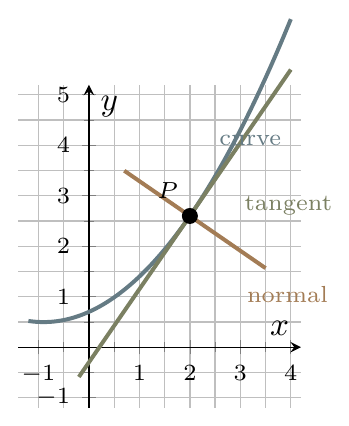
At a chosen point on a smooth curve, the tangent captures the curve's instantaneous direction. The normal is the straight line through the same point that is perpendicular to that tangent.
Tangent
The tangent touches the curve at the point and has the same instantaneous gradient as the curve there.
Normal
The normal passes through the same point and is perpendicular to the tangent. When the tangent gradient is non-zero,
Straight-line facts we will use
Point-gradient form
This is usually the quickest form once you know a point and gradient.
Perpendicular gradients
Equivalent to \(m_n=-1/m_t\) when neither line is vertical.
Do not forget the point
A gradient alone does not determine a line. A tangent or normal question therefore normally needs both the gradient and the point on the curve.
A reliable tangent method
Tangent checklist
- Find the point on the curve by evaluating \(f(a)\).
- Differentiate to find \(f'(x)\).
- Evaluate \(f'(a)\) to get the tangent gradient.
- Use \(y-y_1=m(x-x_1)\).
- Simplify the equation if required.
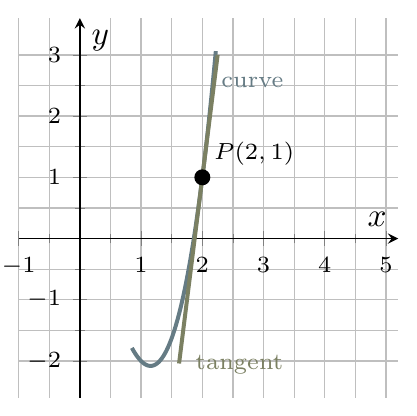
Worked example 1: tangent to a cubic
Find the tangent to \(f(x)=x^3-4x+1\) at \(x=2\).
Step 1: point.
so the point is \((2,1)\).
Step 2: gradient.
Step 3: line equation.
Video: Equation of a tangent
Follow the full derivative → gradient → point-gradient sequence in a worked example.
A reliable normal method
Normal checklist
- Find the point on the curve.
- Find the tangent gradient from the derivative.
- Convert it to the perpendicular normal gradient.
- Use point-gradient form through the same point.
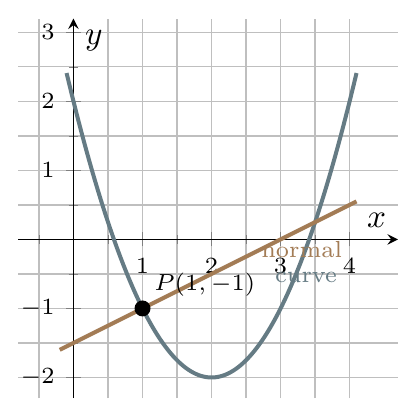
Worked example 2: normal to a quadratic
Find the normal to \(y=x^2-4x+2\) at \(x=1\).
The point is
so \(P=(1,-1)\).
Differentiate:
The normal gradient is
Therefore
Multiplying by 2 and rearranging:
Video: Equation of a normal
See how the tangent gradient is converted into the perpendicular normal gradient before writing the line equation.
Tangent and normal at the same point
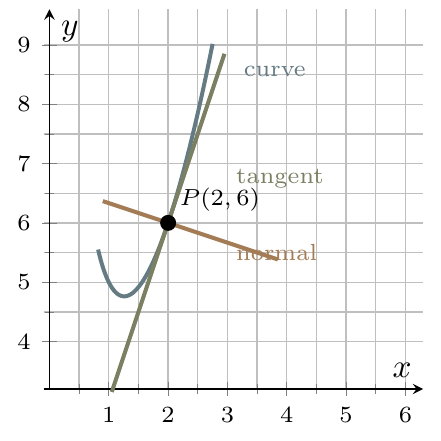
Worked example 3: find both lines
Find the tangent and normal to
at \(x=2\).
Point:
so \(P=(2,6)\).
Tangent gradient:
Tangent:
Normal: \(m_n=-1/3\), so
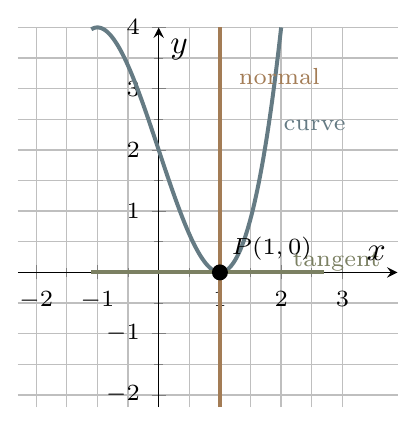
Special case: horizontal tangent and vertical normal
If the tangent gradient is zero, the negative-reciprocal formula would involve division by zero. Geometrically, the answer is straightforward: a horizontal tangent has a vertical normal.
Worked example 4: horizontal tangent
For \(f(x)=x^3-3x+2\), find the tangent and normal at \(x=1\).
First find the point:
so the point is \((1,0)\).
Differentiate:
Therefore the tangent is horizontal:
The normal is vertical through \(x=1\):
Exam-style unknown constants
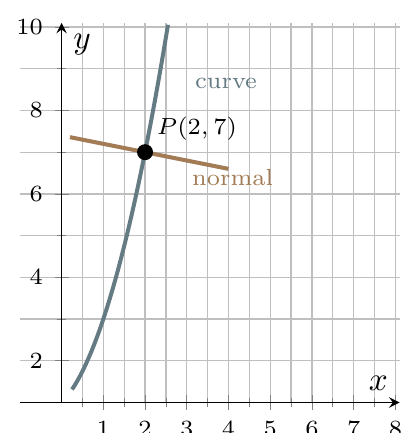
Worked example 5: use a point and a normal gradient to determine parameters
The curve
passes through \((2,7)\). At that point, the normal has gradient \(-1/5\). Find \(a\), \(b\), and the equation of the normal.
Equation 1: use the point.
Equation 2: use the normal gradient. If \(m_n=-1/5\), then the tangent gradient is 5.
At \(x=2\):
Subtracting the equations gives \(2a=2\), so \(a=1\), then \(b=1\).
The normal through \((2,7)\) with gradient \(-1/5\) is
Practice
A. Tangents
- Find the tangent to \(f(x)=x^2+3x-2\) at \(x=1\).
- Find the tangent to \(f(x)=2x^3-x^2+4\) at \(x=-1\).
- Find the tangent to \(y=\frac3x+x^2\) at \(x=1\).
- The tangent to \(y=x^2+kx\) at \(x=2\) is parallel to \(y=5x-1\). Find \(k\), then find the tangent equation.
B. Normals
- Find the normal to \(y=x^2-4x+2\) at \(x=1\).
- Find the normal to \(f(x)=x^3-6x\) at \(x=2\).
- For \(y=\frac4x+x\), find the tangent and normal at \(x=2\).
- The normal to \(y=x^2+kx+3\) at \(x=1\) is parallel to \(y=-\frac14x+10\). Find \(k\), then find the normal equation.
C. Extended
- For \(f(x)=x^3-3x^2+4\), find the tangent and normal at \(x=3\). Hence find where the normal crosses the y-axis.
- The curve \(y=ax^2+bx+1\) passes through \((2,7)\), and the normal there has gradient \(-1/5\). Find \(a\), \(b\) and the normal equation.
Concise answer key
1. \(y=5x-3\)
2. \(y=8x+9\)
3. \(y=-x+5\)
4. \(k=1\), tangent \(y=5x-4\)
5. \(x-2y-3=0\)
6. \(x+6y+22=0\)
7. Point \((2,4)\), tangent \(y=4\), normal \(x=2\)
8. \(k=2\), normal \(x+4y-25=0\)
9. Point \((3,4)\), tangent \(y=9x-23\), normal \(x+9y-39=0\); y-intercept \((0,13/3)\).
10. \(a=1\), \(b=1\), normal \(x+5y-37=0\).
Summary
The complete method
Finish by using the relevant straight-line gradient with the point-gradient equation \(y-y_1=m(x-x_1)\).
Final checks
- Tangent and normal must pass through the same point on the curve.
- If both gradients are finite and non-zero, their product should be \(-1\).
- If the tangent is horizontal, write the normal as a vertical line rather than trying to compute \(-1/0\).