IB Mathematics: Analysis and Approaches SL/HL — Topic 1 Number and Algebra
Binomial Theorem
Build binomial expansions from exponent patterns, Pascal's triangle and \(nCr\), then use the general term to solve IB-style questions.
Learning goal
Expand \((a+b)^n\) for positive integer \(n\), use Pascal's triangle and binomial coefficients, and find specific terms efficiently.
Syllabus link
AA SL/HL: SL 1.9 — binomial theorem, Pascal's triangle and \({}^nC_r\) / \(nCr\), using both formula and technology.
Big idea
The powers follow a fixed pattern. Pascal's triangle and \(nCr\) provide the coefficients.
Key relationship
\((a+b)^n=\sum_{r=0}^n\binom nr a^{n-r}b^r\), with general term \(t_r=\binom nr a^{n-r}b^r\).
This lesson is designed to work as a complete self-study chapter: start with the visible pattern, learn where the coefficients come from, build the formula, then practise the exact question structures that appear in IB-style work.
Start with the pattern of the powers
Before worrying about where the coefficients come from, first look at the structure of a few familiar expansions. The exponents of \(a\) and \(b\) are already following a very regular pattern.
When one of the letters is not written, its exponent is actually zero. This matters because it makes the power pattern completely visible: \(a^4=a^4b^0\) since \(b^0=1\), while \(b^4=a^0b^4\) since \(a^0=1\).
Usually we simplify \(a^1\) to \(a\), \(b^1\) to \(b\), and omit factors such as \(a^0\) or \(b^0\) because they are equal to 1. For spotting the pattern, however, it is useful to write them explicitly.
The power pattern
- the power of \(a\) starts at \(n\) and decreases by 1 each term;
- the power of \(b\) starts at 0 and increases by 1 each term;
- in every term, the two exponents add to \(n\);
- there are exactly \(n+1\) terms.
Following this pattern, we can quickly see what the powers of \(a\) and \(b\) will be in the expansion of \((a+b)^7\), even before we know the coefficients.
The exponents always add to \(n\)
In every term, the exponent of \(a\) plus the exponent of \(b\) is the power to which the binomial is being raised. In \((a+b)^7\), for instance,
\[a^7b^0:\ 7+0=7,\qquad a^6b^1:\ 6+1=7,\qquad a^5b^2:\ 5+2=7,\qquad\ldots\]The same rule holds in general: for \((a+b)^n\), the two exponents in each term add to \(n\).
At this point the powers are completely determined. The only information still missing is the number that should go in front of each term. Pascal's triangle gives us those coefficients.
Pascal's triangle gives the coefficients
Pascal's triangle generates the coefficient row for each positive integer power. Every interior number is the sum of the two numbers directly above it.
How to Draw Pascal's Triangle
Build Pascal's triangle row by row by adding the two entries immediately above each interior value.
Pascal's triangle
The boxed \(n=7\) row gives the coefficients of \((a+b)^7\): \(1,7,21,35,35,21,7,1\).
Row number versus index
The binomial index starts at \(n=0\). So if the top 1 is counted as row 1, then the row corresponding to \(n=7\) is row 8. In general, index \(n\) corresponds to row \(n+1\) when rows are counted starting from 1.
Worked example 1: expand using only the pattern and Pascal's triangle
Question. Expand \((a+b)^7\).
Solution
Because the top 1 is row 1 (index \(n=0\)), the eighth row gives the coefficients for \((a+b)^7\). This is the row already boxed above:
\[1,\ 7,\ 21,\ 35,\ 35,\ 21,\ 7,\ 1.\]How to Use Pascal's Triangle
Use the correct Pascal row as the coefficients, then combine it with the decreasing/increasing exponent pattern.
Worked example 2: a numerical second term
Question. Expand \((x+2)^5\).
Solution
The powers follow the same pattern, but now \(b=2\):
\[\begin{aligned}(x+2)^5&=1x^5+5x^4(2)+10x^3(2^2)+10x^2(2^3)+5x(2^4)+2^5\\&=\boxed{x^5+10x^4+40x^3+80x^2+80x+32}.\end{aligned}\]A minus sign belongs to the whole second term
For \((a-b)^n\), think of it as \((a+(-b))^n\). The sign therefore alternates because the factor \((-b)^r\) is positive for even \(r\) and negative for odd \(r\).
Pascal's triangle is very convenient when the power is small enough to build or recall the required row. We now need a formula that can generate any one of those coefficients directly, without first drawing the whole triangle.
From Pascal's triangle to \(\binom nr\) and \({}^nC_r\)
Each entry in Pascal's triangle is known as a binomial coefficient. For index \(n\), the entries are labelled by \(r=0,1,\ldots,n\), and the coefficient in position \(r\) is calculated by:
Binomial coefficient formula
\[\boxed{\binom nr={}^nC_r=\frac{n!}{(n-r)!\,r!}},\qquad 0\le r\le n.\]Here \(\binom nr\) is read “\(n\) choose \(r\)”, while \({}^nC_r\) is the \(nCr\) notation used in the IB syllabus and on many calculators.
\[n!=n(n-1)(n-2)\cdots2\cdot1,\qquad 0!=1.\]Binomial Coefficient
See how a Pascal-triangle entry is calculated directly using the binomial coefficient formula.
Now compare the ordinary numerical triangle with exactly the same triangle written using \(nCr\) notation. The position \(r\) starts at 0 on the left of each row and increases by 1 as we move across.
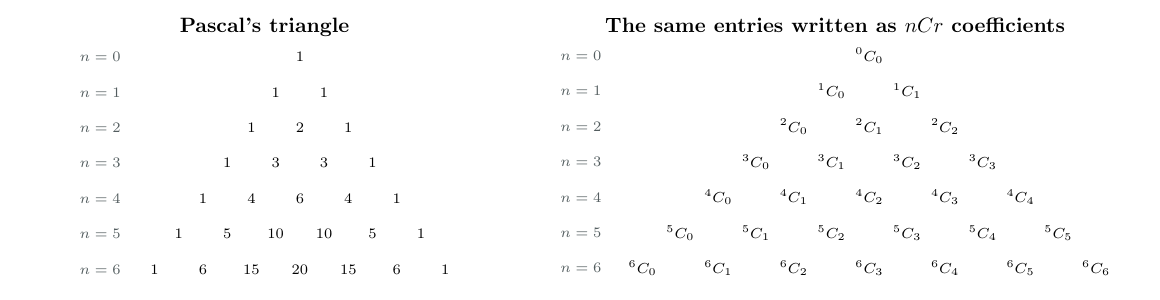
For example, the numerical row \(1,4,6,4,1\) can equally be written as
\[{}^4C_0,\ {}^4C_1,\ {}^4C_2,\ {}^4C_3,\ {}^4C_4,\]or as
\[\binom40,\ \binom41,\ \binom42,\ \binom43,\ \binom44.\]Thus every number in Pascal's triangle is a binomial coefficient, and the two notations are equivalent:
\[\boxed{\binom nr={}^nC_r}.\]Example 3: \(\binom42={}^4C_2\)
Solution
\[\begin{aligned}\binom42={}^4C_2&=\frac{4!}{(4-2)!\,2!}\\&=\frac{4\cdot3\cdot2\cdot1}{(2\cdot1)(2\cdot1)}\\&=\boxed{6}.\end{aligned}\]This is the middle entry of row 4: \(1,4,\boxed{6},4,1\).
Example 4: \(\binom83={}^8C_3\)
Solution
\[\begin{aligned}\binom83={}^8C_3&=\frac{8!}{5!\,3!}\\&=\frac{8\cdot7\cdot\cancel{6}\cdot\cancel{5!}}{\cancel{5!}\cdot\cancel{(3\cdot2\cdot1)}}\\&=8\cdot7=\boxed{56}.\end{aligned}\]The cancellation bars show the common factors removed before multiplying: first \(5!\), then \(6=3\cdot2\cdot1\). There is no need to evaluate the full value of \(8!\).
Symmetry
Pascal's triangle is symmetric, so
\[\boxed{\binom nk=\binom n{n-k}\qquad\text{or}\qquad{}^nC_k={}^nC_{n-k}}.\]For example, \(\binom51=\binom54=5\), equivalently \({}^5C_1={}^5C_4=5\), and \(\binom72=\binom75=21\), equivalently \({}^7C_2={}^7C_5=21\).
Binomial Coefficients Shortcuts
Use symmetry and cancellation to evaluate binomial coefficients efficiently without expanding large factorials.
Technology check
The syllabus expects you to be able to evaluate \({}^nC_r\) (the calculator nCr function), as well as \(\binom nr\), using technology and the factorial formula.
\[{}^6C_r=20\qquad\text{equivalently}\qquad\binom6r=20.\]Generate the values \({}^6C_0,{}^6C_1,\ldots,{}^6C_6\). Since \({}^6C_3=\binom63=20\), we get \(r=3\).
Binomial Coefficients on the TI-Nspire CX
Use the TI-Nspire CX nCr command to evaluate binomial coefficients quickly and check hand calculations.
We now have both ingredients: the exponent pattern from Section 1 and a formula for the coefficients from Section 3. Putting them together gives the binomial theorem in its compact sigma-notation form.
The binomial theorem formula
The power pattern and the Pascal coefficients can now be combined into a single formula.
Binomial theorem
For a positive integer \(n\),
\[\boxed{(a+b)^n=\sum_{r=0}^n\binom nr a^{n-r}b^r=\sum_{r=0}^n{}^nC_r\,a^{n-r}b^r}.\]The general term (that is, the summand corresponding to a particular value of \(r\)) may be written in either notation:
\[\boxed{t_r=\binom nr a^{n-r}b^r={}^nC_r\,a^{n-r}b^r,\qquad r=0,1,\ldots,n}.\]Because \(r\) starts at 0, \(t_r\) is the \((r+1)\)th ordinary term. Equivalently, many textbooks write \(T_{r+1}=t_r\).
Seeing the binomial theorem generate every term of \((a+b)^5\)
Before applying the formula to a new expression, use it on \((a+b)^5\) and watch each value of \(r\) generate one term.
\[(a+b)^5=\sum_{r=0}^5\binom5r a^{5-r}b^r=\sum_{r=0}^5{}^5C_r\,a^{5-r}b^r.\]So, writing all six terms produced by the sigma notation,
\[\begin{aligned}(a+b)^5&=\binom50a^5b^0+\binom51a^4b^1+\binom52a^3b^2+\binom53a^2b^3+\binom54a^1b^4+\binom55a^0b^5\\&={}^5C_0a^5b^0+{}^5C_1a^4b^1+{}^5C_2a^3b^2+{}^5C_3a^2b^3+{}^5C_4a^1b^4+{}^5C_5a^0b^5\\&=\boxed{a^5+5a^4b+10a^3b^2+10a^2b^3+5ab^4+b^5}.\end{aligned}\]This is exactly the same power pattern and the same Pascal coefficients seen earlier; the formula simply generates them systematically.
Worked example 5: apply the formula to a non-trivial binomial
Question. Expand \((2x-3)^5\) using the binomial theorem.
Solution
Here \(a=2x\) and \(b=-3\). Start with
\[(2x-3)^5=\sum_{r=0}^5\binom5r(2x)^{5-r}(-3)^r=\sum_{r=0}^5{}^5C_r(2x)^{5-r}(-3)^r.\]Writing the six terms gives
\[\begin{aligned}(2x-3)^5&=\binom50(2x)^5+\binom51(2x)^4(-3)+\binom52(2x)^3(-3)^2\\&\quad+\binom53(2x)^2(-3)^3+\binom54(2x)(-3)^4+\binom55(-3)^5\\&=32x^5-240x^4+720x^3-1080x^2+810x-243.\end{aligned}\]\((2x-3)^5=32x^5-240x^4+720x^3-1080x^2+810x-243\)
Notice that treating the second term as \(-3\) automatically produces the alternating signs.
Binomial Theorem — Example 1
A complete worked example using the binomial theorem formula and the general term.
Writing the whole expansion is useful when every term is required. In many exam questions, however, only one particular term or coefficient is wanted. The same general term lets us go straight to it.
Finding one specific term without expanding everything
When a question asks for one term or one coefficient, the general term is much more efficient than writing the full expansion.
Specific-term method
- Write the general term (summand) \(t_r=\binom nr a^{n-r}b^r={}^nC_r\,a^{n-r}b^r\).
- Simplify it so that the variable appears as a single power.
- Match that exponent to the power requested.
- Solve for \(r\), then substitute that value into \(t_r\).
Worked example 6: find the \(x^7\) term
Question. Find the \(x^7\) term in the expansion of \((x^2-3x)^5\).
Solution
Write the general term (summand):
\[\begin{aligned}t_r&=\binom5r(x^2)^{5-r}(-3x)^r={}^5C_r(x^2)^{5-r}(-3x)^r\\&=\binom5r(-3)^r x^{10-2r}x^r\\&=\boxed{\binom5r(-3)^r x^{10-r}}=\boxed{{}^5C_r(-3)^r x^{10-r}}.\end{aligned}\]The \(x^7\) term occurs when
\[10-r=7\Longrightarrow r=3.\]Therefore
\[\begin{aligned}t_3&=\binom53(-3)^3x^7={}^5C_3(-3)^3x^7\\&=10(-27)x^7\\&=\boxed{-270x^7}.\end{aligned}\]Exam Question 1: specific term
Exam-style practice on simplifying the general term and matching the required power of x to find one specific term.
Do not confuse the summation index with the power of \(x\)
The value of \(r\) tells you which general term (summand) to use. After substitution, the power of \(x\) may be something quite different because \(a\) and \(b\) themselves can contain powers of \(x\).
Before moving to independent practice, collect the different versions of the method in one place so you can decide quickly which tool to use.
IB decision guide and common traps
Before calculating, identify what the question is actually asking for. The wording usually tells you which version of the binomial theorem is most efficient.
| If the question says… | Think… |
|---|---|
| “Expand…” | Write the full expansion. Use Pascal's triangle for a small integer power, or the binomial theorem directly. |
| “Find the coefficient of \(x^k\)” | Use the general term, match the power of \(x\) to \(k\), then give only the numerical coefficient. |
| “Find the term in \(x^k\)” | Use the general term, match the power, and include both the coefficient and \(x^k\). |
| “Find the term independent of \(x\)” | Simplify the general term to one power of \(x\) and set that exponent equal to 0. |
| “Given that the coefficient is…” | First identify the correct value of \(r\), then equate the resulting coefficient to the given number. |
| The first few terms are given | Compare coefficients term by term: coefficient of \(x\), coefficient of \(x^2\), and so on. |
| “Find the possible values…” | Solve the algebraic equation and then check every solution against the stated conditions. |
| A context is given | Look for a repeated factor such as \(P(1+k)^n\); the binomial theorem may be hidden inside the model. |
Three common IB mistakes
- \(r\) is an index, not automatically the ordinary term number: \(r=0\) gives the first term.
- For \((a-b)^n\), use \(b=-b\) inside the formula so the signs are generated correctly.
- A coefficient is only the numerical factor; a term includes the variable power as well.
The ideas now fit together: first identify the exponent pattern, then obtain the coefficients, and finally choose whether you need the complete expansion or only one term.
IB-style worked examples
These questions are original, but they are modelled on recurring IB structures: extracting one coefficient, working backwards from a coefficient to an unknown parameter, using the first few terms of an expansion to determine unknowns, recognising a binomial inside a context, and — for AA HL — finding a term independent of \(x\).
IB-style worked example 1 (SL): find a coefficient
[4 marks]Question. Find the coefficient of \(x^5\) in the expansion of \((x-3)^8\).
Solution
\[t_r=\binom8r x^{8-r}(-3)^r={}^8C_r\,x^{8-r}(-3)^r.\]We need the power of \(x\) to be 5, so
\[8-r=5\Longrightarrow r=3.\]Therefore
\[\begin{aligned}t_3&=\binom83x^5(-3)^3\\&={}^8C_3(-27)x^5\\&=56(-27)x^5\\&=-1512x^5.\end{aligned}\]Hence the coefficient of \(x^5\) is \(-1512\).
Exam habit: if the question asks only for the coefficient, give the final numerical coefficient rather than the whole term.
IB-style worked example 2 (SL): work backwards from a coefficient
[5 marks]Question. In the expansion of \((x+k)^7\), where \(k>0\), the coefficient of \(x^4\) is 945. Find \(k\).
Solution
\[t_r=\binom7r x^{7-r}k^r={}^7C_r\,x^{7-r}k^r.\]For the term in \(x^4\),
\[7-r=4\Longrightarrow r=3.\]Its coefficient is \(\binom73k^3={}^7C_3k^3=35k^3\). Therefore
\[35k^3=945\Longrightarrow k^3=27\Longrightarrow\boxed{k=3}.\]The condition \(k>0\) confirms the positive value.
IB-style worked example 3 (SL): determine \(n\) and \(k\) from the first terms
[6 marks]Question. The expansion of \((1+kx)^n\) begins \(1+15x+90x^2+\cdots\), where \(n\in\mathbb Z^+\) and \(k\in\mathbb Q\). Find \(n\) and \(k\).
Solution
\[(1+kx)^n=1+\binom n1kx+\binom n2k^2x^2+\cdots.\]Compare coefficients of \(x\):
\[nk=15.\tag{1}\]Compare coefficients of \(x^2\):
\[\binom n2k^2=90\Longrightarrow\frac{n(n-1)}2k^2=90.\tag{2}\]From (1), \(k=15/n\). Substitute into (2):
\[\frac{n(n-1)}2\left(\frac{15}n\right)^2=90\Longrightarrow\frac{225(n-1)}{2n}=90\Longrightarrow45n=225.\]Therefore \(n=5\). Then \(5k=15\), so \(n=5,\ k=3\).
IB-style worked example 4 (SL): recognise the binomial theorem in context
[6 marks]Question. An account contains 2500 euros and pays a nominal annual interest rate of 8%, compounded quarterly.
- Write the amount after one year in the form \(2500(1+k)^4\), and state \(k\). [1]
- Use the binomial theorem to expand \((1+x)^4\). [2]
- Hence find the amount in the account after one year, to the nearest euro. [3]
Solution
A nominal annual rate of 8% compounded quarterly gives a quarterly rate of
\[\frac{0.08}4=0.02.\]Therefore \(k=0.02\) and the amount is \(2500(1.02)^4\).
\[(1+x)^4=1+4x+6x^2+4x^3+x^4.\]Substitute \(x=0.02\):
\[2500\left(1+4(0.02)+6(0.02)^2+4(0.02)^3+(0.02)^4\right)=2706.0804.\]Hence the amount after one year is 2706 euros to the nearest euro.
Exam habit: the words “binomial theorem” may not appear. Recognise the repeated factor \((1+k)^n\) before choosing your method.
IB-style worked example 5 (AA HL extension): term independent of \(x\)
[6 marks]Question. Find the term independent of \(x\) in \(\left(2x^2-\frac1x\right)^9\).
Solution
\[\begin{aligned}t_r&=\binom9r(2x^2)^{9-r}\left(-\frac1x\right)^r\\&={}^9C_r\,2^{9-r}(-1)^r x^{18-2r-r}\\&=\binom9r2^{9-r}(-1)^r x^{18-3r}.\end{aligned}\]A term independent of \(x\) has exponent 0, so
\[18-3r=0\Longrightarrow r=6.\]Therefore
\[\begin{aligned}t_6&=\binom96 2^3(-1)^6\\&={}^9C_6\cdot8\\&=84\cdot8\\&=\boxed{672}.\end{aligned}\]HL idea: before calculating the coefficient, first check that the equation for the power of \(x\) gives an integer value of \(r\) between 0 and \(n\).
Exam Question 2: Product of Two Binomials
AA HL exam practice in which binomial expansions must be combined rather than treated in isolation.
Exam Question 3
Further AA HL exam practice applying the binomial theorem in a less routine multi-step setting.
These worked examples show the main exam moves. The final questions now ask you to decide for yourself which form of the binomial theorem is most efficient.
Practice: from fluency to IB exam style
A. Core fluency
- Without using coefficients, write the complete power pattern for \((a+b)^7\).
- Write the Pascal row corresponding to index \(n=6\) and then write the same row using \({}^6C_r\) notation.
- Expand \((a+b)^6\) completely.
- Expand \((2x-3)^5\) completely.
- Evaluate \(\binom{10}3={}^{10}C_3\) using the factorial formula, showing cancellations clearly.
- Write \((p-2q)^7\) in sigma notation using both \(\binom nr\) and \({}^nC_r\) notation.
B. IB-style practice — AA SL/HL
- Find the coefficient of \(x^6\) in the expansion of \((x-2)^9\). [4 marks]
- Consider the expansion of \((x+k)^9\), where \(k>0\).
- Write down the number of terms in the expansion. [1]
- The coefficient of \(x^6\) is 672. Find \(k\). [4]
- The expansion of \((1+kx)^n\) begins \(1+18x+135x^2+\cdots\), where \(n\in\mathbb Z^+\) and \(k\in\mathbb Q\). Find \(n\) and \(k\). [6 marks]
- Consider the expansion of \((2x+k)^9\), where \(k\in\mathbb Z\). Given that the coefficient of \(x^5\) is 64512, find the possible values of \(k\). [5 marks]
- The coefficient of \(x^4\) in \((ax^2+b)^6\) is 960. The coefficient of \(x^4\) in \((ax^2+b)^8\) is 7168. Find \(a\) and \(b\), given that \(a,b>0\). [7 marks]
- A savings account contains 2000 euros and pays a nominal annual interest rate of 6%, compounded quarterly.
- Write the amount after one year in the form \(2000(1+k)^4\), and state \(k\). [1]
- Expand and simplify \((1+x)^4\). [2]
- Hence, or otherwise, find the amount in the account after one year, to the nearest euro. [3]
- In the expansion of \((x+1)^8\), where \(x\ne0\), the third term is twice the fourth term. Find \(x\). [5 marks]
C. AA HL extension
- Find the term independent of \(x\) in \(\left(3x^2-\frac1x\right)^9\). [6 marks]
- Let \(n\in\mathbb Z^+\). Determine all possible values of \(n\) for which the expansion of \(\left(5x^2-\frac2x\right)^n\) contains a non-zero constant term. [5 marks]
- Find the term independent of \(x\) in \(\frac1{x^2}\left(x^3+\frac2x\right)^6\). [6 marks]
Once you have attempted the questions, use the solution outlines below to check both the answer and the structure of your method.
Appendix: answer key and solution outlines
A. Core fluency — answers
- \(a^7b^0,\ a^6b^1,\ a^5b^2,\ a^4b^3,\ a^3b^4,\ a^2b^5,\ a^1b^6,\ a^0b^7\).
- Numerical row: \(1,6,15,20,15,6,1\). In \(nCr\) notation: \({}^6C_0,{}^6C_1,{}^6C_2,{}^6C_3,{}^6C_4,{}^6C_5,{}^6C_6\).
- \(a^6+6a^5b+15a^4b^2+20a^3b^3+15a^2b^4+6ab^5+b^6\).
- \(32x^5-240x^4+720x^3-1080x^2+810x-243\).
- \(\binom{10}3={}^{10}C_3=\frac{10!}{7!3!}=\frac{10\cdot9\cdot8}{3\cdot2\cdot1}=120\).
- \((p-2q)^7=\sum_{r=0}^7\binom7r p^{7-r}(-2q)^r=\sum_{r=0}^7{}^7C_r\,p^{7-r}(-2q)^r\).
B. IB-style practice — AA SL/HL solutions
- \(t_r=\binom9r x^{9-r}(-2)^r\). For \(x^6\), \(9-r=6\), so \(r=3\). Coefficient \(=\binom93(-2)^3=84(-8)=\boxed{-672}\).
- (a) 10 terms. (b) For \(x^6\), \(r=3\), so \(\binom93k^3=672\). Hence \(84k^3=672\), so \(k^3=8\) and \(\boxed{k=2}\).
- Compare coefficients term by term. From the coefficient of \(x\), \(nk=18\). From the coefficient of \(x^2\), \(\binom n2k^2=135\). Hence \(k=18/n\). Substituting gives \(\frac{n(n-1)}2(18/n)^2=135\), which simplifies to \(n=6\). Then \(6k=18\), so \(\boxed{n=6,\ k=3}\).
- First match the requested power: \(9-r=5\), so \(r=4\). The coefficient is \(\binom94(2)^5k^4=126\cdot32k^4=4032k^4\). Equating coefficients gives \(4032k^4=64512\), hence \(k^4=16\). Both integer values satisfy the condition, so \(\boxed{k=\pm2}\).
- The \(x^4\) term requires exactly two factors of \(ax^2\). Therefore \(\binom62a^2b^4=960\) and \(\binom82a^2b^6=7168\). So \(15a^2b^4=960\) and \(28a^2b^6=7168\). Dividing gives \(\frac{28}{15}b^2=\frac{7168}{960}\), hence \(b^2=4\). Since \(b>0\), \(b=2\). Substitution gives \(a^2=4\), so \(\boxed{a=2,\ b=2}\).
- (a) Quarterly rate \(=6\%/4=1.5\%=0.015\), so \(\boxed{k=0.015}\). (b) \((1+x)^4=1+4x+6x^2+4x^3+x^4\). (c) \(2000(1.015)^4\approx2122.727\), so \(\boxed{2123\text{ euros}}\).
- In \((x+1)^8\), the third and fourth ordinary terms are generated by \(r=2,3\): \(T_3=\binom82x^6=28x^6\) and \(T_4=\binom83x^5=56x^5\). The condition \(T_3=2T_4\) gives \(28x^6=112x^5\). Since \(x\ne0\), divide by \(28x^5\) to obtain \(\boxed{x=4}\).
C. AA HL extension — solutions
- \(t_r=\binom9r(3x^2)^{9-r}(-x^{-1})^r\), so the power of \(x\) is \(18-3r\). Set \(18-3r=0\), giving \(r=6\). Hence the constant term is \(\binom96 3^3=84\cdot27=\boxed{2268}\).
- A general term has power \(x^{2(n-r)-r}=x^{2n-3r}\). For a constant term, \(2n-3r=0\), so \(r=\frac{2n}3\). The index \(r\) must be an integer and satisfy \(0\le r\le n\). The inequality is automatic for positive \(n\), so \(2n/3\) must be an integer. Hence \(n\) must be a positive multiple of 3: \(\boxed{n=3,6,9,12,\ldots}\).
- Including the factor \(x^{-2}\), a general term has power \(-2+3(6-r)-r=16-4r\). For a constant term, \(16-4r=0\), so \(r=4\). The constant term is \(\binom64(2)^4=15\cdot16=\boxed{240}\).
Final idea
The binomial theorem is one coherent pattern written in three languages:
\[\boxed{\text{powers of }a,b}\quad\longleftrightarrow\quad\boxed{\text{Pascal coefficients}}\quad\longleftrightarrow\quad\boxed{\sum_{r=0}^n\binom nr a^{n-r}b^r=\sum_{r=0}^n{}^nC_r\,a^{n-r}b^r}.\]In an IB question, the main skill is deciding which representation gets you to the requested term or coefficient most efficiently.