IB Mathematics: Analysis and Approaches SL — Topic 2: Functions
Transformations of Graphs
Horizontal changes to the input. Vertical changes to the output.
Learning goal
Sketch transformed graphs; track points, domain, range and asymptotes.
Syllabus link
SL 2.11 is shared by AA SL and HL: translations, reflections, stretches and combinations. Combined horizontal changes are a labelled HL extension.
Big idea
Inside changes the input; outside changes the output.
Key relationship
For \(y=af(x-c)+d\), the new coordinates are \(x'=x+c\) and \(y'=ay+d\).
Two important ways to build new functions are transformations and composition (composite functions). We often start from familiar parent functions, but any function can be transformed, whether it is a parent function or not. This lesson explores transformations.
A graph is the collection of input–output pairs \((x,y)\) with \(y=f(x)\). A transformation moves each point \(P=(x,y)\) to an image \(P'=(x',y')\).
Two categories of transformation
Vertical = change of output
The operation acts outside \(f\): \[\begin{gathered}f(x)+d,\\af(x),\\-f(x).\end{gathered}\] Keep the \(x\)-coordinate unchanged. Change the \(y\)-coordinate.
Horizontal = change of input
The operation acts inside \(f\): \[\begin{gathered}f(x-c),\\f(bx),\\f(-x).\end{gathered}\] The \(x\)-coordinate changes; the \(y\)-coordinate stays the same.
Reading the general expression (with \(a,b\ne0\))
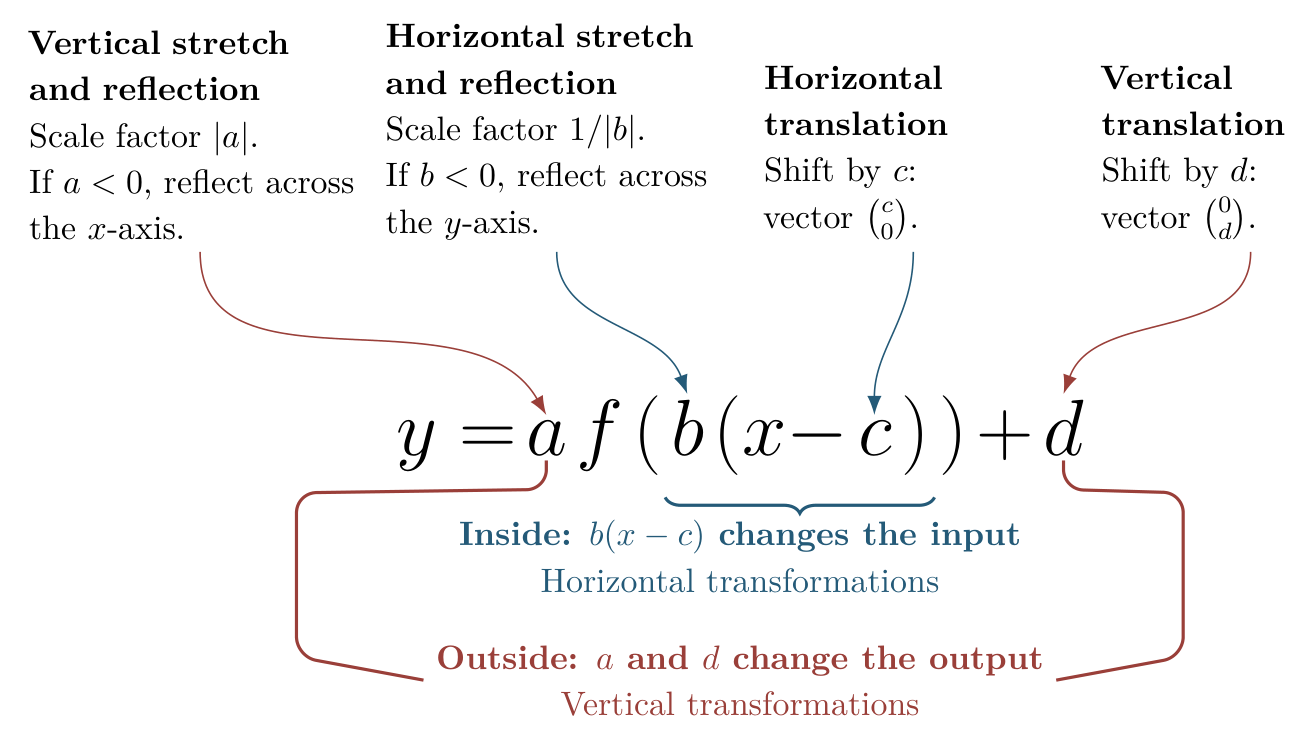
Combined horizontal changes are developed in Section 5 (HL).
Six transformations of the same generic function
We begin with one example graph to introduce the six basic transformations and compare their effects. These sketches give an overview; Sections 2 and 3 then explain each transformation in detail, with worked examples.
Each sketch uses the same original graph, crossing the \(x\)-axis at \(R=(-1,0)\) and containing \(P=(2,5)\). The dashed curve is \(y=f(x)\); the solid curve is its transformed image. Track both \(R\) and \(P\) without needing a formula for \(f\).
Vertical translation: up \(3\)
\(y=f(x)+3\)
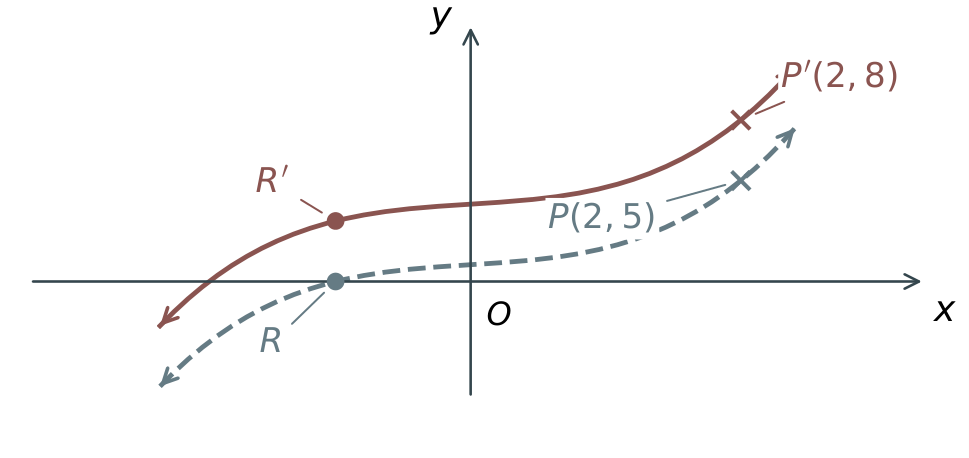
\((x,y)\mapsto(x,y+3)\)
Horizontal translation: left \(3\)
\(y=f(x+3)\)
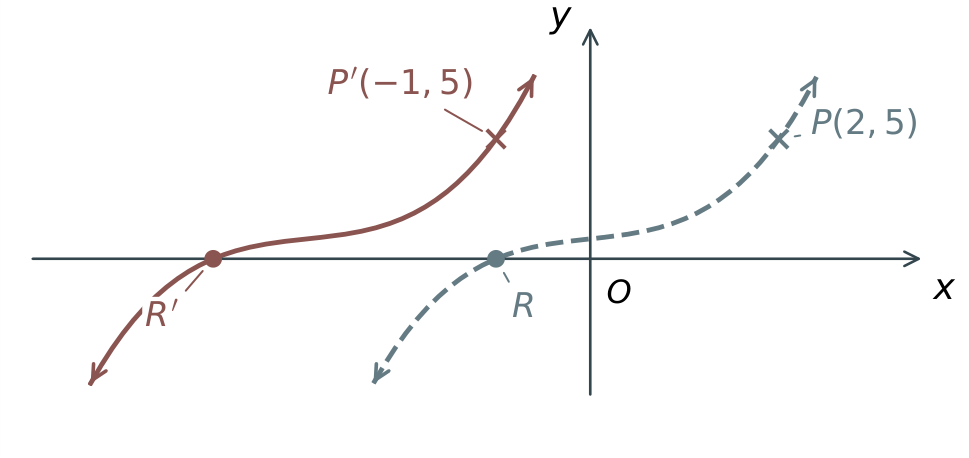
\((x,y)\mapsto(x-3,y)\)
Vertical stretch: scale factor \(2\)
\(y=2f(x)\)
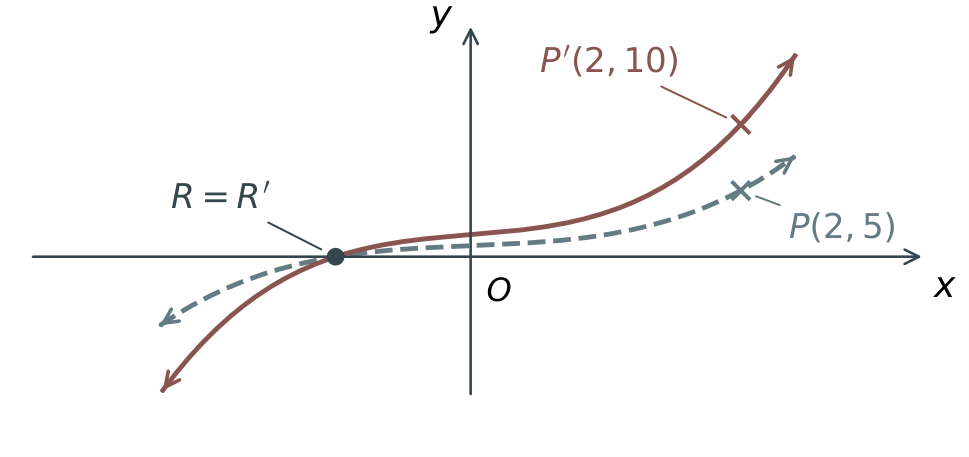
\((x,y)\mapsto(x,2y)\)
Horizontal stretch: scale factor \(\frac12\)
\(y=f(2x)\)
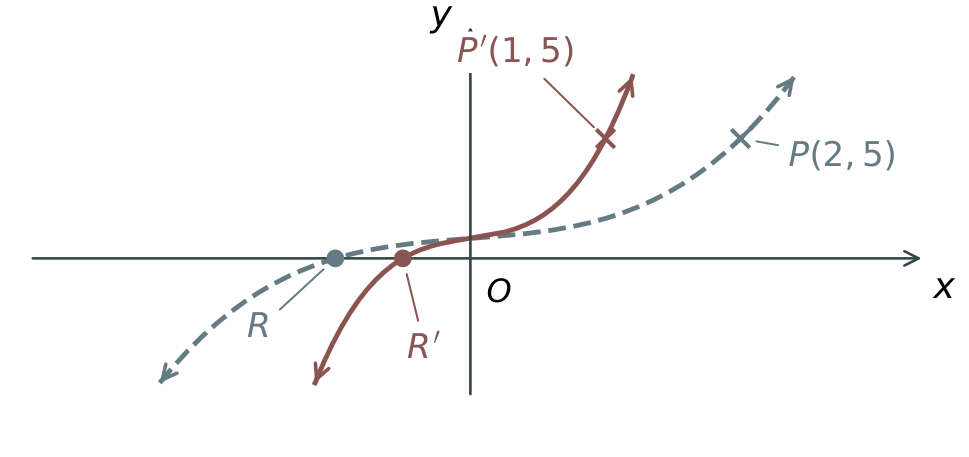
\((x,y)\mapsto(x/2,y)\)
Reflection across the \(x\)-axis
\(y=-f(x)\)
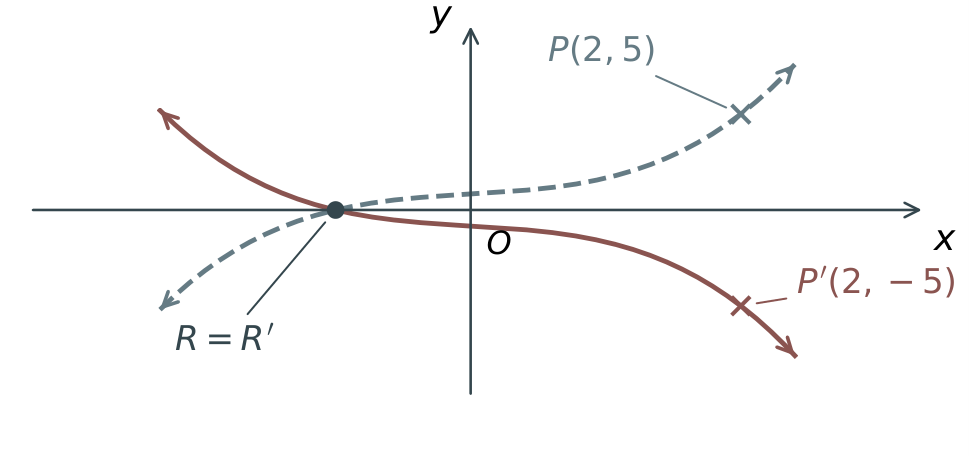
\((x,y)\mapsto(x,-y)\)
Reflection across the \(y\)-axis
\(y=f(-x)\)
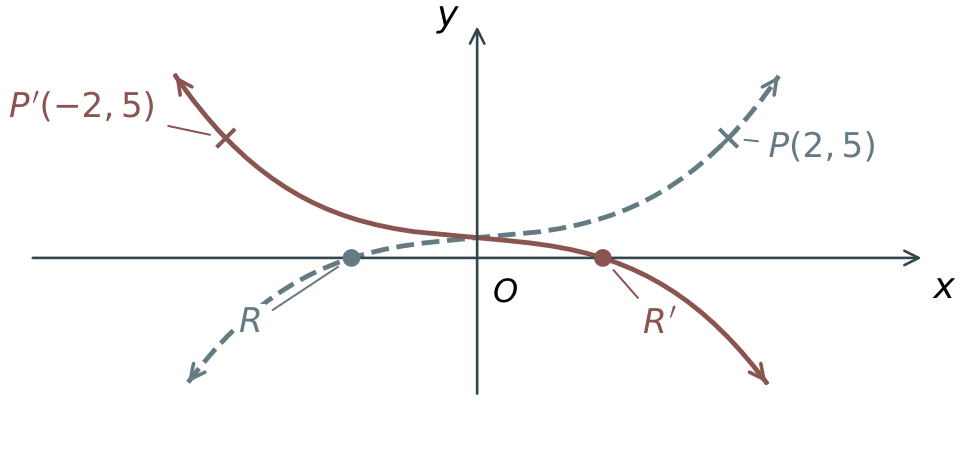
\((x,y)\mapsto(-x,y)\)
Compare the vertical changes. A stretch keeps \(R=(-1,0)\) fixed because \(2\times0=0\): the \(x\)-intercept is unchanged. A translation up \(3\) sends \(R\) to \(R'=(-1,3)\), which is no longer on the \(x\)-axis.
Vertical transformations: change the output
With vertical transformations, “what you see is what you get”: an operation outside \(f\) acts directly on every \(y\)-coordinate. Multiplying the function by \(a\) multiplies each \(y\)-coordinate by \(a\); adding \(d\) adds \(d\) to each \(y\)-coordinate. The \(x\)-coordinates stay unchanged. Horizontal changes will require us to undo the operation on the input.
2.1 Vertical translations
Tutorial: Vertical translations
Add to the output: \(y=f(x)+d\)
Each output increases by \(d\), while the input stays the same: \[\boxed{(x,y)\longmapsto(x,y+d)}.\] If \(d>0\), translate up \(d\) units. If \(d<0\), translate down \(|d|\) units. The translation vector is \(\binom{0}{d}\).
Worked example 1: translate a parabola upwards
Task. Let \(f(x)=-x^2+8x\). Find the equation of \(y=f(x)+3\), map its key points and sketch the result.
Solution
Add \(3\) to every \(y\)-coordinate.
\[\begin{aligned} y&=f(x)+3\\ &=(-x^2+8x)+3\\ &=\boxed{-x^2+8x+3}. \end{aligned}\] The vertex moves up by \(3\). The axis of symmetry remains \(x=4\).
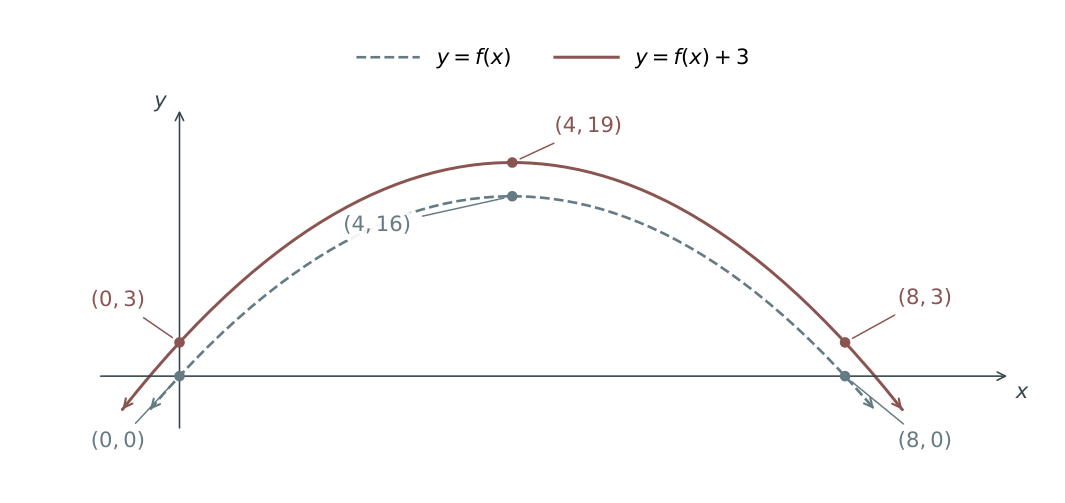
| Left root | Vertex | Right root | |
|---|---|---|---|
| On \(y=f(x)\) | \((0,0)\) | \((4,16)\) | \((8,0)\) |
| On \(y=f(x)+3\) | \((0,3)\) | \((4,19)\) | \((8,3)\) |
A mapped root need not remain a root. The images \((0,3)\) and \((8,3)\) are not roots of the new graph: their \(y\)-coordinates are not zero.
Downwards example. If \(P=(-2,7)\) is on \(y=f(x)\), then on \(y=f(x)-5\) it becomes \((-2,7-5)=(-2,2)\). The graph moves down \(5\) units.
2.2 Vertical stretches
Tutorial: Vertical stretches
Multiply the output: \(y=a f(x)\), with \(a>0\)
\[\begin{gathered}\boxed{(x,y)\mapsto(x,ay)}\\\text{vertical scale factor }a.\end{gathered}\] The scale factor (SF) is \(a\). If \(a>1\), distances from the \(x\)-axis increase; if \(0<a<1\), they decrease. Both are described as vertical stretches.
Worked example 2: compare two vertical scale factors
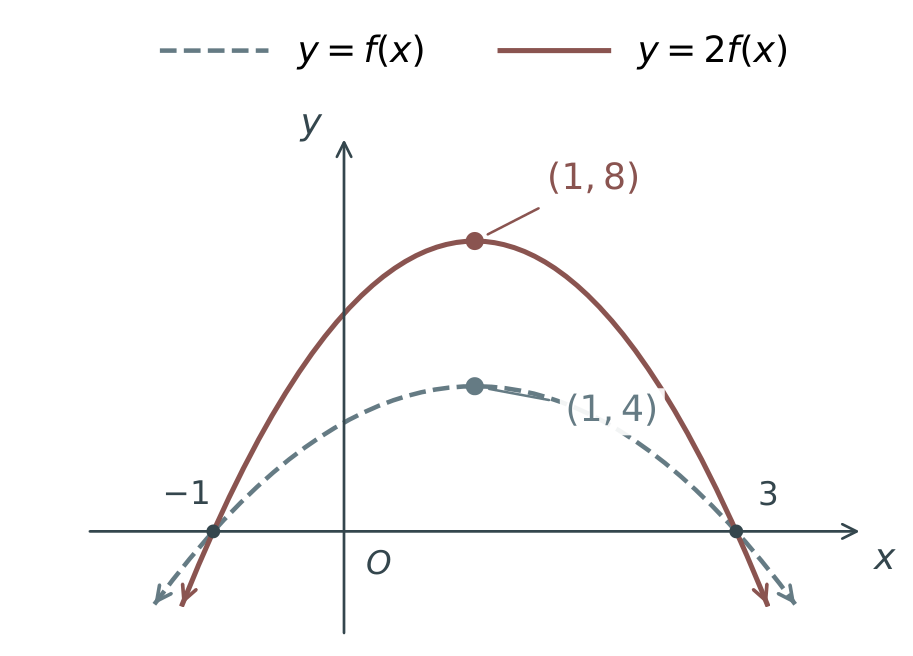
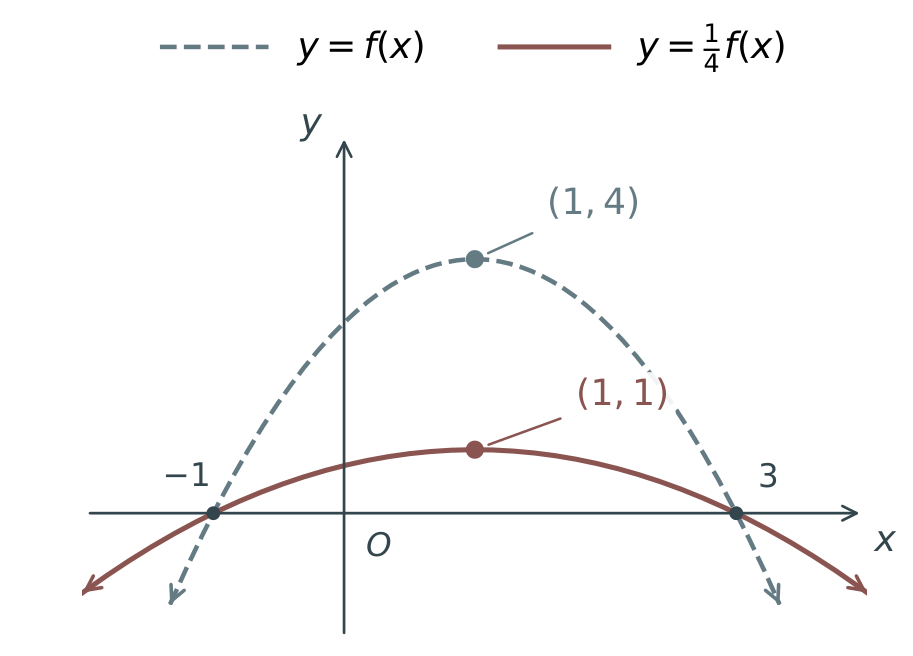
Task. Let \(f(x)=-x^2+2x+3\). Find and sketch (a) \(y=2f(x)\) and (b) \(y=\frac14f(x)\).
Solution
The original vertex is \((1,4)\), the \(y\)-intercept is \((0,3)\) and the roots are \((-1,0)\) and \((3,0)\). Multiply every output by the scale factor.
(a) Scale factor \(2\) \[\begin{aligned}
y&=2(-x^2+2x+3)\\
&=\boxed{-2x^2+4x+6}.
\end{aligned}\] Vertex: \((1,4)\mapsto(1,8)\).
\(y\)-intercept: \((0,3)\mapsto(0,6)\).
(b) Scale factor \(\frac14\) \[\begin{aligned}
y&=\tfrac14(-x^2+2x+3)\\
&=\boxed{-\tfrac14x^2+\tfrac12x+\tfrac34}.
\end{aligned}\] Vertex: \((1,4)\mapsto(1,1)\).
\(y\)-intercept: \((0,3)\mapsto(0,\frac34)\).
What stays fixed?
The \(x\)-coordinates stay the same. Both graphs still pass through \((-1,0)\) and \((3,0)\), because multiplying a zero output by \(a\) still gives zero.
Multiply the whole output. Use \(2f(x)=2(-x^2+2x+3)\). Multiplying only the \(x^2\) term would give a different transformation.
2.3 Reflection across the \(x\)-axis
Tutorial: Reflections across the coordinate axes
Negate the output: \(y=-f(x)\)
\[\boxed{(x,y)\longmapsto(x,-y)}.\] The \(x\)-coordinate stays the same. Points above the \(x\)-axis move the same distance below it, and vice versa. Points on the \(x\)-axis remain fixed.
Worked example 3: reflect a parabola vertically
Task. Reflect \(y=f(x)\), where \(f(x)=-x^2+8x\), across the \(x\)-axis. Give its equation, vertex and roots.
Solution
The entire output changes sign.
\[\begin{aligned} y&=-f(x)\\ &=-(-x^2+8x)\\ &=\boxed{x^2-8x}. \end{aligned}\]
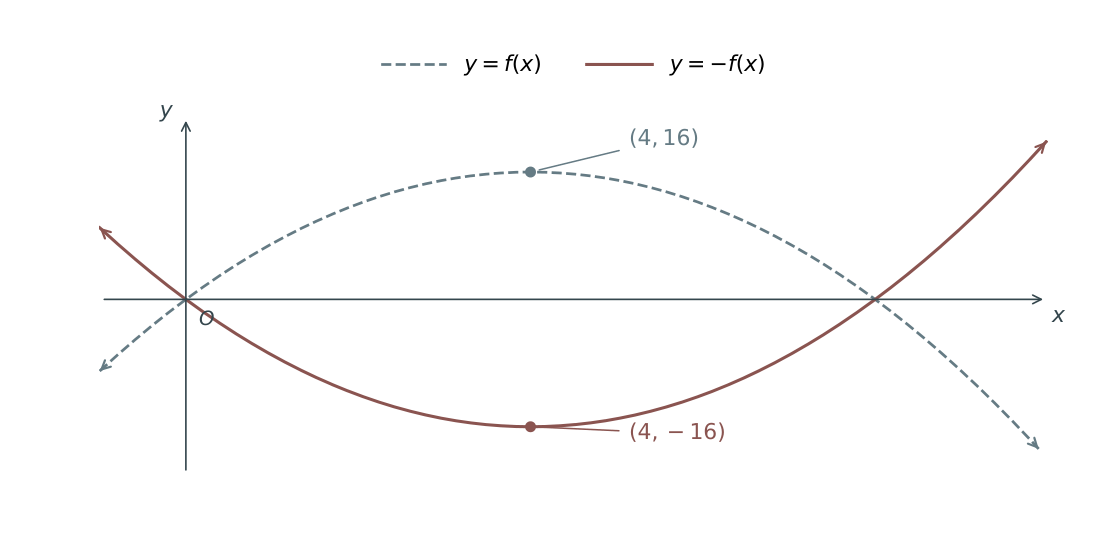
Map the vertex and roots: \[\begin{aligned} (4,16)&\mapsto\boxed{(4,-16)},\\ (0,0)&\mapsto(0,0),\\ (8,0)&\mapsto(8,0). \end{aligned}\] The original maximum becomes a minimum. The roots remain \(x=0\) and \(x=8\).
Worked example 4: a negative multiplier
Task. Describe \(y=-2f(x)\) and find the image of \(P=(-3,4)\).
Solution
First stretch vertically by scale factor \(2\), then reflect across the \(x\)-axis: \[\begin{aligned}(-3,4)&\mapsto(-3,8)\\&\mapsto\boxed{(-3,-8)}.\end{aligned}\] Equivalently, reflect first and then stretch. Both orders multiply each output by \(-2\).
Why is this vertical? The name of the mirror is the \(x\)-axis, but the changing coordinate is \(y\). Classify the transformation by what changes.
Horizontal transformations: change the input
In Section 3.4, we will see why horizontal transformations can seem to do the opposite of what we expect.
3.1 Horizontal translations
Tutorial: Horizontal translations
The rule: \(y=f(x-c)\)
Translate the graph horizontally by \(c\): \[\boxed{(x,y)\longmapsto(x+c,y)}.\] For \(c>0\), move right \(c\) units.
For \(c<0\), move left \(|c|\) units.
The translation vector is \(\binom{c}{0}\); every output stays unchanged.
Worked example 5: translate a parabola to the right
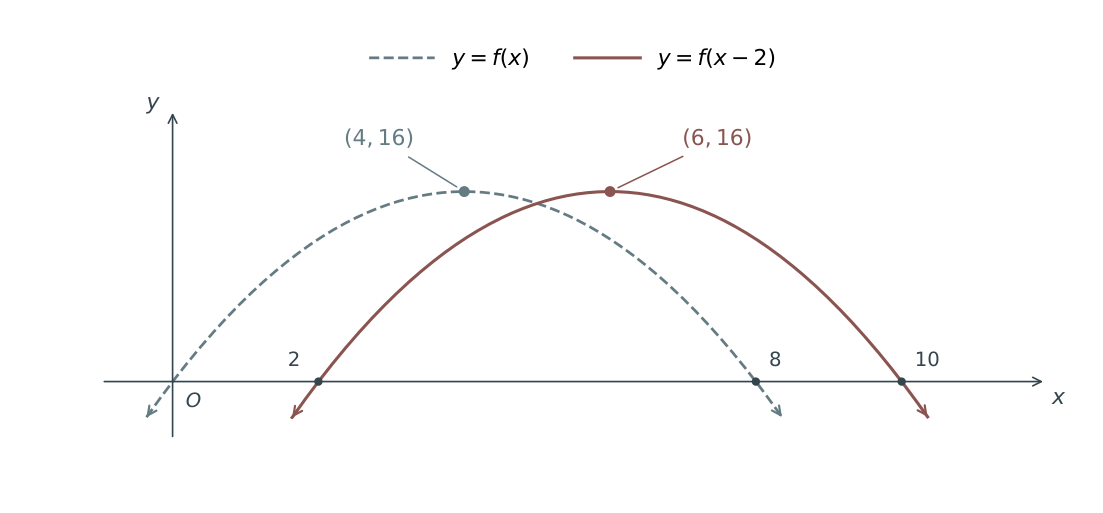
Task. Let \(f(x)=-x^2+8x\). Find the equation and key points of \(y=f(x-2)\), then sketch the result.
Solution
Here \(c=2\), so translate every point \(2\) units right. Replace every \(x\) in the original expression by \((x-2)\): \[\begin{gathered}f(x-2)\\=-(x-2)^2+8(x-2)\\=-(x^2-4x+4)\\{}+8x-16\\=\boxed{-x^2+12x-20}.\end{gathered}\]
Apply \((x,y)\mapsto(x+2,y)\): \[\begin{aligned} (4,16)&\mapsto(6,16),\\ (0,0)&\mapsto(2,0),\\ (8,0)&\mapsto(10,0). \end{aligned}\] The vertex and both roots move \(2\) units to the right.
3.2 Horizontal stretches
Tutorial: Horizontal stretches
The rule: \(y=f(bx)\), with \(b>0\)
\[\boxed{(x,y)\longmapsto\left(\frac{x}{b},y\right)}.\] The horizontal stretch has scale factor \(1/b\).
If \(b>1\), then SF \(1/b<1\): points move towards the \(y\)-axis.
If \(0<b<1\), then SF \(1/b>1\): points move away from the \(y\)-axis.
Worked example 6: compare two horizontal scale factors
Task. Find the equation and key points for each transformation below, then sketch each graph.
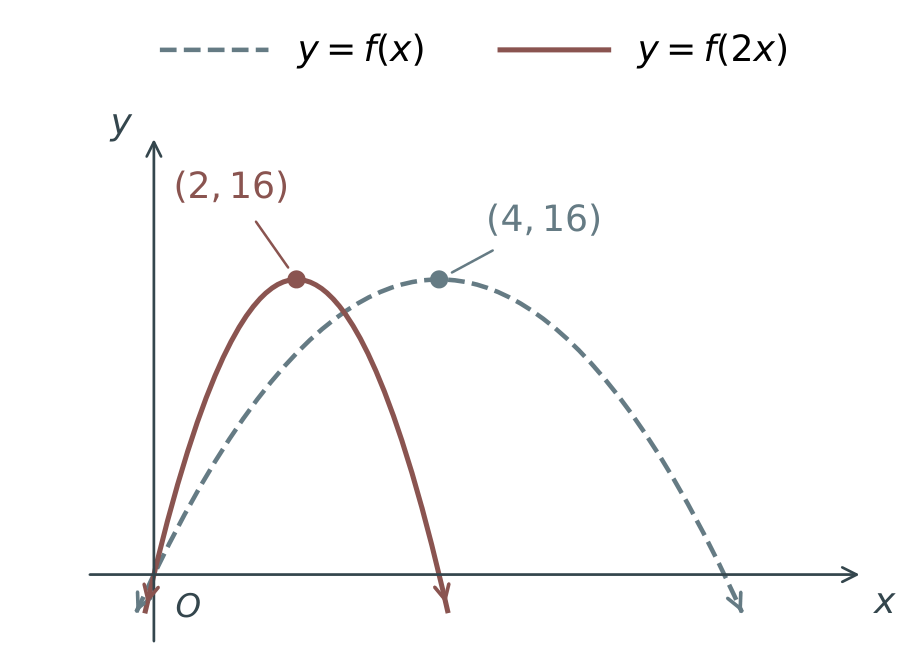
\(y=f(2x)\), where \(f(x)=-x^2+8x\).
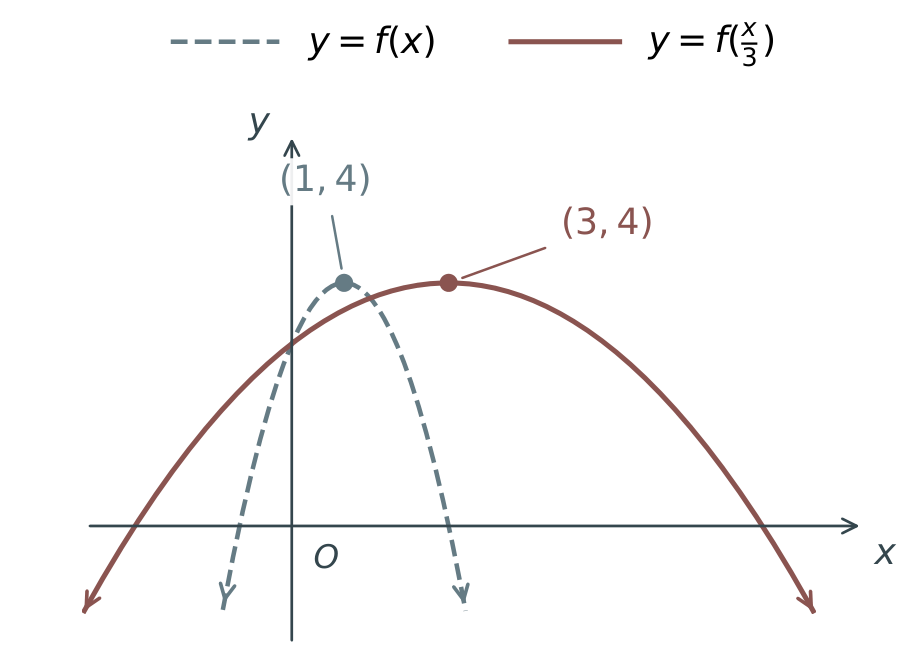
\(y=f(x/3)\), where \(f(x)=-x^2+2x+3\).
Solution
Divide each original \(x\)-coordinate by the multiplier inside \(f\).
(a) Horizontal SF \(\frac12\) \[\begin{aligned} f(2x)&=-(2x)^2+8(2x)\\ &=\boxed{-4x^2+16x}. \end{aligned}\] Vertex: \((4,16)\mapsto(2,16)\).
Roots: \((0,0)\mapsto(0,0)\);
\((8,0)\mapsto(4,0)\).
(b) Horizontal SF \(3\) \[\begin{gathered}f(\tfrac{x}{3})\\=-(\tfrac{x}{3})^2+2(\tfrac{x}{3})+3\\=\boxed{-\tfrac{x^2}{9}+\tfrac{2x}{3}+3}.\end{gathered}\] Vertex: \((1,4)\mapsto(3,4)\).
Roots: \((-1,0)\mapsto(-3,0)\);
\((3,0)\mapsto(9,0)\).
3.3 Reflection across the \(y\)-axis
Tutorial: Reflections across the coordinate axes
The rule: \(y=f(-x)\)
Reflect the graph across the \(y\)-axis: \[\boxed{(x,y)\longmapsto(-x,y)}.\] The \(y\)-coordinate stays the same. Points on the right move the same distance to the left, and vice versa. Points on the \(y\)-axis remain fixed.
Worked example 7: reflect a parabola horizontally
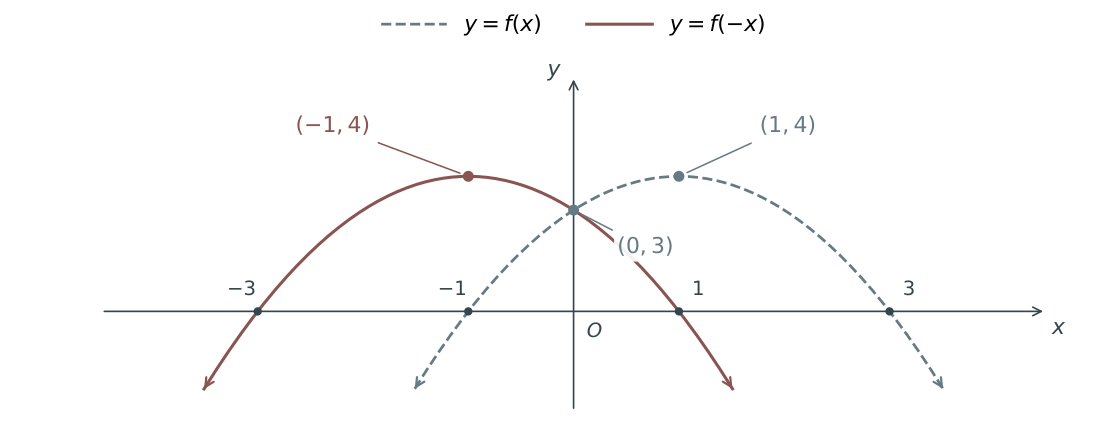
Task. Reflect \(y=f(x)\), where \(f(x)=-x^2+2x+3\), across the \(y\)-axis. Find its equation, vertex and roots, then sketch it.
Solution
Replace every \(x\) by \((-x)\), retaining brackets: \[\begin{gathered}y=f(-x)\\=-(-x)^2+2(-x)+3\\=\boxed{-x^2-2x+3}.\end{gathered}\]
Map each key point: \[\begin{aligned} \text{Vertex: }&(1,4)\mapsto(-1,4),\\ \text{Roots: }&(-1,0)\mapsto(1,0),\\ &(3,0)\mapsto(-3,0). \end{aligned}\] The \(y\)-intercept \((0,3)\) is unchanged.
Do not confuse \(-f(x)\) with \(f(-x)\)
For \(f(x)=-x^2+2x+3\): \[\begin{gathered}\text{Reflect across the }x\text{-axis:}\\-f(x)=x^2-2x-3.\\[10pt]\text{Reflect across the }y\text{-axis:}\\f(-x)=-x^2-2x+3.\end{gathered}\] The first changes the output; the second changes the input.
For a symmetric graph such as \(y=x^2\), reflection across the \(y\)-axis gives the same graph. The point mapping still applies.
3.4 Why do horizontal transformations seem to work backwards?
At first glance, horizontal transformations can seem to do the opposite of what we expect: subtracting \(c\) inside \(f\) shifts the graph right when \(c>0\), while multiplying the input by \(b\) multiplies the graph’s \(x\)-coordinates by \(1/b\).
Recover the original input to keep the same output
Take a point \(\bigl(a,f(a)\bigr)\) on the original graph. What must the new \(x\)-coordinate be so that the input to \(f\) equals \(a\) again?
Set the expression inside \(f\) equal to \(a\) and solve for \(x\). Undoing the input operation keeps the corresponding point at height \(f(a)\).
Horizontal translation: undo the subtraction
For \(y=f(x-c)\), recover the original input \(a\): \[x-c=a\quad\Longrightarrow\quad x=a+c.\] We add \(c\) to undo the subtraction, keeping the output \(f(a)\): \[\boxed{\bigl(a,f(a)\bigr)\longmapsto\bigl(a+c,f(a)\bigr)}.\] This holds for every point: translate right by \(c\) units if \(c>0\), or left by \(|c|\) units if \(c<0\).
Illustration: the same output occurs one unit farther right
Let \(f(x)=-x^2+4x\). Compare \(y=f(x)\) with \(y=f(x-1)\).
Solution
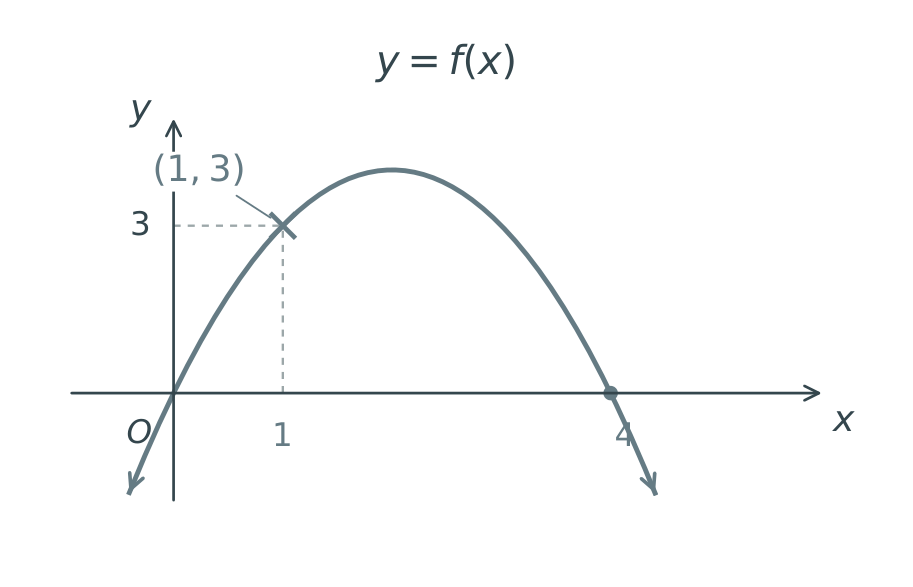
Original graph. For the input \(x=1\), we can see that the output is \(3\): \[f(1)=3.\] The point \((1,3)\) lies on the curve. We will recover this same input to \(f\) on the transformed graph, so the output remains \(3\).
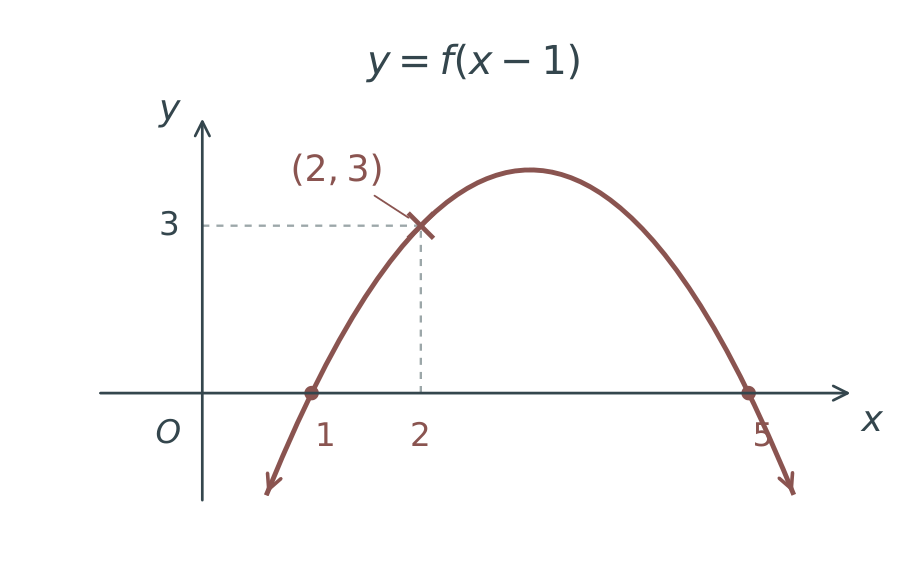
Transformed graph. The input to \(f\) is now \(x-1\). To recover the original input \(1\), we need \[x-1=1\quad\Longrightarrow\quad x=2.\] The output is still \(3\), but \(x=2\) is one unit to the right of \(1\). The same reasoning applies to every point, so the entire curve shifts one unit right.
A plus sign inside. For \(f(x+3)\), solve \(x+3=a\), giving \(x=a-3\): subtract \(3\) from every horizontal coordinate, so the curve moves \(3\) units left.
Horizontal stretch: undo the multiplication
For \(y=f(bx)\), with \(b>0\), recover the original input \(a\): \[\begin{gathered}bx=a\\\Longrightarrow x=\frac ab=\frac1b a.\end{gathered}\] We divide by \(b\) to undo the multiplication. Since \(f(b\cdot a/b)=f(a)\), \[\boxed{\bigl(a,f(a)\bigr)\longmapsto\left(\frac ab,f(a)\right)}.\] Every \(x\)-coordinate is multiplied by \(1/b\) while its output stays the same. This explains the horizontal stretch with scale factor \(1/b\).
Illustration: multiplying the input by \(2\) halves the horizontal coordinates
Again let \(f(x)=-x^2+4x\). Compare \(y=f(x)\) with \(y=f(2x)\).
Solution
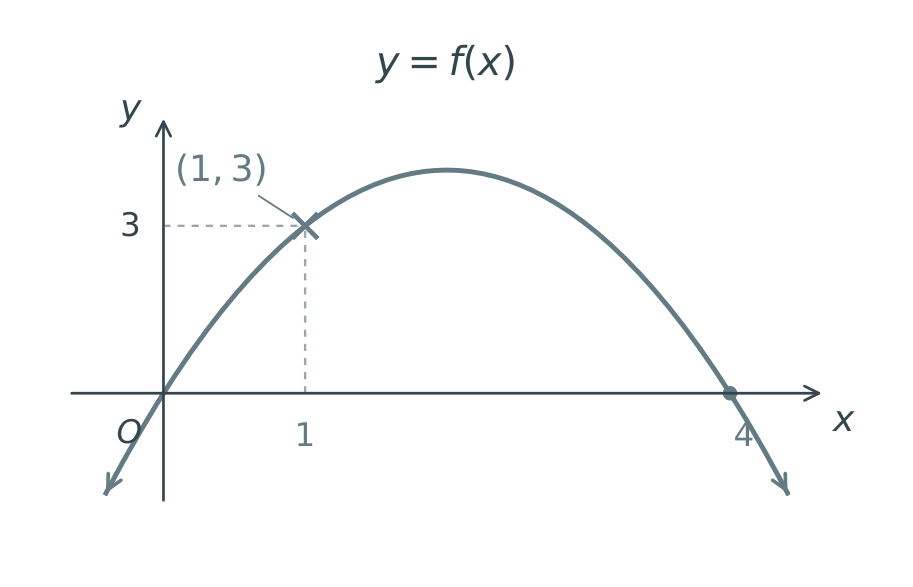
Original graph. For the input \(x=1\), we can see that the output is \(3\): \[f(1)=3.\] The point \((1,3)\) lies on the curve. We will recover this same input to \(f\) on the transformed graph, so the output remains \(3\).
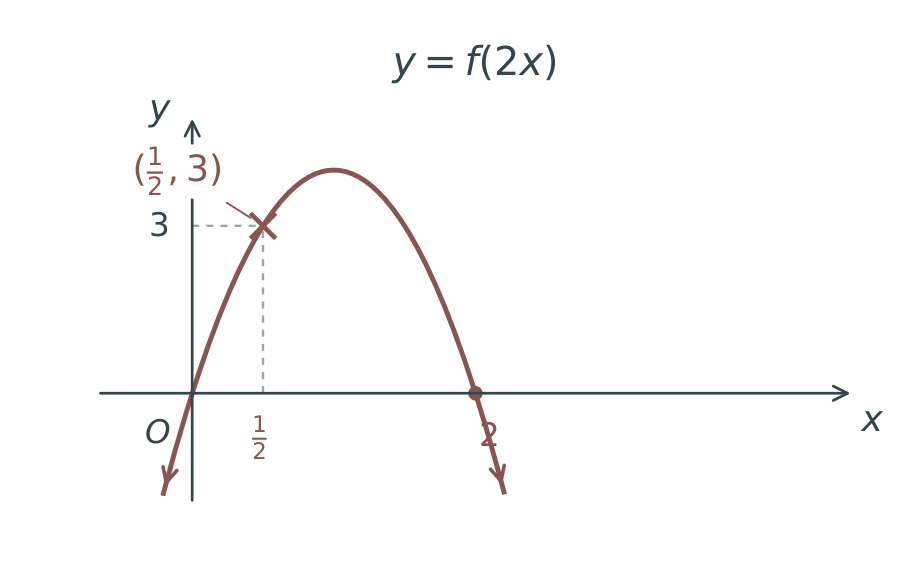
Transformed graph. The input to \(f\) is now \(2x\). To recover the original input \(1\), we need \[2x=1\quad\Longrightarrow\quad x=\tfrac12.\] The output is still \(3\), but the horizontal coordinate is halved. Applying this to every point halves its distance from the \(y\)-axis: a horizontal stretch with SF \(\tfrac12\).
The same reasoning works for a scale factor greater than \(1\)
For \(y=f(x/3)\), solve \(x/3=a\) to get \(x=3a\). The horizontal coordinates are multiplied by \(3\), so the stretch has SF \(3\).
Points on the \(y\)-axis stay fixed: an original input \(a=0\) gives the new coordinate \(0/b=0\).
When finding the equation of \(f(2x)\), retain brackets: \((2x)^2=4x^2\).
Horizontal reflection: undo the sign change
For \(y=f(-x)\), recover the original input \(a\): \[-x=a\quad\Longrightarrow\quad x=-a.\] Changing sign is its own inverse operation. Since \(f(-(-a))=f(a)\), \[\boxed{\bigl(a,f(a)\bigr)\longmapsto\bigl(-a,f(a)\bigr)}.\] The points keep the same height and lie equal distances on opposite sides of the \(y\)-axis.
Illustration: the same output comes from the opposite input
Again let \(f(x)=-x^2+4x\). Compare \(y=f(x)\) with \(y=f(-x)\).
Solution
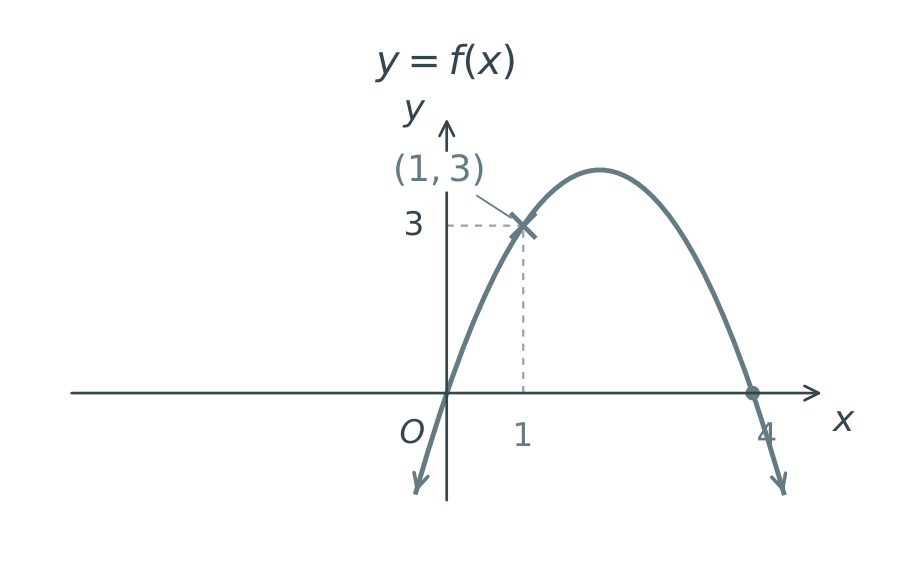
Original graph. For the input \(x=1\), we can see that the output is \(3\): \[f(1)=3.\] The point \((1,3)\) lies on the curve. We will recover this same input to \(f\) on the transformed graph, so the output remains \(3\).
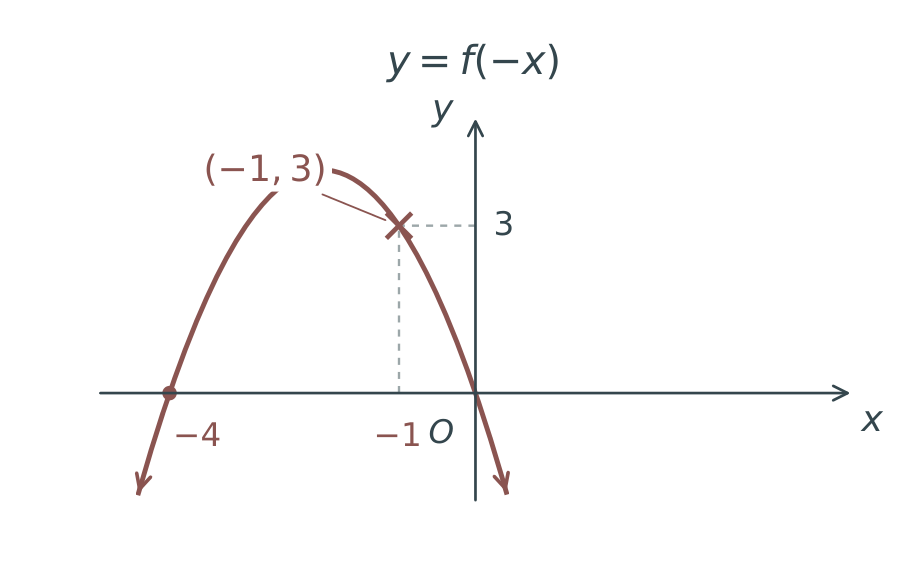
Transformed graph. The input to \(f\) is now \(-x\). To recover the original input \(1\), we need \[-x=1\quad\Longrightarrow\quad x=-1.\] The output is still \(3\), but the point is now one unit to the left of the \(y\)-axis. Every point moves to the opposite horizontal coordinate, so the curve reflects across the \(y\)-axis.
Compare the two categories
Vertical: apply the operation directly to the output. Adding \(d\) outside \(f\) adds \(d\) to each \(y\)-coordinate; multiplying \(f\) multiplies its outputs.
Horizontal: undo the operation on the input. Recover the original input \(a\) to find the new horizontal coordinate, keeping height \(f(a)\).
These are inverse operations; we are not finding the inverse function \(f^{-1}\).
Negative input multipliers. For \(f(-2x)\), solve \(-2x=a\) to get \(x=-a/2\): reflect across the \(y\)-axis and stretch horizontally with SF \(\frac12\).
Multiple transformations and their effects
4.1 Tracking features through multiple transformations
A transformed function inherits the structure of its original graph. This is a general principle: it applies to a familiar parent function or any other starting function.
As we apply transformations, we can follow the domain, range and features such as turning points, endpoints and asymptotes. Knowing the original graph often lets us read off these transformed features without solving new equations or using a calculator. We track known points too, remembering that a vertical translation can move a root off the \(x\)-axis.
Domain and range: which values can change?
For translations, reflections and stretches with non-zero scale factors:
Vertical transformations can affect the range, but not the domain. They change the outputs (\(y\)-coordinates), while keeping the inputs unchanged.
Horizontal transformations can affect the domain, but not the range. They change the inputs (\(x\)-coordinates), while keeping the outputs unchanged.
Can affect does not mean must change: a transformed set of values may be the same as the original set.
An illustration: from \(y=1/x\) to a rational function
Worked example 8 illustrates this general principle using the reciprocal parent \(y=1/x\). Every rational function \[\begin{gathered}f(x)=\frac{ax+b}{cx+d},\\c\ne0,\quad ad\ne bc,\end{gathered}\] is a transformed version of this parent. It inherits the two branches and two asymptotes; the transformations determine their positions. The sketch shows a typical member, with asymptotes \(x=h\) and \(y=k\).
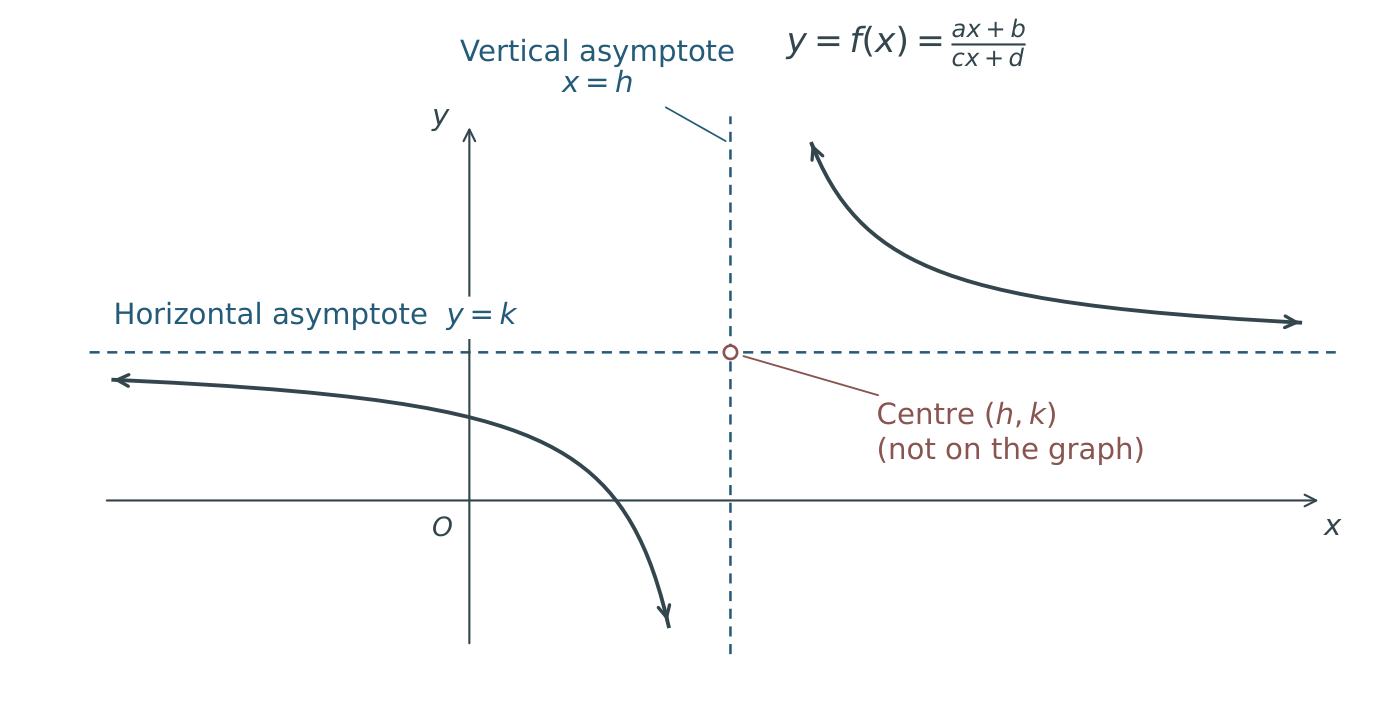
\[\begin{gathered}\boxed{\text{Domain: }\mathbb R\setminus\{h\}}\\[6pt]\boxed{\text{Range: }\mathbb R\setminus\{k\}}.\end{gathered}\] The centre \((h,k)\) is the intersection of the asymptotes; it is not a point on the curve. One possible orientation is shown. Reflections can reverse the orientation of the branches.
We now start with \(y=1/x\) and follow the transformations one at a time. Track the points, the asymptotes and the allowed input and output values together.
Worked example 8: follow the transformations
Task. Start with the parent function \(y=1/x\). First sketch this graph and state its domain, range and the equations of its two asymptotes.
Then carry out the following transformations in order, each time transforming the graph obtained in the previous part.
For each of parts (a)–(d): write the new equation, make a small sketch showing both asymptotes and any intercepts, and state the updated domain and range. Also track the reference point \(P_0=(1,1)\).
Translate the parent graph \(2\) units to the right.
Reflect the graph from part (a) across the \(x\)-axis.
Stretch the graph from part (b) vertically with scale factor \(2\).
Translate the graph from part (c) \(3\) units upwards.
Write your final equation as a single fraction of the form \[y=\frac{ax+b}{cx+d}.\] State \(a\), \(b\), \(c\) and \(d\) for your chosen expression.
Solution
Begin with the parent graph.
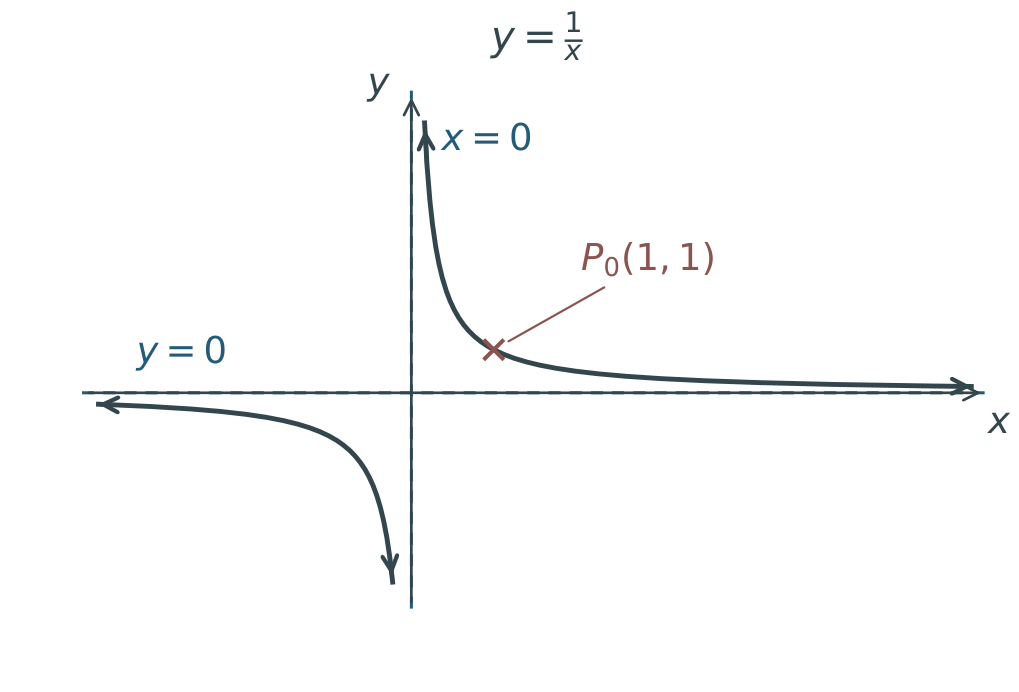
Starting graph: \(y=1/x\)
The input \(0\) is forbidden, and the output can never be \(0\).
Domain: \(\mathbb R\setminus\{0\}\).
Range: \(\mathbb R\setminus\{0\}\).
Vertical asymptote: \(x=0\).
Horizontal asymptote: \(y=0\).
There are no intercepts. The graph contains \(P_0=(1,1)\) and has two branches approaching the coordinate axes.
(a) Translate \(2\) units to the right
Replace \(x\) by \(x-2\): \[\boxed{y=\frac{1}{x-2}}.\] Domain: \(\mathbb R\setminus\{2\}\).
Range: \(\mathbb R\setminus\{0\}\).
Vertical asymptote: \(x=2\).
Horizontal asymptote: \(y=0\).
At \(x=0\), \(y=-\tfrac12\), giving the \(y\)-intercept \((0,-\tfrac12)\). There is no \(x\)-intercept. \[P_0(1,1)\mapsto P_1(3,1).\]
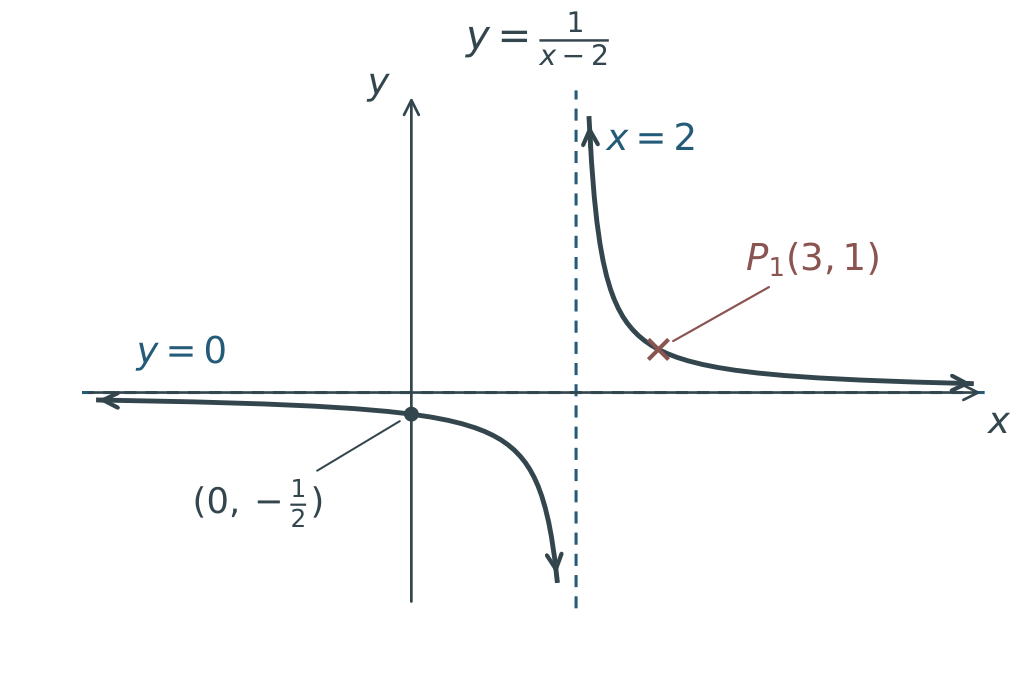
The forbidden input moves from \(0\) to \(2\), so the vertical asymptote moves with it. The outputs and the horizontal asymptote are unchanged.
(b) Reflect the current graph across the \(x\)-axis
Negate the current output: \[\boxed{y=-\frac{1}{x-2}}.\] Domain: \(\mathbb R\setminus\{2\}\).
Range: \(\mathbb R\setminus\{0\}\).
Vertical asymptote: \(x=2\).
Horizontal asymptote: \(y=0\).
The \(y\)-intercept becomes \((0,\tfrac12)\). There is still no \(x\)-intercept. \[P_1(3,1)\mapsto P_2(3,-1).\]
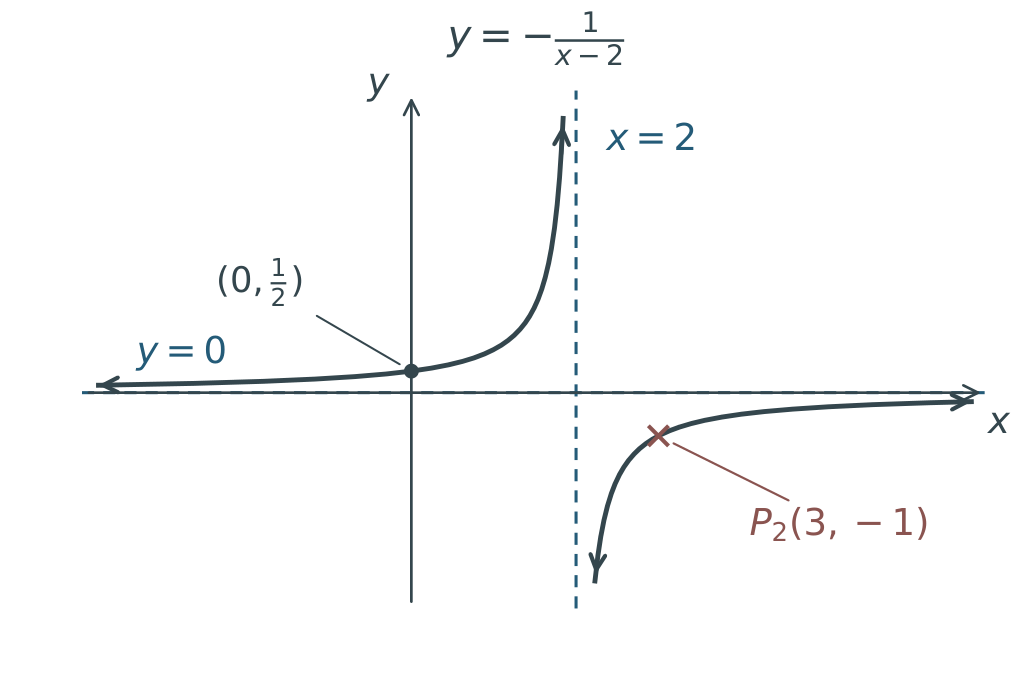
Every output changes sign, but the set of all non-zero outputs stays the same. The excluded output is still \(0\), since \(-0=0\).
(c) Stretch the current graph vertically with scale factor \(2\)
Multiply the current output by \(2\): \[\boxed{y=-\frac{2}{x-2}}.\] Domain: \(\mathbb R\setminus\{2\}\).
Range: \(\mathbb R\setminus\{0\}\).
Vertical asymptote: \(x=2\).
Horizontal asymptote: \(y=0\).
The \(y\)-intercept becomes \((0,1)\). There is still no \(x\)-intercept. \[P_2(3,-1)\mapsto P_3(3,-2).\]
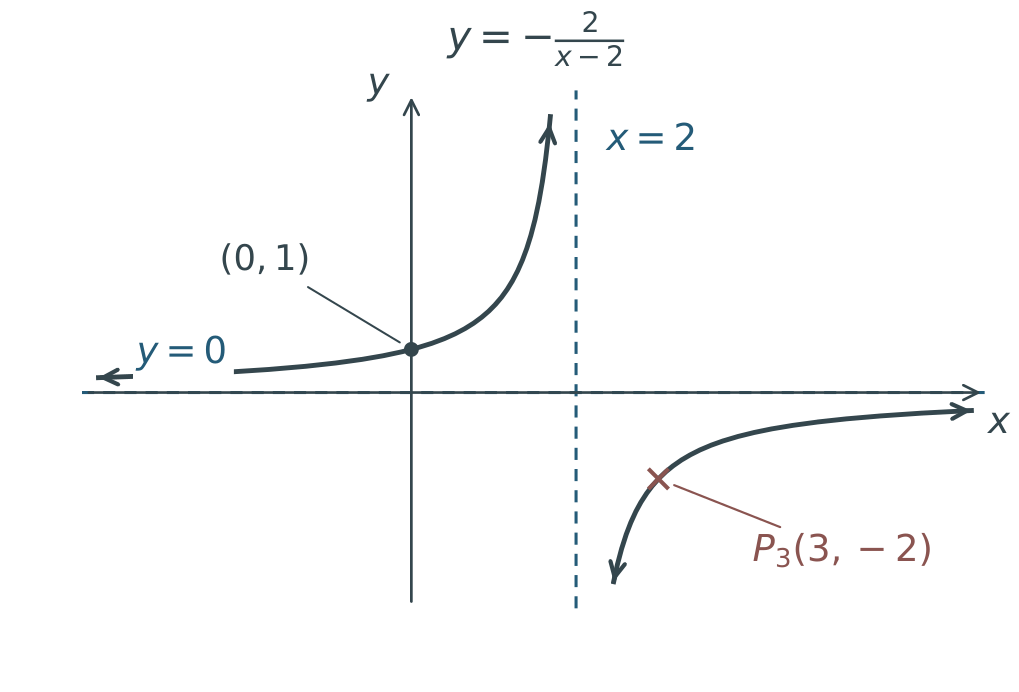
The points move farther from the \(x\)-axis. Multiplying every non-zero output by \(2\) still gives all non-zero outputs, so the range and asymptotes are unchanged.
(d) Translate the current graph \(3\) units upwards
Add \(3\) to the current output: \[\boxed{y=3-\frac{2}{x-2}}.\] Domain: \(\mathbb R\setminus\{2\}\).
Range: \(\mathbb R\setminus\{3\}\).
Vertical asymptote: \(x=2\).
Horizontal asymptote: \(y=3\).
At \(x=0\), \(y=4\). Setting \(y=0\) gives \(3(x-2)=2\), so \(x=\tfrac83\). \[P_3(3,-2)\mapsto P_4(3,1).\]
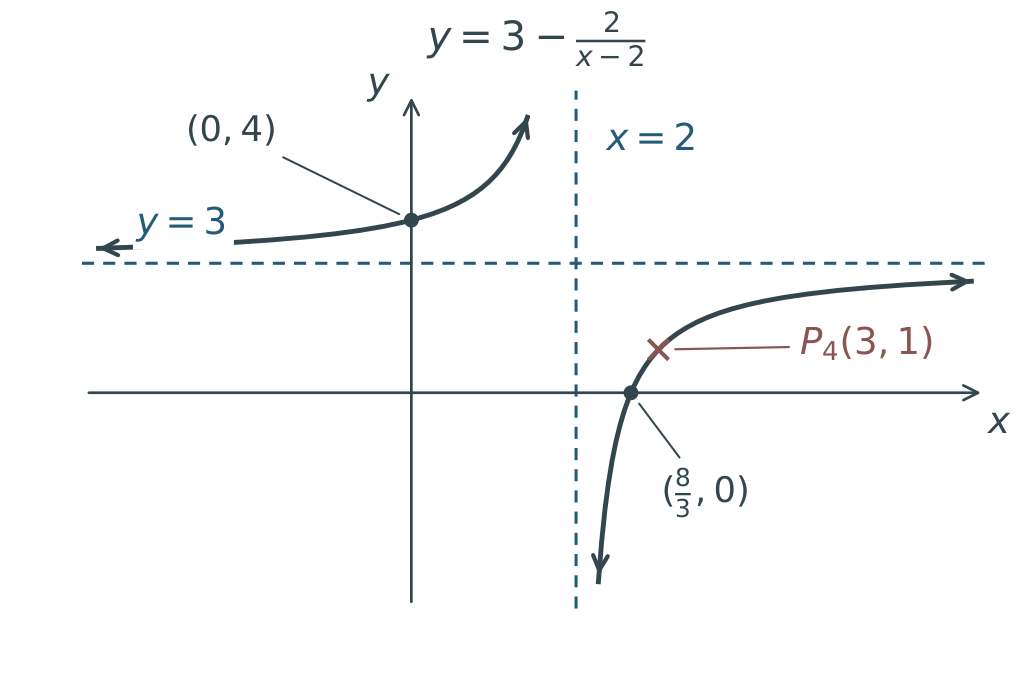
The excluded output \(0\) becomes \(3\), moving the horizontal asymptote to \(y=3\). The domain and vertical asymptote are unchanged.
(e) Write the final equation as one fraction
\[\begin{gathered}3-\frac{2}{x-2}\\=\frac{3(x-2)-2}{x-2}\\=\boxed{\frac{3x-8}{x-2}},\\x\ne2.\end{gathered}\] In this expression, \[\boxed{\begin{gathered}a=3,\quad b=-8,\\c=1,\quad d=-2\end{gathered}}\].
The transformed function inherits its parent’s key features
The function we obtained in Worked example 8 belongs to the family \[\begin{gathered}f(x)=\frac{ax+b}{cx+d},\\c\ne0,\quad ad\ne bc.\end{gathered}\] Every function in this family is a transformed version of \(y=1/x\). This is why the parent graph is so useful: its key features carry over to the new graph, and the transformations tell us where to place them.
Find the features of \(f(x)=\dfrac{ax+b}{cx+d}\)
Suppose the transformed graph has vertical asymptote \(x=h\) and horizontal asymptote \(y=k\).
Follow the parent’s excluded input and output through the transformations: the excluded input \(0\) becomes \(h\), and the excluded output \(0\) becomes \(k\).
| Feature | Parent \(y=1/x\) | Transformed function |
|---|---|---|
| Vertical asymptote | \(x=0\) | \(x=h\) |
| Horizontal asymptote | \(y=0\) | \(y=k\) |
| Domain | \(\mathbb R\setminus\{0\}\) | \(\boxed{\mathbb R\setminus\{h\}}\) |
| Range | \(\mathbb R\setminus\{0\}\) | \(\boxed{\mathbb R\setminus\{k\}}\) |
| Centre of symmetry | \((0,0)\) | \((h,k)\) |
The new graph still has two branches, approaches its asymptotes and never meets either asymptote. A reflection may reverse the orientation of its branches.
Connect the category of transformation to the features
Horizontal transformations can change the domain and move the vertical asymptote, while leaving the range and the horizontal asymptote’s height unchanged.
Vertical transformations can change the range and move the horizontal asymptote, while leaving the domain and the vertical asymptote’s position unchanged.
In Worked example 8: the horizontal translation moves the excluded input and vertical asymptote from \(0\) to \(2\). The vertical reflection and stretch leave the excluded output at \(0\); the final upward translation moves it to \(3\). Therefore: \[\begin{gathered}\text{Domain: }\mathbb R\setminus\{2\},\\\text{vertical asymptote: }x=2,\\[6pt]\text{Range: }\mathbb R\setminus\{3\},\\\text{horizontal asymptote: }y=3.\end{gathered}\] We have found these features entirely by following the transformations of the parent graph.
The reciprocal case. The conditions \(c\ne0\) and \(ad\ne bc\) exclude lines and constant functions with a missing input; these do not have the reciprocal graph’s two branches and two asymptotes.
4.2 Listing a sequence of transformations to obtain a given function
A key skill is to start with a known function, often a parent function, and list a sequence of transformations that produces a given function. There is often more than one correct sequence. The following two rules give us a reliable way to organise the steps.
Thread 1: group the horizontal and vertical transformations
Split the changes into two categories:
Horizontal: change the input and hence the points’ \(x\)-coordinates.
Vertical: change the output and hence the points’ \(y\)-coordinates.
You may start with either category. Once you choose one, list all the transformations in that category before moving to the other. \[\begin{gathered}\boxed{\begin{gathered}\text{all horizontal,}\\\text{then all vertical}\end{gathered}}\\\text{or}\\\boxed{\begin{gathered}\text{all vertical,}\\\text{then all horizontal}\end{gathered}}.\end{gathered}\] These give the same final graph because the two categories act on different coordinates.
Thread 2: within each category, leave the translation until last
Within the horizontal category, carry out any stretch and reflection before its horizontal shift. Within the vertical category, carry out any stretch and reflection before its vertical shift.
A stretch and a reflection in the same category can be listed in either order. For example, vertically, \[\begin{gathered}y\mapsto3y\mapsto-3y\\\text{or}\\y\mapsto-y\mapsto-3y.\end{gathered}\] Both multiply the output by \(-3\). Once those changes are complete, add the vertical translation.
“Translation last” means last within its own category
A horizontal translation may come before every vertical change. Likewise, a vertical translation may come before every horizontal change. The rule applies separately within each category.
Other sequences can also work if the translation amounts are adjusted. Here we use the two rules above so that the listed shifts stay consistent with the final, suitably factored expression.
4.3 A square-root sequence: domain and range at every step
Worked example 9: identify the changes before listing them
Task. Starting with the parent function \(y=\sqrt{x}\), list a valid sequence of transformations giving \[\boxed{y=-3\sqrt{x-1}+2}.\] Sketch the graph after each transformation, track the reference point \(P_0=(1,1)\) and state the domain and range at every stage, including the parent function.
Solution
Set \(f(x)=\sqrt{x}\). The target is \(y=-3f(x-1)+2\).
| Category | What changes? | Transformations to list |
|---|---|---|
| Horizontal | Replace \(x\) by \(x-1\) inside \(f\) | Translate \(1\) unit right. |
| Vertical | Multiply the output by \(-3\), then add \(2\) | Reflect across the \(x\)-axis and stretch vertically with scale factor \(3\), in either order; then translate \(2\) units up. |
We first choose horizontal, then vertical, and within the vertical category we choose reflection, then stretch, then translation.
Route A: horizontal first, then vertical
We now sketch the sequence one transformation at a time, writing the new equation, domain and range after every step. In each sketch, the marked cross tracks the reference point; the filled dot marks the endpoint.
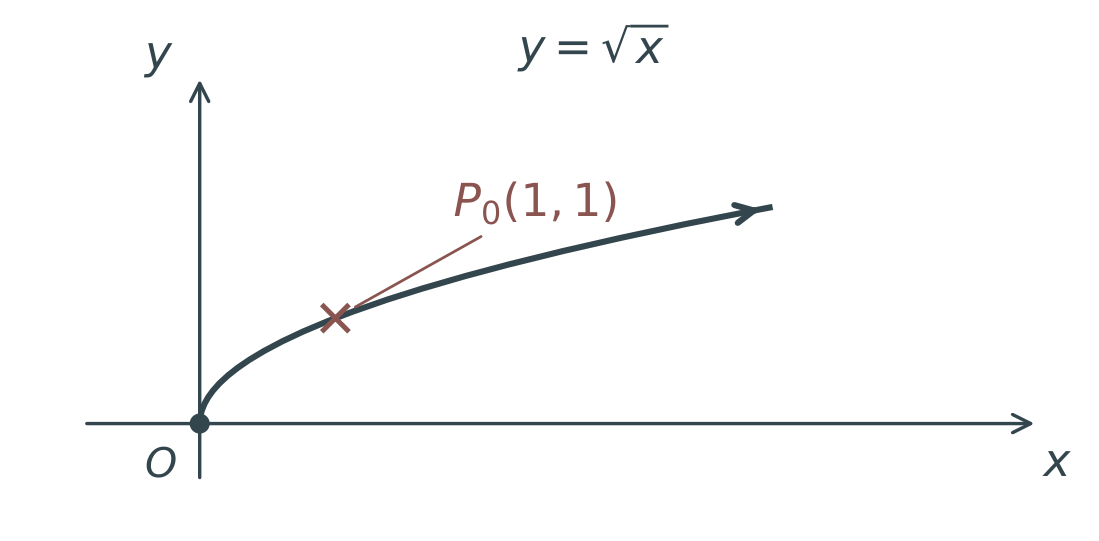
Starting graph: the parent function
\[y=\sqrt{x}.\] Since \(\sqrt{1}=1\), a convenient reference point is \[\boxed{P_0=(1,1)}.\] The graph starts at \((0,0)\).
Domain: \([0,\infty)\).
Range: \([0,\infty)\).
Both include \(0\): the endpoint lies on the graph.
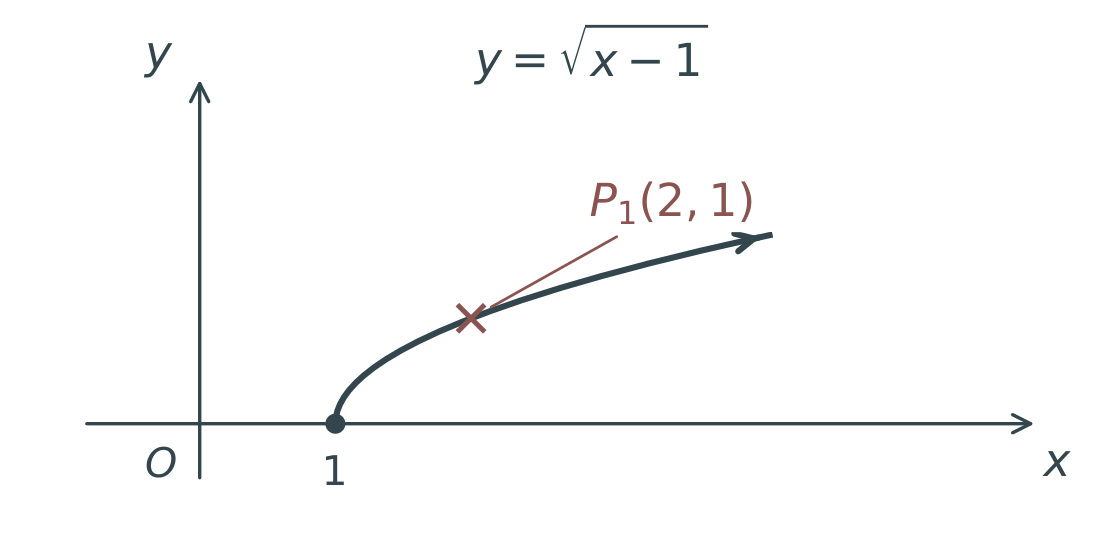
Step 1: horizontal translation \(1\) unit to the right
Replace the input \(x\) by \(x-1\): \[y=\sqrt{x-1}.\] Add \(1\) to every \(x\)-coordinate: \[\boxed{P_0(1,1)\mapsto P_1(2,1)}.\] The endpoint moves to \((1,0)\).
Domain: \([1,\infty)\).
Range: \([0,\infty)\).
Inputs shift right by \(1\); outputs are unchanged.
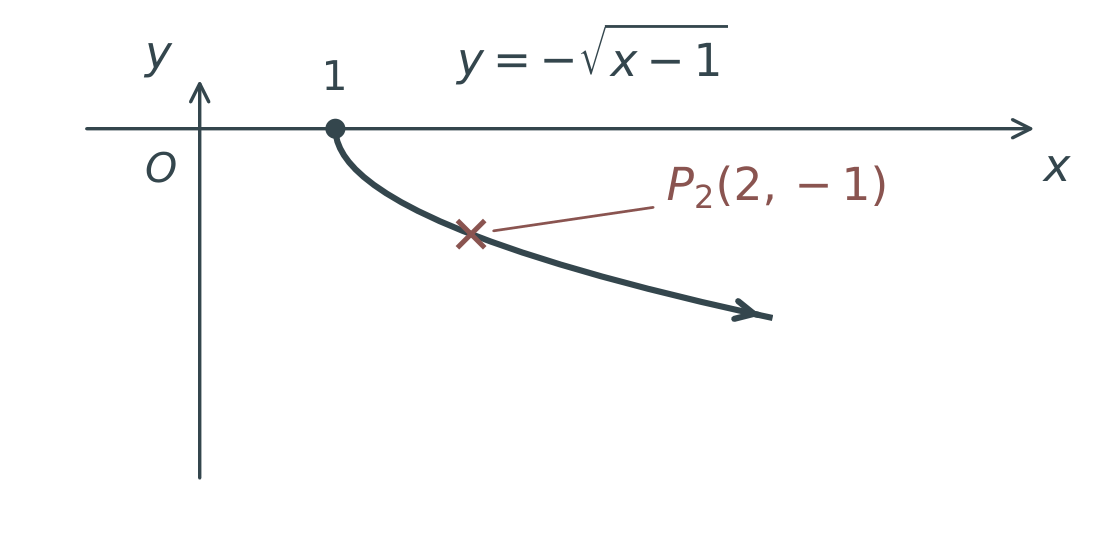
Step 2: vertical reflection across the \(x\)-axis
Negate the whole output: \[y=-\sqrt{x-1}.\] Change the sign of every \(y\)-coordinate: \[\boxed{P_1(2,1)\mapsto P_2(2,-1)}.\] The endpoint \((1,0)\) stays fixed.
Domain: \([1,\infty)\).
Range: \((-\infty,0]\).
Outputs \(y\ge0\) become outputs \(y\le0\); the boundary \(0\) is still included.
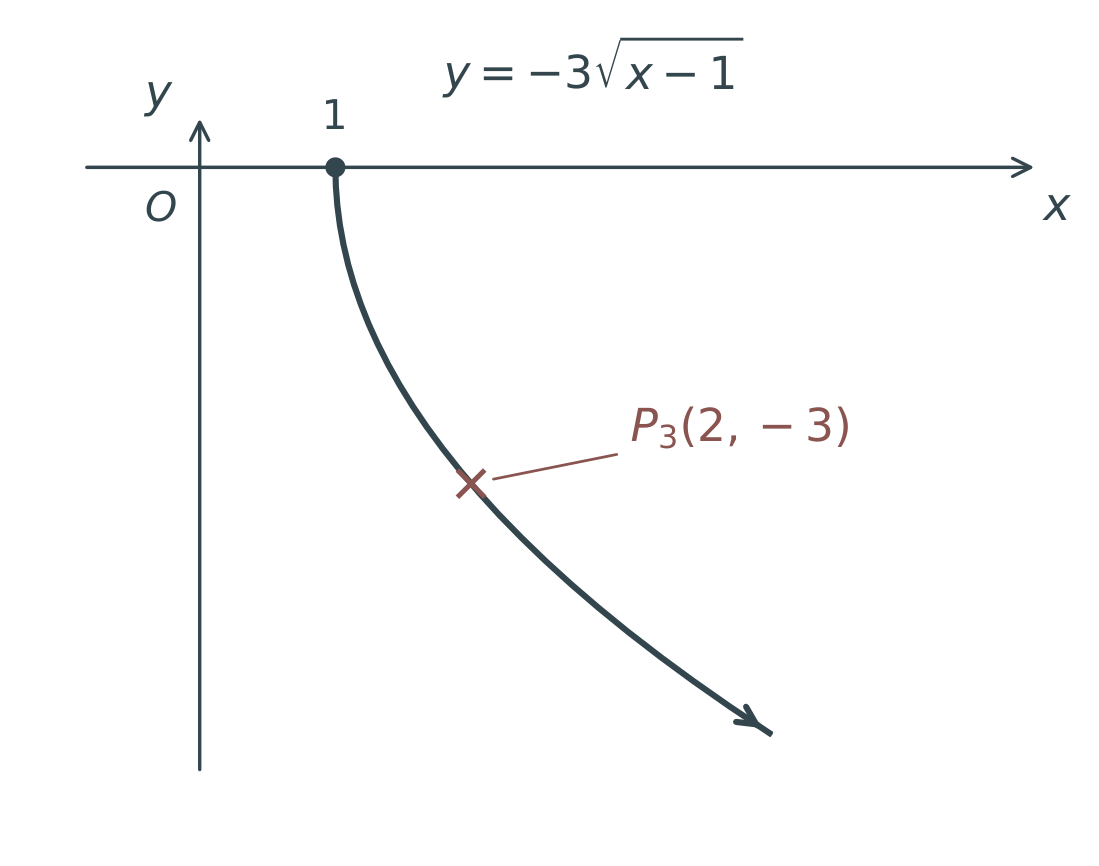
Step 3: vertical stretch with scale factor \(3\)
Multiply the current output by \(3\): \[\begin{aligned}y&=3\bigl(-\sqrt{x-1}\bigr)\\&=-3\sqrt{x-1}.\end{aligned}\] Multiply every \(y\)-coordinate by \(3\): \[\boxed{P_2(2,-1)\mapsto P_3(2,-3)}.\] The endpoint remains \((1,0)\).
Domain: \([1,\infty)\).
Range: \((-\infty,0]\).
Multiplying all non-positive outputs by \(3\) still gives all non-positive outputs.
Step 4: vertical translation \(2\) units upwards
Add \(2\) to the current output: \[\boxed{y=-3\sqrt{x-1}+2}.\] Add \(2\) to every \(y\)-coordinate: \[\boxed{P_3(2,-3)\mapsto P_4(2,-1)}.\] The endpoint moves to \((1,2)\).
Domain: \([1,\infty)\).
Range: \((-\infty,2]\).
Adding \(2\) to outputs \(y\le0\) gives outputs \(y\le2\). The endpoint is included.
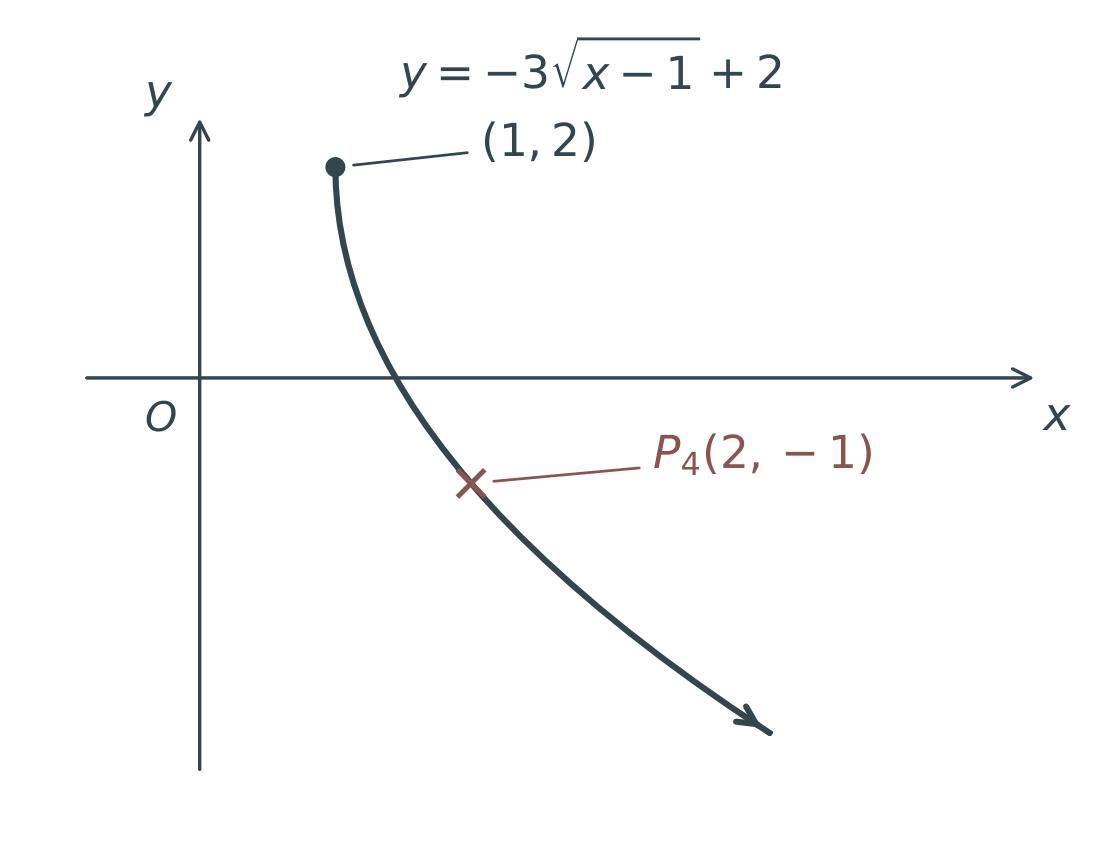
Check the final point. At \(x=2\), \[\begin{aligned}y&=-3\sqrt{2-1}+2\\&=-3+2\\&=-1\end{aligned}\]. Thus \(P_4=(2,-1)\) lies on the final graph. Its domain is \([1,\infty)\) and its range is \((-\infty,2]\).
Route B: vertical first is equally valid
Here we also swap the order of the stretch and reflection. Complete all the vertical changes, then make the horizontal change.
| Transformation | New equation | Point | Domain | Range |
|---|---|---|---|---|
| Parent function | \(y=\sqrt{x}\) | \((1,1)\) | \([0,\infty)\) | \([0,\infty)\) |
| Vertical stretch, SF \(3\) | \(y=3\sqrt{x}\) | \((1,3)\) | \([0,\infty)\) | \([0,\infty)\) |
| Reflect across the \(x\)-axis | \(y=-3\sqrt{x}\) | \((1,-3)\) | \([0,\infty)\) | \((-\infty,0]\) |
| Translate \(2\) units up | \(y=-3\sqrt{x}+2\) | \((1,-1)\) | \([0,\infty)\) | \((-\infty,2]\) |
| Translate \(1\) unit right | \(y=-3\sqrt{x-1}+2\) | \((2,-1)\) | \([1,\infty)\) | \((-\infty,2]\) |
Same destination. Both routes give \((x,y)\mapsto(x+1,-3y+2)\). The vertical shift is last within the vertical category, although the horizontal shift comes afterwards in Route B.
Read the domain and range from the parent
Domain. The parent accepts \(x\ge0\). The horizontal translation sends each input to \(x+1\), so the new inputs satisfy \(x\ge1\). None of the vertical changes affects the domain.
Range. The parent produces \(y\ge0\). Follow those outputs through the vertical changes: \[\begin{array}{ll}\text{parent:}&y\ge0\\\text{stretch, SF }3\text{:}&y\ge0\\\text{reflect:}&y\le0\\\text{translate up }2\text{:}&y\le2\end{array}\] The original endpoint is included, so its image is included too. Hence the final domain is \([1,\infty)\) and the final range is \((-\infty,2]\).
Useful habit. Track boundary values and included endpoints; check them against your sketch.
4.4 An exponential sequence: domain and range at every step
An exponential parent has no endpoint. Its horizontal asymptote helps us identify a boundary of its range, and that boundary is not attained.
Worked example 10: from \(y=3^x\) to a transformed exponential
Task. Starting with the parent function \(y=3^x\), list a valid sequence of transformations giving \[\boxed{y=4-2\times3^{x+1}}.\] Sketch the graph after each transformation. State the domain and range at every stage, including the parent, and track its horizontal asymptote and the point \(P_0=(0,1)\).
Solution
Let \(f(x)=3^x\). The target is \(y=-2f(x+1)+4\).
| Category | Transformations, in our chosen order |
|---|---|
| Horizontal | Translate \(1\) unit left. |
| Vertical | Stretch vertically with SF \(2\); reflect across the \(x\)-axis; then translate \(4\) units up. |
We complete the horizontal category first and leave the vertical translation until last.
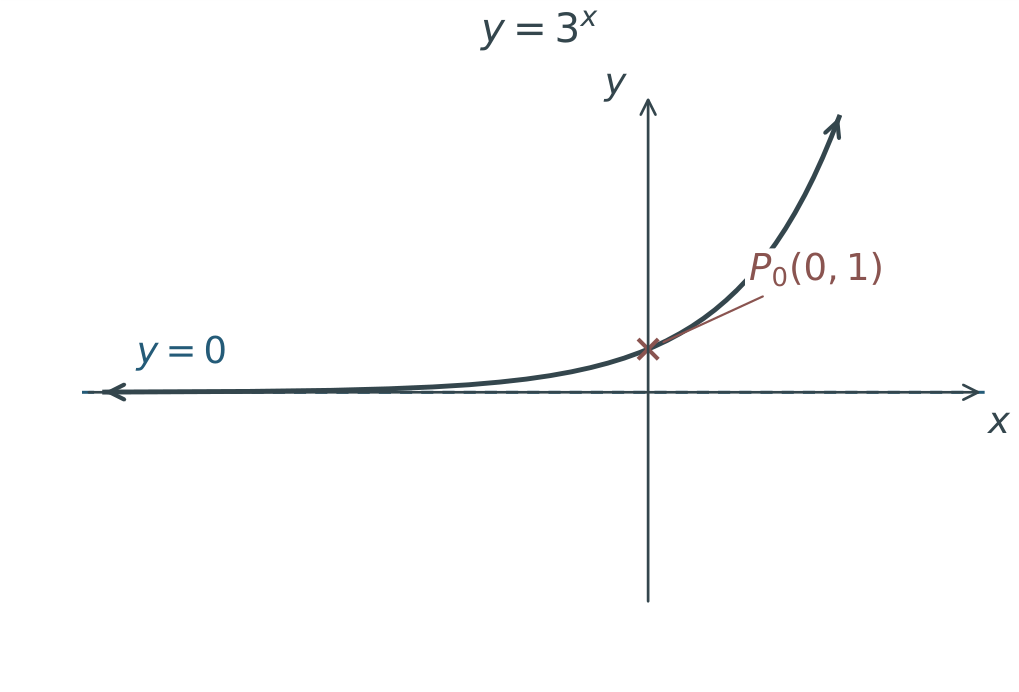
Starting graph: the parent \(y=3^x\)
Every real input is allowed, and \(3^x>0\) for every real \(x\). \[\begin{aligned} \text{Domain: }&\mathbb R,\\ \text{Range: }&(0,\infty). \end{aligned}\] Horizontal asymptote: \(y=0\).
The graph contains \(P_0=(0,1)\) because \(3^0=1\). It approaches the \(x\)-axis but never reaches it.
Use the parent graph to reason about the range
We will transform the original outputs \(y>0\) one operation at a time. Keep track of whether a boundary value is included: a stretch, reflection or translation cannot turn an unattained boundary into an attained endpoint.
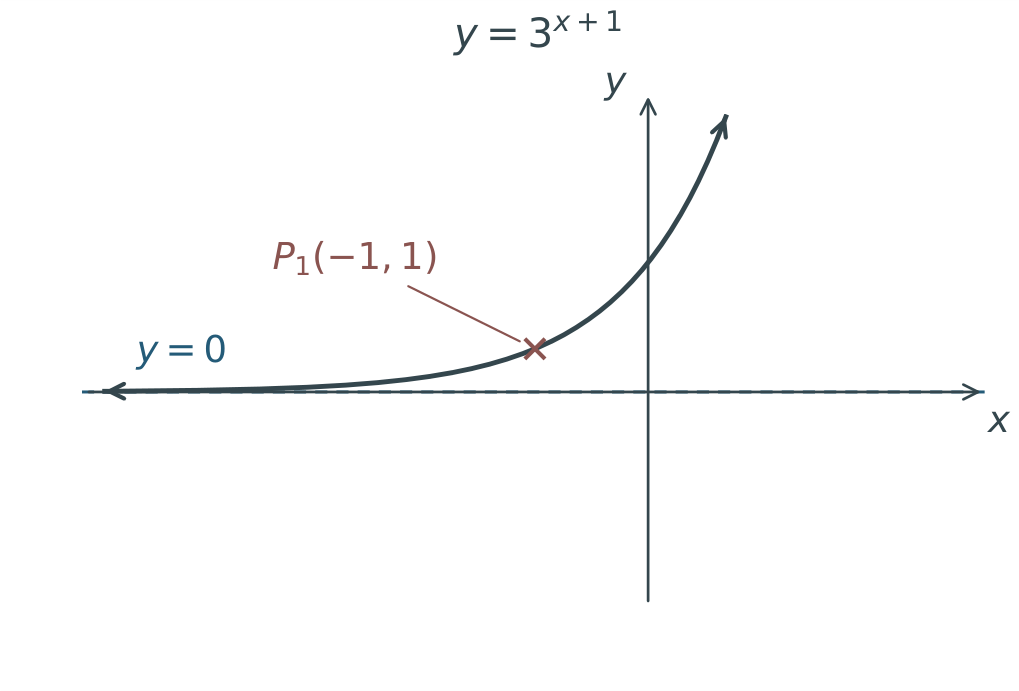
Step 1: horizontal translation \(1\) unit to the left
Replace \(x\) by \(x+1\): \[y=3^{x+1}.\] \[\boxed{P_0(0,1)\mapsto P_1(-1,1)}.\] Domain: \(\mathbb R\).
Range: \((0,\infty)\).
Horizontal asymptote: \(y=0\).
Shifting all real inputs still gives all real inputs. Outputs do not change in a horizontal transformation.
Step 2: vertical stretch with scale factor \(2\)
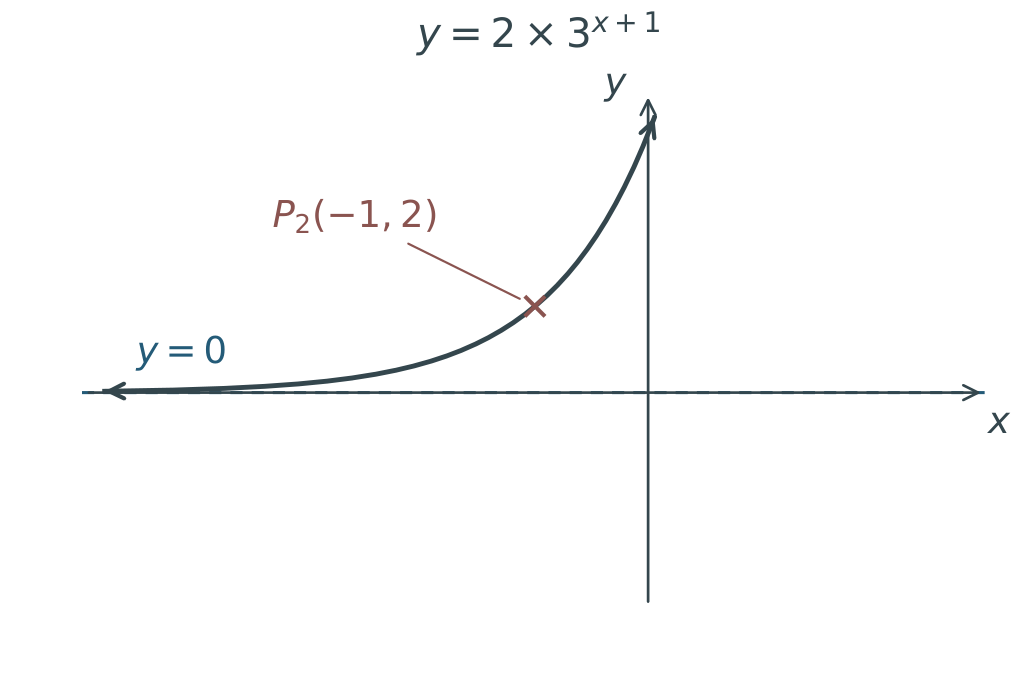
Multiply the current output by \(2\): \[y=2\times3^{x+1}.\] \[\boxed{P_1(-1,1)\mapsto P_2(-1,2)}.\] Domain: \(\mathbb R\).
Range: \((0,\infty)\).
Horizontal asymptote: \(y=0\).
Twice a positive output is positive; every positive output remains possible. The limiting height stays \(2\times0=0\).
The graph changes even when its domain and range do not
The horizontal shift and vertical stretch have moved the points, but both graphs still accept every real input and produce every positive output. Domain and range describe the sets of values, not the exact location of every point.
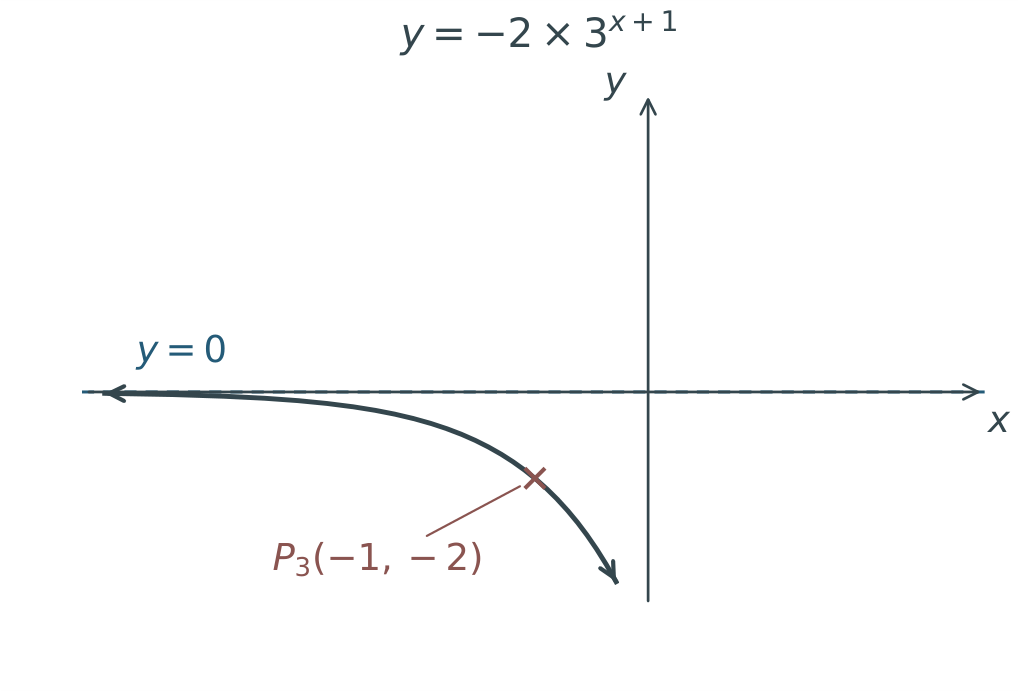
Step 3: reflection across the \(x\)-axis
Negate the current output: \[y=-2\times3^{x+1}.\] \[\boxed{P_2(-1,2)\mapsto P_3(-1,-2)}.\] Domain: \(\mathbb R\).
Range: \((-\infty,0)\).
Horizontal asymptote: \(y=0\).
Positive outputs become negative outputs. Zero is still not attained.
Step 4: vertical translation \(4\) units upwards
Add \(4\) to the current output: \[\boxed{y=4-2\times3^{x+1}}.\] \[\boxed{P_3(-1,-2)\mapsto P_4(-1,2)}.\] Domain: \(\mathbb R\).
Range: \((-\infty,4)\).
Horizontal asymptote: \(y=4\).
Add \(4\) to every output below \(0\): the new outputs are all below \(4\), and \(4\) is excluded.
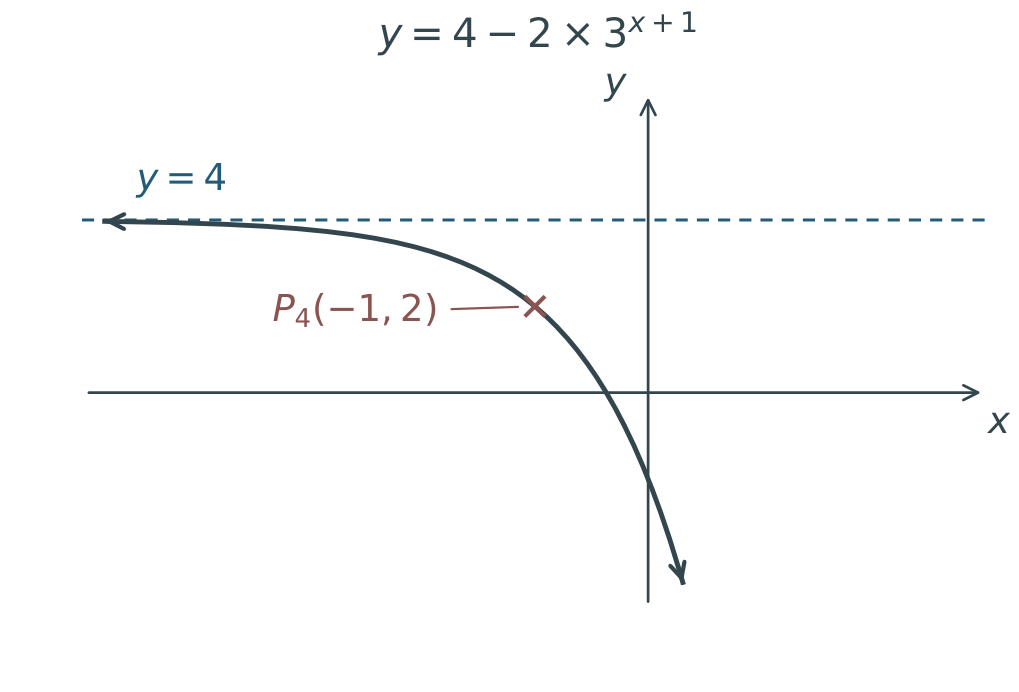
Check the final point. At \(x=-1\), \(y=4-2\times3^0=2\), so \(P_4=(-1,2)\) lies on the target graph.
Compare the two parent functions
The square-root example has range \((-\infty,2]\): its endpoint \((1,2)\) lies on the graph. The exponential example has range \((-\infty,4)\): the graph approaches \(y=4\) but never reaches it.
Knowledge of the parent function tells us both where the range boundary moves and whether to include it.
4.5 From \(y=x^2\) to a transformed parabola
Tutorial: Listing a sequence of transformations for a parabola
Track the input and output separately
For \(y=a f(x-c)+d\) with \(a\ne0\), \[\boxed{(x,y)\longmapsto(x+c,ay+d)}.\] One valid order is: horizontal translation by \(c\); vertical stretch with scale factor \(|a|\) (and reflection across the \(x\)-axis if \(a<0\)); vertical translation by \(d\).
Worked example 11: give a sequence, then sketch
Task. Starting with \(y=x^2\), describe a sequence of transformations giving \(y=-2(x-3)^2+4\). State its vertex, axis of symmetry and intercepts.
Solution
Write the equation as \(y=-2f(x-3)+4\), where \(f(x)=x^2\).
Translate \(3\) units to the right: \(y=(x-3)^2\).
Stretch vertically by scale factor \(2\): \(y=2(x-3)^2\).
Reflect across the \(x\)-axis: \(y=-2(x-3)^2\).
Translate \(4\) units upwards: \(y=-2(x-3)^2+4\).
The mapping is \((x,y)\mapsto(x+3,-2y+4)\), so the vertex \((0,0)\) becomes \(\boxed{(3,4)}\). The axis of symmetry is \(\boxed{x=3}\).
\[\begin{aligned} y(0)&=-2(0-3)^2+4\\ &=-14. \end{aligned}\] The \(y\)-intercept is \((0,-14)\).
For the \(x\)-intercepts, set \(y=0\): \[\begin{gathered}-2(x-3)^2+4=0,\\(x-3)^2=2,\\x=\boxed{3\pm\sqrt2}.\end{gathered}\]
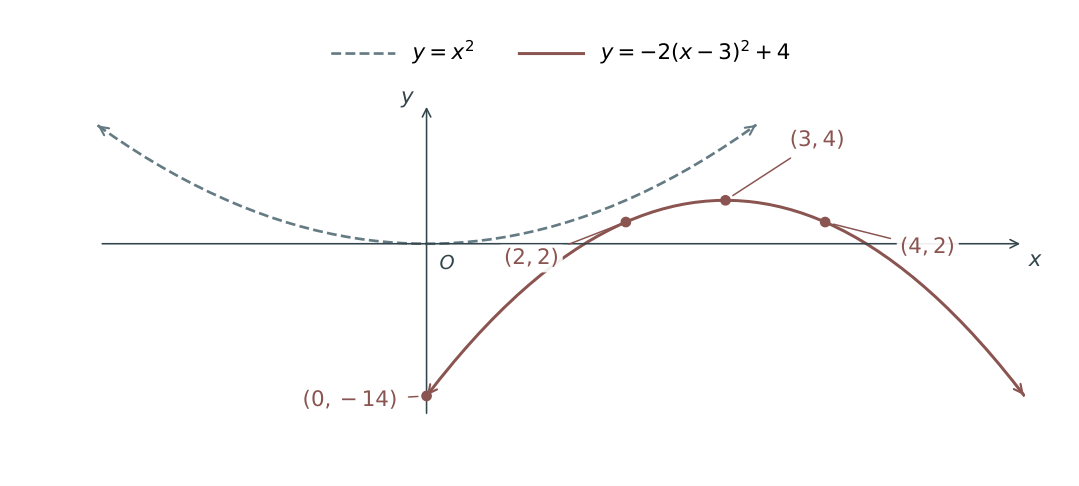
Sketch check. The parabola opens downwards, with maximum value \(4\). Its domain is \(\mathbb R\) and its range is \(y\le4\).
4.6 Why the order matters
Worked example 12: the same two instructions in different orders
Task. Compare “stretch vertically with scale factor \(2\), then move up \(3\)” with “move up \(3\), then stretch vertically with scale factor \(2\)”.
Solution
Write an equation after each step: \[\begin{aligned}f(x)&\longrightarrow2f(x)\\&\longrightarrow\boxed{2f(x)+3},\\[10pt]f(x)&\longrightarrow f(x)+3\\&\longrightarrow2\bigl(f(x)+3\bigr)\\&\phantom{\longrightarrow}{}=\boxed{2f(x)+6}.\end{aligned}\] For a point \((x,y)\), the final outputs are \(2y+3\) and \(2y+6\), respectively. The graphs are different: the second sequence also doubles the vertical translation.
This is why our method leaves the translation until last within each category. Stretches and reflections in that category can swap order; moving a translation earlier generally requires changing its amount.
4.7 Transforming a graph without knowing a formula
Worked example 13: map the important points
Task. The graph of \(f\) consists of straight segments joining \(A(-3,-1)\), \(B(-1,3)\), \(C(2,1)\) and \(D(4,-2)\) in that order, including its endpoints. Sketch \(g(x)=2f(x-2)-1\) and state its domain and range.
Solution
The new coordinates are \(x'=x+2\) and \(y'=2y-1\): \[\boxed{(x,y)\mapsto(x+2,2y-1)}.\]
| Calculation | Image |
|---|---|
| \((-3+2,\,2(-1)-1)\) | \(A'(-1,-3)\) |
| \((-1+2,\,2(3)-1)\) | \(B'(1,5)\) |
| \((2+2,\,2(1)-1)\) | \(C'(4,1)\) |
| \((4+2,\,2(-2)-1)\) | \(D'(6,-5)\) |
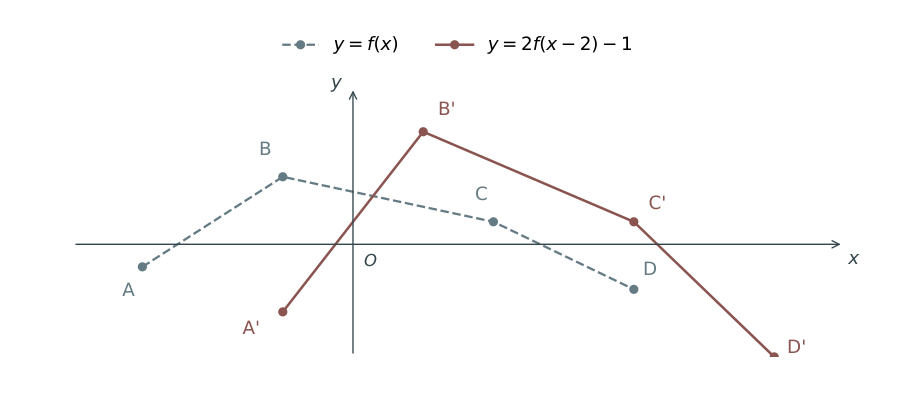
Join the image points in the same order. The original domain \([-3,4]\) becomes \(\boxed{[-1,6]}\); the original range \([-2,3]\) becomes \(\boxed{[-5,5]}\).
HL extension: combined horizontal changes
Course boundary
Transformations of the form \(f(ax+b)\) are not required in the SL syllabus. This section extends the shared 2.11 material for HL students.
SL students are strongly encouraged to learn these transformations too, especially for the mathematical exploration (IA) and mathematical modelling. They help us adapt a known function to fit a new situation.
The rule: factor the input first
For \(y=f(bx+e)\), with \(b\ne0\), factor the input as \[\begin{gathered}bx+e=b(x-c),\\c=-\frac eb.\end{gathered}\] One valid sequence is:
Stretch horizontally with scale factor \(1/|b|\); also reflect across the \(y\)-axis if \(b<0\).
Translate horizontally by \(c\).
Worked example 14: \(f(2x-6)\) and the order of operations
Task. Describe a sequence taking \(y=f(x)\) to \(y=f(2x-6)\). Find the image of \(P=(4,5)\).
Solution
Factor the input: \[2x-6=2(x-3).\] First stretch horizontally with scale factor \(\frac12\).
Then translate \(3\) units to the right: \[\begin{aligned}(x,y)&\mapsto(\tfrac x2,y)\\&\mapsto(\tfrac x2+3,y).\end{aligned}\] Apply this to the given point: \[(4,5)\mapsto(2,5)\mapsto\boxed{(5,5)}.\] Check the input: \[2(5)-6=4,\] which is the original input, so the output remains \(5\).
A second sequence and the same-output check
A second valid sequence is to translate \(6\) units right first, then stretch horizontally with scale factor \(\frac12\): \[\begin{aligned}x&\mapsto x+6\\&\mapsto\frac{x+6}{2}\\&\phantom{\mapsto}{}=\frac x2+3.\end{aligned}\] These sequences produce the same final mapping. Translating right \(3\) before applying the stretch would instead give \(x/2+3/2\).
Worked example 15: horizontal and vertical changes together
Task. The point \(P=(6,-2)\) lies on \(y=f(x)\). Find its image under \[g(x)=-2f(3(x+1))+5\].
Solution
Find the new horizontal coordinate by recovering the original input \(6\): \[\begin{aligned} 3(x+1)&=6,\\ x+1&=2,\\ x&=1. \end{aligned}\] Now transform the original output \(-2\): \[y=-2(-2)+5=9.\] Therefore the image is \(\boxed{P'=(1,9)}\).
One valid sequence is:
Stretch horizontally with SF \(\frac13\).
Translate \(1\) unit left.
Stretch vertically with SF \(2\).
Reflect across the \(x\)-axis.
Translate \(5\) units up.
Quick reference and tutorial library
6.1 The six basic transformations
For each row, \((x,y)\) is a point on the original graph \(y=f(x)\).
| Category | New equation | Point mapping | Description |
|---|---|---|---|
| Vertical | \(y=f(x)+d\) | \((x,y)\mapsto(x,y+d)\) | Translate up \(d\) if \(d>0\); down \(|d|\) if \(d<0\). |
| Vertical | \(y=af(x)\), \(a>0\) | \((x,y)\mapsto(x,ay)\) | Stretch vertically by scale factor \(a\). |
| Vertical | \(y=-f(x)\) | \((x,y)\mapsto(x,-y)\) | Reflect across the \(x\)-axis. |
| Horizontal | \(y=f(x-c)\) | \((x,y)\mapsto(x+c,y)\) | Translate right \(c\) if \(c>0\); left \(|c|\) if \(c<0\). |
| Horizontal | \(y=f(bx)\), \(b>0\) | \((x,y)\mapsto(x/b,y)\) | Stretch horizontally by scale factor \(1/b\). |
| Horizontal | \(y=f(-x)\) | \((x,y)\mapsto(-x,y)\) | Reflect across the \(y\)-axis. |
A reliable sketching method
Identify the changes to the input and to the output.
Map useful points: roots, the \(y\)-intercept, turning points and endpoints.
Transform any asymptotes too: their positions can change.
Draw the same type of curve through the image points. Label the new intercepts, turning points and any asymptotes.
Check the domain and range. After a reflection, put interval endpoints back in increasing order.
Asymptote example. From \(f(x)=1/x\) to \[\begin{aligned}g(x)&=f(x-2)+3\\&=\frac1{x-2}+3\end{aligned}\], translate right \(2\) and up \(3\). The asymptotes \(x=0\) and \(y=0\) become \(x=2\) and \(y=3\). Thus \(x\ne2\) and \(y\ne3\).
6.2 All six tutorials
| Topic | Clickable link |
|---|---|
| Vertical translations (2.1) | youtu.be/CwyEZHlwR0o |
| Vertical stretches (2.2) | youtu.be/dWpioKsecC8 |
| Reflections in both axes (2.3 and 3.3) | youtu.be/wKg2rG1nUjM |
| Horizontal translations (3.1) | youtu.be/v2VH94C_Tco |
| Horizontal stretches (3.2) | youtu.be/5HT7vOHBiVA |
| A sequence for a parabola (4.5) | youtu.be/g38d5EZgWjE |
Practice: basic skills, applications and mixed questions
These questions are suitable for both SL and HL. Work without a calculator. Give exact values and show your method. Use separate paper for sketches and working.
For each equation, state whether the transformation is horizontal or vertical, and describe it fully.
(a) \(y=f(x)-4\) (b) \(y=f(x+5)\) (c) \(y=\frac13f(x)\) (d) \(y=f(4x)\) (e) \(y=-f(x)\) (f) \(y=f(-x)\) The point \(P=(-6,8)\) lies on \(y=f(x)\). Find its image on each graph.
(a) \(y=f(x)+2\) (b) \(y=f(x-3)\) (c) \(y=\frac12f(x)\) (d) \(y=f(\frac{x}{2})\) (e) \(y=-f(x)\) (f) \(y=f(-x)\) Let \(f(x)=x^2-4x+1\). Write each equation as a simplified polynomial.
(a) \(y=f(x)+3\) (b) \(y=f(x+2)\) (c) \(y=2f(x)\) (d) \(y=f(2x)\) (e) \(y=f(-x)\) (f) \(y=-f(x)\) A graph has vertex \(V=(2,-3)\) and passes through \(P=(0,5)\). Find the images of both points under (a) \(y=f(x)-2\); (b) \(y=f(x+4)\); (c) \(y=-2f(x)\).
A student says, “\(y=f(3x)\) stretches the graph horizontally by scale factor \(3\).” Explain the error. If \(f(6)=4\), identify the corresponding point on \(y=f(3x)\).
A graph is stretched vertically by scale factor \(3\) and then translated \(2\) units downwards.
Write the new equation in terms of \(f\).
Write the equation if the two transformations are performed in reverse order.
Explain why the answers differ.
Starting from \(y=f(x)\), write an equation for each sequence.
Reflect across the \(x\)-axis, then translate \(4\) units upwards.
Stretch horizontally by scale factor \(5\), then translate \(2\) units upwards.
Translate \(3\) units left, then stretch vertically by scale factor \(2\).
Let \(f(x)=1/x\). The graph is translated \(4\) units left and \(2\) units down. State the new equation, both asymptotes, the domain and the range.
Mixed questions
Questions 9–11: shared SL and HL
[Maximum mark: 10] Let \(g(x)=-3(x+2)^2+12\).
Describe a sequence of transformations from \(y=x^2\) to \(y=g(x)\). [4]
State the vertex and axis of symmetry. [2]
Find both intercepts with the \(x\)-axis. [2]
Sketch the graph, indicating its intercepts and vertex, and state its range. [2]
[Maximum mark: 9] The graph below consists of the line segments \(AB\), \(BC\) and \(CD\), including their endpoints. Let \(g(x)=-f(x)+1\).
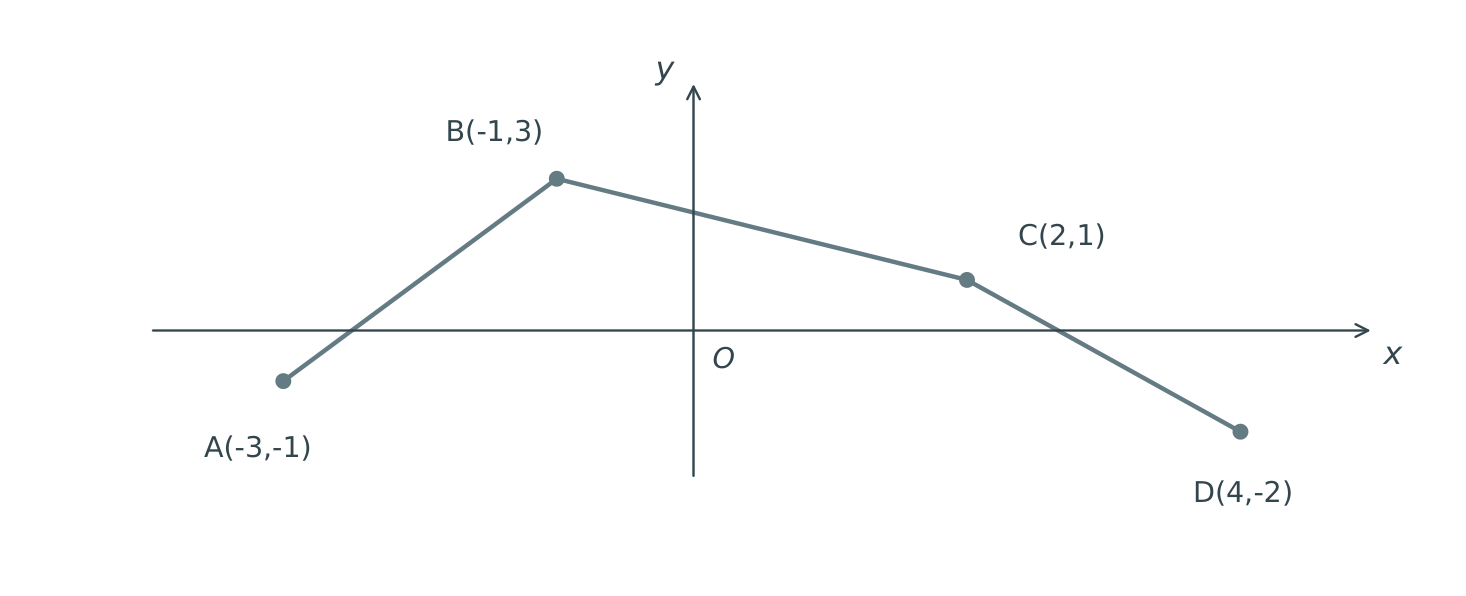
Find the coordinates of \(A'\), \(B'\), \(C'\) and \(D'\) on \(y=g(x)\). [4]
Sketch \(y=g(x)\). [2]
State its domain and range. [2]
Explain why the domain is unchanged. [1]
[Maximum mark: 5] Let \(f(x)=(x-1)^2\). The graph is stretched vertically by scale factor \(a>0\) and then translated vertically by \(k\). Its image has vertex \((1,-6)\) and passes through \((3,10)\). Find \(a\) and \(k\), and hence state the transformed equation. [5]
Question 12: HL extension
[Maximum mark: 10] A function \(f\) has domain \([-4,8]\), range \([-1,5]\), and its graph contains \(P=(2,3)\). Let \(g(x)=-2f(2x-6)+1\).
Describe a sequence of transformations from \(y=f(x)\) to \(y=g(x)\). [4]
Find the image of \(P\). [2]
State the domain and range of \(g\). [4]
Worked answers
1. Describe the transformation
| (a) | Vertical: translate down \(4\) units. |
| (b) | Horizontal: translate left \(5\) units. |
| (c) | Vertical: stretch by scale factor \(\frac13\). |
| (d) | Horizontal: stretch by scale factor \(\frac14\). |
| (e) | Vertical: reflect across the \(x\)-axis. |
| (f) | Horizontal: reflect across the \(y\)-axis. |
2. Images of \(P=(-6,8)\)
| (a) \((-6,8+2)=\boxed{(-6,10)}\) | (b) \((-6+3,8)=\boxed{(-3,8)}\) |
| (c) \((-6,\frac12\cdot8)=\boxed{(-6,4)}\) | (d) \((2(-6),8)=\boxed{(-12,8)}\) |
| (e) \((-6,-8)\) | (f) \((6,8)\) |
3. Substitute before simplifying
\[\begin{gathered}\text{(a)}\quad f(x)+3\\=x^2-4x+1+3\\=\boxed{x^2-4x+4}.\\[12pt]\text{(b)}\quad f(x+2)\\=(x+2)^2-4(x+2)+1\\=x^2+4x+4\\{}-4x-8+1\\=\boxed{x^2-3}.\\[12pt]\text{(c)}\quad2f(x)\\=2(x^2-4x+1)\\=\boxed{2x^2-8x+2}.\\[12pt]\text{(d)}\quad f(2x)\\=(2x)^2-4(2x)+1\\=\boxed{4x^2-8x+1}.\\[12pt]\text{(e)}\quad f(-x)\\=(-x)^2-4(-x)+1\\=\boxed{x^2+4x+1}.\\[12pt]\text{(f)}\quad-f(x)\\=-(x^2-4x+1)\\=\boxed{-x^2+4x-1}.\end{gathered}\]
Answers to questions 4–8
4. Map both points
(a) \(V'=(2,-5)\) and \(P'=(0,3)\).
(b) \(V'=(-2,-3)\) and \(P'=(-4,5)\).
(c) Multiply the outputs by \(-2\): \[\begin{gathered}V^{\prime}=(2,6),\\P^{\prime}=(0,-10).\end{gathered}\]
5. Use the reciprocal scale factor
For \(f(3x)\), the input must satisfy \(3x=6\), so \(x=2\). The corresponding point is \((2,4)\). All \(x\)-coordinates are divided by \(3\): the scale factor is \(\frac13\).
6. Equations and order
(a) \(y=3f(x)-2\).
(b) \[\begin{aligned}y&=3\bigl(f(x)-2\bigr)\\&=3f(x)-6.\end{aligned}\] (c) In the reverse order, the stretch also multiplies the downward shift by \(3\).
7. Write the transformed equation
(a) \(y=-f(x)+4\).
(b) \(y=f(x/5)+2\).
(c) \(y=2f(x+3)\).
8. Transform the reciprocal graph
\[\begin{aligned}y&=f(x+4)-2\\&=\frac1{x+4}-2.\end{aligned}\] Vertical asymptote: \(x=-4\).
Horizontal asymptote: \(y=-2\).
Domain: \(\mathbb R\setminus\{-4\}\).
Range: \(\mathbb R\setminus\{-2\}\).
Answers to questions 9–10
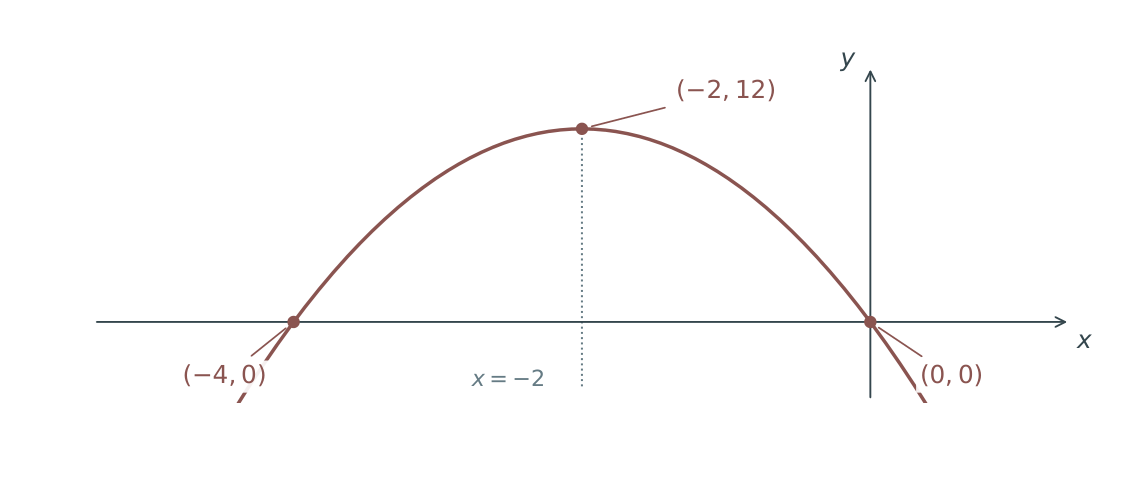
9. The parabola \(g(x)=-3(x+2)^2+12\)
(a) One sequence: translate left \(2\); stretch vertically with scale factor \(3\); reflect across the \(x\)-axis; translate up \(12\).
(b) The vertex \((0,0)\) maps to \(\boxed{(-2,12)}\); axis of symmetry: \(\boxed{x=-2}\).
(c) Set the output equal to zero: \[\begin{gathered}-3(x+2)^2+12=0\\\Rightarrow(x+2)^2=4\\\Rightarrow x+2=\pm2.\end{gathered}\] Thus \(x=-4\) or \(x=0\), giving the intercepts \(\boxed{(-4,0)}\) and \(\boxed{(0,0)}\).
(d) Sketch a downward-opening parabola through these intercepts, symmetric about \(x=-2\), with maximum at \((-2,12)\). Its \(y\)-intercept is also \((0,0)\). Range: \(\boxed{(-\infty,12]}\).
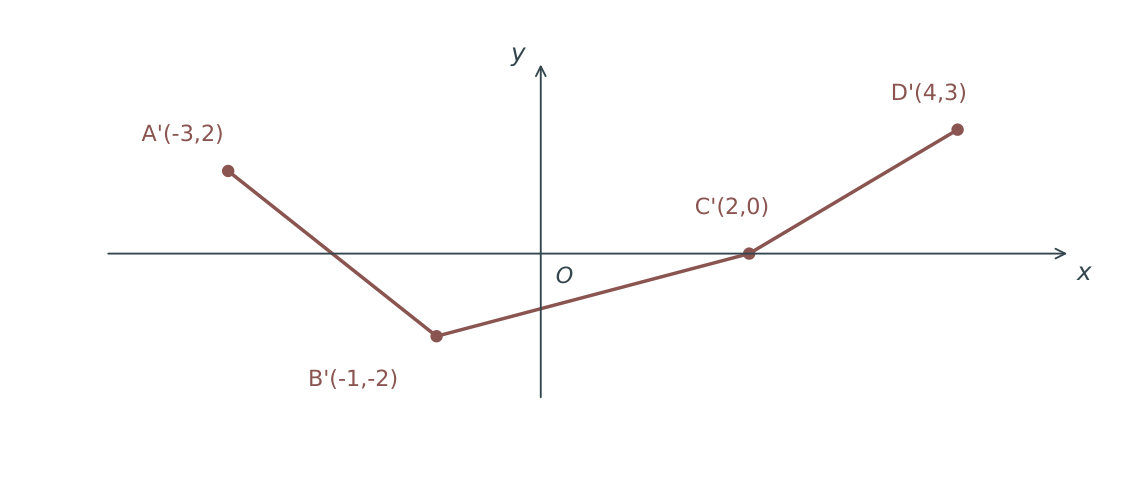
10. A reflected and translated piecewise linear graph
(a) Use \((x,y)\mapsto(x,-y+1)\): \[\boxed{\begin{gathered}A^{\prime}(-3,2),\\B^{\prime}(-1,-2),\\C^{\prime}(2,0),\\D^{\prime}(4,3)\end{gathered}}.\] (b) Join \(A'\) to \(B'\), \(B'\) to \(C'\) and \(C'\) to \(D'\) with straight segments; include both endpoints.
(c) Domain: \(\boxed{[-3,4]}\). Range: \(\boxed{[-2,3]}\). The old largest output \(3\) becomes \(-2\); the old smallest output \(-2\) becomes \(3\).
(d) Both transformations are vertical, so the \(x\)-coordinates and domain stay the same.
Answers to questions 11–12
11. Recover the scale factor and translation
The transformed graph is \(y=a(x-1)^2+k\). Its vertex is \((1,k)\), so \(\boxed{k=-6}\).
Use the fact that the graph passes through \((3,10)\): an input of \(3\) must give an output of \(10\). Substitute into \(y=a(x-1)^2-6\): \[\begin{gathered}10=a(3-1)^2-6\\\Rightarrow16=4a\\\Rightarrow\boxed{a=4}.\end{gathered}\] Hence the equation is \(\boxed{y=4(x-1)^2-6}\).
Check. At \(x=1\), the output is \(-6\), confirming the vertex. At \(x=3\), the output is \(4(2)^2-6=10\), confirming the given point.
12. HL extension: \(g(x)=-2f(2x-6)+1\)
(a) Since \(2x-6=2(x-3)\), one sequence is: horizontal stretch with scale factor \(\frac12\); translation right \(3\); vertical stretch with scale factor \(2\) and reflection across the \(x\)-axis; translation up \(1\).
(b) Solve \(2x'-6=x\) for the new horizontal coordinate, and transform the output: \[(x,y)\mapsto(\tfrac x2+3,-2y+1).\] Thus \(P=(2,3)\) maps to \(\boxed{P'=(4,-5)}\). Check the input: \(2(4)-6=2\). Then \[\begin{aligned}g(4)&=-2f(2)+1\\&=-2(3)+1\\&=-5\end{aligned}\].
(c) For the domain, require \(-4\le2x-6\le8\): \[\begin{gathered}2\le2x\le14\\\Rightarrow\boxed{1\le x\le7}.\end{gathered}\] For the range, let \(y\) be the original output, so \(-1\le y\le5\). The new output is \(y'=-2y+1\). Multiplication by a negative number reverses the inequalities: \[\begin{gathered}2\ge-2y\ge-10\\\Longrightarrow3\ge y^{\prime}\ge-9.\end{gathered}\] Write the new outputs in increasing order: \(\boxed{-9\le y'\le3}\). In interval notation, the domain is \(\boxed{[1,7]}\) and the range is \(\boxed{[-9,3]}\).