IB Mathematics: Analysis and Approaches SL — Topic 2: Functions
Functions, Domain, Range and Inverses
Connect inputs, outputs and graphs — then reverse the relationship.
Learning goal
Read function notation, identify inputs and outputs, determine domain and range, and explain what an inverse does.
Syllabus link
SL 2.2 is common to AA SL and HL. Later-course connections and HL extensions are clearly labelled.
Big idea
A function assigns exactly one output to each allowed input.
Key relationship
\(f(a)=b\Longleftrightarrow f^{-1}(b)=a\), when the inverse exists.
What is a function?
Think of a function as a rule or machine. You choose an allowed input, the rule acts on it, and you obtain exactly one output.

The letter \(f\) names the function. The expression \(f(x)\) is read “\(f\) of \(x\)” and means “the value of \(f\) at input \(x\)”. It does not mean \(f\) multiplied by \(x\).
Worked example 1: reading function notation
Task. Let \(f(x)=3x+2\).
Find \(f(-2)\).
Find \(f(a+1)\).
Solve \(f(x)=17\).
Solution
Replace every \(x\) by the input, using brackets when necessary.
(a) \[\begin{aligned}f(-2)&=3(-2)+2\\&=\boxed{-4}\end{aligned}.\]
(b) \[\begin{aligned}f(a+1)&=3(a+1)+2\\&=\boxed{3a+5}\end{aligned}.\]
(c) The output is given; find the input: \[3x+2=17\quad\Longrightarrow\quad3x=15\quad\Longrightarrow\quad\boxed{x=5}.\] Thus \(f(5)=17\): input \(5\) gives output \(17\).
Different names, the same idea
\(v(t)\) can represent velocity at time \(t\); \(C(n)\) can represent the cost of \(n\) items. The letter inside the brackets names the input variable. For example, \(C(4)=18\) means that four items cost 18 currency units.
Domain, range and the graph
Two sets to distinguish
The domain is the set of allowed input values, usually the \(x\)-values.
The range is the set of output values that the function actually produces, usually the \(y\)-values.
A curve is a collection of input–output pairs
The graph contains every point \((x,f(x))\) for the allowed inputs: \[\boxed{(x,f(x))=(\text{input},\text{corresponding output})}.\]
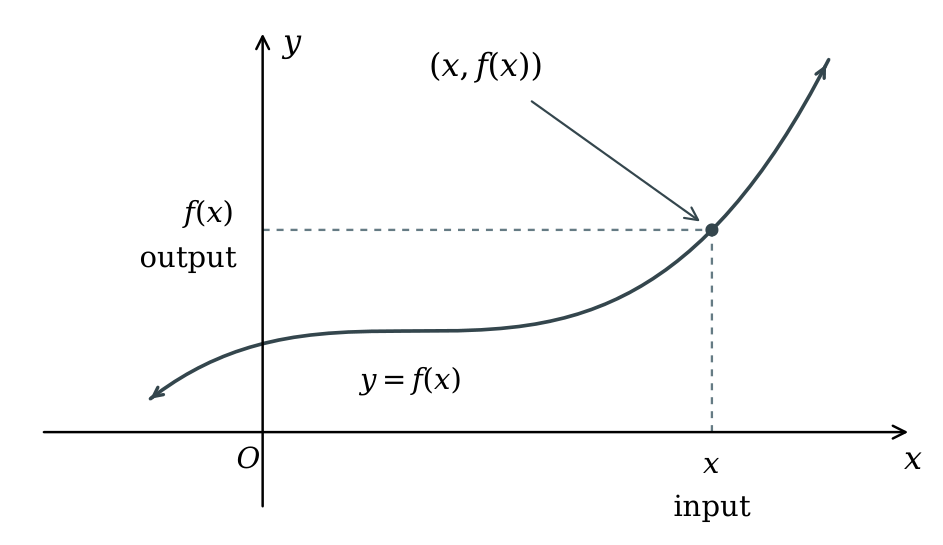
The first coordinate gives the input on the horizontal axis.
The second coordinate gives its matching output on the vertical axis.
A continuous curve collects these pairs over an interval. A discrete function has separate points.
Worked example 2: reading inputs and outputs from a curve
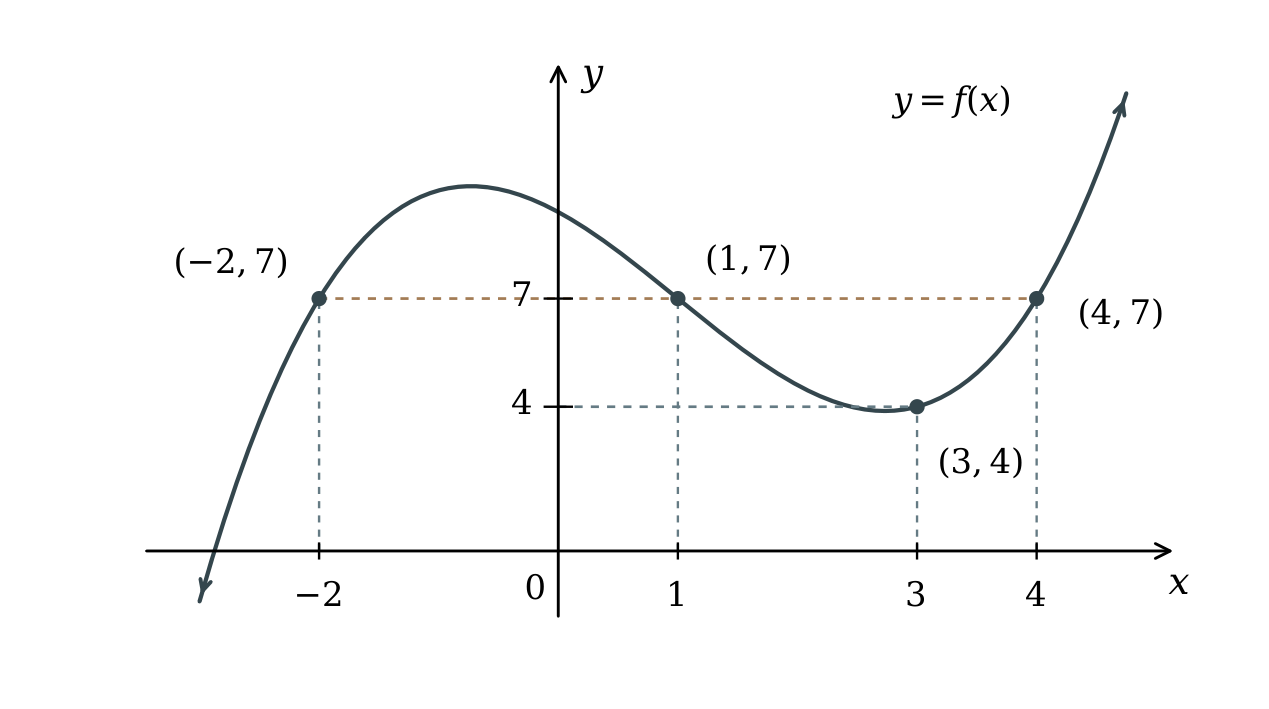
Task. No formula for \(f\) is given. Use the marked points on \(y=f(x)\).
Find \(f(3)\).
Solve \(f(x)=7\).
Solution
(a) From input \(3\), move vertically to \((3,4)\), then across to output \(4\). Thus \(\boxed{f(3)=4}\): the point \((3,4)\) is the pair (input, output).
(b) The line \(y=7\) meets the curve at \((-2,7)\), \((1,7)\) and \((4,7)\). Read the three inputs: \[\boxed{x=-2,\quad x=1\quad\text{or}\quad x=4}.\] Here \(f(-2)=f(1)=f(4)=7\): three different inputs give the same output.
Remember: \(f(3)\) asks for an output (\(y\)); solving \(f(x)=7\) asks for inputs (\(x\)).
Read across for the domain; read up and down for the range. A graph can help you see both, but the visible calculator window may show only part of the graph.
Worked example 3: a restricted graph
Task. Let \(f(x)=(x-1)^2\), with \(-1\leq x\leq3\).
State the domain.
State the range.
Solution
(a) The allowed inputs are stated: \[\boxed{D=[-1,3]}.\] (b) A square cannot be negative. The smallest output is \(f(1)=0\). At the endpoints, \[f(-1)=(-2)^2=4,\qquad f(3)=2^2=4.\] All outputs between \(0\) and \(4\) occur, so \[\boxed{R=[0,4]}.\]
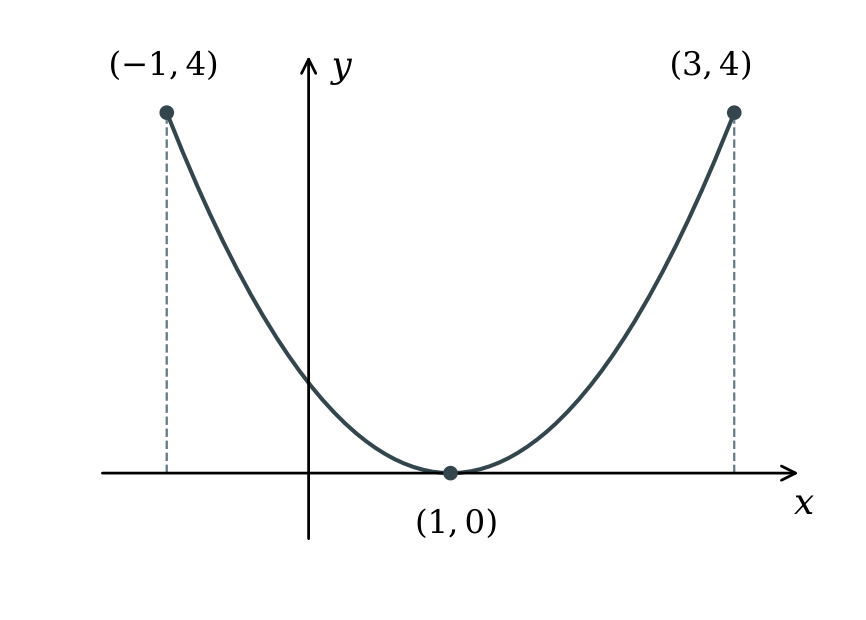
The filled endpoints show that \(x=-1\) and \(x=3\) are included. Checking only the endpoints would miss the minimum at \(x=1\).
Interval notation
| Description | Interval | Meaning |
|---|---|---|
| \(-1\leq x\leq3\) | \([-1,3]\) | Both endpoints included |
| \(-1<x<3\) | \((-1,3)\) | Both endpoints excluded |
| \(x\geq0\) | \([0,\infty)\) | Zero included; no upper bound |
| \(x>0\) | \((0,\infty)\) | Zero excluded; no upper bound |
| \(x\neq0\) | \(\mathbb{R}\setminus\{0\}\) | All real values except zero |
\(\mathbb{R}\) means all real numbers. Use round brackets at \(\pm\infty\): infinity is not an endpoint that can be included. The notation \([a,b[\) also means \([a,b)\).
The domain is part of the function
The rule \(f(x)=x^2\) with domain \(\mathbb{R}\) has range \([0,\infty)\). The same rule with domain \([2,5]\) has range \([4,25]\). Always use the domain given in the question.
Finding the allowed inputs
If no domain is stated, use the largest real domain for which the expression is defined. If a context or a stated interval restricts the inputs further, apply that restriction too.
Three checks to remember
| Expression | Requirement for real inputs |
|---|---|
| A fraction | Denominator \(\neq0\) |
| A square root | Expression inside the root \(\geq0\) |
| A logarithm | Expression inside the logarithm \(>0\) |
Worked example 4: a square root
Task. Let \(g(x)=\sqrt{5-2x}\).
Find the domain.
Find the range.
Solution
(a) The expression inside a real square root must be non-negative: \[5-2x\geq0\quad\Longrightarrow\quad -2x\geq-5\quad\Longrightarrow\quad x\leq\frac52.\] The inequality reverses when we divide by \(-2\). Thus \(\boxed{D=(-\infty,\frac52]}\).
(b) A square root is non-negative, and \(g(\frac52)=0\). As \(x\) becomes more negative, \(5-2x\) grows without bound. Every non-negative output occurs, so \(\boxed{R=[0,\infty)}\).
Worked example 5: combining restrictions
Task. Find the largest real domain of \(h(x)=\dfrac{\sqrt{x+2}}{x-1}\).
Solution
Both conditions must hold at the same time: \[\underbrace{x+2\geq0}_{\text{square root defined}}\ \Longrightarrow\ x\geq-2, \qquad\underbrace{x-1\neq0}_{\text{denominator nonzero}}\ \Longrightarrow\ x\neq1.\] Therefore \(\boxed{D=[-2,1)\cup(1,\infty)}\). The symbol \(\cup\) joins the two allowed intervals. The input \(-2\) is allowed because it gives \(0/(-3)=0\); input \(1\) is not allowed.
Worked example 6: a logarithm (later-course connection)
Task. Find the largest real domain of \(p(x)=\ln(4-x)\).
Solution
The logarithm’s argument must be strictly positive: \[4-x>0\quad\Longrightarrow\quad x<4.\qquad\boxed{D=(-\infty,4)}.\] Zero is allowed inside a square root, but not inside a real logarithm.
Functions as mathematical models
A mathematical model uses a function to describe a relationship in a real situation. Identify the input, the output, their units, and the inputs that make sense.
Worked example 7: a discrete cost model
Task. A school trip costs a fixed booking fee of € 24 plus € 6 per student. There can be at most 30 students. Let \(C(n)\) be the total cost for \(n\) students, including a booking with no students yet registered.
Write a model for \(C(n)\).
State its domain.
State its range.
Find \(C(12)\) and interpret your answer.
Find the number of students when the total cost is € 126.
Solution
(a) Fixed cost \(+\) cost per student \(\times\) number of students gives \[\boxed{C(n)=24+6n}.\] (b) Students are counted in whole numbers, and the capacity is 30: \(D=\{0,1,2,\ldots,30\}\).
(c) \(R=\{24,30,36,\ldots,204\}\). These are separate costs, not every value in \([24,204]\).
(d) \(C(12)=24+6(12)=96\). The total cost for 12 students is € 96.
(e) Set the cost equal to 126 and solve: \[24+6n=126\quad\Longrightarrow\quad6n=102\quad\Longrightarrow\quad\boxed{n=17}.\] Seventeen students is an allowed input, so this solution makes sense.
Discrete or continuous?
A discrete input takes separate values, such as a number of students. Its graph consists of separate points.
A continuous input can take every real value in an interval, such as time during a journey. A continuous graph is appropriate when the model produces continuously varying outputs.
Worked example 8: a continuous model
Task. A tank contains 80 litres and drains at a constant rate of 4 litres per minute.
Write a volume model \(V(t)\), where \(t\) is the time in minutes.
Give a sensible domain while the tank drains.
Give the corresponding range.
Solution
(a) After \(t\) minutes, \(4t\) litres have left, so \(\boxed{V(t)=80-4t}\) litres.
(b) The tank is empty when \[80-4t=0\quad\Longrightarrow\quad t=20.\] Hence \(\boxed{0\leq t\leq20}\) minutes; negative time is excluded.
(c) The volume decreases from 80 litres to 0 litres, so \(\boxed{0\leq V(t)\leq80}\) litres.
Inverse functions: undoing the rule
An inverse function reverses the input-output relationship. If \(f\) takes \(a\) to \(b\), its inverse takes \(b\) back to \(a\): \[\boxed{f(a)=b\quad\Longleftrightarrow\quad f^{-1}(b)=a}.\]
A three-step method for finding an inverse
First write the original function as \(y=f(x)\).
Swap \(x\) and \(y\). The inputs and outputs exchange roles.
Rearrange to make \(y\) the subject.
Define the inverse function in terms of \(x\): replace \(y\) by \(f^{-1}(x)\).
The original function must be one-to-one on its domain.
Worked example 9: finding an inverse step by step
Task. Let \(f(x)=2x+1\), for \(x\in\mathbb{R}\).
Find \(f^{-1}(x)\).
Find \(f^{-1}(7)\).
Solution
(a) Write the original equation: \(y=2x+1\).
Step 1: swap \(x\) and \(y\).\(x=2y+1\).
Step 2: make \(y\) the subject.\[\begin{aligned}x-1&=2y\\y&=\frac{x-1}{2}\end{aligned}.\]
Step 3: define the inverse.\(\displaystyle\boxed{f^{-1}(x)=\frac{x-1}{2}}\).
The inverse subtracts 1, then divides by 2: it undoes the original operations in reverse order.
(b) \(\displaystyle f^{-1}(7)=\frac{7-1}{2}=\boxed{3}\).
Check: \(f(3)=2(3)+1=7\), so the inverse correctly takes 7 back to 3.
Inverse does not mean reciprocal
\(f^{-1}(x)\) means the inverse function. It does not mean \(\dfrac{1}{f(x)}\). For the example above, \(f^{-1}(7)=3\), whereas \(\dfrac1{f(7)}=\dfrac1{15}\).
The domain and range swap when we take an inverse
If \(f\) has an inverse function on its range, then \[\boxed{D_{f^{-1}}=R_f}\qquad\text{and}\qquad\boxed{R_{f^{-1}}=D_f}.\] Domain of the inverse = range of the original function.
Range of the inverse = domain of the original function.
Why? Every output of \(f\) becomes an input of \(f^{-1}\), and every input of \(f\) becomes an output of \(f^{-1}\). Here \(D_f=R_f=\mathbb{R}\), so both sets for the inverse are also \(\mathbb{R}\).
Sketching an inverse from a given graph
Every point \((a,b)\) on \(y=f(x)\) becomes \((b,a)\) on \(y=f^{-1}(x)\). This reflects the whole graph in the line \(y=x\), not in either coordinate axis.
Worked example 10: build the inverse sketch in three stages
Task. Step 1 shows the complete graph of a one-to-one function \(f\), with three labelled points and included endpoints. No formula for \(f\) is given.
Sketch \(y=f^{-1}(x)\).
State the domain of \(f^{-1}\).
State the range of \(f^{-1}\).
Solution
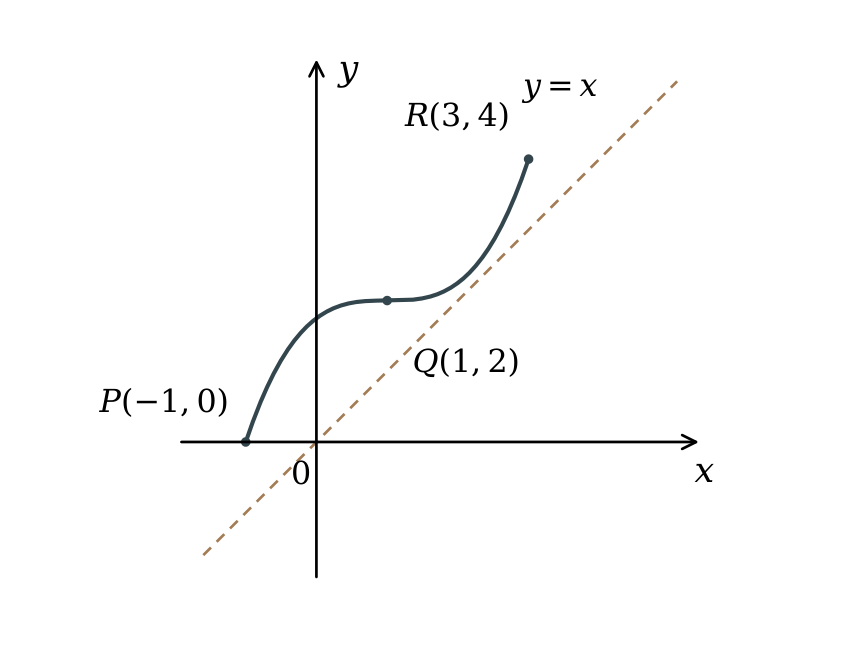
(a) Step 1: draw the mirror line.
Copy the given graph and draw the dashed line \(y=x\). Use the same scale on both axes so that this is a \(45^\circ\) line.
The given points are \(P(-1,0)\), \(Q(1,2)\) and \(R(3,4)\). The graph increases from \(P\) to \(R\), so \[D_f=[-1,3],\qquad R_f=[0,4].\]
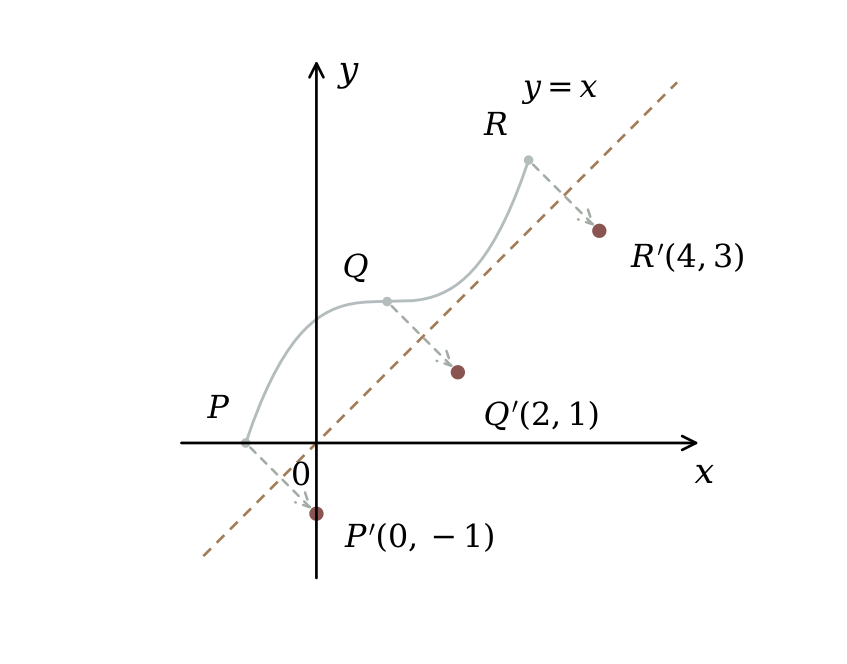
Step 2: swap each point’s coordinates.
Plot the corresponding points on the inverse: \[\begin{aligned} P(-1,0)&\longmapsto P'(0,-1),\\ Q(1,2)&\longmapsto Q'(2,1),\\ R(3,4)&\longmapsto R'(4,3). \end{aligned}\] Each pair of points lies at equal distances on opposite sides of \(y=x\).
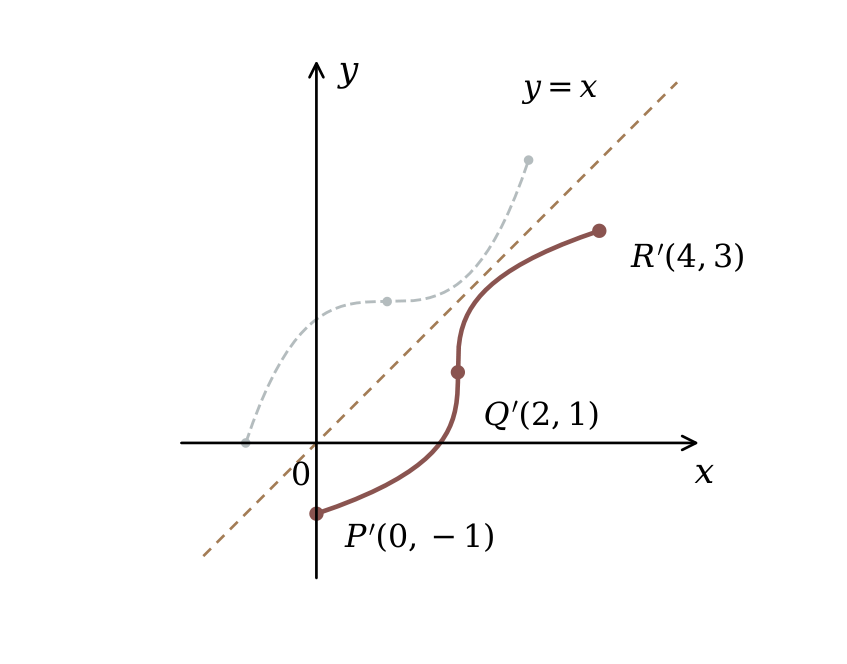
Step 3: reflect the rest of the curve.
Draw a smooth reflection through the new points, keeping the endpoints filled.
The brick-coloured curve is \(y=f^{-1}(x)\); the pale dashed curve is the original.
(b) Use the original range: \[\boxed{D_{f^{-1}}=[0,4]}.\] (c) Use the original domain: \[\boxed{R_{f^{-1}}=[-1,3]}.\]
Does an inverse function exist?
One output per input; one input per output
To be a function, every allowed input must have exactly one output. Different inputs are allowed to share the same output.
To have an inverse function on its range, the function must also be one-to-one: different inputs must produce different outputs.
The vertical line test
A graph represents \(y\) as a function of \(x\) if no vertical line intersects it more than once.
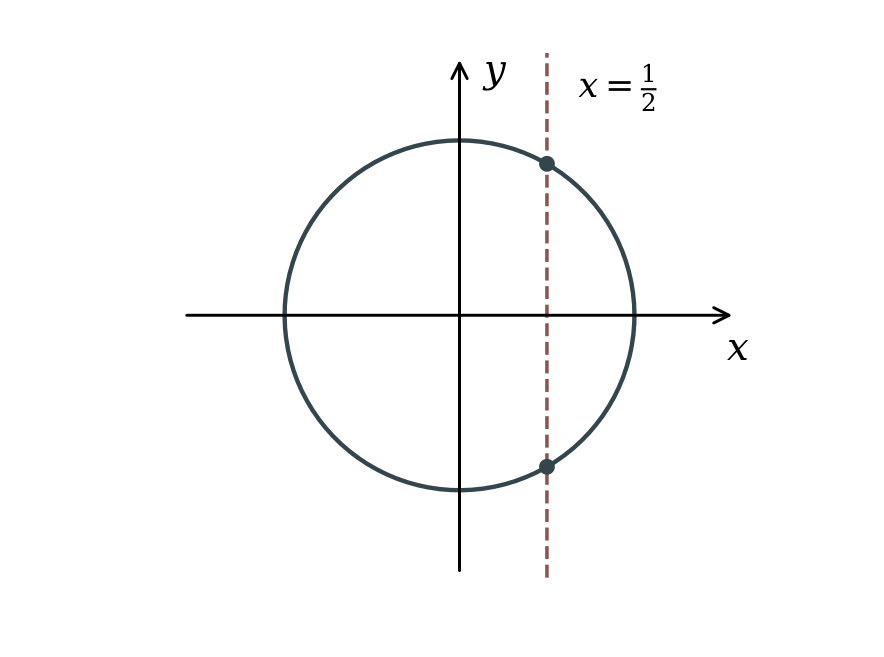
The circle \(x^2+y^2=1\) fails: the input \(x=\frac12\) gives two outputs. The whole circle is not the graph of a function \(y=f(x)\).
The horizontal line test
A function is one-to-one if no horizontal line intersects its graph more than once.
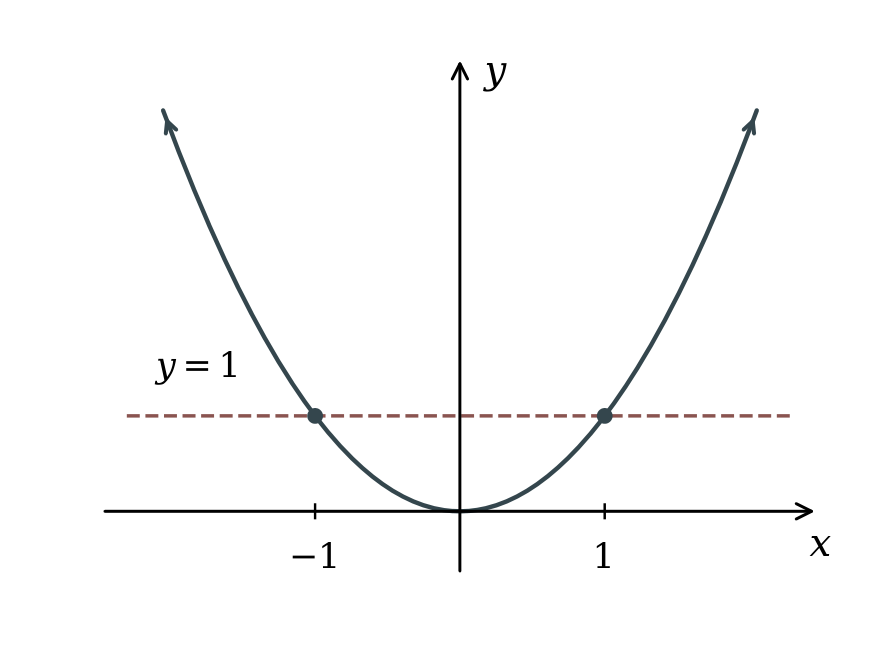
\(y=x^2\) passes the vertical test but fails the horizontal test: \(f(-1)=f(1)=1\). On \(\mathbb{R}\), it has no inverse function.
Worked example 11: deciding from a table
Task. The complete domain of \(f\) is \(\{-2,0,3\}\). The table gives its outputs. \[\begin{array}{c|rrr}x&-2&0&3\\\textbf{HL extension}ine f(x)&5&1&7\end{array}\]
Does an inverse function exist? Explain your answer.
If it exists, find \(f^{-1}(7)\).
State the domain of \(f^{-1}\).
State the range of \(f^{-1}\).
Solution
(a) Yes. The outputs \(5,1,7\) are all different, so \(f\) is one-to-one.
(b) Since \(f(3)=7\), we have \(\boxed{f^{-1}(7)=3}\).
(c) The original outputs become inputs: \(\boxed{D_{f^{-1}}=\{1,5,7\}}\).
(d) The original inputs become outputs: \(\boxed{R_{f^{-1}}=\{-2,0,3\}}\).
Why restricting the domain can help
If we keep only \(x\geq0\) for \(f(x)=x^2\), each output comes from just one input, and the inverse is \(\sqrt{x}\). The idea explains the square-root graph; systematic inverse problems with domain restrictions are an HL extension (AHL 2.14).
Parent functions: know these graphs by heart
A parent function is a simple reference function from which a family of related graphs can be built. Learn its graph, domain, range, key points and asymptotes. The following graphs are a reference for use throughout the course, not a list confined to section 2.2.
Linear: \(y=x\)
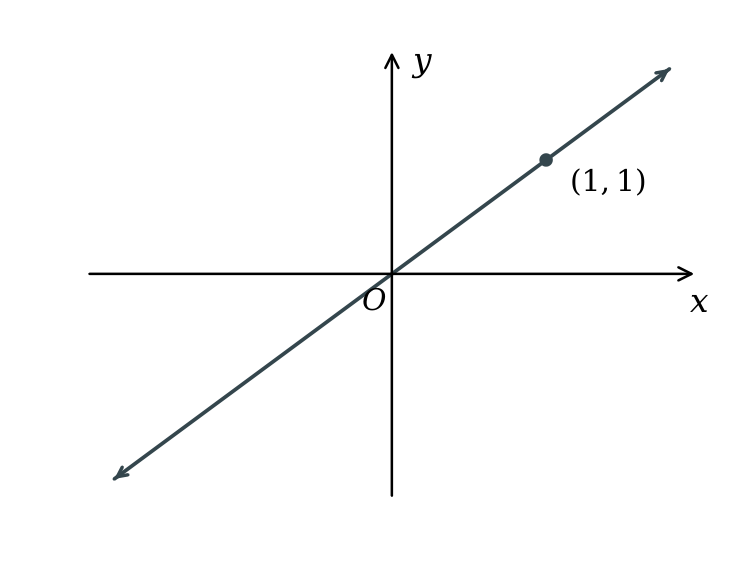
Domain: \(\mathbb{R}\) Range: \(\mathbb{R}\)
Key points: \((0,0)\) and \((1,1)\).
Gradient \(1\); increasing for all \(x\). No maximum, minimum or asymptote. One-to-one; its own inverse.
Quadratic: \(y=x^2\)
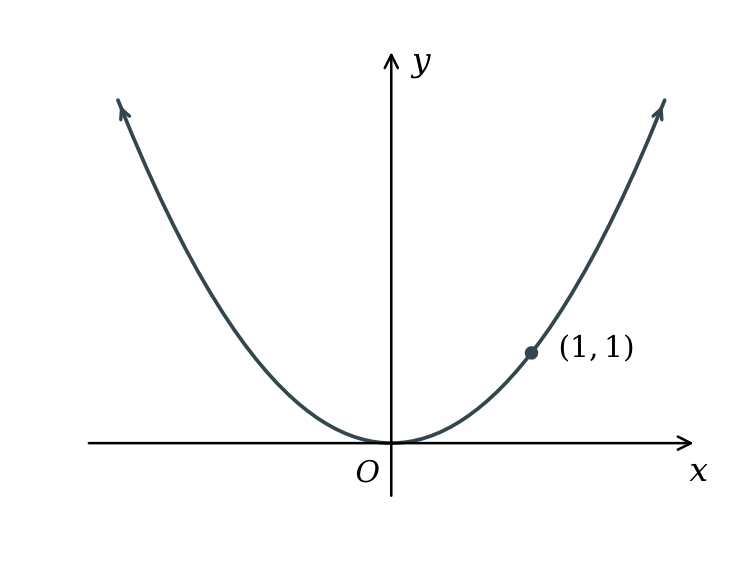
Domain: \(\mathbb{R}\) Range: \([0,\infty)\)
Key points: \((0,0)\), \((\pm1,1)\).
Minimum at \((0,0)\); symmetry about the \(y\)-axis. Decreasing for \(x\leq0\), increasing for \(x\geq0\). Not one-to-one on \(\mathbb{R}\).
Cubic: \(y=x^3\)
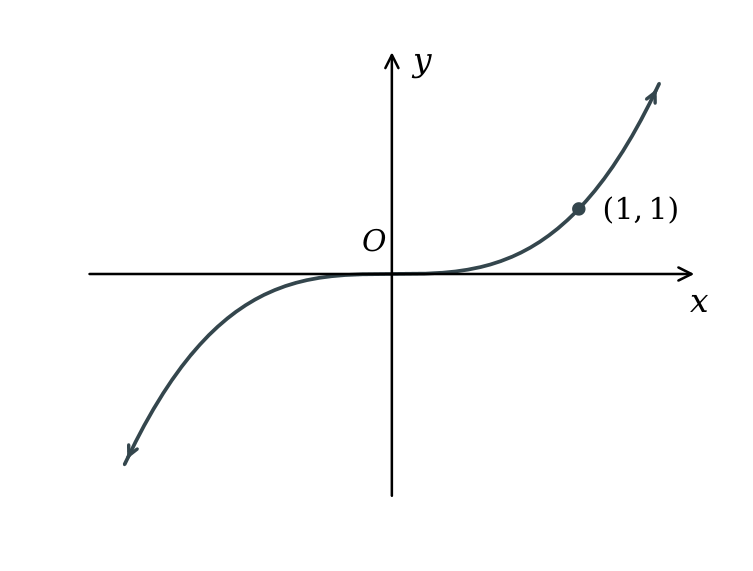
Domain: \(\mathbb{R}\) Range: \(\mathbb{R}\)
Key points: \((0,0)\), \((1,1)\), \((-1,-1)\).
Increasing throughout; horizontal point of inflexion at the origin, not a maximum or minimum. Half-turn symmetry about the origin. One-to-one.
Square root: \(y=\sqrt{x}\)
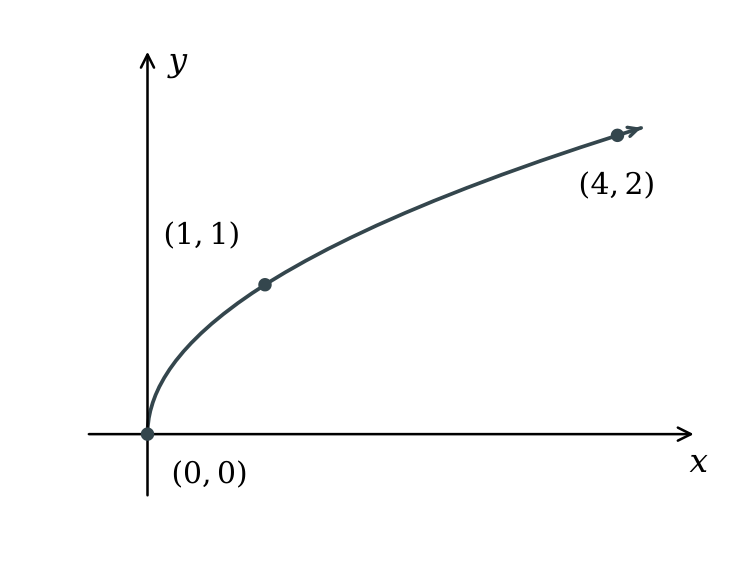
Domain: \([0,\infty)\)
Range: \([0,\infty)\)
Key points: \((0,0)\), \((1,1)\), \((4,2)\).
Starts at the origin and increases. No negative inputs or outputs. Inverse of \(y=x^2\) restricted to \(x\geq0\).
Course note. These basic graphs are useful at both levels. General polynomial graph analysis is developed further at HL (AHL 2.12); recognising \(x^3\) is not an HL-only skill.
Parent functions: reciprocals, powers and logs
Reciprocal: \(y=\dfrac1x\)
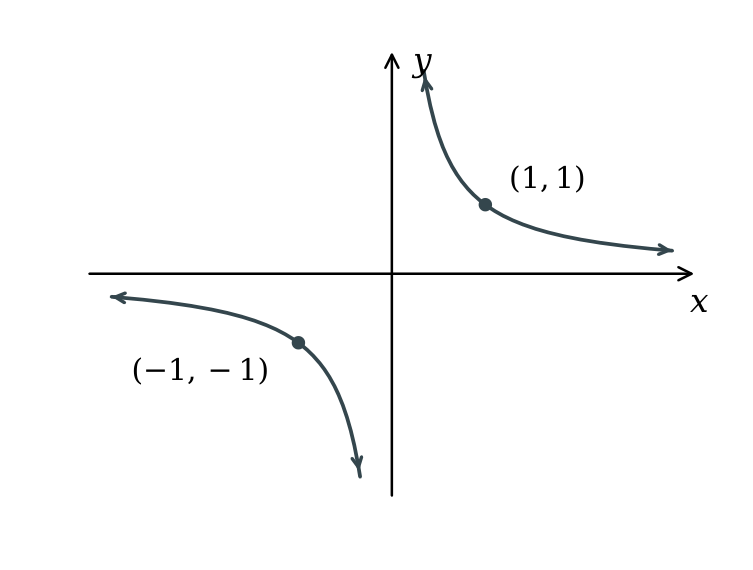
Domain and range: \(\mathbb{R}\setminus\{0\}\)
Asymptotes: \(x=0\) and \(y=0\).
No axis intercepts. Decreasing on each interval \((-\infty,0)\) and \((0,\infty)\). Half-turn symmetry about the origin. One-to-one; its own inverse.
Modulus: \(y=|x|\) HL extension
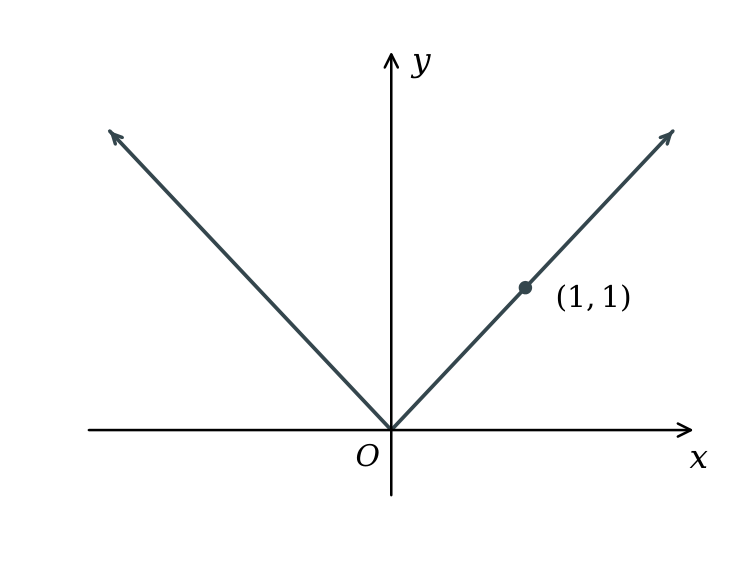
Domain: \(\mathbb{R}\) Range: \([0,\infty)\)
\(\displaystyle |x|=\begin{cases}x&x\geq0,\\-x&x<0.\end{cases}\)
V-shape; corner and minimum at \((0,0)\); symmetry about the \(y\)-axis. Not one-to-one on \(\mathbb{R}\). Modulus graphs are developed in AHL 2.16.
Exponential: \(y=b^x\)
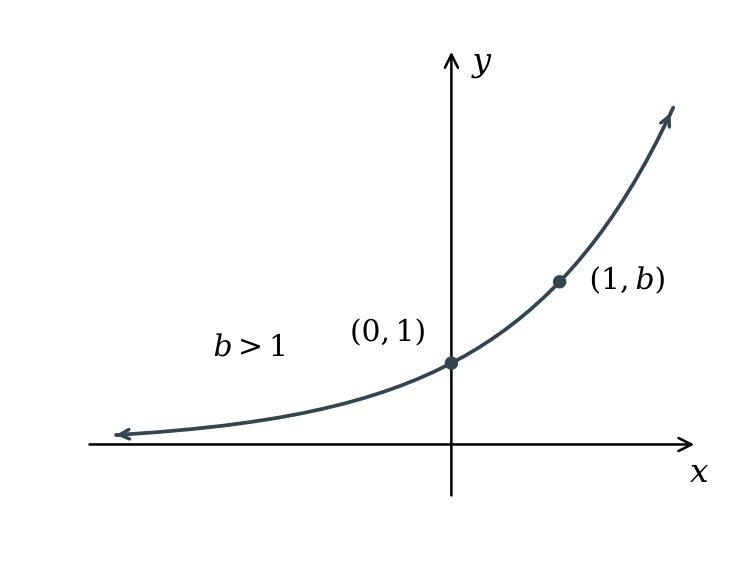
Base: \(b>0\), \(b\neq1\).
Domain: \(\mathbb{R}\) Range: \((0,\infty)\)
Asymptote: \(y=0\).
Passes through \((0,1)\) and \((1,b)\); no \(x\)-intercept. Increasing if \(b>1\) (shown), decreasing if \(0<b<1\). Always one-to-one.
Logarithmic: \(y=\log_bx\)
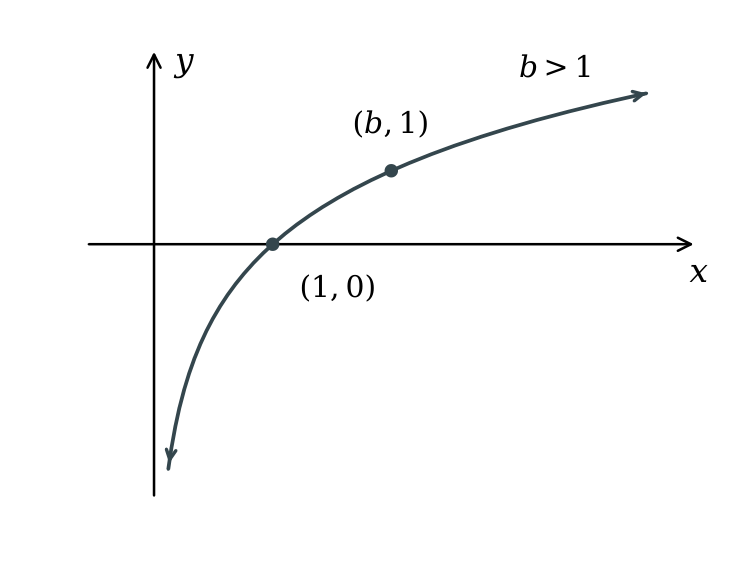
Base: \(b>0\), \(b\neq1\).
Domain: \((0,\infty)\) Range: \(\mathbb{R}\)
Asymptote: \(x=0\).
Passes through \((1,0)\) and \((b,1)\); no \(y\)-intercept. Increasing if \(b>1\) (shown), decreasing if \(0<b<1\). Inverse of \(b^x\).
Asymptotes and the special base \(e\)
An asymptote describes a line approached by a branch of a graph. For these parent functions, the stated asymptotes are not reached. With base \(e\), write \(e^x\) and \(\ln x\); they are inverse functions.
Parent functions: circular functions (SL and HL)
Angles on these graphs are in radians. A period is the horizontal distance over which the pattern repeats. In the formulas below, \(k\in\mathbb{Z}\) means any integer.
Sine: \(y=\sin x\)
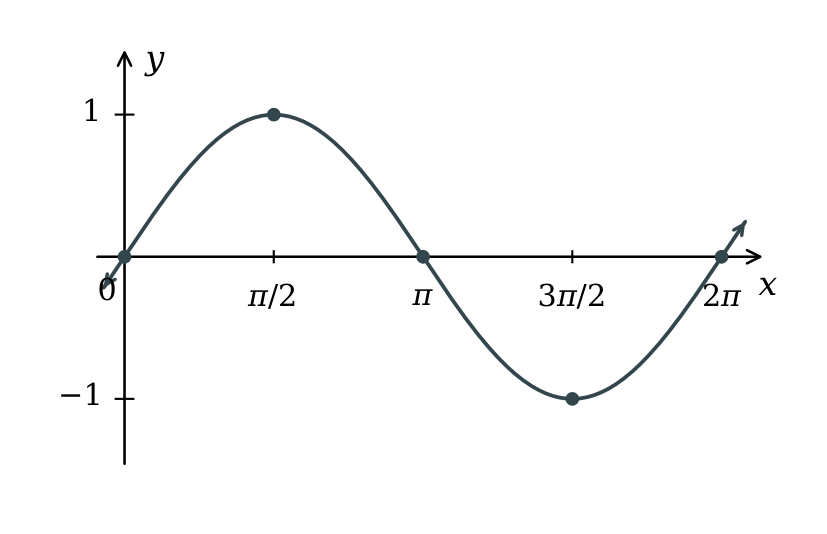
Domain: \(\mathbb{R}\) Range: \([-1,1]\)
Period: \(2\pi\) Amplitude: \(1\)
Zeros: \(x=k\pi\).
Maxima: \((\frac\pi2+2k\pi,1)\).
Minima: \((\frac{3\pi}2+2k\pi,-1)\).
Passes through \((0,0)\); half-turn symmetry about the origin. No asymptotes. Not one-to-one on \(\mathbb{R}\).
Cosine: \(y=\cos x\)
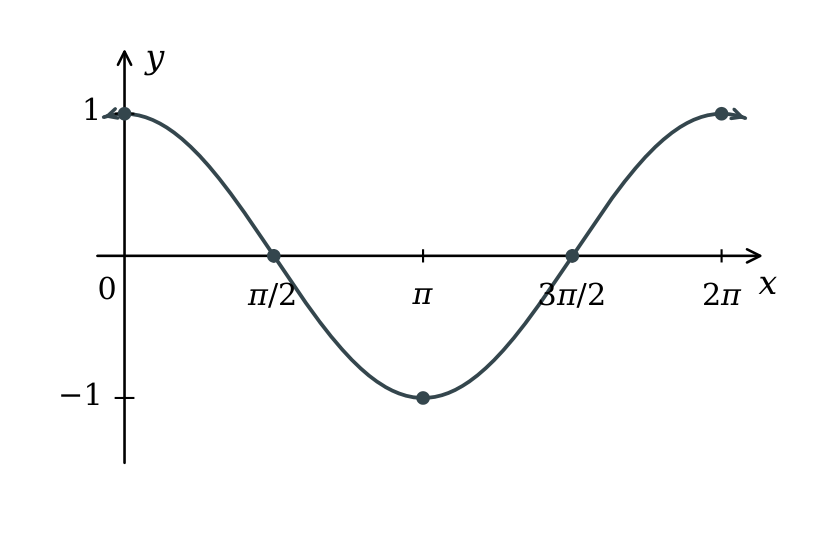
Domain: \(\mathbb{R}\) Range: \([-1,1]\)
Period: \(2\pi\) Amplitude: \(1\)
Zeros: \(x=\frac\pi2+k\pi\).
Maxima: \((2k\pi,1)\).
Minima: \((\pi+2k\pi,-1)\).
Passes through \((0,1)\); symmetry about the \(y\)-axis. No asymptotes. Not one-to-one on \(\mathbb{R}\).
Tangent: \(y=\tan x\)
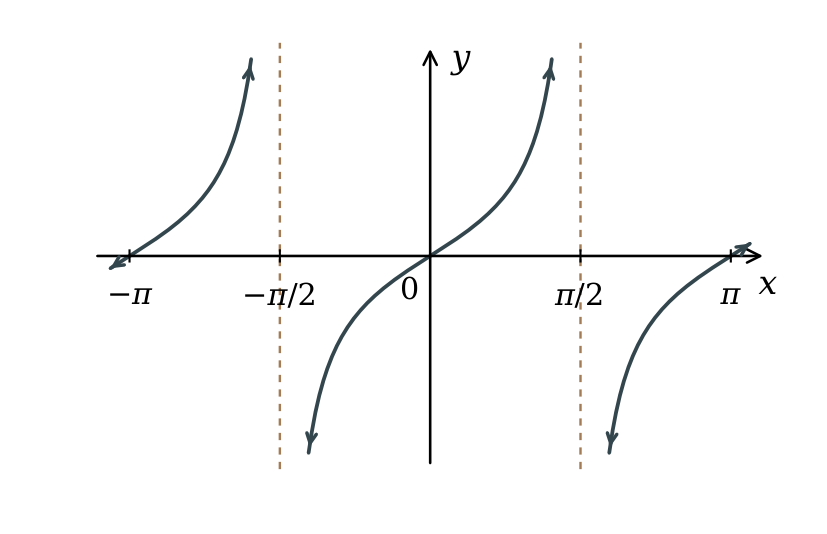
Domain: \(\mathbb{R}\setminus\{\frac\pi2+k\pi:k\in\mathbb{Z}\}\)
Range: \(\mathbb{R}\) Period: \(\pi\)
Zeros: \(x=k\pi\).
Vertical asymptotes: \(x=\frac\pi2+k\pi\).
Increasing on each branch; passes through \((0,0)\) and \((\frac\pi4,1)\). No maximum or minimum. Not one-to-one on its full domain.
Tangent is defined only where cosine is nonzero
Since \(\tan x=\dfrac{\sin x}{\cos x}\), inputs with \(\cos x=0\) are excluded. The dashed vertical lines mark asymptotes, not parts of the graph.
Parent functions: inverse circular functions (HL only)
HL extensionAHL 3.9. To obtain each inverse, first restrict the original circular function to a one-to-one branch. The restricted domain becomes the inverse’s range. All angles are in radians.
Inverse sine: \(y=\arcsin x\)
Also written \(\arcsin x=\sin^{-1}x\).
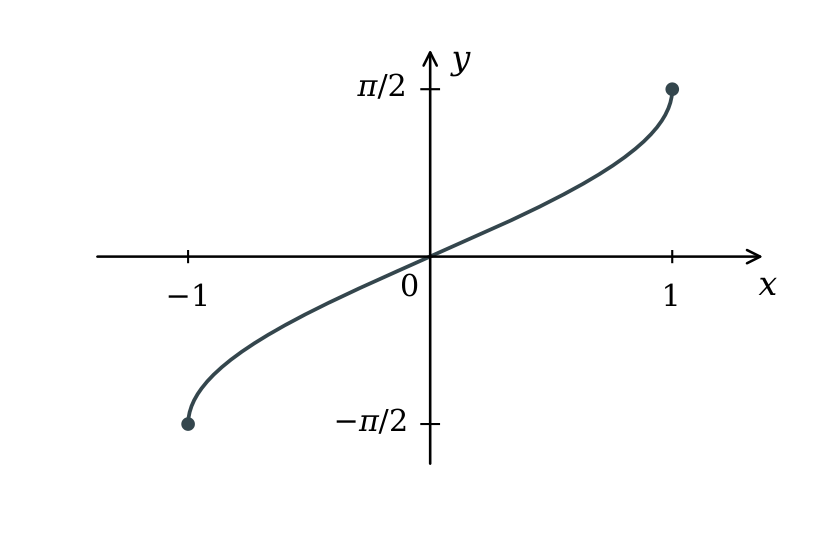
Domain: \([-1,1]\)
Range: \([-\frac\pi2,\frac\pi2]\)
Key points: \((-1,-\frac\pi2)\), \((0,0)\), \((1,\frac\pi2)\).
Increasing; endpoints included; no asymptotes.
Original branch: \(\sin x\) with
\(-\frac\pi2\leq x\leq\frac\pi2\).
Inverse cosine: \(y=\arccos x\)
Also written \(\arccos x=\cos^{-1}x\).
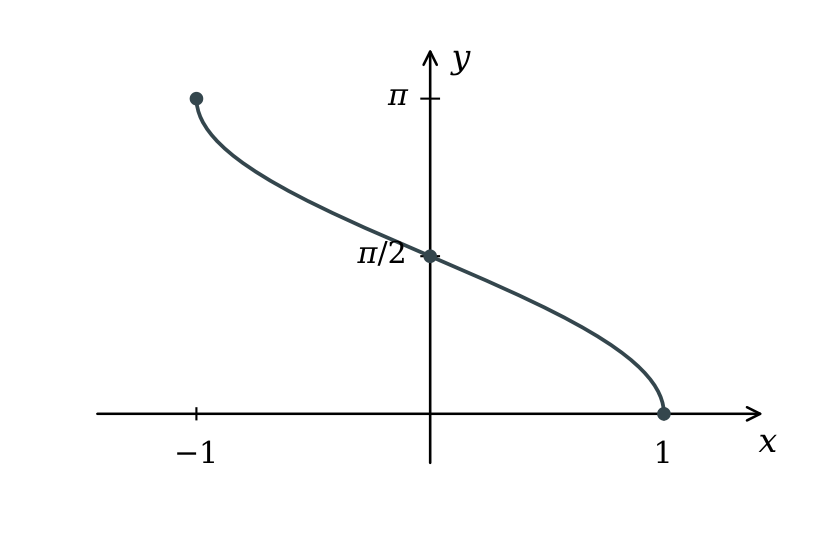
Domain: \([-1,1]\)
Range: \([0,\pi]\)
Key points: \((-1,\pi)\), \((0,\frac\pi2)\), \((1,0)\).
Decreasing; endpoints included; no asymptotes.
Original branch: \(\cos x\) with
\(0\leq x\leq\pi\).
Inverse tangent: \(y=\arctan x\)
Also written \(\arctan x=\tan^{-1}x\).
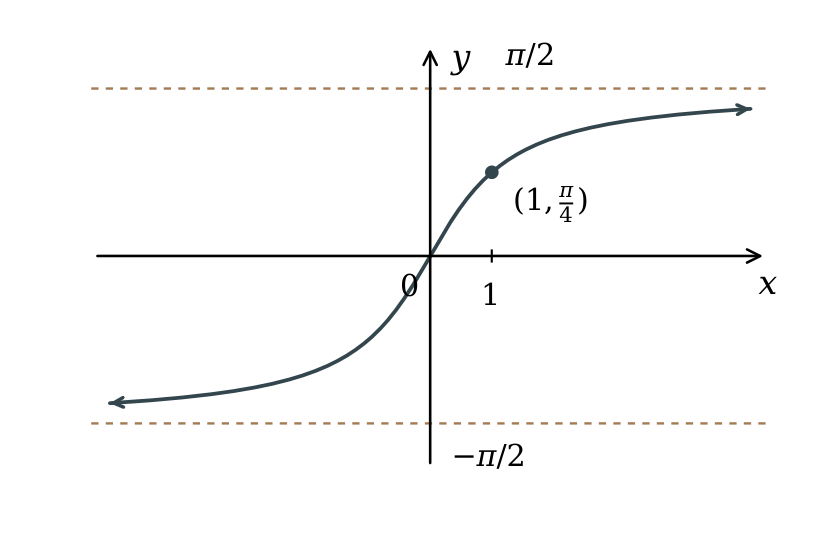
Domain: \(\mathbb{R}\)
Range: \((-\frac\pi2,\frac\pi2)\)
Horizontal asymptotes: \(y=\pm\frac\pi2\).
Increasing; passes through \((0,0)\) and \((1,\frac\pi4)\); never reaches \(\pm\frac\pi2\).
Original branch: \(\tan x\) with
\(-\frac\pi2<x<\frac\pi2\).
Inverse trig notation
\(\sin^{-1}x\) means \(\arcsin x\), not \(1/\sin x\). Finding an angle using inverse trig on a calculator is used at SL too; the systematic study of these three graphs, domains and ranges is HL content.
Use the parent functions to reason
This section links directly to AA SL/HL section 2.11: transformations of graphs. You may move back and forth between the two sections: use the parent functions here to recognise the starting graph, and section 2.11 to understand how a transformation changes it.
A vertical translation shifts the range by the same amount
For \(g(x)=f(x)+k\), every point moves from \((x,y)\) to \((x,y+k)\). The inputs stay the same, while every output increases by \(k\). \[\boxed{D_g=D_f}\qquad\boxed{R_g=\{y+k:y\in R_f\}}.\] In words: keep the domain and add \(k\) to every value in the range. For an interval, shift its finite endpoints by \(k\) and keep them included or excluded as before. A negative \(k\) translates the graph downwards.
Worked example 12: translate an exponential graph upwards
Task. Let \(g(x)=2^x+3\).
State the domain.
State the range.
State the horizontal asymptote.
Solution
Start with the parent function \(f(x)=2^x\). Its domain is \(\mathbb{R}\), its range is \((0,\infty)\) and its horizontal asymptote is \(y=0\).
(a) Adding 3 translates the graph vertically upwards by 3 units (section 2.11). The inputs are unchanged, so \(\boxed{D_g=\mathbb{R}}\).
(b) Every output increases by 3, so \[(0,\infty)\ \xrightarrow{\text{add }3}\ \boxed{R_g=(3,\infty)}.\]
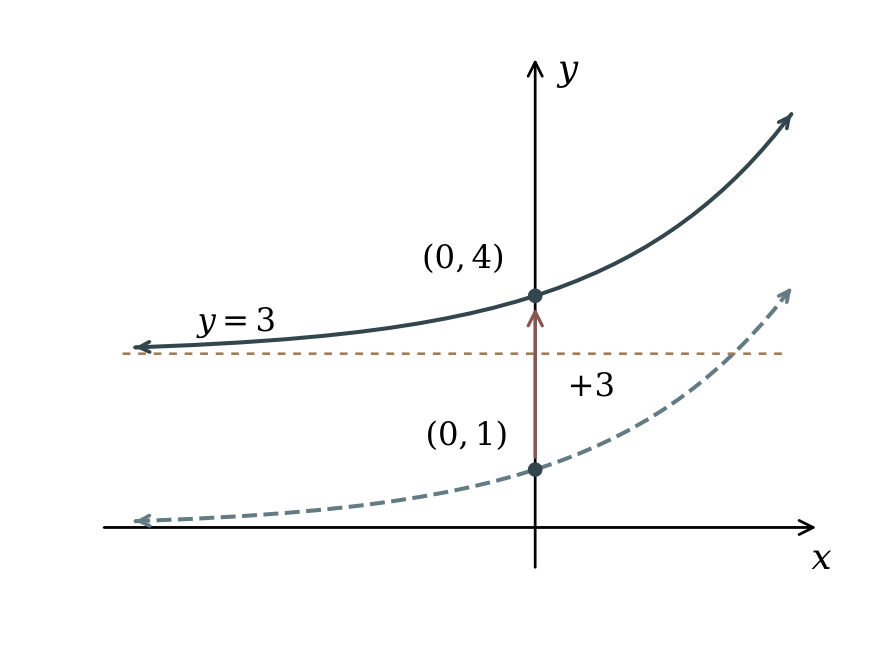
Dashed curve: \(y=2^x\).
Solid curve: \(y=2^x+3\).
For example, \((0,1)\) moves to \((0,4)\).
(c) The horizontal asymptote also moves up by 3 units: \[y=0\ \longmapsto\ \boxed{y=3}.\] The domain is unchanged because the input \(x\) has not changed.
Check the range algebraically: \(2^x>0\), so \(2^x+3>3\). The output 3 is approached but never reached, and there is no upper bound. Therefore the lower endpoint remains excluded.
Translate the outputs, not the inputs
In \(f(x)+3\), the \(+3\) is outside the function: it moves the graph upwards. The different expression \(f(x+3)\) changes the input and gives a horizontal translation. See section 2.11 for that distinction.
Translation, range and an inverse (HL extension)
The next example combines the vertical translations of section 2.11 with domain and range from this section, then uses the inverse method. Domain restriction in inverse problems is developed further in AHL 2.14.
Worked example 13: a translated, restricted function and its inverse
Task. Let \(f(x)=x^2+1\) for \(0\leq x\leq2\).
Find the range of \(f\).
Find the inverse rule \(f^{-1}(x)\).
State the domain of \(f^{-1}\).
State the range of \(f^{-1}\).
Solution
(a) Find the range by translating.
Start with \(y=x^2\) on the same restricted domain \([0,2]\). Its range is \([0,4]\).
Adding 1 translates the graph upwards by 1 unit. Therefore every output increases by 1: \[[0,4]\ \xrightarrow{\text{add }1}\ \boxed{R_f=[1,5]}.\] The domain stays \([0,2]\). Both endpoints of the range are still included.
![The dashed y = x squared and solid y = x squared + 1 on 0 ≤ x ≤ 2; the range changes from [0, 4] to [1, 5].](/assets/img/functions-domain-range-inverses/quadratic-translation.png)
Dashed: \(y=x^2\).
Solid: \(y=x^2+1\).
(b) Find the inverse. Write \(y=x^2+1\).
Step 1: swap \(x\) and \(y\).\(x=y^2+1\).
Step 2: make \(y\) the subject.\(y^2=x-1\), so \(y=\pm\sqrt{x-1}\).
The inverse must return an original input in \([0,2]\). Its outputs must therefore be non-negative, so choose \(y=\sqrt{x-1}\).
Step 3: define the inverse.\(\displaystyle\boxed{f^{-1}(x)=\sqrt{x-1}}\).
(c) The inverse’s domain is \(\boxed{D_{f^{-1}}=R_f=[1,5]}\).
(d) The inverse’s range is \(\boxed{R_{f^{-1}}=D_f=[0,2]}\). For example, \(f(2)=5\) and \(f^{-1}(5)=\sqrt4=2\).
HL vocabulary: even and odd functions (AHL 2.14)
For a domain symmetric about zero, an even function satisfies \(f(-x)=f(x)\) and has symmetry about the \(y\)-axis: for example \(x^2\), \(|x|\), \(\cos x\).
An odd function satisfies \(f(-x)=-f(x)\) and has half-turn symmetry about the origin: for example \(x\), \(x^3\), \(1/x\), \(\sin x\), \(\tan x\).
Know the graphs by heart: cover the reference graphs and sketch each relevant parent function. Then add its domain, range, key points and asymptotes before checking your work.
Practice: functions, models and inverses
Work on separate paper. Give exact answers and a short reason where requested.
Let \(f(x)=2x^2-3\). Find \(f(-2)\), \(f(a+1)\) and all inputs for which \(f(x)=15\).
Each relation has complete domain \(\{1,2,3\}\). Decide whether it is a function and, if it is, whether it is one-to-one.
(a) \(\{(1,4),(2,4),(3,7)\}\) (b) \[\left\{\begin{gathered}(1,4),(1,5),\\(2,6),(3,7)\end{gathered}\right\}.\]
State the largest real domain of each function.
(a) \(\displaystyle f(x)=\frac1{x+4}\) (b) \(g(x)=\sqrt{3-x}\)
(c) \(\displaystyle h(x)=\frac{\sqrt{x+1}}{x-2}\) (d) \(p(x)=\ln(2x+6)\).
Find the range of \(f(x)=x^2\) when its domain is:
(a) \(\mathbb{R}\); (b) \([-2,3]\); (c) \((1,4]\).
Find the domain and range of \(g(x)=\sqrt{x+4}-2\). Explain whether \(-2\) belongs to the range.
A club charges a fixed fee of € 18 plus € 5 per session. A member can attend 0 to 12 sessions.
(a) Write a function \(C(n)\) for the total cost.
(b) State its domain and range.
(c) Find \(C(7)\) and interpret the answer.
(d) A member pays € 63. How many sessions does this represent?
A tank contains 72 litres and drains at 3 litres per minute. Write a volume function \(V(t)\) and give a sensible domain and range while it drains.
Let \(f(x)=4x-7\), for \(x\in\mathbb{R}\).
(a) Explain the two steps needed to undo \(f\).
(b) Find \(f^{-1}(9)\) and \(f^{-1}(x)\).
(c) State the domain and range of the inverse.
A one-to-one function \(g\) has domain \([-2,5]\), range \([1,8]\) and \(g(3)=7\). State:
(a) \(g^{-1}(7)\); (b) the domain and range of \(g^{-1}\);
(c) the point on \(y=g^{-1}(x)\) corresponding to \((3,7)\) on \(y=g(x)\).
Practice: parent functions and HL extensions
Without a calculator, sketch each graph. State the domain and range, and label its intercepts and any asymptotes.
(a) \(y=x^3\); (b) \(y=1/x\); (c) \(y=\sqrt{x}\); (d) \(y=2^x\); (e) \(y=\log_2x\).
For \(y=\sin x\), \(y=\cos x\) and \(y=\tan x\):
(a) state the domain, range and period;
(b) state the zeros in \([0,2\pi]\);
(c) sketch the graphs on \([0,2\pi]\), marking all vertical asymptotes where relevant.
State the domain and range of each function. For parts (a) and (b), also give the horizontal asymptote.
(a) \(p(x)=3^x-2\) (b) \(q(x)=4-2^x\) (c) \(r(x)=\sin x+2\).
Explain why \(f(x)=x^2\), for \(x\in\mathbb{R}\), is a function but does not have an inverse function on its range. Refer to both the vertical and horizontal line tests.
HL-only practice
Sketch \(y=|x|\). State its domain, range and minimum. Explain why it is even but not one-to-one on \(\mathbb{R}\).
For \(\arcsin x\), \(\arccos x\) and \(\arctan x\), state each domain and range. Then find exactly:
(a) \(\arcsin(-\frac12)\); (b) \(\arccos(-\frac12)\); (c) \(\arctan(-1)\).
Let \(f(x)=x^2+3\) for \(-2\leq x\leq0\).
(a) State its range and explain why it is one-to-one on this domain.
(b) Find \(f^{-1}(x)\), stating its domain and range.
(c) Find \(f^{-1}(7)\) and explain why the negative square-root branch is required.
A quick self-check
Can you distinguish an excluded input from an output the graph never reaches? Can you explain why the inverse swaps domain and range? Can you redraw the parent functions without relying on a calculator window?
Answers: functions, models and inverses
1–3. Notation, functions and domains
1. \(f(-2)=2(4)-3=5\).
\[\begin{aligned}f(a+1)&=2(a+1)^2-3\\&=2a^2+4a-1\end{aligned}.\]
\[\begin{aligned}2x^2-3&=15\\x^2&=9\\x&=\boxed{\pm3}\end{aligned}.\]
2. (a) It is a function: every input has exactly one output. It is not one-to-one because inputs 1 and 2 both give 4. (b) It is not a function: input 1 has two different outputs.
3. (a) \(\mathbb{R}\setminus\{-4\}\), because \(x+4\neq0\).
(b) \((-\infty,3]\), because \(3-x\geq0\).
(c) \([-1,2)\cup(2,\infty)\), because \(x+1\geq0\) and \(x-2\neq0\).
(d) \((-3,\infty)\), because \(2x+6>0\).
4–5. Ranges
4. (a) \([0,\infty)\).(b) \([0,9]\): the minimum is \(f(0)=0\) and the maximum is \(f(3)=9\).(c) \((1,16]\): on positive inputs the square increases; 1 is excluded and 16 is included.
5. \(x+4\geq0\Rightarrow D=[-4,\infty)\). Since \(\sqrt{x+4}\geq0\), the range is \([-2,\infty)\). The output \(-2\) is included because \(g(-4)=\sqrt0-2=-2\).
6–7. Mathematical models
6. (a) \(C(n)=18+5n\).
(b) \(D=\{0,1,\ldots,12\}\), \(R=\{18,23,28,\ldots,78\}\).
(c) \(C(7)=18+35=53\): seven sessions cost € 53.
(d) \[\begin{aligned}18+5n&=63\\5n&=45\\n&=9\end{aligned}\] sessions.
7. \(V(t)=72-3t\). Empty when \(72-3t=0\Rightarrow t=24\).
Domain: \([0,24]\) minutes. Range: \([0,72]\) litres.
8–9. Inverses
8. (a) Add 7, then divide by 4.
(b) \(f^{-1}(9)=(9+7)/4=4\), and \(f^{-1}(x)=(x+7)/4\).
(c) Domain and range are both \(\mathbb{R}\).
9. (a) \(g^{-1}(7)=3\).(b) \(D_{g^{-1}}=[1,8]\) and \(R_{g^{-1}}=[-2,5]\).
(c) \((7,3)\): swap the coordinates, reflecting in \(y=x\).
Answers: parent functions and HL extensions
10–11. Sketch checks
10. Compare your sketches with the algebraic, reciprocal, exponential and logarithmic reference graphs in section 7. Open the parent-function reference.
| Function | Domain | Range | Key checks |
|---|---|---|---|
| \(x^3\) | \(\mathbb{R}\) | \(\mathbb{R}\) | Intercept \((0,0)\) |
| \(1/x\) | \(\mathbb{R}\setminus\{0\}\) | \(\mathbb{R}\setminus\{0\}\) | No intercepts; \(x=0\), \(y=0\) asymptotes |
| \(\sqrt{x}\) | \([0,\infty)\) | \([0,\infty)\) | Endpoint \((0,0)\) |
| \(2^x\) | \(\mathbb{R}\) | \((0,\infty)\) | \((0,1)\); asymptote \(y=0\) |
| \(\log_2x\) | \((0,\infty)\) | \(\mathbb{R}\) | \((1,0)\); asymptote \(x=0\) |
11. Sine: \(D=\mathbb{R}\), \(R=[-1,1]\), period \(2\pi\); zeros \(0,\pi,2\pi\).
Cosine: \(D=\mathbb{R}\), \(R=[-1,1]\), period \(2\pi\); zeros \(\frac\pi2,\frac{3\pi}2\).
Tangent: \(D=\mathbb{R}\setminus\{\frac\pi2+k\pi:k\in\mathbb{Z}\}\), \(R=\mathbb{R}\), period \(\pi\); zeros \(0,\pi,2\pi\). In \([0,2\pi]\) its vertical asymptotes are \(x=\frac\pi2,\frac{3\pi}2\). Compare the graphs with the circular-function graphs in section 7; the tangent pattern repeats every \(\pi\).
12–13. Range and invertibility
12. All three domains are \(\mathbb{R}\).
(a) \(3^x>0\Rightarrow p(x)>-2\): range \((-2,\infty)\); asymptote \(y=-2\).
(b) \(2^x>0\Rightarrow q(x)<4\): range \((-\infty,4)\); asymptote \(y=4\).
(c) \[\begin{gathered}-1\leq\sin x\leq1\\\Longrightarrow 1\leq r(x)\leq3\end{gathered}:\] range \([1,3]\).
13. Every vertical line meets the parabola exactly once, so it is a function. A horizontal line such as \(y=1\) meets it twice, at \(x=\pm1\), so it is not one-to-one. Reversing the relation would give two outputs for input 1.
14–16. HL extensions
14. V-shape; \(D=\mathbb{R}\), \(R=[0,\infty)\); minimum \((0,0)\). Since \(|-x|=|x|\), it is even. Inputs \(-1\) and 1 both give 1, so it is not one-to-one.
15. \(\arcsin\): \(D=[-1,1]\), \(R=[-\frac\pi2,\frac\pi2]\).
\(\arccos\): \(D=[-1,1]\), \(R=[0,\pi]\).
\(\arctan\): \(D=\mathbb{R}\), \(R=(-\frac\pi2,\frac\pi2)\).
(a) \(-\frac\pi6\); (b) \(\frac{2\pi}3\); (c) \(-\frac\pi4\). Each angle lies in the required principal range.
16. (a) \(R_f=[3,7]\). The function decreases strictly on \([-2,0]\), so it is one-to-one.
(b) \(y=x^2+3\Rightarrow x^2=y-3\). Since \(x\leq0\), \(x=-\sqrt{y-3}\). Thus \(f^{-1}(x)=-\sqrt{x-3}\), with domain \([3,7]\) and range \([-2,0]\).
(c) \(f^{-1}(7)=-\sqrt4=-2\). The negative branch returns an input in the original domain.