IB Mathematics: Analysis and Approaches SL/HL — Topic 5 Calculus
Kinematics in Calculus
Connect displacement, velocity, acceleration, speed, total distance and signed area in one-dimensional motion.
Learning goal
Connect the motion of a particle with the calculus language of displacement, velocity, acceleration, speed and total distance travelled.
Syllabus link
IB Mathematics AA SL/HL: SL 5.9. Kinematics; displacement \(s\), velocity \(v\), acceleration \(a\), total distance, and the relationships between differentiation and integration.
Big idea
First decide the origin and positive direction. Then \(s(t)\) tells us the particle's signed position relative to the origin; differentiating gives velocity and acceleration, while integrating velocity gives displacement.
Key relationships
\(v(t)=\dfrac{ds}{dt}\), \(a(t)=\dfrac{dv}{dt}=\dfrac{d^2s}{dt^2}\), displacement \(=\int v(t)\,dt\), and total distance \(=\int |v(t)|\,dt\).
What is kinematics?
We begin by setting the scene. Before formulas appear, we need to know what kind of motion is being described and how direction will be recorded.
Motion on a single straight line
Kinematics is the mathematics of motion. It studies how a particle's position, velocity, speed and acceleration change with time.
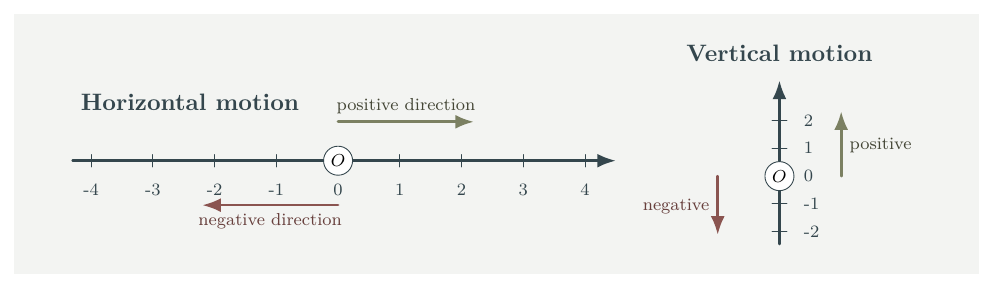
In this lesson we only consider one-dimensional motion. This means the particle moves along one straight line: either horizontally or vertically. Before doing any calculus, we choose:
- an origin, labelled \(O\), from which positions are measured;
- a positive direction. The opposite direction is then negative.
Once this is chosen, displacement means the particle's signed position relative to the origin.
What this lesson will cover
The aim is not only to practise formulas. The aim is to make sure we truly understand each function connected to kinematics: what it represents, how to read its sign and graph, and how it links to the other functions.
- how to choose the origin and positive direction for one-dimensional motion;
- what \(s(t)\), \(v(t)\), \(a(t)\) and \(|v(t)|\) each mean;
- how to read position, direction and turning points from displacement and velocity graphs;
- how differentiation connects \(s(t)\), \(v(t)\) and \(a(t)\);
- how integration connects velocity with displacement and total distance;
- how to use these ideas in worked examples and IB-style questions.
The four core quantities
With the origin and positive direction fixed, we can now name the quantities that will appear throughout the lesson. These four objects are the vocabulary of kinematics.
| Quantity | Meaning | Typical unit |
|---|---|---|
| \(s(t)\) | Displacement, meaning the particle's signed position relative to the origin at time \(t\). It can be positive, negative or zero. | m |
| \(v(t)\) | Velocity, the rate of change of displacement. Its sign tells us the direction of motion. | \(\mathrm{m\,s^{-1}}\) |
| \(a(t)\) | Acceleration, the rate of change of velocity. It tells us whether velocity is increasing or decreasing. | \(\mathrm{m\,s^{-2}}\) |
| \(|v(t)|\) | Speed, the magnitude of velocity. Speed is never negative. | \(\mathrm{m\,s^{-1}}\) |
Language point
In this lesson, displacement and position relative to the origin mean the same thing. So \(s(t)\) tells you where the particle is compared with the origin, using a sign to indicate direction.
Calculus links between the key quantities
Going backwards requires integration:
Example: one particle, four quantities
For one particular particle, the displacement function might be
For this same motion, the other quantities look like
| Quantity | What it tells us for this particle |
|---|---|
| \(s(t)=t^2-4t+3\) | where the particle is relative to the origin at time \(t\) |
| \(v(t)=2t-4\) | how quickly \(s(t)\) is changing, including direction |
| \(a(t)=2\) | the velocity is increasing at a constant rate of \(2\,\mathrm{m\,s^{-2}}\) |
| \(|v(t)|=|2t-4|\) | the speed: the size of the velocity, without its sign |
Reading displacement as position relative to the origin
The first quantity to understand is displacement. Before we connect it to calculus, we pause to make the meaning of \(s(t)\) completely concrete.
Using the displacement function
Assume the motion is horizontal, the origin is \(O\), and the positive direction is to the right. For the particle from the previous section,
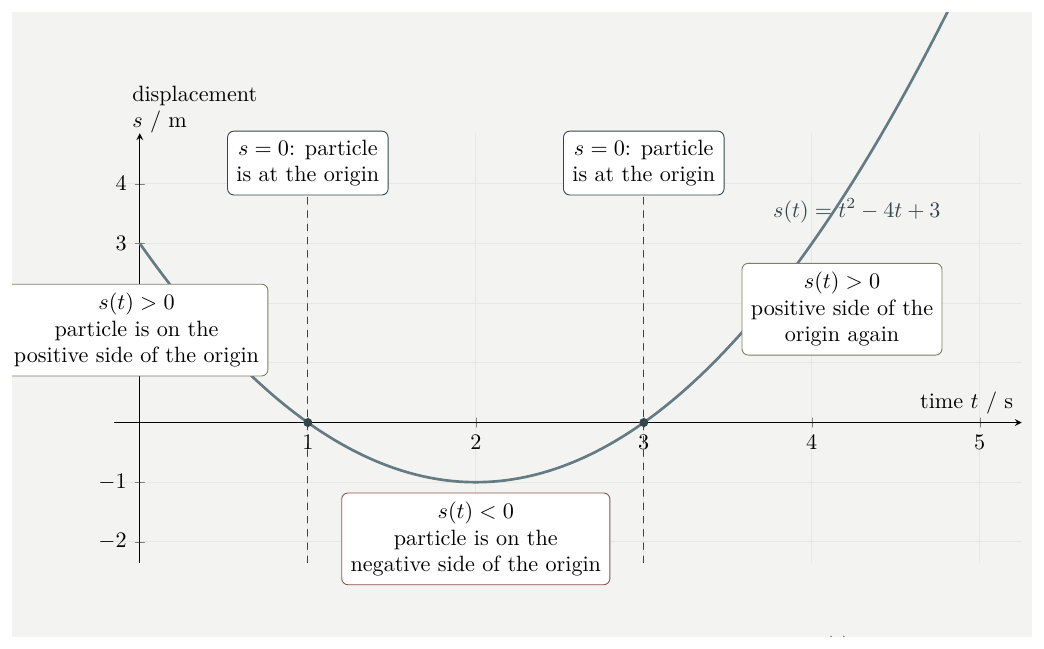
This means that for any time \(t\), the value of \(s(t)\) gives the particle's position relative to the origin. The sign tells us which side of the origin the particle is on.
Reading motion directly from a displacement graph
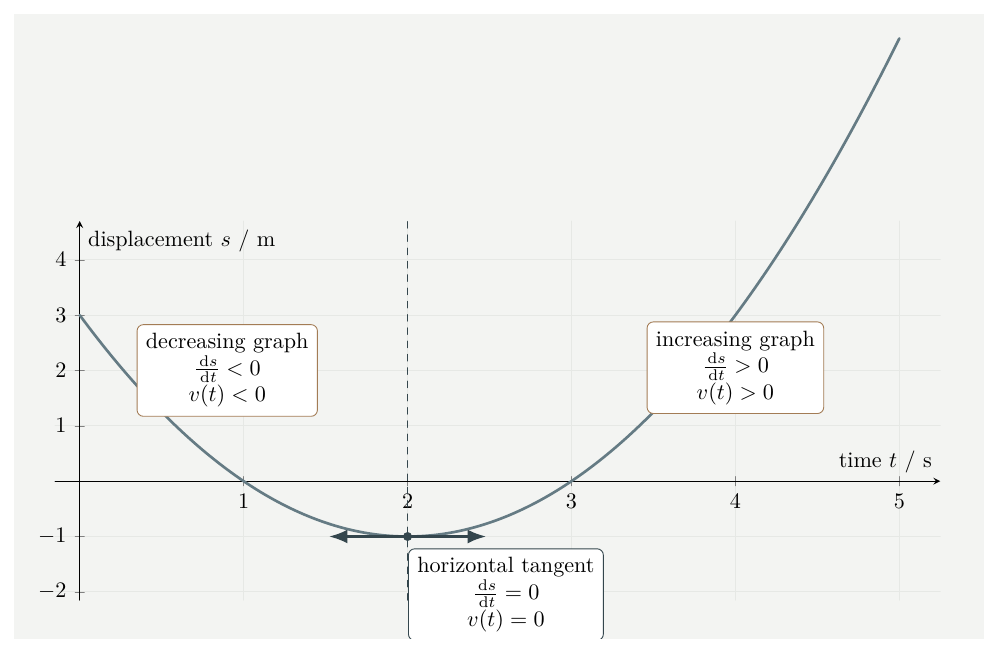
The height of the displacement graph tells us position, but now we focus only on its gradient. Since
a negative gradient means the particle is moving in the negative direction, while a positive gradient means it is moving in the positive direction.
Reading from left to right
- At first the displacement graph is decreasing, so its gradient is negative. Therefore \(\dfrac{ds}{dt}\lt 0\), so \(v(t)\lt 0\): the particle moves in the negative direction.
- At the turning point the graph has a horizontal tangent. Therefore \(\dfrac{ds}{dt}=0\), so \(v(t)=0\): the particle is momentarily at rest.
- After the turning point the graph is increasing, so its gradient is positive. Therefore \(\dfrac{ds}{dt}\gt 0\), so \(v(t)\gt 0\): the particle moves in the positive direction.
- Because the graph changes from decreasing to increasing, the particle changes direction at the turning point.
Worked example: sketching the particle's trajectory
For \(s(t)=t^2-4t+3=(t-1)(t-3)\), \(0\leq t\leq 4\), use the displacement function and the graph to sketch the particle's trajectory along the position axis.
Because \(s(t)=0\) when \(t=1\) and \(t=3\), the particle passes through the origin at these two times. Since the quadratic opens upwards, \(s(t)\gt 0\) outside these roots and \(s(t)\lt 0\) between them.
Reading from the function,
So the particle starts on the positive side, moves left to the origin, continues into the negative side, then turns around and comes back through the origin to the positive side again.
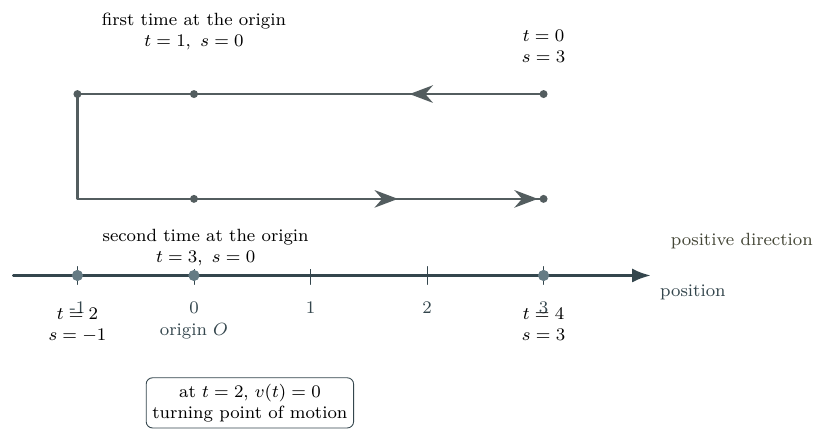
\(s(t)\gt 0\) for \(0\leq t\lt 1\) and \(3\lt t\leq 4\).
\(s(t)\lt 0\) for \(1\lt t\lt 3\).
\(s(t)=0\) when \(t=1\) and \(t=3\).
The worked example above already shows how a displacement graph tells us where the particle is. We now use that idea to make an important distinction: displacement records the final signed change in position, while total distance records the full path travelled.
The velocity function
Velocity is the quantity that tells us the direction of motion. The sign of \(v(t)\) tells us the direction, while the magnitude \(|v(t)|\) tells us speed.
What the velocity function tells us
Reading the sign of \(v(t)\) from a graph
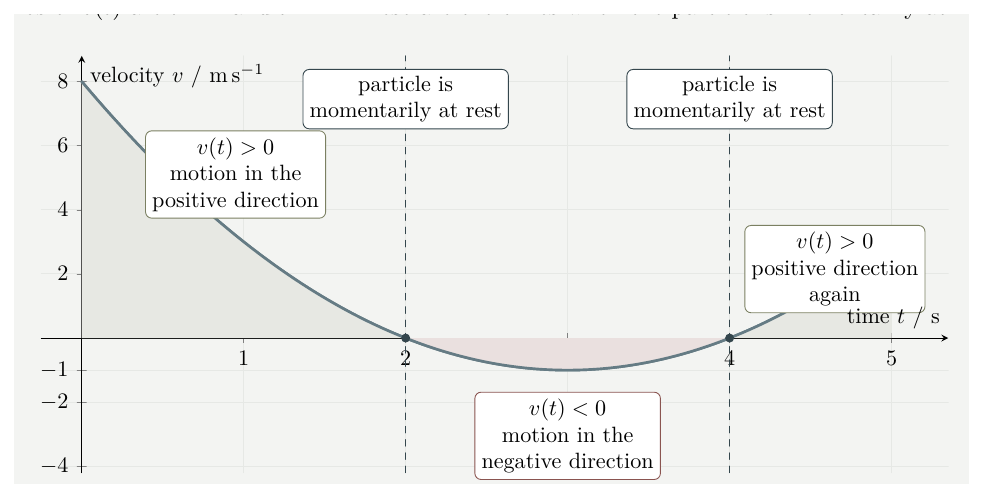
Suppose a particle has velocity
The zeros of \(v(t)\) are \(t=2\) and \(t=4\). These are the times when the particle is momentarily at rest.
Takeaways from this graph
- On intervals where the graph is above the \(t\)-axis, \(v(t)\gt 0\), so the particle moves in the positive direction.
- On intervals where the graph is below the \(t\)-axis, \(v(t)\lt 0\), so the particle moves in the negative direction.
- At \(t=2\) and \(t=4\), the graph crosses the \(t\)-axis, so \(v(t)=0\). Therefore the particle is momentarily at rest at those times.
- At \(t=2\), the sign of \(v(t)\) changes from \(+\) to \(-\), so the particle changes direction from positive motion to negative motion.
- At \(t=4\), the sign of \(v(t)\) changes from \(-\) to \(+\), so the particle changes direction from negative motion to positive motion again.
Reading acceleration from the gradient of a velocity graph
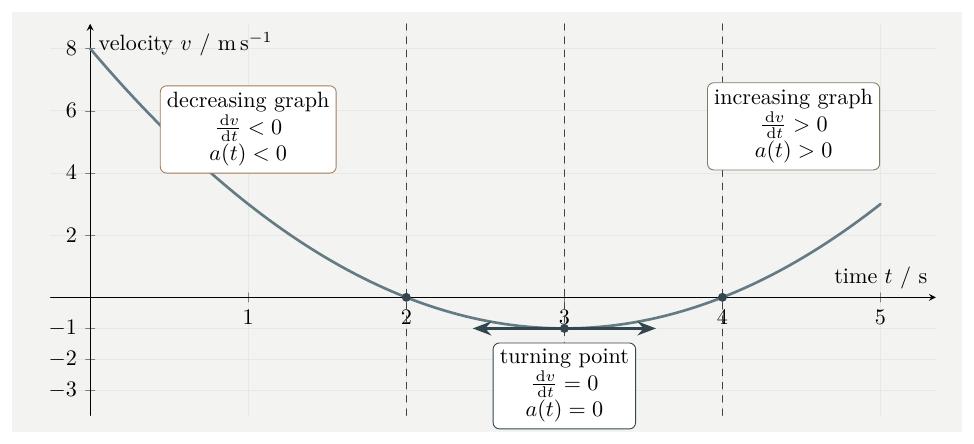
The sign of \(v(t)\) tells us the direction of motion. To understand acceleration, we look at the gradient of the velocity graph. Since \(\dfrac{dv}{dt}=a(t)\), a negative gradient means \(a(t)\lt 0\), a positive gradient means \(a(t)\gt 0\), and a horizontal tangent means \(a(t)=0\).
To decide whether the particle is speeding up or slowing down, compare the signs of \(v(t)\) and \(a(t)\).
| Sign of \(v\) | Sign of \(a\) | Interpretation |
|---|---|---|
| \(+\) | \(+\) | Moving in the positive direction and speeding up. |
| \(+\) | \(-\) | Moving in the positive direction but slowing down. |
| \(-\) | \(+\) | Moving in the negative direction but slowing down. |
| \(-\) | \(-\) | Moving in the negative direction and speeding up. |
In short: when \(v(t)\) and \(a(t)\) have the same sign, the particle is speeding up; when they have opposite signs, the particle is slowing down.
Reading from left to right
- At first the velocity graph is decreasing, so \(\dfrac{dv}{dt}\lt 0\). Therefore \(a(t)\lt 0\): the particle has negative acceleration. Since \(v(t)\gt 0\) here, it is moving in the positive direction but slowing down.
- When the graph first crosses the \(t\)-axis, \(v(t)=0\). The particle is momentarily at rest.
- Between the first zero and the minimum point, the graph is still decreasing, so \(a(t)\lt 0\). Now \(v(t)\lt 0\), so the particle is moving in the negative direction and speeding up in the negative direction.
- At the minimum point, the velocity graph has a horizontal tangent. Therefore \(\dfrac{dv}{dt}=0\), so \(a(t)=0\).
- Beyond the minimum point, the graph is increasing, so \(\dfrac{dv}{dt}\gt 0\). While the graph is still below the axis, \(v(t)\lt 0\), so the particle is moving in the negative direction but slowing down.
- When the graph crosses the \(t\)-axis again, \(v(t)=0\) once more. After that, \(v(t)\gt 0\) and \(a(t)\gt 0\), so the particle moves in the positive direction and speeds up in the positive direction.
Common trap
A particle can have \(s(t)\gt 0\) and still be moving left. The position is positive, but the direction of motion depends on \(v(t)\). Always use the sign of the velocity function to decide direction.
Acceleration: what it tells you and what it does not tell you
Acceleration is often misunderstood. It tells us whether velocity is increasing or decreasing, but it does not by itself tell us whether the particle is speeding up.
Acceleration is about changing velocity
Acceleration tells you whether velocity is increasing or decreasing:
This is not exactly the same as saying the particle is speeding up or slowing down. Speeding up depends on whether \(v(t)\) and \(a(t)\) have the same sign.
Velocity and acceleration on the same motion
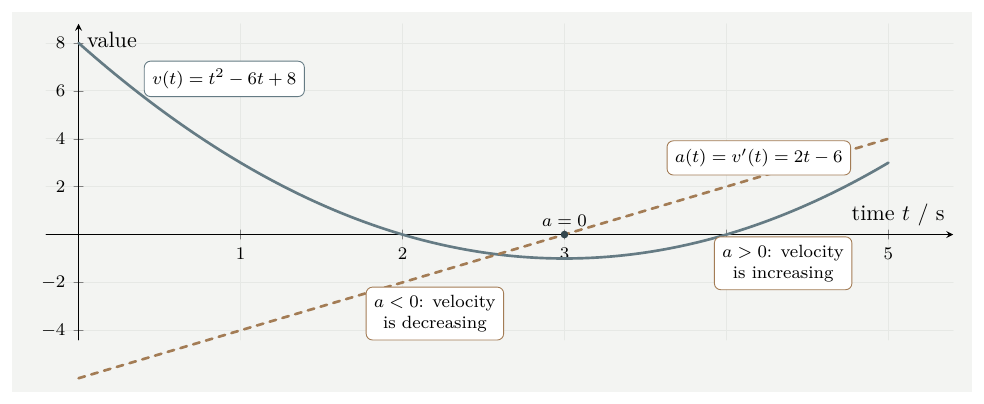
The graph below shows two functions for the same particle. The blue curve is the velocity \(v(t)=t^2-6t+8\), and the dashed orange line is its derivative, \(a(t)=v'(t)=2t-6\).
So the orange line tells us the gradient of the blue velocity curve. This is the key idea: acceleration is not a separate story; it describes how the velocity graph is changing.
What to take away
- For \(0\leq t\lt 3\), \(a(t)\lt 0\), so the velocity curve is decreasing. This means the particle's velocity is becoming smaller.
- At \(t=3\), \(a(t)=0\). This corresponds to the minimum point of the velocity graph, where the gradient of \(v(t)\) is zero.
- For \(t>3\), \(a(t)\gt 0\), so the velocity curve is increasing. This means the particle's velocity is becoming larger.
- To decide whether the particle is actually speeding up or slowing down, compare the signs of \(v(t)\) and \(a(t)\), not \(a(t)\) alone.
Using the calculus links
The relationships between \(s(t)\), \(v(t)\) and \(a(t)\) were introduced immediately after the four quantities. We now apply them in a worked example.
Worked example: using calculus to move from one quantity to the next
For the particle with \(s(t)=t^2-4t+3\), find the velocity function, the acceleration function, and the displacement from \(t=0\) to \(t=2\).
Solution. Differentiate displacement to get velocity:
Differentiate velocity to get acceleration:
Now use displacement from velocity:
We can also check this using \(s(2)-s(0)\):
Quick check: same displacement, different distance
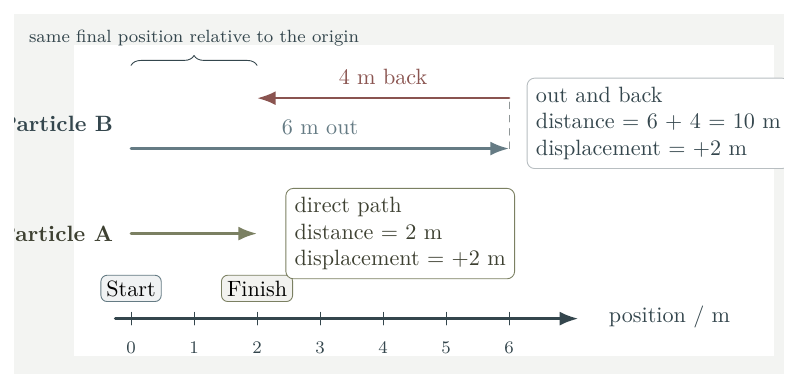
Both particles start at the origin and both finish at position \(2\text{ m}\). Which particle has the greater distance travelled? What is the displacement of each particle? Why can two particles have the same displacement but different distances travelled?
Important distinction
Displacement cares only about the particle's signed position relative to the origin. Distance travelled cares about the full path taken. A particle can finish where it started, so its displacement is \(0\), while still having travelled a positive distance.
Velocity-time graphs: area tells the story
After reading direction from the sign of velocity, the next key idea is area. A velocity-time graph lets us accumulate motion: signed area gives displacement, while area under speed gives total distance.
Displacement and total distance from \(v(t)\)
For a particle with velocity \(v(t)\), from time \(t_1\) to time \(t_2\):
Positive area above the \(t\)-axis and negative area below the \(t\)-axis can cancel for displacement. Distance does not allow cancellation.
One velocity function, three connected pictures
Let \(v(t)=6t-12\), for \(0\leq t\leq 4\). The velocity changes sign at \(t=2\), so this is exactly where distance calculations must be split.
Read the pictures from top to bottom:
- First use the velocity graph to find where \(v(t)\lt 0\), where \(v(t)=0\), and where \(v(t)\gt 0\). This tells us the direction of motion and the turning time.
- Then use the same graph as a signed-area graph. Area below the axis is negative and area above the axis is positive, so these contributions may cancel when calculating displacement.
- Finally graph \(|v(t)|\). This is a speed-time graph, so every area is counted positively when calculating total distance.
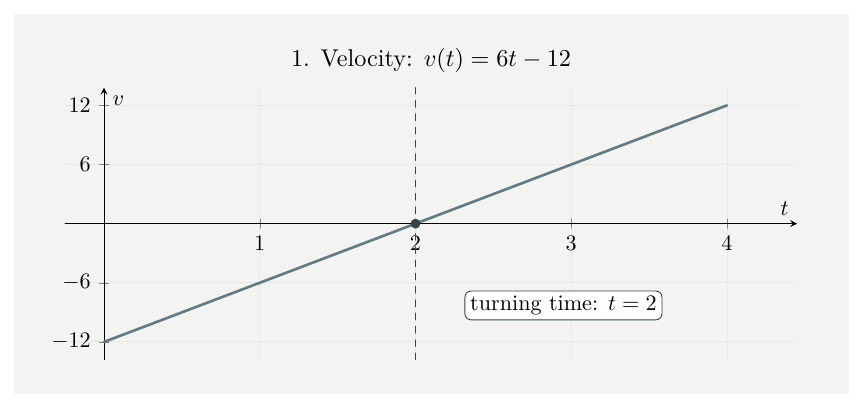
1. Velocity: \(v(t)=6t-12\)
Solve \(6t-12=0\), giving \(t=2\). The velocity changes sign at \(t=2\), so this is the turning time and also where distance calculations must be split.
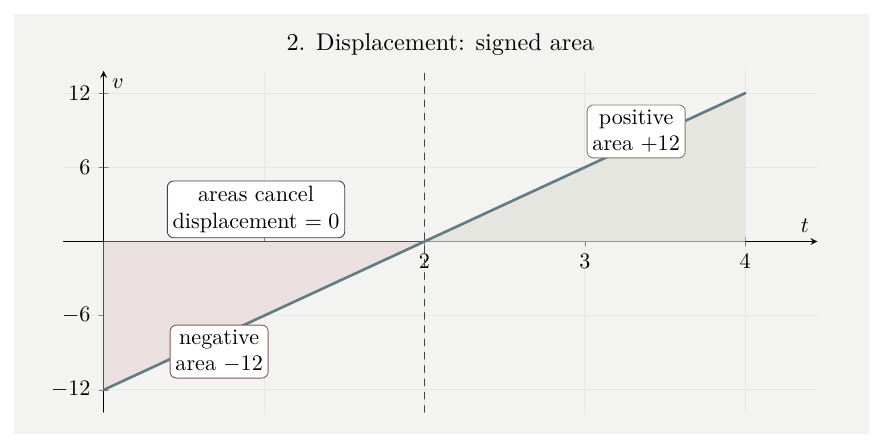
2. Displacement: signed area
The negative area from \(0\) to \(2\) is \(-12\), and the positive area from \(2\) to \(4\) is \(+12\). Therefore \(\int_0^4(6t-12)\,dt=-12+12=0\text{ m}\).
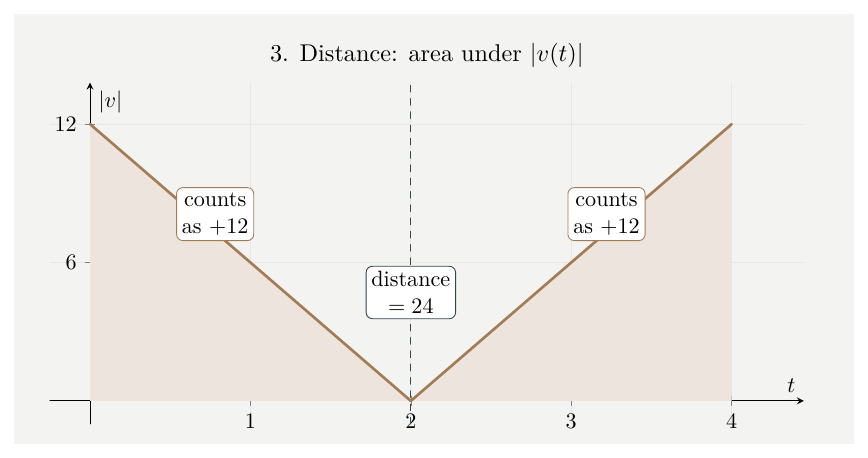
3. Distance: area under \(|v(t)|\)
For total distance, the negative part is reflected above the axis. Hence \(\int_0^4 |6t-12|\,dt=12+12=24\text{ m}\).
Reading takeaway
The same velocity function can answer different questions depending on how we read the graph. The sign of \(v(t)\) tells us direction, the signed area under \(v(t)\) gives displacement, and the area under \(|v(t)|\) gives total distance travelled.
Worked example: average velocity and average speed
For the same particle, \(v(t)=6t-12\), \(0\leq t\leq 4\), find the average velocity and the average speed over the interval \(0\leq t\leq 4\).
The total time is \(4-0=4\text{ s}\). Average velocity uses displacement, so we use the signed area:
Average speed uses total distance travelled. Since the velocity changes sign at \(t=2\), split the interval:
Takeaway. The average velocity is \(0\,\mathrm{m\,s^{-1}}\) because the signed displacement is zero, but the average speed is \(6\,\mathrm{m\,s^{-1}}\) because the particle still travelled \(24\text{ m}\) in total.
The next two graphs show the same idea for a curved velocity function. The first graph keeps the sign of velocity, so it is used for displacement. The second graph turns velocity into speed, so it is used for total distance.
Signed area under a velocity-time graph
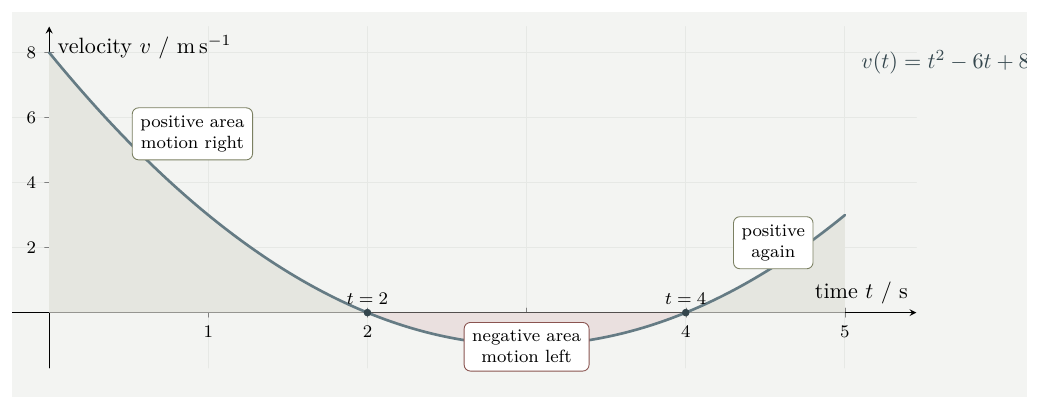
This is a velocity-time graph. First look at whether the curve is above or below the \(t\)-axis: above means motion in the positive direction, below means motion in the negative direction. Then read the shaded regions as signed areas.
Interpretation
- On \(0\lt t\lt 2\), the graph is above the axis, so \(v(t)\gt 0\). The particle moves in the positive direction and the area contributes positively to displacement.
- On \(2\lt t\lt 4\), the graph is below the axis, so \(v(t)\lt 0\). The particle moves in the negative direction and the area contributes negatively to displacement.
- On \(4\lt t\lt 5\), the graph is above the axis again, so the particle moves in the positive direction again.
Speed-time graph: reflect the negative part above the axis
To calculate total distance, we do not allow negative areas to cancel positive areas. Instead, we use speed, \(|v(t)|\). Any part of the velocity graph below the axis is reflected above the axis before finding area.
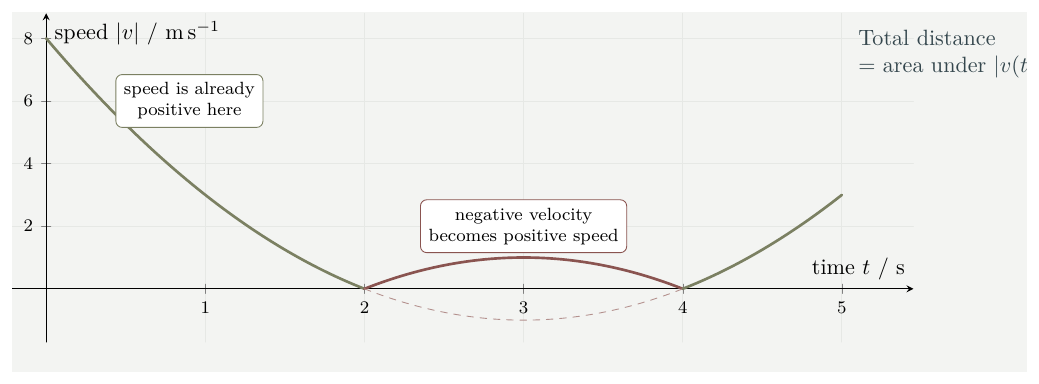
Notice the change from \(-\dfrac{4}{3}\) in the displacement calculation to \(+\dfrac{4}{3}\) in the distance calculation.
Worked example: from displacement to velocity and acceleration
We now practise moving forwards through the ladder. Starting with a displacement function, we differentiate to find velocity and acceleration, then interpret the signs.
Example 1
A particle moves along a straight line with displacement, in metres, given by
- Find \(v(t)\) and \(a(t)\).
- Find the times when the particle is instantaneously at rest.
- Determine when the particle is moving in the positive and negative directions.
- Find the total distance travelled between \(t=0\) and \(t=5\).
Solution.
The particle is at rest when \(v(t)=0\):
Using the sign of \(v(t)=3(t-1)(t-3)\), the particle moves in the positive direction for \(0\lt t\lt 1\) and \(3\lt t\lt 5\), and in the negative direction for \(1\lt t\lt 3\).
Now calculate positions at the turning times:
Why split at the turning times? Once the turning times have been found by solving \(v(t)=0\), split the motion at those times and add the absolute changes in displacement:
Worked example: displacement vs total distance from velocity
This example focuses on a common exam distinction. Displacement can include cancellation, but total distance counts every part of the journey positively.
Example 2
A particle has velocity \(v(t)=t^2-6t+8\), \(0\leq t\leq 5\). Find the displacement and the total distance travelled from \(t=0\) to \(t=5\).
Solution. First find where \(v(t)=0\), because the direction can change there:
so \(t=2\) and \(t=4\). An antiderivative of \(v(t)\) is
Displacement from \(0\) to \(5\):
For total distance, split at the zeros of \(v\):
Since \(F(0)=0\), \(F(2)=\dfrac{20}{3}\), \(F(4)=\dfrac{16}{3}\), and \(F(5)=\dfrac{20}{3}\), we get
Why the two answers differ
The displacement is only \(\dfrac{20}{3}\text{ m}\) because the negative area from \(t=2\) to \(t=4\) cancels some of the positive area. The total distance is \(\dfrac{28}{3}\text{ m}\) because distance counts every part of the journey as positive.
Worked example: from acceleration back to motion
We now move backwards through the ladder. Starting with acceleration, we integrate to recover velocity and displacement, using given information to find the constants.
Example 3
A particle moves in a straight line with acceleration \(a(t)=6t-4\). Given that \(v(0)=3\) and \(s(0)=2\), find \(v(t)\) and \(s(t)\).
Solution. Since \(a(t)=\dfrac{dv}{dt}\), integrate to find \(v(t)\):
Use \(v(0)=3\):
Therefore \(v(t)=3t^2-4t+3\). Now integrate velocity to find displacement:
Use \(s(0)=2\), giving \(D=2\). Therefore
Reminder
Each integration introduces a constant. Use the given initial or boundary condition immediately before integrating again.
Related video tutorials
The videos below match the main stages of this lesson. Use them to revisit the ideas visually, especially the difference between displacement and distance.
Video 1: displacement integrals
This lesson focuses on integrating a velocity function to find a particle's displacement. It emphasises signed area under the velocity-time graph, connects the integral to change in position, and works through the algebra carefully.
Video 2: displacement vs distance travelled
This lesson compares displacement with distance travelled. It shows why you must first find where \(v(t)=0\), split the interval at turning times, and then add absolute changes or integrate \(|v(t)|\).
Video 3: IB exam-style walkthrough
This walkthrough solves a typical IB Paper 1 style question on a velocity function. It discusses maximum velocity, maximum speed, the instant when the particle changes direction, and the distance travelled before turning.
IB exam-style worked question
This exam-style question brings the main ideas together: maximum velocity, maximum speed, change of direction and distance travelled before a turning time.
Question from the linked walkthrough video
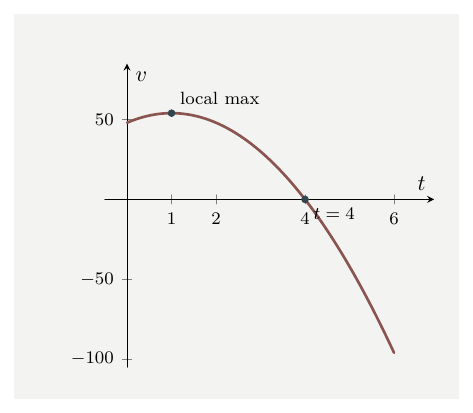
An object moves in a straight line. Its velocity \(v\), in \(\mathrm{m\,s^{-1}}\), at time \(t\) seconds, is given by
The graph of \(v\) has a local maximum point where \(t=1\) and it intersects the \(t\)-axis at \(t=4\).
- Determine the object's
(i) maximum velocity
(ii) maximum speed. - At \(t=T\), the object changes direction.
(i) State the value of \(T\).
(ii) Find the distance travelled by the object in the first \(T\) seconds.
Solution
Rewrite the velocity in completed-square form:
So the maximum velocity occurs at \(t=1\), giving
For maximum speed, we need the largest value of \(|v(t)|\) on \([0,6]\). Since
we get
The particle changes direction when the velocity changes sign, which happens when \(v(t)=0\). The graph shows this occurs at
For the distance travelled in the first \(T\) seconds, note that \(v(t)\geq 0\) on \([0,4]\), so distance equals displacement:
An antiderivative is \(48t+6t^2-2t^3\). Therefore
Hence, the distance travelled in the first \(T\) seconds is \(160\text{ m}\).
IB-style method checklist
Before attempting independent questions, it helps to have a compact routine. This checklist is designed to prevent the most common mistakes in kinematics problems.
Common mistakes to avoid
- Confusing displacement with distance travelled.
- Confusing velocity with speed.
- Forgetting the absolute value when finding total distance: \(\text{distance}=\int |v(t)|\,dt\).
- Forgetting to split the interval whenever \(v(t)\) changes sign.
- Thinking that \(a(t)\gt 0\) always means the particle is speeding up. Acceleration tells you that velocity is increasing; speed depends on \(|v(t)|\).
When answering a kinematics question
- Identify what you have been given: \(s(t)\), \(v(t)\), or \(a(t)\).
- Move along the ladder using differentiation or integration.
- If you are asked for times at rest, solve \(v(t)=0\).
- If you are asked for direction of motion, make a sign table for \(v(t)\).
- If you are asked for displacement, integrate \(v(t)\) over the whole interval.
- If you are asked for total distance, split at every zero of \(v(t)\) inside the interval and add absolute changes.
- Include units and interpret negative answers carefully.
Kinematics summary sheet
This summary belongs at the end of the lesson sequence. Use it as a final reference before attempting the practice questions.
Key idea
Kinematics is the mathematics of motion. In this topic, motion is one-dimensional, so the particle moves along one straight line.
Key formulas
Interpreting signs
| Expression | Meaning |
|---|---|
| \(v(t)\gt 0\) | moving in the positive direction |
| \(v(t)\lt 0\) | moving in the negative direction |
| \(v(t)=0\) | momentarily at rest |
| \(a(t)\gt 0\) | velocity is increasing |
| \(a(t)\lt 0\) | velocity is decreasing |
Speeding up or slowing down
| \(a(t)\gt 0\) | \(a(t)\lt 0\) | |
|---|---|---|
| \(v(t)\gt 0\) | speed increases | speed decreases |
| \(v(t)\lt 0\) | speed decreases | speed increases |
Rule: speed increases when \(v(t)\) and \(a(t)\) have the same sign, and decreases when they have opposite signs.
Practice questions
The questions now move from basic interpretation to exam-style applications. For each problem, first identify what is given: \(s(t)\), \(v(t)\), or \(a(t)\).
A. Core skills
- A particle has displacement \(s(t)=t^3-9t^2+24t+5\), for \(0\leq t\leq 6\). Find \(v(t)\), \(a(t)\), and the times when the particle is at rest.
- A particle has velocity \(v(t)=5-2t\), for \(0\leq t\leq 4\). Find the displacement and the total distance travelled.
- A particle has velocity \(v(t)=t^2-4t+3\), for \(0\leq t\leq 5\). Find the times when the particle changes direction and hence find the total distance travelled.
- A particle has acceleration \(a(t)=4t-6\). Given \(v(0)=7\), find \(v(t)\). Then find the time when the velocity is a minimum.
- A particle has \(s(t)=2t^3-15t^2+36t\), for \(0\leq t\leq 5\). Determine when the particle is moving in the positive direction.
B. IB-style extended response
- A particle moves along a straight line. Its velocity, in \(\mathrm{m\,s^{-1}}\), is given by \(v(t)=t^2-6t+8\), \(0\leq t\leq 5\).
(a) Find the times when the particle is at rest.
(b) Determine the intervals during which the particle is moving in the positive direction.
(c) Find the displacement from \(t=0\) to \(t=5\).
(d) Find the total distance travelled from \(t=0\) to \(t=5\). - A particle has acceleration \(a(t)=6t-4\). Initially, \(s(0)=2\) and \(v(0)=3\).
(a) Find an expression for \(v(t)\).
(b) Find an expression for \(s(t)\).
(c) Find \(a(2)\) and interpret its meaning. - A particle moves with displacement \(s(t)=t^3-6t^2+9t+1\), \(0\leq t\leq 5\).
(a) Find \(v(t)\) and \(a(t)\).
(b) Find the times at which the particle changes direction.
(c) Find the total distance travelled in the first five seconds.
Concise answer key
Use the answer key to check both your calculations and your interpretation. Units and signs matter in every kinematics answer.
Answers to A. Core skills
- \(v(t)=3t^2-18t+24=3(t-2)(t-4)\), \(a(t)=6t-18\). At rest at \(t=2,4\).
- Displacement \(=\int_0^4(5-2t)\,dt=4\text{ m}\). Since \(v=0\) at \(t=2.5\), total distance \(=21\text{ m}\).
- \(v(t)=(t-1)(t-3)\), so direction changes at \(t=1,3\). Total distance \(=\dfrac{28}{3}\text{ m}\).
- \(v(t)=2t^2-6t+7\). The velocity is minimum when \(a(t)=v'(t)=4t-6=0\), so \(t=\dfrac{3}{2}\).
- \(v(t)=6t^2-30t+36=6(t-2)(t-3)\). Positive direction on \(0\lt t\lt 2\) and \(3\lt t\lt 5\).
Answers to B. IB-style extended response
- 1(a) \(t=2,4\).
1(b) Positive direction on \(0\lt t\lt 2\) and \(4\lt t\lt 5\).
1(c) Displacement \(=\dfrac{20}{3}\text{ m}\).
1(d) Total distance \(=\dfrac{28}{3}\text{ m}\). - 2(a) \(v(t)=3t^2-4t+3\).
2(b) \(s(t)=t^3-2t^2+3t+2\).
2(c) \(a(2)=8\,\mathrm{m\,s^{-2}}\), meaning the velocity is increasing at a rate of \(8\,\mathrm{m\,s^{-2}}\) at \(t=2\). - 3(a) \(v(t)=3t^2-12t+9=3(t-1)(t-3)\), \(a(t)=6t-12\).
3(b) Changes direction at \(t=1\) and \(t=3\).
3(c) Total distance \(=28\text{ m}\).