IB Mathematics: Applications and Interpretation SL — Topic 4
Discrete random variables
Probability distributions, expected value and fair games: learn the ideas, follow the reasoning and practise independently.
Learning goal
Build and use probability distributions, calculate their mean and interpret expected gains and losses.
Syllabus link
AI SL: SL 4.7. Discrete random variables, distributions, expected value and applications.
Big idea
Use the probability of each value as its weight when calculating an average.
Key relationship
\(\operatorname{E}(X)=\sum_x x\operatorname{P}(X=x)\)
What is a discrete random variable?
Imagine tossing two coins. You record just one thing: the number of heads.
Call this number \(X\). It could be \(0\), \(1\) or \(2\). You do not know which value you will get until you toss the coins.
This is a discrete random variable:
- Random: the number depends on chance.
- Variable: the number can change from one try to the next.
- Discrete: the possible values are separate values we can list. Here, we can get \(0\), \(1\) or \(2\) heads, but not \(1.5\) heads.
A probability distribution tells us which values \(X\) can take and how likely each value is.
Worked example 1: How many heads?
Two fair coins are tossed independently. Let \(X\) be the number of heads. Find its probability distribution.
Solution
Use H for heads and T for tails. List the four possible results:
| Result | TT | TH | HT | HH |
|---|---|---|---|---|
| Number of heads, \(X\) | 0 | 1 | 1 | 2 |
Each coin has probability \(\frac12\) of heads and \(\frac12\) of tails. The coins do not affect each other, so each result above has probability \(\frac12\times\frac12=\frac14\).
One result gives no heads, two give one head, and one gives two heads:
| \(x\) | 0 | 1 | 2 |
|---|---|---|---|
| \(\operatorname{P}(X=x)\) | \(\frac14\) | \(\frac12\) | \(\frac14\) |
For example, \(\operatorname{P}(X=1)\) means “the probability of getting one head”. Here, \(\operatorname{P}(X=1)=\frac24=\frac12\).
Read and check a probability distribution
A probability distribution gives every possible value of a random variable and the probability of each value. In a table, \(x\) is a possible value of \(X\) and \(\operatorname{P}(X=x)\) is its probability. Read them from the same column.
| \(x\) | 0 | 2 | 5 |
|---|---|---|---|
| \(\operatorname{P}(X=x)\) | \(\frac15\) | \(\frac12\) | \(\frac3{10}\) |
For example, if \(X\) is the number of tokens in a randomly selected envelope, the middle column says that the probability of getting 2 tokens is \(\frac12\). The number 2 is a value of \(X\); \(\frac12\) is its probability.
Discrete does not mean positive whole numbers. Possible gains of −€2, €0 and €1.50 are still separate, discrete values. A continuous measurement, such as exact time, can take any value within an interval.
Worked example 2: Find a missing constant in a table
Let \(X\) be the number of messages received in a particular ten-minute interval. Its model is
| \(x\) | 0 | 1 | 2 | 3 |
|---|---|---|---|---|
| \(\operatorname{P}(X=x)\) | \(k\) | \(2k\) | \(3k\) | \(4k\) |
Find \(k\) and verify that the completed table is a valid probability distribution.
Solution
The probabilities must add to 1:
The completed probabilities are \(0.1,0.2,0.3,0.4\). Each lies between 0 and 1, and their sum is 1. Both conditions hold.
Quick check A
Let \(V\) take values \(0,1,2\) with probabilities \(k,2k,5k\). Find \(k\) and check that the completed probabilities form a valid distribution.
Check your answerFrom a probability formula to a table and bar chart
A distribution may be given by a formula for \(\operatorname{P}(X=x)\) together with its allowed values of \(x\). Substitute each allowed value to find its probability. Values outside the stated set have probability zero.
Worked example 3: Find a constant and construct the distribution
A spinner has three unequal sectors labelled 1, 2 and 3. The arrow is equally likely to stop at any angle. Let \(X\) be the number on one spin. Its distribution is
with probability zero for all other values.
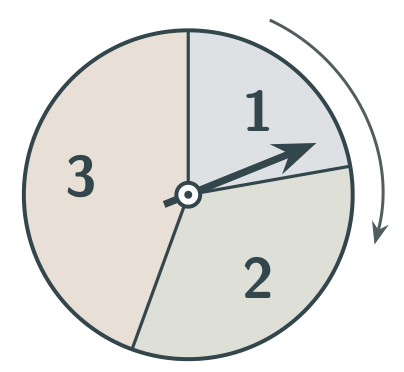
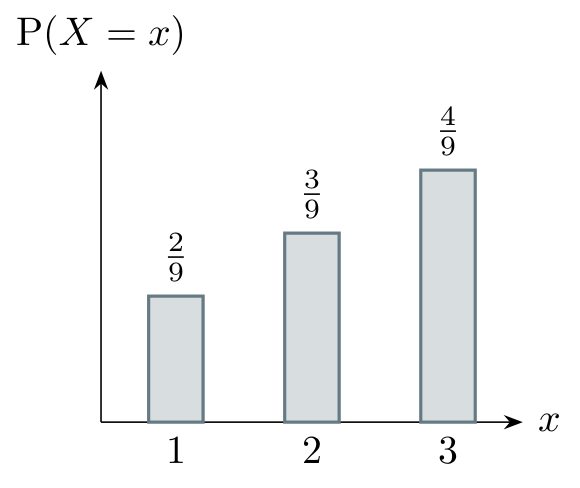
Find \(k\) and represent the distribution as a table and a probability bar chart.
Solution
First substitute the allowed values:
Now make the total probability equal to 1:
| \(x\) | 1 | 2 | 3 |
|---|---|---|---|
| \(\operatorname{P}(X=x)\) | \(\frac29\) | \(\frac39\) | \(\frac49\) |
All entries lie between 0 and 1, and \(\frac29+\frac39+\frac49=1\).
Quick check B
Let \(\operatorname{P}(Y=y)=c(5-y)\) for \(y\in\{1,2,3\}\), with probability zero otherwise. Find \(c\), \(\operatorname{P}(Y=3)\) and \(\operatorname{P}(Y=2.5)\).
Check your answerFind probabilities from a distribution
An event is a condition on the outcome. For example, \(X\geq2\) means that the value of \(X\) is at least 2. List the allowed values satisfying the condition, then add their probabilities.
| Wording | Condition |
|---|---|
| Exactly \(a\) | \(X=a\) |
| At most \(a\) | \(X\leq a\) |
| Fewer than \(a\) | \(X<a\) |
| More than \(a\) | \(X>a\) |
| At least \(a\) | \(X\geq a\) |
| From \(a\) to \(b\), inclusive | \(a\leq X\leq b\) |
Worked example 4: Inequalities and impossible values
Let \(X\) be the change in a player’s score, in points, after one round:
| \(x\) | −2 | 0 | 1 | 3 |
|---|---|---|---|---|
| \(\operatorname{P}(X=x)\) | \(\frac1{10}\) | \(\frac2{10}\) | \(\frac4{10}\) | \(\frac3{10}\) |
Find:
- \(\operatorname{P}(X>1)\);
- \(\operatorname{P}(X\geq1)\);
- \(\operatorname{P}(X\leq0)\) using the complement;
- \(\operatorname{P}(X=2)\).
Solution
Only 3 is greater than 1:
\[\begin{aligned}\operatorname{P}(X>1)&=\operatorname{P}(X=3)\\&=\boxed{\frac3{10}}.\end{aligned}\]Both 1 and 3 are at least 1:
\[\begin{aligned}\operatorname{P}(X\geq1)&=\frac4{10}+\frac3{10}\\&=\boxed{\frac7{10}}.\end{aligned}\]The positive values are 1 and 3, so
\[\begin{gathered}\operatorname{P}(X\leq0)\\\begin{aligned}&=1-\operatorname{P}(X>0)\\&=1-\left(\frac4{10}+\frac3{10}\right)\\&=\boxed{\frac3{10}}.\end{aligned}\end{gathered}\]The value 2 is not in the distribution: \(\boxed{\operatorname{P}(X=2)=0}\).
Quick check C
Using the same table, find \(\operatorname{P}(-1<X\leq3)\). List the values you include.
Check your answerExpected value: the mean of a random variable
What average value should we expect over many repetitions of a random experiment? More likely values should contribute more to that average. This leads to a probability-weighted mean.
Worked example 5: Calculate and interpret a mean
Let \(X\) be the number of tokens in one randomly selected envelope, with
| \(x\) | 0 | 2 | 5 |
|---|---|---|---|
| \(\operatorname{P}(X=x)\) | \(\frac15\) | \(\frac12\) | \(\frac3{10}\) |
Find \(\operatorname{E}(X)\) and explain what it means.
Solution
Keep each value matched with its probability:
| \(x\) | 0 | 2 | 5 |
|---|---|---|---|
| \(\operatorname{P}(X=x)\) | \(\frac15\) | \(\frac12\) | \(\frac3{10}\) |
| \(x\operatorname{P}(X=x)\) | \(0\left(\frac15\right)=0\) | \(2\left(\frac12\right)=1\) | \(5\left(\frac3{10}\right)=\frac32\) |
Add the products in the bottom row:
Over many independent selections with this same distribution, the average number of tokens per envelope will tend towards 2.5. For example, counts near 200, 500 and 300 in 1000 selections would give an average near \(2.5\); actual counts fluctuate.
Quick check D
Let \(W\) take values \(0,2,4\) with probabilities \(\frac12,\frac14,\frac14\). Find \(\operatorname{E}(W)\). Can \(W\) equal its mean on a single trial?
Check your answerUse and interpret expected value
An expected value has the same units as the random variable. A mean number of customers is measured in customers; a mean gain measured in euros is also in euros.
When the same model applies to each of \(n\) trials, the expected total is \(n\) times the expected value for one trial. This is an average prediction, not a guaranteed total.
Worked example 6: From a daily mean to an expected total
Let \(X\) be the number of express deliveries made by a small shop in one day:
| \(x\) | 0 | 1 | 2 | 3 |
|---|---|---|---|---|
| \(\operatorname{P}(X=x)\) | 0.10 | 0.25 | 0.40 | 0.25 |
- Find and interpret \(\operatorname{E}(X)\).
- Find the expected number of express deliveries over 30 days, assuming this model applies each day.
Solution
Multiply the values by their probabilities and add:
\[\begin{gathered}\operatorname{E}(X)\\\begin{aligned}&=0(0.10)\\&\quad+1(0.25)\\&\quad+2(0.40)\\&\quad+3(0.25)\\&=\boxed{1.8\text{ deliveries}}.\end{aligned}\end{gathered}\]Over many days, the shop averages about 1.8 express deliveries per day. A single day’s count is still a whole number.
The expected total is \(30(1.8)=\boxed{54\text{ deliveries}}\). The actual total could be different.
Worked example 7: Use a given mean to find probabilities
Let \(X\) be the number of points earned in one round of a game:
| \(x\) | 0 | 2 | 6 |
|---|---|---|---|
| \(\operatorname{P}(X=x)\) | \(p\) | \(\frac12\) | \(q\) |
Given that \(\operatorname{E}(X)=\frac52\), find \(p\) and \(q\).
Solution
There are two unknown probabilities, so use two facts:
Total probability:
Expected value:
From the second equation,
Then \(p=1-\frac12-\frac14=\frac14\). The probabilities \(\frac14,\frac12,\frac14\) lie between 0 and 1 and sum to 1. Check the mean:
which agrees with the given value.
Quick check E
A score \(S\) takes values \(1,3,5\) with probabilities \(p,q,0.20\). Given that \(\operatorname{E}(S)=2.4\), find \(p\) and \(q\) by forming and solving two equations. Check your probabilities.
Check your answerFair games: distinguish a prize from a net gain
A player may receive a prize but also pay to take part. To decide whether a game is fair, work with the player’s net gain: the money received minus the money paid.
Worked example 8: A prize does not tell the whole story
A player pays €2 to select one prize envelope. Let \(R\) be the prize money received, in euros, on this play:
| \(r\) | 0 | 2 | 5 |
|---|---|---|---|
| \(\operatorname{P}(R=r)\) | \(\frac15\) | \(\frac12\) | \(\frac3{10}\) |
- Find the expected prize money, \(\operatorname{E}(R)\).
- Define the player’s net-gain distribution and find its mean.
- Find the probability that the player makes a profit. Is the game fair?
Solution
- \[\begin{gathered}\operatorname{E}(R)\\\begin{aligned}&=0\left(\frac15\right)\\&\quad+2\left(\frac12\right)\\&\quad+5\left(\frac3{10}\right)\\&=\boxed{\text{€}2.50}.\end{aligned}\end{gathered}\]
Let \(G\) be the player’s net gain, in euros, on this play. Since \(G=R-2\), subtract 2 from each prize; the corresponding probabilities stay the same:
Prize \(r\) 0 2 5 Net gain \(g\) −2 0 3 \(\operatorname{P}(G=g)\) \(\frac15\) \(\frac12\) \(\frac3{10}\) \[\begin{gathered}\operatorname{E}(G)\\\begin{aligned}&=(-2)\left(\frac15\right)\\&\quad+0\left(\frac12\right)\\&\quad+3\left(\frac3{10}\right)\\&=\boxed{\text{€}0.50}.\end{aligned}\end{gathered}\]A profit requires \(G>0\), which occurs only when the prize is €5:
\[\operatorname{P}(G>0)=\boxed{\frac3{10}}.\]The game is not fair: \(\operatorname{E}(G)>0\). The player gains an average of €0.50 per play in the long run, even though a profit occurs on only 30% of plays.
Quick check F
If the entry fee in example 8 becomes €3 but the prizes stay the same, what is the player’s expected net gain per play?
Check your answerFind a fair entry fee or an unknown prize
For these questions, first define the player’s net gain on one play. Express its possible values, calculate its expected value and set that expectation equal to zero.
Worked example 9: Find the fair entry fee
In the envelope game, the prize \(R\) is €0, €2 or €5, with probabilities \(\frac15,\frac12,\frac3{10}\). Find the entry fee \(c\) euros that makes the game fair.
Solution
Let \(G\) be the player’s net gain, in euros, on one play. Since \(G=R-c\), its values are \(-c\), \(2-c\) and \(5-c\), with the same probabilities as the prizes.
For fairness, \(\operatorname{E}(G)=0\), so \(\frac52-c=0\) and \(\boxed{c=2.50}\). The fair entry fee is €2.50.
Worked example 10: Find the prize that makes a game fair
A spinner has eight equal sectors. One sector wins a prize of €\(w\); the other seven pay nothing. It costs €3 to play. Find \(w\) for a fair game.
Solution
Let \(G\) be the player’s net gain, in euros, on one spin. The possible net gains are
| \(g\) | \(w-3\) | \(-3\) |
|---|---|---|
| \(\operatorname{P}(G=g)\) | \(\frac18\) | \(\frac78\) |
Set the expected net gain equal to zero:
The prize must be €24. Check: the net gains are €21 and −€3, and \(21(\frac18)-3(\frac78)=0\).
Quick check G
A player’s net gain is €9 with probability \(0.1\) and −€1 with probability \(0.9\). Is the game fair? Explain using expected value.
Check your answerPractice: distributions, expectation and fair games
Try each question before reading the worked answers. Use your GDC where helpful, but show your setup and reasoning. Give exact answers or answers to three significant figures unless otherwise stated.
1. Identify a discrete random variable
For each situation, state whether the variable is discrete and explain briefly:
- the number of text messages received in one hour;
- the exact time taken to run 100 m, before any rounding;
- the net gain from a game, whose only possible values are −€1.50, €0 and €2.50.
2. Check both conditions
Each list below is proposed as the probabilities of all three distinct values of a random variable. State whether each list is valid and justify your answer.
- \(0.20,\;0.35,\;0.55\);
- \(-0.10,\;0.50,\;0.60\).
3. A probability formula
Let \(X\) be the number of vouchers in a randomly selected packet, with
and probability zero otherwise.
- Find \(k\) and write the probability distribution as a table.
- Find \(\operatorname{P}(X\geq2)\) and \(\operatorname{P}(X=2.5)\).
- Find \(\operatorname{E}(X)\).
4. Read a probability bar chart
Let \(X\) be the number of items returned to a shop in one hour. Its distribution is shown below.
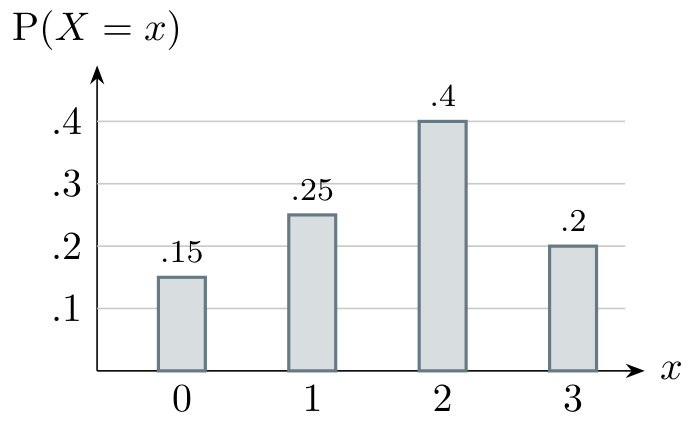
- Write the probability distribution as a table.
- Find \(\operatorname{P}(1<X\leq3)\).
- Find and interpret \(\operatorname{E}(X)\).
5. Construct a distribution from an experiment
A bag contains three red counters and one blue counter. A counter is selected at random, replaced, and then a second counter is selected independently. Let \(X\) be the number of blue counters selected in the two draws.
- Construct the probability distribution of \(X\).
- Find and interpret \(\operatorname{E}(X)\).
Reminder: for independent draws, multiply probabilities along an outcome such as red then blue; add probabilities of different outcomes that give the same count.
6. An expected total
Let \(X\) be the number of customers arriving at a kiosk in a five-minute interval:
| \(x\) | 0 | 1 | 2 | 3 | 4 |
|---|---|---|---|---|---|
| \(\operatorname{P}(X=x)\) | 0.10 | 0.20 | 0.35 | 0.25 | 0.10 |
- Find and interpret \(\operatorname{E}(X)\).
- Assuming this model applies to each interval, find the expected total number of arrivals over 200 such intervals.
7. Two missing probabilities
Let \(X\) be the change in a player’s score, in points, after one round:
| \(x\) | −1 | 2 | 4 |
|---|---|---|---|
| \(\operatorname{P}(X=x)\) | \(a\) | \(b\) | \(\frac14\) |
Given that \(\operatorname{E}(X)=\frac74\), find \(a\) and \(b\). Verify both the total probability and the given mean.
8. Fairness and the chance of a profit
Let \(G\) be the player’s net gain, in euros, on one play of a game:
| \(g\) | −4 | 1 | 8 |
|---|---|---|---|
| \(\operatorname{P}(G=g)\) | 0.50 | 0.35 | 0.15 |
- Find and interpret \(\operatorname{E}(G)\).
- Find \(\operatorname{P}(G>0)\).
- A student says, “The chance of a profit is 50%, so the game is fair.” Explain why this reasoning is incorrect.
9. Prize money, net gain and a fair fee
A fair six-sided die is rolled once. A player receives €0 for a result from 1 to 4, €6 for a 5 and €12 for a 6. Let \(R\) be the prize received, in euros, on one play.
- Write the distribution of \(R\) and calculate \(\operatorname{E}(R)\).
- The entry fee is €2. Let \(G\) be the player’s net gain, in euros, on one play. Write its distribution and calculate \(\operatorname{E}(G)\).
- Find the entry fee that would make the game fair.
10. Set a fair prize and interpret the result
A spinner has five equal sectors. One sector pays a prize of €\(w\); the other four pay nothing. A player pays €4 to spin once.
- Define the player’s net gain \(G\), state its distribution and find \(w\) so that the game is fair.
- Find the probability of a profit when the game is fair.
- An alternative gives a guaranteed prize of €4 for the same €4 fee. Compare the two games’ expected net gains and explain one difference between them.
Worked answers
Question 1 — Identify a discrete random variable
Solution
- Discrete: the possible counts are \(0,1,2,\ldots\) messages.
- Continuous: exact, unrounded time can take any value in an interval.
- Discrete: the possible gains form a finite list. Discrete values may be negative or non-integer.
Question 2 — Check both conditions
Solution
Invalid. Each number lies between 0 and 1, but the total is
\[\begin{gathered}0.20+0.35+0.55\\=1.10\ne1.\end{gathered}\]- Invalid. The total is 1, but \(-0.10<0\) cannot be a probability.
Question 3 — A probability formula
Solution
Substituting \(x=1,2,3\) gives probabilities \(3k,2k,k\). Thus
\[\begin{aligned}3k+2k+k&=1,\\k&=\boxed{\frac16}.\end{aligned}\]\(x\) 1 2 3 \(\operatorname{P}(X=x)\) \(\frac12\) \(\frac13\) \(\frac16\) All entries are in \([0,1]\), and their sum is 1.
The values 2 and 3 satisfy \(X\geq2\), so
\[\begin{aligned}\operatorname{P}(X\geq2)&=\frac13+\frac16\\&=\boxed{\frac12}.\end{aligned}\]The value 2.5 is outside the allowed set, so \(\boxed{\operatorname{P}(X=2.5)=0}\).
Multiply each value by its probability and add:
\[\begin{aligned}\operatorname{E}(X)&=1\left(\frac12\right)\\&\quad+2\left(\frac13\right)\\&\quad+3\left(\frac16\right)\\&=\frac12+\frac23+\frac12\\&=\boxed{\frac53\text{ vouchers}}.\end{aligned}\]
Question 4 — Read a probability bar chart
Solution
Read the height of each bar:
\(x\) 0 1 2 3 \(\operatorname{P}(X=x)\) 0.15 0.25 0.40 0.20 The allowed values satisfying \(1<X\leq3\) are 2 and 3:
\[\begin{aligned}\operatorname{P}(1<X\leq3)&=0.40\\&\quad+0.20\\&=\boxed{0.60}.\end{aligned}\]The probability-weighted mean is
\[\begin{aligned}\operatorname{E}(X)&=0(0.15)\\&\quad+1(0.25)\\&\quad+2(0.40)\\&\quad+3(0.20)\\&=\boxed{1.65\text{ items}}.\end{aligned}\]Over many hours under this model, the average is about 1.65 returned items per hour.
Question 5 — Construct a distribution from an experiment
Solution
Because the first counter is replaced, on each draw \(\operatorname{P}(\mathrm{B})=\frac14\) and \(\operatorname{P}(\mathrm{R})=\frac34\). The outcomes are:
Ordered outcome \(X\) Probability Red, red 0 \(\frac34\times\frac34=\frac9{16}\) Red, blue 1 \(\frac34\times\frac14=\frac3{16}\) Blue, red 1 \(\frac14\times\frac34=\frac3{16}\) Blue, blue 2 \(\frac14\times\frac14=\frac1{16}\) Combine the two outcomes giving \(X=1\):
\(x\) 0 1 2 \(\operatorname{P}(X=x)\) \(\frac9{16}\) \(\frac6{16}\) \(\frac1{16}\) The probabilities sum to 1. Notice that the ordered outcomes are not equally likely in this experiment.
- \[\begin{aligned}\operatorname{E}(X)&=0\left(\frac9{16}\right)\\&\quad+1\left(\frac6{16}\right)\\&\quad+2\left(\frac1{16}\right)\\&=\frac8{16}=\boxed{\frac12}.\end{aligned}\]
Over many repetitions of the two-draw experiment, the mean number of blue counters selected is 0.5 per experiment.
Question 6 — An expected total
Solution
- \[\begin{aligned}\operatorname{E}(X)&=0(0.10)\\&\quad+1(0.20)\\&\quad+2(0.35)\\&\quad+3(0.25)\\&\quad+4(0.10)\\&=2.05.\end{aligned}\]
The expected number is 2.05 customers.
Over many five-minute intervals, the mean arrival count is about 2.05 customers per interval.
Expected total: \(200(2.05)=410\) customers. This is not a guaranteed count.
Question 7 — Two missing probabilities
Solution
Use total probability and the given mean:
Adding these equations gives \(3b=\frac32\), so \(\boxed{b=\frac12}\) and \(\boxed{a=\frac14}\).
The probabilities \(\frac14,\frac12,\frac14\) lie between 0 and 1 and sum to 1. The mean is
which agrees with the given value.
Question 8 — Fairness and the chance of a profit
Solution
- \[\begin{aligned}\operatorname{E}(G)&=(-4)(0.50)\\&\quad+1(0.35)\\&\quad+8(0.15)\\&=-2+0.35+1.20\\&=\boxed{-0.45\text{ euros}}.\end{aligned}\]
The player has an expected loss of €0.45 per play.
A profit means \(G>0\):
\[\begin{aligned}\operatorname{P}(G>0)&=0.35+0.15\\&=\boxed{0.50}.\end{aligned}\]The game is not fair, because \(\operatorname{E}(G)\ne0\). The probability of a profit does not account for the different sizes of gains and losses.
Question 9 — Prize money, net gain and a fair fee
Solution
Four die results give no prize; one gives €6 and one gives €12:
\(r\) 0 6 12 \(\operatorname{P}(R=r)\) \(\frac46\) \(\frac16\) \(\frac16\) \[\begin{aligned}\operatorname{E}(R)&=0\left(\frac46\right)\\&\quad+6\left(\frac16\right)\\&\quad+12\left(\frac16\right)\\&=\boxed{3\text{ euros}}.\end{aligned}\]With a €2 fee, \(G=R-2\):
\(g\) −2 4 10 \(\operatorname{P}(G=g)\) \(\frac46\) \(\frac16\) \(\frac16\) \[\begin{aligned}\operatorname{E}(G)&=(-2)\left(\frac46\right)\\&\quad+4\left(\frac16\right)\\&\quad+10\left(\frac16\right)\\&=\frac{-8+4+10}{6}\\&=\boxed{1\text{ euro}}.\end{aligned}\]For a fee of \(c\) euros, the expected net gain is \(3-c\). Set \(3-c=0\) to obtain the fair entry fee of €3.
Question 10 — Set a fair prize and interpret the result
Solution
Let \(G\) be the player’s net gain, in euros, on one spin. Then
\(g\) \(w-4\) −4 \(\operatorname{P}(G=g)\) \(\frac15\) \(\frac45\) For fairness,
\[\begin{aligned}\operatorname{E}(G)&=(w-4)\left(\frac15\right)\\&\quad+(-4)\left(\frac45\right)\\&=0,\end{aligned}\]\[\begin{aligned}w-4-16&=0,\\w&=\boxed{20}.\end{aligned}\]Thus the prize must be €20.
The player makes a profit only on the winning sector, so \(\operatorname{P}(G>0)=\boxed{\frac15}\).
Both expected net gains are €0. The alternative always gives net gain \(4-4=0\). The spinner gives either €16 or −€4: its individual outcomes vary even though its mean is also zero.
Mixed assessment
Suggested time: 30 minutes · Total: 23 marks
Try these questions without consulting the examples or answers. Use your GDC and formula booklet. Answer on separate paper and show your working. Give exact answers or round to 3 significant figures, except money, which should be given to the nearest cent. Mark your work using the worked marking guide.
1. [Maximum mark: 7]
Let \(X\) be the number of bicycles hired from a small kiosk in a randomly chosen hour. Its probability distribution is
with probability zero otherwise.
- Find \(k\). [2]
- Calculate \(\operatorname{P}(X\geq2)\). [2]
- Find \(\operatorname{E}(X)\) and interpret your answer in this context. [3]
2. [Maximum mark: 7]
A player’s score \(X\) on one turn of a board game has the following distribution.
| \(x\) | 1 | 4 | 7 |
|---|---|---|---|
| \(\operatorname{P}(X=x)\) | \(a\) | \(b\) | 0.25 |
The expected score on one turn is 3.55 points.
- Find \(a\) and \(b\). [4]
- Find \(\operatorname{P}\bigl(X>\operatorname{E}(X)\bigr)\). [2]
- The same model applies on each of 20 turns. A student says, “The total score will be 71 points.” Explain whether this is necessarily correct. [1]
3. [Maximum mark: 9]
In a charity game, a player pays €3 to select one ticket at random from 20 tickets numbered 1 to 20. Each ticket is equally likely to be selected. The prize money is shown below.
| Ticket number | 1–14 | 15–19 | 20 |
|---|---|---|---|
| Prize money | €0 | €4 | €30 |
Let \(G\) be the player’s net gain, in euros, on one play.
- Write down the probability distribution of \(G\). [3]
- Calculate \(\operatorname{E}(G)\) and determine whether the game is fair. [3]
- The organizer wants an expected profit of €1.20 per play, before other costs. The prizes remain the same. Find the entry fee the organizer should charge. [3]
Mixed assessment: worked marking guide
Mark after completing all three questions. In this guide, M1 awards one method mark, A1 one accuracy mark and R1 one reasoning mark. Accept equivalent correct methods. Give method marks for a correct setup even if an arithmetic slip follows.
Question 1 — Maximum mark: 7
Solution
\(k+3k+5k+7k=1\) [M1], so \(\boxed{k=\frac1{16}}\). [A1]
Include \(x=2,3\):
\[\operatorname{P}(X\geq2)=\frac5{16}+\frac7{16}.\][M1]
\[\operatorname{P}(X\geq2)=\boxed{\frac34}.\][A1]
Use \(\operatorname{E}(X)=\sum x\operatorname{P}(X=x)\):
\[\begin{aligned}\operatorname{E}(X)&=\frac{0(1)+1(3)}{16}\\&\quad+\frac{2(5)+3(7)}{16}.\end{aligned}\][M1]
\[\operatorname{E}(X)=\boxed{\frac{17}{8}=2.125}.\][A1]
Over many hours under this model, the kiosk averages about 2.13 bicycle hires per hour. [R1]
Question 2 — Maximum mark: 7
Solution
Total probability gives \(a+b+0.25=1\), so \(a+b=0.75\). [M1]
The mean gives
\[\begin{gathered}a+4b+7(0.25)\\=3.55,\end{gathered}\]so \(a+4b=1.80\). [M1]
Subtracting gives \(3b=1.05\): \(\boxed{b=0.35}\) [A1] and \(\boxed{a=0.40}\). [A1]
Check the total probability:
\[\begin{gathered}0.40+0.35+0.25\\=1.\end{gathered}\]Check the mean:
\[\begin{aligned}\operatorname{E}(X)&=0.40\\&\quad+4(0.35)\\&\quad+7(0.25)\\&=3.55.\end{aligned}\]Only 4 and 7 exceed 3.55. [M1]
\[\begin{aligned}\operatorname{P}\bigl(X>\operatorname{E}(X)\bigr)&=0.35\\&\quad+0.25\\&=\boxed{0.60}.\end{aligned}\][A1]
No. \(20(3.55)=71\) is the expected total, not a guaranteed score; the actual total can differ. [R1]
Question 3 — Maximum mark: 9
Solution
Subtract the €3 fee from every prize:
\(g\) −3 1 27 \(\operatorname{P}(G=g)\) \(\frac{14}{20}=0.70\) \(\frac5{20}=0.25\) \(\frac1{20}=0.05\) Award one mark for each correctly paired net gain and probability. [3 marks]
- \[\begin{aligned}\operatorname{E}(G)&=(-3)(0.70)\\&\quad+1(0.25)\\&\quad+27(0.05).\end{aligned}\]
[M1]
\[\operatorname{E}(G)=\boxed{-0.50\text{ euros}}.\][A1]
The game is not fair: the player loses €0.50 per play on average, so \(\operatorname{E}(G)\ne0\). [R1]
Expected prize money:
\[\begin{gathered}0(0.70)+4(0.25)\\+30(0.05)\\=2.50\text{ euros}.\end{gathered}\][M1]
For an entry fee of \(c\) euros, the organizer’s expected profit is \(c-2.50\). Set \(c-2.50=1.20\) [M1] to obtain \(\boxed{c=3.70}\): charge €3.70. [A1]
Use your mistakes to choose what to revisit
Question 1: sections 2–3 and 5. Question 2: section 6. Question 3: sections 7–8.
After reviewing a missed method, redo that part without notes and explain your answer in context.
Quick-check answers and final review
Quick check A
Solution
\(k+2k+5k=1\), so \(k=\frac18\). The probabilities \(\frac18,\frac14,\frac58\) all lie between 0 and 1 and add to 1, so the distribution is valid.
Quick check B
Solution
\(4c+3c+2c=1\), so \(c=\frac19\). Then \(\operatorname{P}(Y=3)=\frac29\) and \(\operatorname{P}(Y=2.5)=0\), since 2.5 is not an allowed value.
Quick check C
Solution
Include 0, 1 and 3. Their probabilities give
Quick check D
Solution
The mean 1.5 is not a possible value of \(W\).
Quick check E
Solution
\(p+q=0.80\) and
so \(p+3q=1.4\). Subtracting gives \(2q=0.6\), hence \(q=0.30\), \(p=0.50\). All probabilities lie in \([0,1]\), add to 1 and give
Quick check F
Solution
The net gains become \(-3,-1,2\), so
The player loses €0.50 per play on average.
Quick check G
Solution
The game is fair in the expected-value sense, although only 10% of plays make a profit.
What you should now be able to do
- Define a random variable, including one trial and any units.
- Read its table, formula or bar chart; check both probability conditions.
- Select the values satisfying an event and add their probabilities.
- Calculate \(\operatorname{E}(X)\) by hand or with a GDC and interpret the long-run mean.
- Use a given mean and total probability to find missing probabilities.
- Define net gain before using \(\operatorname{E}(G)=0\) to analyse a fair game.
Final checks before you finish a question
Match values with their probabilities. Check negative signs and endpoints. Round only at the end, and give units and an interpretation for a mean.
The mean of a finite distribution must lie between its smallest and largest possible values. An answer outside that range signals an error.
Tutorial guide
Distribution tables and bar charts
Use with sections 2–3 to connect the numerical values, probabilities and bar heights.
Mean and mode of a discrete random variable
Use with section 5 to practise the probability-weighted mean. The mode is the most likely value; it need not equal the mean.
Syllabus reference: IB Mathematics: applications and interpretation guide, first assessment 2021, SL 4.7, p. 55; calculator and working expectations, p. 76. Expected-value formula: IB AI formula booklet, version 1.1, SL 4.7, p. 9. These lesson notes use original worked examples, practice and assessment questions.