IB Mathematics: Analysis and Approaches SL/HL — Topic 5 Calculus
Standard Integrals
Recognise standard antiderivatives, use linearity, rewrite powers cleanly and handle linear inputs with the correct scale factor.
Learning goal
Recognise and use the standard integrals needed in AA SL, including powers, \(1/x\), \(e^x\), sine and cosine.
Syllabus link
SL 5.10 Standard indefinite integrals and simple results involving linear inputs.
Big idea
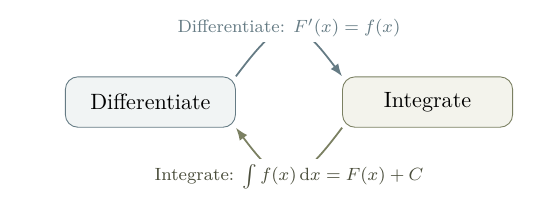
Integration reverses differentiation. Check answers by differentiating them.
Boundary
This lesson covers standard forms and linear inputs. Non-linear reverse-chain-rule substitution is treated separately.
Core standard integrals
The following standard results should become automatic. For indefinite integrals, always include the constant of integration \(C\).
| Integral | Result and notes |
|---|---|
| \(\int k\,dx\) | \(kx+C\), where \(k\) is constant. |
| \(\int x^n\,dx\) | \(\dfrac{x^{n+1}}{n+1}+C\), for \(n\in\mathbb Q\), \(n\ne-1\). |
| \(\int\frac1x\,dx\) | \(\ln|x|+C\). If \(x>0\), this is \(\ln x+C\). |
| \(\int e^x\,dx\) | \(e^x+C\). |
| \(\int\sin x\,dx\) | \(-\cos x+C\). |
| \(\int\cos x\,dx\) | \(\sin x+C\). |
Important exception
The power rule does not work for \(n=-1\), because \(n+1=0\) would require division by zero. Use the separate logarithmic result:
Radians reminder
The derivative and antiderivative results for \(\sin x\) and \(\cos x\) are stated in radians. In calculus, trigonometric functions are interpreted in radians unless explicitly stated otherwise.
Linearity: combining standard integrals
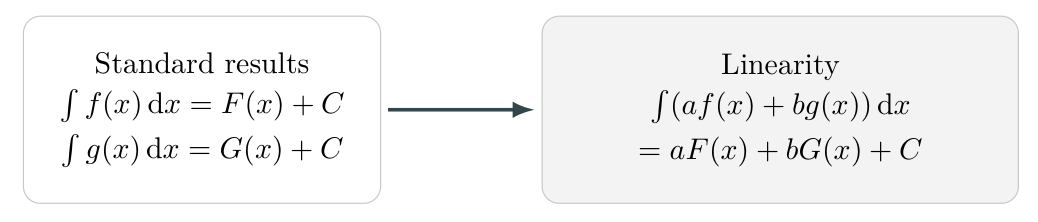
Linearity lets us integrate term by term. If \(a\) and \(b\) are constants, then
Split sums and differences, and keep constant multipliers in front.
Useful simplification step
Before integrating, rewrite roots and fractions as powers when this makes the standard table easier to use:
Worked example 1: powers, logarithms and exponentials
Find \(\int\left(6x^2-\frac4x+5e^x\right)\,dx\).
Solution
Use linearity to separate the three standard integrals:
Worked example 2: trigonometric standard integrals
Find \(\int(3\sin x-2\cos x)\,dx\).
Solution
Use \(\int\sin x\,dx=-\cos x+C\) and \(\int\cos x\,dx=\sin x+C\):
Worked example 3: rewriting roots as powers
Find \(\int\left(4x^3-3\sqrt{x}+\frac2{\sqrt{x}}\right)\,dx\).
Solution
First write \(\sqrt{x}=x^{1/2}\) and \(1/\sqrt{x}=x^{-1/2}\). Apply the power rule to each term:
Linear inputs: functions of \(ax+b\)
Once the standard results and linearity are secure, we can change the input from \(x\) to a linear expression \(ax+b\).
Linear-input rule
If \(F'(x)=f(x)\) and \(a\ne0\), then
Integrate as usual, then divide by the coefficient of x inside the bracket.

Why divide by a?
Check by differentiating:
The factor \(1/a\) cancels the extra \(a\) produced by the chain rule.
| Integral | Result (with a ≠ 0) |
|---|---|
| \(\int(ax+b)^n\,dx\) | \(\dfrac{(ax+b)^{n+1}}{a(n+1)}+C\), \(n\ne-1\). |
| \(\int\frac1{ax+b}\,dx\) | \(\dfrac1a\ln|ax+b|+C\). |
| \(\int e^{ax+b}\,dx\) | \(\dfrac1ae^{ax+b}+C\). |
| \(\int\sin(ax+b)\,dx\) | \(-\dfrac1a\cos(ax+b)+C\). |
| \(\int\cos(ax+b)\,dx\) | \(\dfrac1a\sin(ax+b)+C\). |
Worked example 4: cosine with a linear input
Find \(\int\cos(2x+3)\,dx\).
Solution
Since \(\int\cos u\,du=\sin u+C\), and the coefficient of \(x\) inside is \(2\),
Worked example 5: logarithmic integral with a negative coefficient
Find \(\int\frac1{5-2x}\,dx\).
Solution
Here \(5-2x=-2x+5\), so \(a=-2\). Use the logarithmic linear-input rule:
Check.
Worked example 6: mixed standard and linear inputs
Find \(\int\left(4x^3-3\sqrt{x}+2e^{1-3x}\right)\,dx\).
Solution
First write \(\sqrt{x}=x^{1/2}\). Integrate term by term; the exponential input has coefficient \(-3\).
Worked example 7: power of a linear expression
Find \(\int(3x-5)^7\,dx\).
Solution
The inside is \(3x-5\), so \(a=3\). Increase the power to \(8\), then divide by both \(8\) and \(3\).
Check.
Common traps
| Trap | Fix |
|---|---|
| Forgetting \(+C\) | Include it for every indefinite integral unless a condition determines a particular antiderivative. |
| Using power rule for \(x^{-1}\) | Use \(\ln|x|+C\). |
| Forgetting linear coefficient | For \(f(ax+b)\), divide by \(a\). |
| Dividing by the constant term | Divide by the coefficient of \(x\), not \(b\). |
| Degrees instead of radians | Calculus uses radians unless stated otherwise. |
| Dropping absolute values | Write \(\ln|ax+b|\) unless the domain guarantees positivity. |
Check habit
Differentiate your answer. It should reconstruct the original integrand.
Practice questions
Try these without looking at the answers first. For indefinite integrals, include \(+C\).
A. Core standard integrals and linearity
- \(\int7x^6dx\)
- \(\int(5x^4-3x^2+8)dx\)
- \(\int(6/x+4e^x)dx\)
- \(\int(3\sin x-2\cos x)dx\)
- \(\int(\sqrt{x}+2/\sqrt{x})dx\)
B. Linear inputs
- \(\int(2x+1)^5dx\)
- \(\int(7-3x)^4dx\)
- \(\int e^{4x-1}dx\)
- \(\int\sin(5x)dx\)
- \(\int\cos(3x-\pi)dx\)
- \(\int\frac1{4x+9}dx\)
- \(\int\frac3{2-5x}dx\)
C. Mixed and particular antiderivatives
- \(\int(2(3x-1)^4-5e^{-x})dx\)
- \(\int(6x^2+4\cos(2x)-3/x)dx\)
- \(\int(5e^{2x-1}-2\sin(3x))dx\)
- Find \(F\) if \(F'(x)=6x^2-2/x\) and \(F(1)=4\).
- Explain why \(\int x^{-1}dx\) is not found using \(x^0/0\).
Answer key
Show the answers to A, B and C
A
- \(x^7+C\)
- \(x^5-x^3+8x+C\)
- \(6\ln|x|+4e^x+C\)
- \(-3\cos x-2\sin x+C\)
- \(\frac23x^{3/2}+4x^{1/2}+C\)
B
- \((2x+1)^6/12+C\)
- \(-(7-3x)^5/15+C\)
- \(e^{4x-1}/4+C\)
- \(-\cos(5x)/5+C\)
- \(\sin(3x-\pi)/3+C\)
- \(\ln|4x+9|/4+C\)
- \(-3\ln|2-5x|/5+C\)
C
- \(2(3x-1)^5/15+5e^{-x}+C\)
- \(2x^3+2\sin(2x)-3\ln|x|+C\)
- \(\frac52e^{2x-1}+\frac23\cos(3x)+C\)
- First integrate: \(F(x)=2x^3-2\ln|x|+C\). Since \(F(1)=4\), we have \(2-2\ln1+C=4\), so \(C=2\). Therefore \(F(x)=2x^3-2\ln|x|+2\).
- The power rule is invalid because \(n+1=0\); use \(\ln|x|+C\).