IB Mathematics: Analysis and Approaches HL — Topic 5 Calculus
Further Derivatives & Antiderivatives
Build the AHL 5.15 derivative–antiderivative library, handle linear composites, and choose between arctangent forms, power-rule forms and partial fractions for reciprocal quadratics.
Learning goal
Differentiate and integrate the additional reciprocal-trig, base-\(a\), logarithmic and inverse-trig functions required at AA HL.
Syllabus link
AHL 5.15 Further derivatives and antiderivatives; linear composites; partial fractions.
Big idea
Learn each new derivative pair once, then read it forwards to differentiate and backwards to integrate.
Method choice
For reciprocal quadratics, the discriminant tells you whether to complete the square, use a repeated-root power rule, or use partial fractions.
AHL 5.15 is best learned as a reversible derivative–antiderivative library. The same pair is read forwards to differentiate and backwards to integrate; linear composites and rational integrands then add method choices around that core library.
One relationship, two directions
We have already used the central link many times: \[F'(x)=f(x) \quad\Longleftrightarrow\quad \frac{\mathrm{d}}{\mathrm{d} x}F(x)=f(x) \quad\Longleftrightarrow\quad \int f(x)\,\mathrm{d} x=F(x)+C.\]
So the aim of this handout is not to learn one list of derivatives and then a separate list of integrals. Instead, each new result is learned as a reversible pair.
Read a derivative pair in either direction
For example, \[\frac{\mathrm{d}}{\mathrm{d} x}(\tan x)=\sec^2x.\] Read from left to right: \[\tan x \;\longrightarrow\; \sec^2x \qquad\text{(differentiate).}\] Read from right to left: \[\int \sec^2x\,\mathrm{d} x=\tan x+C \qquad\text{(antidifferentiate).}\] The mathematics is the same relationship viewed in opposite directions.
Formula-booklet orientation
The IB Mathematics: analysis and approaches formula booklet contains the full AHL 5.15 table of the nine new standard derivatives introduced in this handout. It also explicitly lists \[\int a^x\,\mathrm{d} x=\frac{a^x}{\ln a}+C,\qquad \int\frac{1}{a^2+x^2}\,\mathrm{d} x=\frac1a\arctan\!\left(\frac{x}{a}\right)+C,\] and \[\int\frac{1}{\sqrt{a^2-x^2}}\,\mathrm{d} x=\arcsin\!\left(\frac{x}{a}\right)+C.\] However, it does not provide a ready-made formula for every linear composite or every rearrangement needed in a rational integral. You must still recognize the pattern, apply the chain rule in reverse, complete the square when appropriate, and know how to use partial fractions. For examination speed, aim to know the standard derivative–antiderivative pairs by heart even though the derivative table is supplied.
Notation: \(\arcsin x\) is not the reciprocal of \(\sin x\)
In this handout we use \(\arcsin x\), \(\arccos x\) and \(\arctan x\) for inverse trigonometric functions. This avoids the ambiguity of notation such as \(\sin^{-1}x\). The reciprocal of \(\sin x\) is \(\operatorname{cosec} x\), not \(\arcsin x\).
Reciprocal trigonometric derivatives and antiderivatives
| Function \(F(x)\) | Derivative \(F'(x)\) | Antiderivative read backwards |
|---|---|---|
| \(\tan x\) | \(\sec^2x\) | \(\int\sec^2x\,dx=\tan x+C\) |
| \(\sec x\) | \(\sec x\tan x\) | \(\int\sec x\tan x\,dx=\sec x+C\) |
| \(\operatorname{cosec}x\) | \(-\operatorname{cosec}x\cot x\) | \(\int\operatorname{cosec}x\cot x\,dx=-\operatorname{cosec}x+C\) |
| \(\cot x\) | \(-\operatorname{cosec}^2x\) | \(\int\operatorname{cosec}^2x\,dx=-\cot x+C\) |
Recall from AHL trigonometry that \[\sec x=\frac1{\cos x},\qquad \operatorname{cosec} x=\frac1{\sin x},\qquad \cot x=\frac{\cos x}{\sin x},\] and \[1+\tan^2x=\sec^2x, \qquad 1+\cot^2x=\operatorname{cosec}^2x.\]
The four reciprocal-trigonometric pairs
| Function \(F(x)\) | Derivative \(F'(x)\) | |
|---|---|---|
| \(\tan x\) | \(\sec^2x\) | |
| \(\sec x\) | \(\sec x\tan x\) | |
| \(\operatorname{cosec} x\) | \(-\operatorname{cosec} x\cot x\) | |
| \(\cot x\) | \(-\operatorname{cosec}^2x\) |
Read each row left-to-right for differentiation and right-to-left for integration, adding \(+C\) in the integral direction.
Formula booklet: reciprocal trigonometric pairs
All four derivative rules in the table above are printed in the AHL 5.15 formula-booklet table. Their antiderivatives are not repeated as a separate list of standard integrals; instead, read the supplied derivative table backwards. In practice, these four pairs are worth knowing by heart, especially the two negative signs in the \(\operatorname{cosec} x\) and \(\cot x\) rows.
Worked example 1: differentiating a combination of reciprocal trigonometric functions
Differentiate \[f(x)=3\tan x-2\sec x+4\operatorname{cosec} x-5\cot x.\]
Apply the four rules term by term: \[\begin{aligned} f'(x) &=3\sec^2x-2\sec x\tan x+4(-\operatorname{cosec} x\cot x)-5(-\operatorname{cosec}^2x)\\ &=\boxed{3\sec^2x-2\sec x\tan x-4\operatorname{cosec} x\cot x+5\operatorname{cosec}^2x}. \end{aligned}\]
Worked example 2: reading the same pairs backwards
Evaluate \[\int\left(5\sec^2x-3\sec x\tan x+2\operatorname{cosec} x\cot x+4\operatorname{cosec}^2x\right)\,\mathrm{d} x.\]
Match each term to a derivative from the table: \[\begin{aligned} \int5\sec^2x\,\mathrm{d} x &=5\tan x,\\ \int(-3\sec x\tan x)\,\mathrm{d} x &=-3\sec x,\\ \int2\operatorname{cosec} x\cot x\,\mathrm{d} x &=-2\operatorname{cosec} x,\\ \int4\operatorname{cosec}^2x\,\mathrm{d} x &=-4\cot x. \end{aligned}\] Therefore \[\boxed{\begin{aligned} &\int\left(5\sec^2x-3\sec x\tan x+2\operatorname{cosec} x\cot x+4\operatorname{cosec}^2x\right)\,\mathrm{d} x\\ &\hspace{1.8cm}=5\tan x-3\sec x-2\operatorname{cosec} x-4\cot x+C \end{aligned}}\] A quick differentiation of the answer reproduces the integrand.
Common sign trap
The two rules involving \(\operatorname{cosec} x\) and \(\cot x\) contain negatives: \[(\operatorname{cosec} x)'=-\operatorname{cosec} x\cot x, \qquad (\cot x)'=-\operatorname{cosec}^2x.\] Therefore \[\int \operatorname{cosec} x\cot x\,\mathrm{d} x=-\operatorname{cosec} x+C, \qquad \int \operatorname{cosec}^2x\,\mathrm{d} x=-\cot x+C.\]
Exponential and logarithmic functions with base \(a\)
| Function | Derivative | Antiderivative |
|---|---|---|
| \(a^x\) | \(a^x\ln a\) | \(\int a^x\,dx=\frac{a^x}{\ln a}+C\) |
| \(\log_a x\) | \(\frac1{x\ln a}\) | \(\int\frac1{x\ln a}\,dx=\log_a x+C\) |
The familiar special-base results \[\frac{\mathrm{d}}{\mathrm{d} x}e^x=e^x, \qquad \frac{\mathrm{d}}{\mathrm{d} x}\ln x=\frac1x\] extend naturally to any valid base \(a\).
Base conditions
Throughout this section, \[a>0,\qquad a\neq1.\] For \(\log_a x\), we also require \(x>0\).
The base- \(a\) pairs
| Function \(F(x)\) | Derivative \(F'(x)\) | |
|---|---|---|
| \(a^x\) | \(a^x\ln a\) | |
| \(\log_a x\) | \(\dfrac1{x\ln a}\) |
Two especially useful integral forms are therefore \[\boxed{\int a^x\,\mathrm{d} x=\frac{a^x}{\ln a}+C} \qquad\text{and}\qquad \boxed{\int\frac1{x\ln a}\,\mathrm{d} x=\log_a x+C\quad(x>0).}\]
Formula booklet: base- \(a\) exponential and logarithm
The derivatives \[(a^x)'=a^x\ln a, \qquad (\log_a x)'=\frac{1}{x\ln a}\] are both given in the AHL 5.15 derivative table. The booklet also explicitly gives \(\int a^x\,\mathrm{d} x=\dfrac{a^x}{\ln a}+C\). It does not separately list \(\int \dfrac{1}{x\ln a}\,\mathrm{d} x\); recover that immediately by reading the derivative of \(\log_a x\) backwards. The \(\ln a\) factors are worth knowing without having to look them up.
Worked example 3: differentiating base- \(a\) exponential and logarithmic functions
Differentiate \[f(x)=2\cdot5^x-3\log_2x.\]
Using the two rules, \[\begin{aligned} f'(x) &=2\cdot5^x\ln5-3\left(\frac1{x\ln2}\right)\\ &=\boxed{2\cdot5^x\ln5-\frac3{x\ln2}}. \end{aligned}\]
Worked example 4: integrating base- \(a\) expressions
Evaluate, for \(x>0\), \[\int\left(7\cdot3^x+\frac4{x\ln5}\right)\,\mathrm{d} x.\]
For the first term we need to divide by \(\ln3\), because differentiating \(3^x\) produces the extra factor \(\ln3\): \[\begin{aligned} \int\left(7\cdot3^x+\frac4{x\ln5}\right)\,\mathrm{d} x &=7\frac{3^x}{\ln3}+4\log_5x+C. \end{aligned}\] Hence \[\boxed{\frac{7\cdot3^x}{\ln3}+4\log_5x+C.}\]
A common exponential-integral mistake
For \(a\neq e\), \[\int a^x\,\mathrm{d} x\neq a^x+C.\] The factor \(\ln a\) appears when \(a^x\) is differentiated, so the antiderivative must compensate for it: \[\int a^x\,\mathrm{d} x=\frac{a^x}{\ln a}+C.\]
Inverse trigonometric derivatives and antiderivatives
| Function | Derivative | Domain |
|---|---|---|
| \(\arcsin x\) | \(\frac1{\sqrt{1-x^2}}\) | \(-1<x<1\) |
| \(\arccos x\) | \(-\frac1{\sqrt{1-x^2}}\) | \(-1<x<1\) |
| \(\arctan x\) | \(\frac1{1+x^2}\) | all real \(x\) |
The three inverse trigonometric functions required here are \(\arcsin x\), \(\arccos x\) and \(\arctan x\).
The inverse-trigonometric pairs
So, on appropriate intervals, \[\boxed{\int\frac{1}{\sqrt{1-x^2}}\,\mathrm{d} x=\arcsin x+C} \qquad\text{and}\qquad \boxed{\int\frac1{1+x^2}\,\mathrm{d} x=\arctan x+C.}\]
Formula booklet: inverse-trigonometric forms
All three derivatives of \(\arcsin x\), \(\arccos x\) and \(\arctan x\) are given in the AHL 5.15 derivative table. The booklet also explicitly gives the more general standard integrals \[\int\frac{1}{a^2+x^2}\,\mathrm{d} x \quad\text{and}\quad \int\frac{1}{\sqrt{a^2-x^2}}\,\mathrm{d} x,\] leading to \(\arctan(x/a)\) and \(\arcsin(x/a)\), respectively. There is no separate standard-integral entry for an \(\arccos\) antiderivative; use the supplied derivative rule in reverse. For speed, know the three derivative shapes by heart: \(\arcsin\) and \(\arccos\) involve \(\sqrt{1-x^2}\), while \(\arctan\) involves \(1+x^2\).
Worked example 5: differentiating inverse trigonometric functions
Differentiate \[g(x)=2\arcsin x-\arccos x+3\arctan x.\]
Then \[\begin{aligned} g'(x) &=\frac2{\sqrt{1-x^2}}-\left(-\frac1{\sqrt{1-x^2}}\right)+\frac3{1+x^2}\\ &=\boxed{\frac3{\sqrt{1-x^2}}+\frac3{1+x^2}}. \end{aligned}\] The derivative exists for \(-1<x<1\), because the \(\arcsin x\) and \(\arccos x\) terms impose the narrower domain.
Worked example 6: integrating inverse-trigonometric derivative forms
Evaluate \[\int\left(\frac6{1+x^2}-\frac5{\sqrt{1-x^2}}\right)\,\mathrm{d} x.\]
Recognize the two standard derivative forms: \[\begin{aligned} \int\frac6{1+x^2}\,\mathrm{d} x &=6\arctan x,\\ \int-\frac5{\sqrt{1-x^2}}\,\mathrm{d} x &=-5\arcsin x. \end{aligned}\] Therefore \[\boxed{6\arctan x-5\arcsin x+C.}\]
Do not confuse these two patterns
\[\frac1{1+x^2}\quad\longrightarrow\quad\arctan x, \qquad \frac1{\sqrt{1-x^2}}\quad\longrightarrow\quad\arcsin x.\] The square root is the key visual cue for the \(\arcsin\) / \(\arccos\) pair.
Linear composites: the same pairs with one extra constant
The syllabus also requires composites of these functions with a linear function. This is not a new collection of derivative and integral rules. It is the same table together with the chain rule.
Suppose \[F'(u)=f(u),\qquad u=mx+c,\qquad m\neq0.\] Then \[\frac{\mathrm{d}}{\mathrm{d} x}F(mx+c)=m\,f(mx+c).\] Reading the same relationship backwards gives \[\boxed{\int f(mx+c)\,\mathrm{d} x=\frac1mF(mx+c)+C.}\]
Formula booklet: what is not written as a separate composite rule
The formula booklet gives the chain rule and the underlying standard derivatives, but it does not list every AHL 5.15 linear-composite derivative or antiderivative separately. You need to supply the inner derivative yourself: multiply by \(m\) when differentiating \(F(mx+c)\), and divide by \(m\) when integrating \(f(mx+c)\). This adjustment should be automatic rather than something you need to search for in the booklet.
The one adjustment to remember
Differentiating: multiply by the derivative of the linear inside function. \[F(mx+c)\longrightarrow m\,F'(mx+c).\] Integrating: compensate for that inner derivative by dividing by it. \[F'(mx+c)\longrightarrow \frac1mF(mx+c)+C.\] Because the inside function is linear, its derivative is just the constant \(m\).
Worked example 7: differentiating linear composites
Differentiate \[f(x)=2\sec(3x-1)+4\arctan(5x+2)-7^{2x-3}+3\log_4(6x+1).\]
Show the basic derivative first, then multiply by the derivative of the inside function: \[\begin{aligned} f'(x) &=2\bigl[\sec(3x-1)\tan(3x-1)\bigr](3)\\ &\quad+4\left[\frac{1}{1+(5x+2)^2}\right](5)\\ &\quad-\bigl[7^{2x-3}\ln7\bigr](2) +3\left[\frac{1}{(6x+1)\ln4}\right](6). \end{aligned}\] Therefore \[\boxed{f'(x)=6\sec(3x-1)\tan(3x-1) +\frac{20}{1+(5x+2)^2} -2(7^{2x-3})\ln7 +\frac{18}{(6x+1)\ln4}.}\]
Worked example 8: integrating linear composites directly from the table
Evaluate \[\int\left[\sec^2(2x+5)+3\cdot5^{4x-1}\right]\,\mathrm{d} x.\]
For the first term, \[\int\sec^2(2x+5)\,\mathrm{d} x =\frac12\tan(2x+5).\] For the second term, differentiating \(5^{4x-1}\) would produce both a factor of \(4\) and a factor of \(\ln5\). Therefore \[\int3\cdot5^{4x-1}\,\mathrm{d} x =\frac{3}{4\ln5}\,5^{4x-1}.\] Hence \[\boxed{\int\left[\sec^2(2x+5)+3\cdot5^{4x-1}\right]\,\mathrm{d} x =\frac12\tan(2x+5)+\frac{3\,5^{4x-1}}{4\ln5}+C.}\] The first result is the same pattern as the syllabus example \(\int\sec^2(2x+5)\,\mathrm{d} x=\tfrac12\tan(2x+5)+C\).
Worked example 9: rewriting into an arcsine form
Evaluate \[\int\frac{1}{\sqrt{9-4x^2}}\,\mathrm{d} x.\]
Factor \(9\) inside the square root: \[\begin{aligned} \sqrt{9-4x^2} &=3\sqrt{1-\frac{4x^2}{9}}\\ &=3\sqrt{1-\left(\frac{2x}{3}\right)^2}. \end{aligned}\] So \[\int\frac{1}{\sqrt{9-4x^2}}\,\mathrm{d} x =\frac13\int\frac{1}{\sqrt{1-\left(\frac{2x}{3}\right)^2}}\,\mathrm{d} x.\] Since the derivative of \(\dfrac{2x}{3}\) is \(\dfrac23\), reverse the chain rule by multiplying by \(\dfrac32\): \[\frac13\cdot\frac32\,\arcsin\left(\frac{2x}{3}\right)+C.\] Therefore \[\boxed{\int\frac{1}{\sqrt{9-4x^2}}\,\mathrm{d} x =\frac12\arcsin\left(\frac{2x}{3}\right)+C.}\]
Common linear-composite trap
Do not simply replace \(x\) by \(mx+c\) and forget the chain-rule factor. For example, \[\frac{\mathrm{d}}{\mathrm{d} x}\bigl(\arctan(3x)\bigr) =\frac{3}{1+9x^2},\] so \[\int\frac{1}{1+9x^2}\,\mathrm{d} x =\frac13\arctan(3x)+C.\] A quick differentiation of your proposed antiderivative is the fastest check.
Reciprocal of a quadratic
We now look at integrals in which the denominator is a quadratic, for example \[\int\frac{1}{x^2+2x+5}\,\mathrm{d} x.\] Do not try to integrate it immediately. First inspect the quadratic in the denominator: its roots help determine which integration method is most appropriate.
Reciprocal of a quadratic: let the discriminant guide the method
For a quadratic denominator \(ax^2+bx+c\), the discriminant \[\Delta=b^2-4ac\] tells us about its real roots and therefore helps us choose the most natural integration method.
For the quadratic in Worked example 10 below, \[\Delta=2^2-4(1)(5)=-16<0,\] so the absence of real roots tells us to complete the square and look for an \(\arctan\) form.
By contrast, \[x^2+3x+2=(x+1)(x+2), \qquad \Delta=1>0,\] so an integral such as \[\int\frac{1}{x^2+3x+2}\,\mathrm{d} x\] is naturally treated using partial fractions. AHL 5.15 explicitly requires us to use partial fractions to rearrange the integrand; we do that immediately after the arctangent example below.
Formula booklet: the formula is given; choosing and creating the form is your job
For the \(\Delta<0\) case, the booklet gives the useful standard integral \[\int\frac{1}{a^2+x^2}\,\mathrm{d} x =\frac1a\arctan\!\left(\frac{x}{a}\right)+C.\] What it does not do is tell you to inspect the discriminant, complete the square, factor out constants, or make the required linear substitution. Likewise, it does not provide a partial-fraction decomposition for the \(\Delta>0\) case. Those are techniques you must recognize and carry out yourself.
Worked example 10: rewriting a quadratic denominator into an arctangent form
Evaluate \[\int\frac{1}{x^2+2x+5}\,\mathrm{d} x.\]
The denominator does not yet look like \(1+u^2\), so complete the square: \[\begin{aligned} x^2+2x+5 &=(x+1)^2+4\\ &=4\left[1+\left(\frac{x+1}{2}\right)^2\right]. \end{aligned}\] Therefore \[\int\frac{1}{x^2+2x+5}\,\mathrm{d} x =\frac14\int\frac{1}{1+\left(\frac{x+1}{2}\right)^2}\,\mathrm{d} x.\] The inside function is \(u=\dfrac{x+1}{2}\), whose derivative is \(\dfrac12\). To reverse the chain rule we therefore multiply by \(2\): \[\frac14\cdot2\,\arctan\left(\frac{x+1}{2}\right)+C.\] Hence \[\boxed{\int\frac{1}{x^2+2x+5}\,\mathrm{d} x =\frac12\arctan\left(\frac{x+1}{2}\right)+C.}\] This is the exact form highlighted in the AHL 5.15 syllabus guidance.
6.1 When the quadratic has two distinct real roots: use partial fractions
What AHL 5.15 adds: rearrange the integrand first
If the quadratic denominator factors into two distinct linear factors, the integrand can often be rewritten as a sum of two simpler fractions. This is the partial-fractions technique linked back to AHL 1.11.
Within the AA HL syllabus scope used here, \[\frac{px+q}{(ax+b)(cx+d)} =\frac{A}{ax+b}+\frac{B}{cx+d},\] where the numerator has lower degree than the denominator. Once the integrand has been rearranged, integrate the two simple linear-denominator terms separately.
Formula booklet: partial fractions are a method, not a supplied formula
The formula booklet does not carry out or tabulate the decomposition \[\frac{px+q}{(ax+b)(cx+d)} =\frac{A}{ax+b}+\frac{B}{cx+d}.\] You are expected to know how to find \(A\) and \(B\). After decomposition, the earlier SL standard integral \(\int \frac1x\,\mathrm{d} x=\ln x+C\), together with the linear-composite adjustment, gives the required logarithmic antiderivatives. In general working we write logarithms with absolute values, for example \(\ln|ax+b|\).
Worked example 11: the AHL 5.15 partial-fractions integral
Evaluate \[\int\frac{1}{x^2+3x+2}\,\mathrm{d} x.\]
The quadratic has two distinct real roots: \[x^2+3x+2=(x+1)(x+2).\] So first rearrange the integrand using partial fractions: \[\frac{1}{(x+1)(x+2)} =\frac{A}{x+1}+\frac{B}{x+2}.\] Multiply through by \((x+1)(x+2)\): \[1=A(x+2)+B(x+1).\] Choose values of \(x\) that make one term disappear: \[x=-1:\quad 1=A \quad\Rightarrow\quad A=1,\] \[x=-2:\quad 1=-B \quad\Rightarrow\quad B=-1.\] Therefore \[\frac{1}{x^2+3x+2} =\frac{1}{x+1}-\frac{1}{x+2}.\] Now the integration is immediate: \[\begin{aligned} \int\frac{1}{x^2+3x+2}\,\mathrm{d} x &=\int\left(\frac{1}{x+1}-\frac{1}{x+2}\right)\mathrm{d} x\\ &=\ln|x+1|-\ln|x+2|+C\\ &=\boxed{\ln\left|\frac{x+1}{x+2}\right|+C}. \end{aligned}\] This is the partial-fractions example highlighted in the AHL 5.15 syllabus guidance.
Why partial fractions help with integration
The difficult-looking rational expression is not integrated in its original form. Partial fraction decomposition is an algebraic rearrangement: \[\frac{px+q}{(ax+b)(cx+d)} \quad\longrightarrow\quad \frac{A}{ax+b}+\frac{B}{cx+d}.\] Each new term is then a familiar logarithmic integral. If you need a refresher on how to find \(A\) and \(B\), see Appendix A: Partial Fraction Decomposition Crash Course.
6.2 For completeness: when \(\Delta=0\)
If the quadratic has a repeated real root, partial fractions are not needed. Factor the quadratic as a square and use a simple \(u\)-substitution to turn the integral into a standard power-rule form.
Worked example 12: a repeated root ( \(\Delta=0\) )
Evaluate \[\int\frac{1}{4x^2+12x+9}\,\mathrm{d} x.\]
First check the discriminant: \[\Delta=12^2-4(4)(9)=144-144=0.\] So the quadratic has a repeated root, and \[4x^2+12x+9=(2x+3)^2.\] Hence \[\int\frac{1}{4x^2+12x+9}\,\mathrm{d} x =\int\frac{1}{(2x+3)^2}\,\mathrm{d} x.\] Let \[u=2x+3, \qquad \mathrm{d} u=2\,\mathrm{d} x, \qquad \mathrm{d} x=\frac12\,\mathrm{d} u.\] Then \[\begin{aligned} \int\frac{1}{(2x+3)^2}\,\mathrm{d} x &=\frac12\int\frac{1}{u^2}\,\mathrm{d} u\\ &=-\frac{1}{2u}+C\\ &=\boxed{-\frac{1}{2(2x+3)}+C}. \end{aligned}\] So the three discriminant cases are now complete: \(\Delta<0\) leads to an \(\arctan\) form, \(\Delta=0\) to a repeated-factor power-rule integral (often after a short \(u\)-substitution), and \(\Delta>0\) to partial fractions.
A quick reminder: why do we write \(+C\) ?
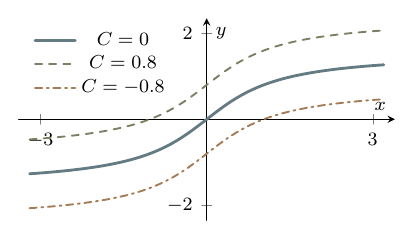
An indefinite integral represents a family of curves
If \(F'(x)=f(x)\), then \[\frac{\mathrm{d}}{\mathrm{d} x}\bigl(F(x)+C\bigr)=f(x)\] for any constant \(C\), because the derivative of a constant is zero. Therefore \[\int f(x)\,\mathrm{d} x=F(x)+C\] represents a family of vertically translated curves.
For example, every curve \[y=\arctan x+C\] has derivative \(\dfrac{1}{1+x^2}\). Changing \(C\) moves the curve up or down; it does not change its gradient at any given \(x\)-value.
Using the table efficiently
| Derivative pattern | Think of this antiderivative |
|---|---|
| \(\sec^2x\) | \(\tan x\) |
| \(\sec x\tan x\) | \(\sec x\) |
| \(\operatorname{cosec}x\cot x\) | \(-\operatorname{cosec}x\) |
| \(\operatorname{cosec}^2x\) | \(-\cot x\) |
| \(a^x\) | \(a^x/\ln a\) |
| \(1/(x\ln a)\) | \(\log_a x\) |
| \(1/\sqrt{1-x^2}\) | \(\arcsin x\) |
| \(-1/\sqrt{1-x^2}\) | \(\arccos x\) |
| \(1/(1+x^2)\) | \(\arctan x\) |
When differentiating, ask: Which function do I see? When integrating, reverse the question: Which derivative pattern do I see?
Fast pattern-recognition checklist
For a linear composite, make the inner derivative visible
If the inside is \(mx+c\), write the constant \(m\) explicitly in your working. For differentiation it appears as a multiplier; for integration you compensate by dividing by it. This one habit prevents most linear-composite errors.
Why the derivative rules work
The practical rules above are the ones we need to use fluently. The derivations are placed here, after the methods, so that they explain and connect results we can already use.
9.1 Deriving the reciprocal-trigonometric rules
Start with \(\tan x=\dfrac{\sin x}{\cos x}\). By the quotient rule, \[\begin{aligned} \frac{\mathrm{d}}{\mathrm{d} x}(\tan x) &=\frac{\cos x\cos x-\sin x(-\sin x)}{\cos^2x}\\ &=\frac{\cos^2x+\sin^2x}{\cos^2x}\\ &=\frac1{\cos^2x}=\boxed{\sec^2x}. \end{aligned}\]
For \(\sec x=(\cos x)^{-1}\), \[\begin{aligned} \frac{\mathrm{d}}{\mathrm{d} x}(\sec x) &=-(\cos x)^{-2}(-\sin x)\\ &=\frac{\sin x}{\cos^2x} =\frac1{\cos x}\frac{\sin x}{\cos x}\\ &=\boxed{\sec x\tan x}. \end{aligned}\]
Similarly, \[\begin{aligned} \frac{\mathrm{d}}{\mathrm{d} x}(\operatorname{cosec} x) &=\frac{\mathrm{d}}{\mathrm{d} x}(\sin x)^{-1} =-(\sin x)^{-2}\cos x\\ &=-\frac1{\sin x}\frac{\cos x}{\sin x} =\boxed{-\operatorname{cosec} x\cot x}. \end{aligned}\]
Finally, with \(\cot x=\dfrac{\cos x}{\sin x}\), \[\begin{aligned} \frac{\mathrm{d}}{\mathrm{d} x}(\cot x) &=\frac{(-\sin x)\sin x-\cos x\cos x}{\sin^2x}\\ &=-\frac{\sin^2x+\cos^2x}{\sin^2x} =\boxed{-\operatorname{cosec}^2x}. \end{aligned}\]
9.2 Deriving the base-\(a\) exponential and logarithmic rules
Use \[a^x=e^{x\ln a}.\] Then the chain rule gives \[\frac{\mathrm{d}}{\mathrm{d} x}(a^x) =e^{x\ln a}\ln a =\boxed{a^x\ln a}.\]
Also, by the change-of-base formula, \[\log_a x=\frac{\ln x}{\ln a}.\] Since \(\ln a\) is a constant, \[\frac{\mathrm{d}}{\mathrm{d} x}(\log_a x) =\frac1{\ln a}\cdot\frac1x =\boxed{\frac1{x\ln a}}.\]
9.3 Deriving the inverse-trigonometric rules by implicit differentiation
For \(y=\arcsin x\): write \(\sin y=x\). Differentiate implicitly: \[\cos y\,\frac{\mathrm{d} y}{\mathrm{d} x}=1, \qquad \frac{\mathrm{d} y}{\mathrm{d} x}=\frac1{\cos y}.\] Since \(y\in[-\pi/2,\pi/2]\), we have \(\cos y\ge0\), so \[\cos y=\sqrt{1-\sin^2y}=\sqrt{1-x^2}.\] Hence \[\boxed{\frac{\mathrm{d}}{\mathrm{d} x}(\arcsin x)=\frac1{\sqrt{1-x^2}}}.\]
For \(y=\arccos x\): write \(\cos y=x\). Then \[-\sin y\,\frac{\mathrm{d} y}{\mathrm{d} x}=1.\] On the principal range \(y\in[0,\pi]\), \(\sin y\ge0\), so \(\sin y=\sqrt{1-x^2}\). Therefore \[\boxed{\frac{\mathrm{d}}{\mathrm{d} x}(\arccos x)=-\frac1{\sqrt{1-x^2}}}.\]
For \(y=\arctan x\): write \(\tan y=x\). Then \[\sec^2y\,\frac{\mathrm{d} y}{\mathrm{d} x}=1.\] Using \(\sec^2y=1+\tan^2y=1+x^2\), \[\boxed{\frac{\mathrm{d}}{\mathrm{d} x}(\arctan x)=\frac1{1+x^2}}.\]
9.4 Why the linear-composite adjustment works
If \(F'(u)=f(u)\) and \(u=mx+c\), then by the chain rule \[\frac{\mathrm{d}}{\mathrm{d} x}F(mx+c)=F'(mx+c)\cdot m=m\,f(mx+c).\] Dividing by \(m\), \[\frac{\mathrm{d}}{\mathrm{d} x}\left[\frac1mF(mx+c)\right]=f(mx+c).\] Therefore \[\boxed{\int f(mx+c)\,\mathrm{d} x=\frac1mF(mx+c)+C.}\] This is the reverse chain rule specialized to a linear inside function.
Master summary and common mistakes
| Function \(F(x)\) | Derivative \(F'(x)\) |
|---|---|
| \(\tan x\) | \(\sec^2x\) |
| \(\sec x\) | \(\sec x\tan x\) |
| \(\operatorname{cosec}x\) | \(-\operatorname{cosec}x\cot x\) |
| \(\cot x\) | \(-\operatorname{cosec}^2x\) |
| \(a^x\) | \(a^x\ln a\) |
| \(\log_a x\) | \(1/(x\ln a)\) |
| \(\arcsin x\) | \(1/\sqrt{1-x^2}\) |
| \(\arccos x\) | \(-1/\sqrt{1-x^2}\) |
| \(\arctan x\) | \(1/(1+x^2)\) |
Master table: learn each row once and use it in both directions
For integration, read from right to left and add \(+C\). For a linear composite \(F'(mx+c)\), also divide by the inner derivative \(m\). If a base-\(a\) exponential contributes a factor \(\ln a\), compensate for that as well.
What is actually supplied in the IB AA formula booklet?
| Given explicitly | All nine AHL 5.15 standard derivatives in the master table above; \(\displaystyle\int a^x\,\mathrm{d} x\); \(\displaystyle\int\frac{1}{a^2+x^2}\,\mathrm{d} x\); and \(\displaystyle\int\frac{1}{\sqrt{a^2-x^2}}\,\mathrm{d} x\). Earlier SL pages also give \(\displaystyle\int\frac1x\,\mathrm{d} x\), \(\int\sin x\,\mathrm{d} x\), \(\int\cos x\,\mathrm{d} x\), \(\int e^x\,\mathrm{d} x\), the power rule, and the chain rule. |
|---|---|
| Not given as ready-made entries | The reciprocal-trigonometric antiderivatives as a separate integral list; the \(\log_a x\) antiderivative as a separate integral entry; the \(\arccos\) antiderivative; every linear-composite variant; the discriminant-based method choice; completing the square; and partial-fraction decomposition. These must be recovered from the supplied rules or carried out as methods. |
| Best exam habit | Treat the booklet as a safety net. Aim to know the nine derivative–antiderivative pairs, the two negative reciprocal-trig signs, the \(\ln a\) factors, and the inverse-trig denominator patterns by heart. More importantly, know the methods that the booklet cannot perform for you: reverse-chain adjustment, completing the square, discriminant triage and partial fractions. |
Common mistakes
Writing \((\cot x)'=\operatorname{cosec}^2x\). The correct derivative is \(-\operatorname{cosec}^2x\).
Writing \((\operatorname{cosec} x)'=\operatorname{cosec} x\cot x\). The correct derivative has a negative sign.
Forgetting \(\ln a\) in \((a^x)'=a^x\ln a\).
Forgetting to divide by \(\ln a\) in \(\int a^x\,\mathrm{d} x\).
Confusing \(\arcsin x\) with \(1/\sin x\). The reciprocal is \(\operatorname{cosec} x\).
Confusing \(1/(1+x^2)\) with \(1/\sqrt{1-x^2}\).
Omitting \(+C\) from an indefinite integral.
Forgetting the chain-rule factor when differentiating a linear composite, or forgetting to divide by that factor when integrating.
Trying to integrate a factorable rational expression before rearranging it. If the denominator has two distinct linear factors, decompose into partial fractions first.
Forgetting absolute values in logarithmic antiderivatives such as \(\ln|ax+b|\).
Practice
A. Differentiate
Differentiate each function with respect to \(x\).
\(f(x)=\tan x+2\sec x\)
\(g(x)=3\operatorname{cosec} x-4\cot x\)
\(h(x)=7^x+2\log_3x\)
\(p(x)=4\arcsin x-\arccos x\)
\(q(x)=5\arctan x-2\sec x\)
\(r(x)=2\tan(3x-1)-4\operatorname{cosec}(5x)\)
\(s(x)=3\cdot2^{4x+1}+\log_5(2x+3)\)
\(t(x)=2\arcsin(3x)-5\arctan(2x-1)\)
B. Find each indefinite integral
\(\displaystyle \int \left(4\sec^2x-3\sec x\tan x\right)\,\mathrm{d} x\)
\(\displaystyle \int \left(2\operatorname{cosec} x\cot x+5\operatorname{cosec}^2x\right)\,\mathrm{d} x\)
\(\displaystyle \int \left(6\cdot5^x+\frac3{x\ln2}\right)\,\mathrm{d} x\), \(x>0\)
\(\displaystyle \int \left(\frac7{1+x^2}+\frac2{\sqrt{1-x^2}}\right)\,\mathrm{d} x\)
\(\displaystyle \int \sec^2(4x-3)\,\mathrm{d} x\)
\(\displaystyle \int \operatorname{cosec}(2x+1)\cot(2x+1)\,\mathrm{d} x\)
\(\displaystyle \int 3^{5x-2}\,\mathrm{d} x\)
\(\displaystyle \int \frac{1}{1+(3x+2)^2}\,\mathrm{d} x\)
C. Rewrite, recognize and reason
Evaluate \(\displaystyle \int\frac{1}{x^2-4x+8}\,\mathrm{d} x\) by completing the square and rewriting the denominator into an arctangent form.
Evaluate \(\displaystyle \int\frac{1}{\sqrt{25-9x^2}}\,\mathrm{d} x\).
Verify by differentiation that \(\dfrac{a^x}{\ln a}\) is an antiderivative of \(a^x\), where \(a>0\) and \(a\ne1\).
A student writes \[\int\frac{1}{1+(4x-1)^2}\,\mathrm{d} x=\arctan(4x-1)+C.\] Identify and correct the error.
D. Reciprocal quadratics and partial fractions
For each denominator below, use the discriminant to state the most natural method: complete the square and use arctan, power rule, or partial fractions. Do not integrate. \[\text{(a) }x^2+6x+13,\qquad \text{(b) }x^2-6x+9,\qquad \text{(c) }x^2-x-6.\]
Evaluate \(\displaystyle \int\frac{1}{x^2+3x+2}\,\mathrm{d} x\) using partial fractions.
Evaluate \(\displaystyle \int\frac{5}{x^2+x-6}\,\mathrm{d} x\) using partial fractions.
Evaluate \(\displaystyle \int\frac{3x+4}{x^2+x-6}\,\mathrm{d} x\) using partial fractions.
Evaluate \(\displaystyle \int\frac{3x+5}{x^2+4x+3}\,\mathrm{d} x\) using partial fractions.
Evaluate \(\displaystyle \int\frac{5x-3}{(3x+1)(x-2)}\,\mathrm{d} x\) using partial fractions.
Answer key
A. Differentiate
\(\boxed{f'(x)=\sec^2x+2\sec x\tan x}\)
\(\boxed{g'(x)=-3\operatorname{cosec} x\cot x+4\operatorname{cosec}^2x}\)
\(\boxed{h'(x)=7^x\ln7+\dfrac2{x\ln3}}\)
\(\boxed{p'(x)=\dfrac5{\sqrt{1-x^2}}}\), for \(-1<x<1\)
\(\boxed{q'(x)=\dfrac5{1+x^2}-2\sec x\tan x}\)
\(\boxed{r'(x)=6\sec^2(3x-1)+20\operatorname{cosec}(5x)\cot(5x)}\)
\(\boxed{s'(x)=12(2^{4x+1})\ln2+\dfrac{2}{(2x+3)\ln5}}\)
\(\boxed{t'(x)=\dfrac6{\sqrt{1-9x^2}}-\dfrac{10}{1+(2x-1)^2}}\)
B. Indefinite integrals
\(\boxed{4\tan x-3\sec x+C}\)
\(\boxed{-2\operatorname{cosec} x-5\cot x+C}\)
\(\boxed{\dfrac{6\cdot5^x}{\ln5}+3\log_2x+C}\)
\(\boxed{7\arctan x+2\arcsin x+C}\)
\(\boxed{\dfrac14\tan(4x-3)+C}\)
\(\boxed{-\dfrac12\operatorname{cosec}(2x+1)+C}\)
\(\boxed{\dfrac{3^{5x-2}}{5\ln3}+C}\)
\(\boxed{\dfrac13\arctan(3x+2)+C}\)
C. Rewrite, recognize and reason
Since \(x^2-4x+8=(x-2)^2+4=4\left[1+\left(\dfrac{x-2}{2}\right)^2\right]\), \[\boxed{\int\frac{1}{x^2-4x+8}\,\mathrm{d} x =\frac12\arctan\left(\frac{x-2}{2}\right)+C.}\]
Since \(\sqrt{25-9x^2}=5\sqrt{1-(3x/5)^2}\), \[\boxed{\int\frac{1}{\sqrt{25-9x^2}}\,\mathrm{d} x =\frac13\arcsin\left(\frac{3x}{5}\right)+C.}\]
\[\frac{\mathrm{d}}{\mathrm{d} x}\left(\frac{a^x}{\ln a}\right) =\frac{a^x\ln a}{\ln a}=a^x.\]
Differentiating \(\arctan(4x-1)\) produces an extra factor \(4\). Therefore the proposed antiderivative is four times too large: \[\boxed{\int\frac{1}{1+(4x-1)^2}\,\mathrm{d} x =\frac14\arctan(4x-1)+C.}\]
D. Reciprocal quadratics and partial fractions
\(\Delta=6^2-4(1)(13)=-16<0\): complete the square and use \(\arctan\).
\(\Delta=(-6)^2-4(1)(9)=0\): repeated root, so rewrite as a square and use a simple \(u\)-substitution (if useful) followed by the power rule.
\(\Delta=(-1)^2-4(1)(-6)=25>0\): two distinct real roots, so use partial fractions.
\[\frac{1}{x^2+3x+2}=\frac1{x+1}-\frac1{x+2},\] hence \[\boxed{\int\frac{1}{x^2+3x+2}\,\mathrm{d} x =\ln\left|\frac{x+1}{x+2}\right|+C.}\]
Since \(x^2+x-6=(x-2)(x+3)\), \[\frac5{(x-2)(x+3)}=\frac1{x-2}-\frac1{x+3}.\] Therefore \[\boxed{\ln|x-2|-\ln|x+3|+C.}\]
Since \(x^2+x-6=(x-2)(x+3)\), \[\frac{3x+4}{(x-2)(x+3)}=\frac2{x-2}+\frac1{x+3}.\] Therefore \[\boxed{2\ln|x-2|+\ln|x+3|+C.}\]
Since \(x^2+4x+3=(x+1)(x+3)\), \[\frac{3x+5}{(x+1)(x+3)}=\frac1{x+1}+\frac2{x+3}.\] Therefore \[\boxed{\ln|x+1|+2\ln|x+3|+C.}\]
\[\frac{5x-3}{(3x+1)(x-2)}=\frac2{3x+1}+\frac1{x-2}.\] Hence \[\boxed{\frac23\ln|3x+1|+\ln|x-2|+C.}\]
Appendix A: Partial Fraction Decomposition Crash Course
Partial fractions are an algebraic tool for rewriting one rational expression as a sum of simpler rational expressions. In AHL 5.15, the purpose is very practical: rearrange the integrand into pieces that are easy to integrate.
The AHL 1.11 scope linked to AHL 5.15
For the partial fractions required here, the denominator contains at most two distinct linear factors, and the numerator has lower degree than the denominator. So the core pattern is \[\frac{px+q}{(ax+b)(cx+d)} =\frac{A}{ax+b}+\frac{B}{cx+d}.\] More complicated cases such as three or more distinct factors or repeated-factor decompositions are outside the AHL 1.11 scope stated in the syllabus.
A.1 The five-step decomposition method
A reliable routine
Factor the denominator completely into its two distinct linear factors.
Write the partial-fraction form with unknown constants \(A\) and \(B\).
Multiply through by the original denominator to remove the fractions.
Choose convenient values of \(x\) (usually the roots of the denominator) to find \(A\) and \(B\). Comparing coefficients is an alternative.
Check by recombining the two fractions if there is any doubt.
Appendix worked example A1: the AHL 1.11 syllabus pattern
Decompose \[\frac{2x+1}{x^2+x-2}.\]
First factor the denominator: \[x^2+x-2=(x-1)(x+2).\] Write \[\frac{2x+1}{(x-1)(x+2)}=\frac{A}{x-1}+\frac{B}{x+2}.\] Multiply through by \((x-1)(x+2)\): \[2x+1=A(x+2)+B(x-1).\] Set \(x=1\): \[3=3A\quad\Rightarrow\quad A=1.\] Set \(x=-2\): \[-3=-3B\quad\Rightarrow\quad B=1.\] Hence \[\boxed{\frac{2x+1}{x^2+x-2}=\frac1{x-1}+\frac1{x+2}.}\] This is the decomposition pattern given in AHL 1.11.
Appendix worked example A2: a constant numerator
Decompose \[\frac5{x^2+x-6}.\]
Since \[x^2+x-6=(x-2)(x+3),\] write \[\frac5{(x-2)(x+3)}=\frac{A}{x-2}+\frac{B}{x+3}.\] Then \[5=A(x+3)+B(x-2).\] Using \(x=2\) gives \(A=1\), while \(x=-3\) gives \(B=-1\). Therefore \[\boxed{\frac5{x^2+x-6}=\frac1{x-2}-\frac1{x+3}.}\] Notice that a constant numerator does not mean the two numerators in the decomposition are equal.
Appendix worked example A3: a linear numerator
Decompose \[\frac{3x+4}{x^2+x-6}.\]
Again, \[x^2+x-6=(x-2)(x+3),\] so \[\frac{3x+4}{(x-2)(x+3)}=\frac{A}{x-2}+\frac{B}{x+3}.\] Multiplying through gives \[3x+4=A(x+3)+B(x-2).\] Set \(x=2\): \(10=5A\), so \(A=2\).
Set \(x=-3\): \(-5=-5B\), so \(B=1\).
Hence \[\boxed{\frac{3x+4}{x^2+x-6}=\frac2{x-2}+\frac1{x+3}.}\] A quick check is to recombine: \[\frac{2(x+3)+(x-2)}{(x-2)(x+3)} =\frac{3x+4}{x^2+x-6}.\]
Appendix worked example A4: a non-monic linear factor and the integration link
Decompose and then integrate \[\int\frac{3x-3}{(2x+1)(x-4)}\,\mathrm{d} x.\]
Write \[\frac{3x-3}{(2x+1)(x-4)} =\frac{A}{2x+1}+\frac{B}{x-4}.\] Multiplying through, \[3x-3=A(x-4)+B(2x+1).\] Set \(x=4\): \[9=9B\quad\Rightarrow\quad B=1.\] Set \(x=-\frac12\): \[-\frac92=-\frac92A\quad\Rightarrow\quad A=1.\] Thus \[\frac{3x-3}{(2x+1)(x-4)} =\frac1{2x+1}+\frac1{x-4}.\] Now integrate each term, remembering the inner derivative in the first logarithm: \[\begin{aligned} \int\frac{3x-3}{(2x+1)(x-4)}\,\mathrm{d} x &=\frac12\ln|2x+1|+\ln|x-4|+C. \end{aligned}\] Therefore \[\boxed{\int\frac{3x-3}{(2x+1)(x-4)}\,\mathrm{d} x =\frac12\ln|2x+1|+\ln|x-4|+C.}\]
Partial-fraction checks that catch most errors
Factor the denominator correctly before introducing \(A\) and \(B\).
Keep each denominator factor exactly as it appears; a factor such as \(2x+1\) matters when you later integrate.
After finding \(A\) and \(B\), recombine the fractions if the result looks suspicious.
When integrating \(1/(ax+b)\), remember \[\int\frac1{ax+b}\,\mathrm{d} x=\frac1a\ln|ax+b|+C.\]
The absolute-value bars belong in logarithmic antiderivatives unless the domain has already guaranteed a positive argument.