IB Mathematics: Analysis and Approaches HL — Topic 5 Calculus
Areas with the y-Axis & Volumes of Revolution
Let the geometry choose the variable: use horizontal strips for area measured from the y-axis and disks or washers perpendicular to the axis of rotation.
Learning goal
Set up and evaluate integrals for area measured from the \(y\)-axis and for solids formed by rotating regions about the \(x\)- or \(y\)-axis.
Syllabus link
AHL 5.17 Area enclosed by a curve and the \(y\)-axis; volumes of revolution about the coordinate axes.
Big idea
The geometry chooses the variable. Horizontal strips naturally use \(dy\); vertical strips naturally use \(dx\).
Key relationships
\(A=\int|g(y)|\,dy\), \(V_x=\pi\int[f(x)]^2dx\), \(V_y=\pi\int[g(y)]^2dy\).
Area enclosed by a curve and the y-axis
When area is measured from the \(y\)-axis, a horizontal strip has a natural width in the \(x\)-direction. That is why the differential is \(dy\).
You already know how to find area between a curve and the \(x\)-axis. The new idea is to measure area from the vertical line \(x=0\).
If the curve is written as \(x=g(y)\), a thin horizontal strip has
\[\text{width}=|g(y)|,\qquad\text{thickness}=dy.\]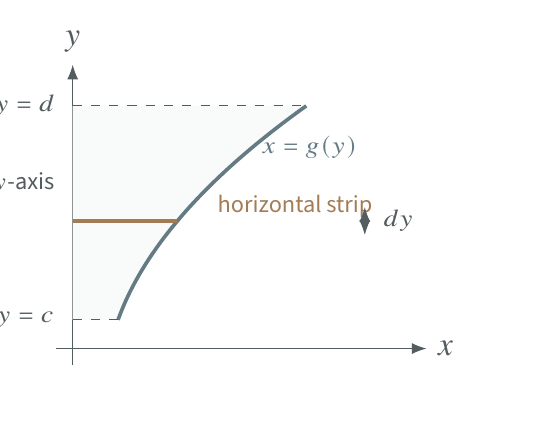
Core formula: area with respect to \(y\)
If \(x=g(y)\) for \(c\le y\le d\), and the region is enclosed by the curve, the \(y\)-axis and the horizontal lines \(y=c\) and \(y=d\), then
Worked example 1: a simple region to the right of the y-axis
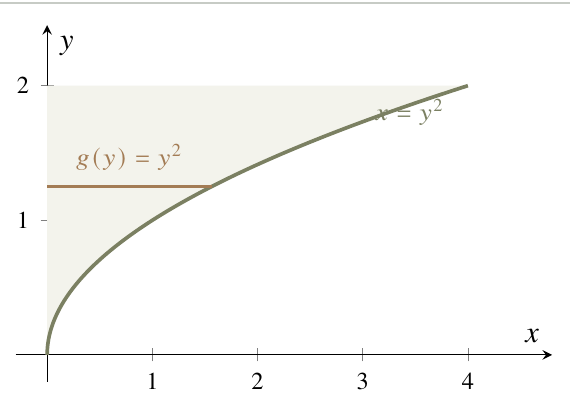
Find the area enclosed by the \(y\)-axis, the curve \(x=y^2\), and the lines \(y=0\) and \(y=2\).
\(A=\frac83\) square units
Area with the y-axis — learning the formula
See how horizontal strips lead to \(A=\int|g(y)|\,dy\), including what changes when the curve lies to the left of the \(y\)-axis.
Area with the y-axis — worked example
Apply the area-with-respect-to-\(y\) method to a complete worked example.
Why the width is \(|g(y)|\)
For area, we consider positive area only. The horizontal width is the distance from the \(y\)-axis to the curve, so it must be non-negative.
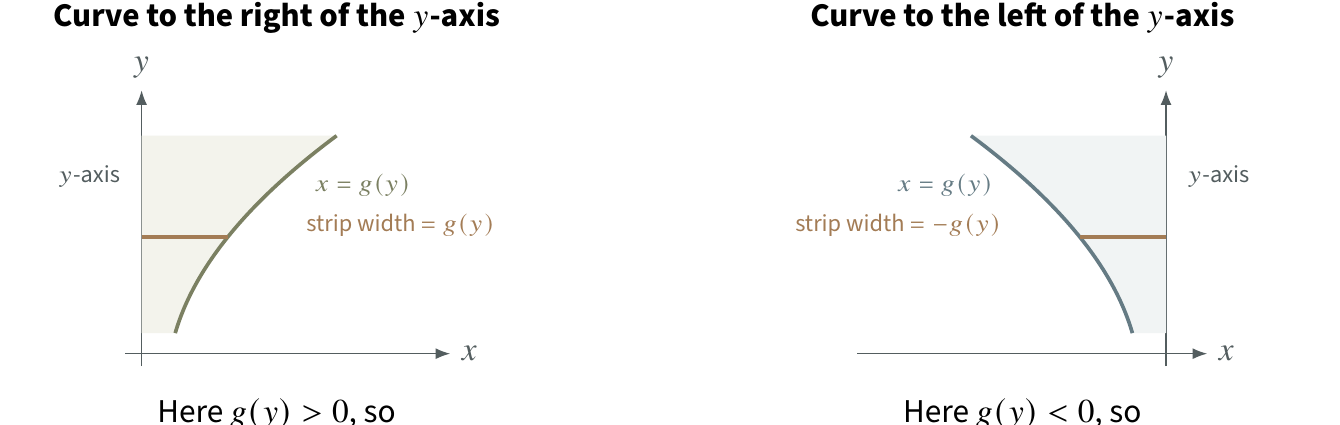
If the curve crosses the \(y\)-axis, split at values where \(g(y)=0\), or use the absolute-value form directly.
Quick check: a curve on the left of the y-axis
Suppose \(x=g(y)=-y^2\) for \(0\le y\le2\). Since \(g(y)\le0\), \(|g(y)|=-g(y)=y^2\). Hence
\[A=\int_0^2|-y^2|\,dy=\int_0^2y^2\,dy=\frac83.\]Worked example 2: rearrange before integrating
The curve \(y=x^2\), with \(x\ge0\), is bounded by the \(y\)-axis and the lines \(y=1\) and \(y=4\). Find the enclosed area.
The integration variable is \(y\), so first express \(x\) as a function of \(y\):
\[y=x^2,\ x\ge0\quad\Longrightarrow\quad x=\sqrt y.\]Therefore
\[A=\int_1^4\sqrt y\,dy=\left[\frac23y^{3/2}\right]_1^4=\frac23(8-1)=\boxed{\frac{14}{3}}.\]Common trap: mixing the function with the differential
An expression such as \(\int_1^4x^2\,dy\) is not ready to evaluate if \(x\) has not been written in terms of \(y\). When the differential is \(dy\), the integrand must be expressed in terms of \(y\).
Volumes of revolution about the x-axis
Suppose a region between \(y=f(x)\) and the \(x\)-axis is rotated through \(2\pi\) radians about the \(x\)-axis. A thin vertical strip becomes a thin circular disk.
Volumes of revolution about the x-axis
Use strips perpendicular to the axis of rotation to build the volume formula and evaluate a volume of revolution.
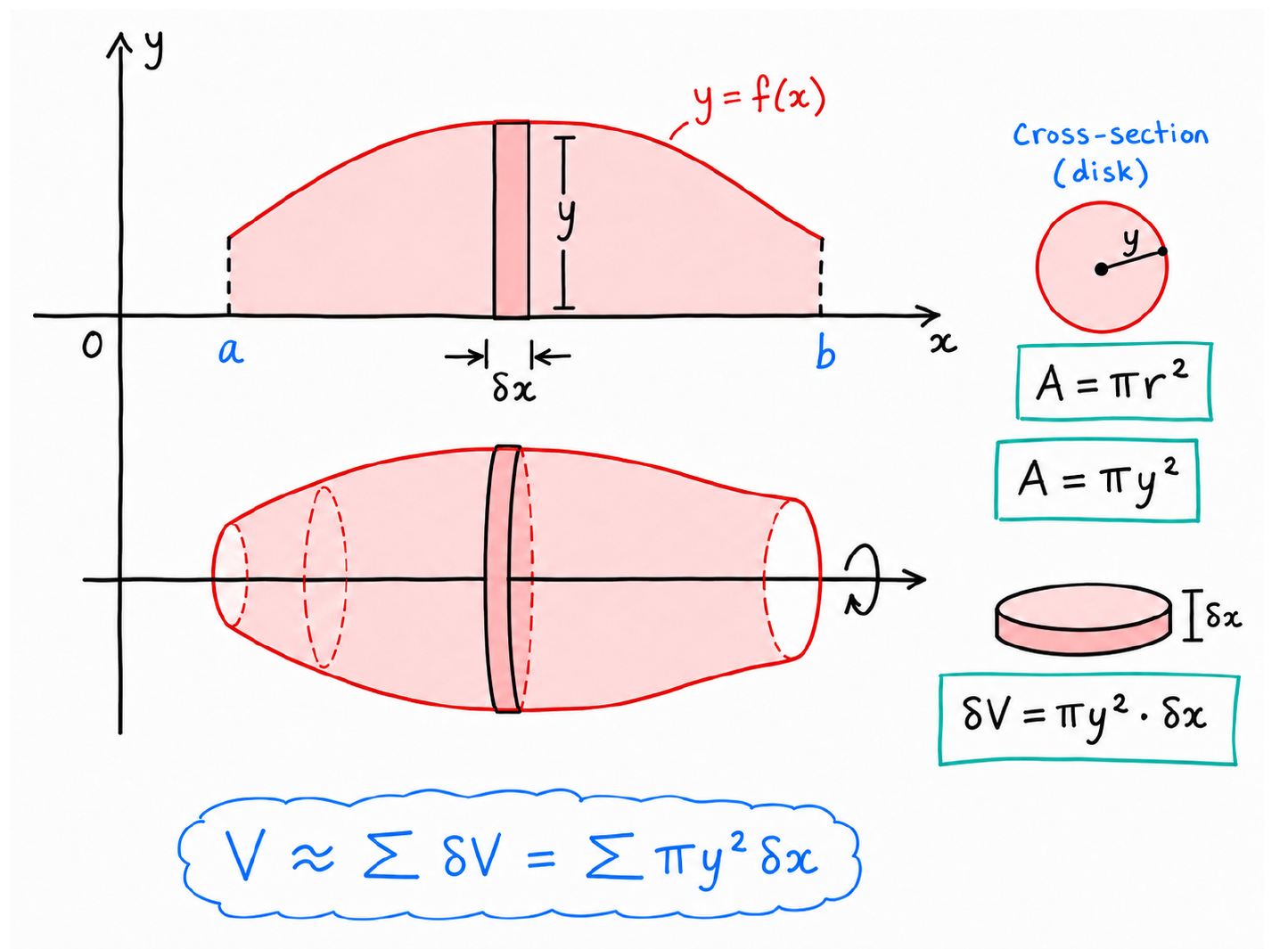
For one thin disk,
\[\Delta V\approx\pi y^2\Delta x.\]Adding the disks gives a Riemann sum; taking the limit gives
If the solid has a hollow part
When the region does not start at the axis of rotation, think of the required volume as
\[\boxed{V_{\text{required}}=V_{\text{outer}}-V_{\text{inner}}}.\]You can subtract the two volume integrals separately or combine them into one integral after squaring the two radii.
Worked example 3: the volume of glass in a simple container
A simple container is modelled by rotating the region between
\[y=2-\frac{x^2}{8}\quad\text{and}\quad y=1-\frac{x^2}{16},\qquad0\le x\le4,\]about the \(x\)-axis. Find the volume of glass needed to make the container.
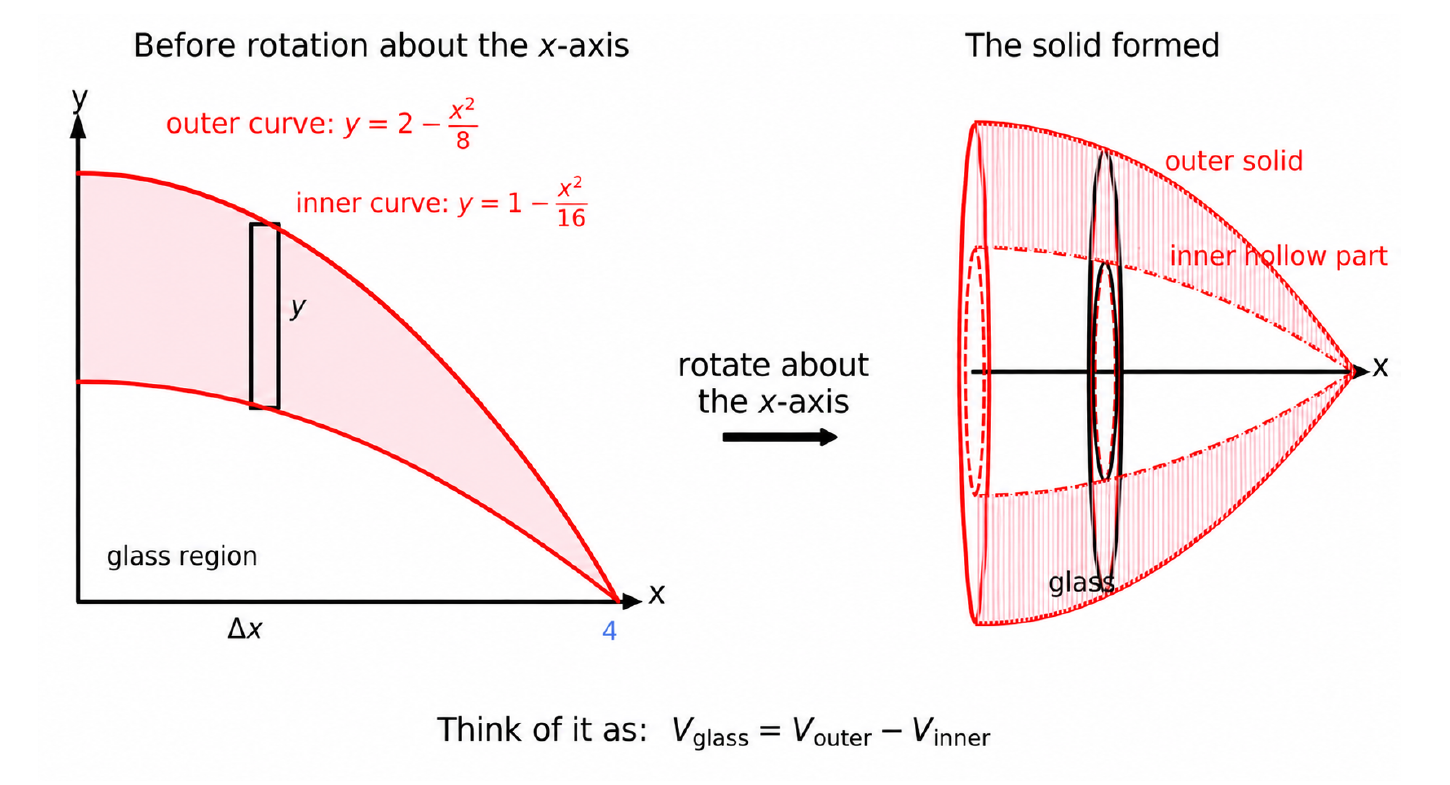
First, write the outer and inner volumes:
\[V_{\text{outer}}=\pi\int_0^4\left(2-\frac{x^2}{8}\right)^2dx,\qquad V_{\text{inner}}=\pi\int_0^4\left(1-\frac{x^2}{16}\right)^2dx.\]Therefore
Worked example 4: a quarter-circle rotated about the x-axis
The region bounded by \(y=\sqrt{4-x^2}\), the \(x\)-axis and the \(y\)-axis is rotated through \(2\pi\) radians about the \(x\)-axis.
Since
\[y^2=4-x^2,\qquad0\le x\le2,\]the squared radius is already simple:
\[V=\pi\int_0^2y^2\,dx=\pi\int_0^2(4-x^2)\,dx=\pi\left[4x-\frac{x^3}{3}\right]_0^2=\boxed{\frac{16\pi}{3}}.\]Volumes of revolution about the y-axis
Now the disk is perpendicular to the \(y\)-axis, so we use horizontal strips and integrate with respect to \(y\). The radius is a horizontal distance, so it is an \(x\)-value.
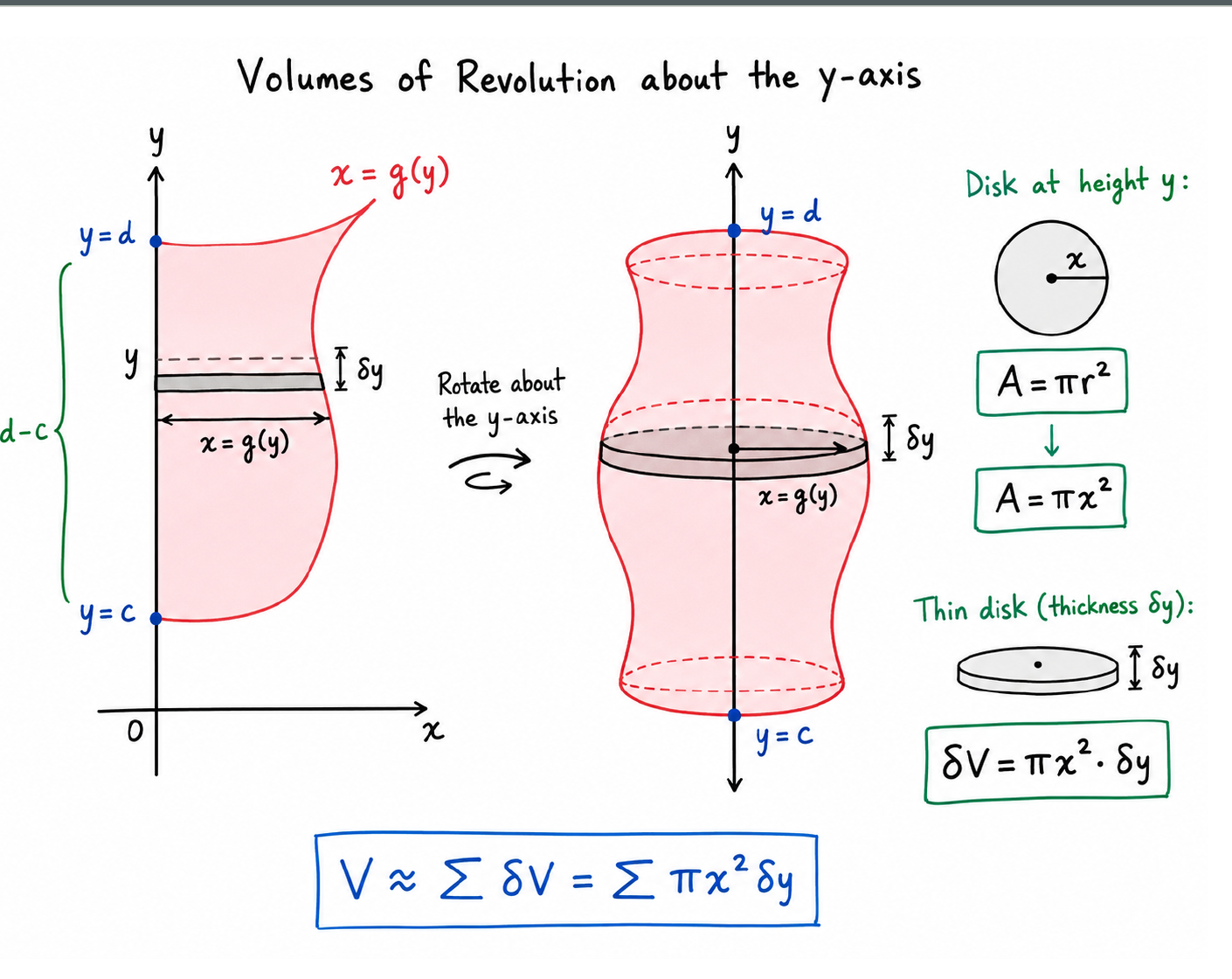
For one disk, \(\Delta V\approx\pi x^2\Delta y\). Passing to the limit gives
Worked example 5: an implicit curve makes \(x^2\) easy to use
The right semicircle \(x^2+y^2=9\), \(x\ge0\), is rotated through \(2\pi\) radians about the \(y\)-axis.
The volume formula requires \(x^2\), so there is no need to take a square root:
\[x^2=9-y^2,\qquad-3\le y\le3.\]Therefore
\[V=\pi\int_{-3}^{3}x^2\,dy=\pi\int_{-3}^{3}(9-y^2)\,dy=\pi\left[9y-\frac{y^3}{3}\right]_{-3}^{3}=\boxed{36\pi}.\]Worked example 6: rearranging an exponential curve
The region between the \(y\)-axis and \(y=\ln x\), from \(y=0\) to \(y=\ln2\), is rotated about the \(y\)-axis.
Rewrite the curve as \(x=e^y\). Then
\[V=\pi\int_0^{\ln2}x^2\,dy=\pi\int_0^{\ln2}e^{2y}\,dy=\frac\pi2[e^{2y}]_0^{\ln2}=\frac\pi2(4-1)=\boxed{\frac{3\pi}{2}}.\]Useful simplification
If the curve is given implicitly and the volume formula needs \(x^2\) or \(y^2\), isolate the squared quantity directly when possible. This can avoid an unnecessary square root that would simply be squared again inside the integral.
Choosing the correct setup
| Task | Natural strip | Differential | Core setup |
|---|---|---|---|
| Area from the \(y\)-axis | horizontal | \(dy\) | \(A=\int|g(y)|\,dy\) |
| Volume about the \(x\)-axis | vertical | \(dx\) | \(V=\pi\int[\text{radius}]^2dx\) |
| Volume about the \(y\)-axis | horizontal | \(dy\) | \(V=\pi\int[\text{radius}]^2dy\) |
A reliable five-step method
- Sketch or interpret the region. Identify the axis, boundaries and relevant interval.
- Choose the strip. Horizontal for \(dy\); vertical for \(dx\).
- Rewrite the curve if needed. Every expression in the integrand should match the chosen variable.
- Write the integral before evaluating it. For volume, identify the radius. If the solid is hollow, write outer volume minus inner volume.
- Evaluate and check. Area must be non-negative; volume must be non-negative and have cubic units.
Fast diagnostic checks
- Rotating about the \(x\)-axis but integrating with \(dy\)? Recheck the setup.
- Rotating about the \(y\)-axis but using \(y^2\) as the radius? Recheck: the radius should be a horizontal distance.
- Missing \(\pi\) in a volume of revolution? The cross-section is circular, so \(\pi\) should appear.
- For a hollow solid, subtract the squared radii or equivalent volume integrands, not just the radii.
Mixed worked example
Worked example 7: same curve, two different axes of rotation
Consider the region bounded by \(y=x^2\), the \(x\)-axis and \(x=2\) in the first quadrant.
(a) Rotate the region about the \(x\)-axis.
\[V_x=\pi\int_0^2y^2\,dx=\pi\int_0^2x^4\,dx=\pi\left[\frac{x^5}{5}\right]_0^2=\boxed{\frac{32\pi}{5}}.\](b) Rotate the same region about the \(y\)-axis.
The relevant \(y\)-interval is \(0\le y\le4\). The outer solid comes from \(x=2\); the inner solid comes from \(x=\sqrt y\):
\[V_{\text{outer}}=\pi\int_0^4 2^2\,dy,\qquad V_{\text{inner}}=\pi\int_0^4(\sqrt y)^2\,dy.\]Therefore
\[V_y=\pi\int_0^4(4-y)\,dy=\pi\left[4y-\frac{y^2}{2}\right]_0^4=\boxed{8\pi}.\]Interpretation. The region is the same, but changing the axis of rotation changes the radii and therefore changes the solid and its volume.
Practice
For each question, first sketch or interpret the region and write the integral. Exact answers are expected unless stated otherwise.
- Find the area enclosed by the \(y\)-axis, \(x=y+1\), \(y=0\) and \(y=3\).
- The curve \(y=x^2\), \(x\ge0\), is bounded by the \(y\)-axis and the lines \(y=1\) and \(y=9\). Find the enclosed area.
- The curve \(x=y^2-4\) lies to the left of the \(y\)-axis for \(0\le y\le2\). Find the area enclosed by the curve, the \(y\)-axis, \(y=0\) and \(y=2\).
- The region bounded by \(y=x+1\), the \(x\)-axis, \(x=0\) and \(x=2\) is rotated about the \(x\)-axis. Find the volume.
- The region between \(y=3\) and \(y=x\), for \(0\le x\le3\), is rotated about the \(x\)-axis. Find the volume.
- The region bounded by the \(y\)-axis, \(x=y^2+1\), \(y=0\) and \(y=1\) is rotated about the \(y\)-axis. Find the volume.
- The region between the \(y\)-axis and \(y=\ln x\), from \(y=0\) to \(y=\ln3\), is rotated about the \(y\)-axis. Find the volume.
- The right semicircle \(x^2+y^2=16\), \(x\ge0\), is rotated about the \(y\)-axis. Find the volume of the solid formed.
- The region between \(x=y^2\) and \(x=4\) is rotated about the \(y\)-axis. The curves meet at \(y=-2\) and \(y=2\). Find the volume.
- For \(0\le y\le2\), the region between the \(y\)-axis and \(x=2-y\) is considered. (a) Find its area. (b) Rotate the region about the \(y\)-axis and find the volume.
Summary
AHL 5.17 in three formulas
\[\boxed{A=\int_c^d|g(y)|\,dy}\]\[\boxed{V_{\text{about }x}=\pi\int_a^b[f(x)]^2\,dx}\]\[\boxed{V_{\text{about }y}=\pi\int_c^d[g(y)]^2\,dy}\]The formulas are easiest to remember through the geometry: width for area, disk area for volume, and a strip perpendicular to the axis of rotation.
Answer key and solution outlines
Practice 1–3: area with the y-axis
1. \(\displaystyle A=\int_0^3(y+1)dy=\left[\frac{y^2}{2}+y\right]_0^3=\frac{15}{2}.\)
2. Since \(y=x^2\) and \(x\ge0\), \(x=\sqrt y\): \(\displaystyle A=\int_1^9\sqrt y\,dy=\left[\frac23y^{3/2}\right]_1^9=\frac{52}{3}.\)
3. Since \(g(y)=y^2-4\le0\), \(|g(y)|=4-y^2\): \(\displaystyle A=\int_0^2(4-y^2)dy=\frac{16}{3}.\)
Practice 4–5: revolution about the x-axis
4. \(\displaystyle V=\pi\int_0^2(x+1)^2dx=\frac{26\pi}{3}.\)
5. Outer radius \(R=3\), inner radius \(r=x\): \(\displaystyle V=\pi\int_0^3(9-x^2)dx=18\pi.\)
Practice 6–10: revolution about the y-axis and mixed
6. \(\displaystyle V=\pi\int_0^1(y^2+1)^2dy=\pi\left[\frac{y^5}{5}+\frac{2y^3}{3}+y\right]_0^1=\frac{28\pi}{15}.\)
7. Rewrite \(y=\ln x\) as \(x=e^y\): \(\displaystyle V=\pi\int_0^{\ln3}e^{2y}dy=4\pi.\)
8. Since \(x^2=16-y^2\), \(\displaystyle V=\pi\int_{-4}^{4}(16-y^2)dy=\frac{256\pi}{3}.\)
9. Outer radius \(4\), inner radius \(y^2\): \(\displaystyle V=\pi\int_{-2}^{2}(16-y^4)dy=\frac{256\pi}{5}.\)
10. Width \(=2-y\): \(\displaystyle A=\int_0^2(2-y)dy=2\), and \(\displaystyle V=\pi\int_0^2(2-y)^2dy=\frac{8\pi}{3}.\)
Final self-check
If you can explain why area with the \(y\)-axis uses \(dy\), and why revolution about the \(y\)-axis uses \(x^2dy\), then the formulas no longer need to be memorized as disconnected rules.
Premium printable resource
This free web lesson follows the finalized Radford Mathematics AHL 5.17 teaching sequence. The printable handout and Topic 5 pack are premium resources; the protected PDF is not linked or exposed here.