IB Mathematics: Analysis and Approaches HL — Topic 5 Calculus
Maclaurin Series
Build local polynomial models near \(x=0\), manipulate standard series efficiently, and use them for approximation, limits and differential equations.
Learning goal
Build, manipulate and use Maclaurin series to approximate functions, derive related series, evaluate limits and solve differential equations near \(x=0\).
Syllabus link
AHL 5.19 Standard Maclaurin series plus substitution, products, differentiation, integration and differential-equation methods.
Big idea
Near \(x=0\), many functions can be replaced by a polynomial whose coefficients are determined by derivatives at zero.
Key relationship
\(\displaystyle f(x)=\sum_{n=0}^\infty\frac{f^{(n)}(0)}{n!}x^n\).
Can a polynomial pretend to be a curve?
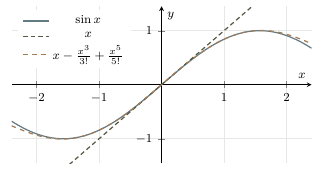
Maclaurin series replace a function by a polynomial near \(x=0\). For example,
\[\sin x\approx x-\frac{x^3}{3!}+\frac{x^5}{5!}.\]This does not make \(\sin x\) a polynomial. It means that close to zero the polynomial can match the function’s value, gradient, curvature and higher-derivative behaviour extremely closely.
Local model
A Maclaurin polynomial is designed to be especially accurate near \(x=0\). Keeping more appropriate terms usually improves the local approximation.
Maclaurin series: how they work
A conceptual bridge between Taylor polynomials and Maclaurin polynomials.
The Maclaurin series formula and standard series
Common trap
The coefficient of \(x^n\) is \(f^{(n)}(0)/n!\), not simply \(f^{(n)}(0)\). The factorial matters.
Maclaurin series formula
How the formula is built from successive derivatives evaluated at zero.
Worked example 1: build the series from derivatives
Find the Maclaurin series for \(f(x)=e^{2x}\) up to \(x^3\).
| Function/derivative | Value at 0 |
|---|---|
| \(f=e^{2x}\) | 1 |
| \(f'=2e^{2x}\) | 2 |
| \(f''=4e^{2x}\) | 4 |
| \(f'''=8e^{2x}\) | 8 |
Standard Maclaurin series to know
| Function | Maclaurin series | Validity note |
|---|---|---|
| \(e^x\) | \(1+x+x^2/2!+x^3/3!+\cdots\) | all real \(x\) |
| \(\sin x\) | \(x-x^3/3!+x^5/5!-\cdots\) | all real \(x\) |
| \(\cos x\) | \(1-x^2/2!+x^4/4!-\cdots\) | all real \(x\) |
| \(\ln(1+x)\) | \(x-x^2/2+x^3/3-x^4/4+\cdots\) | typically \(|x|<1\); also converges at \(x=1\) |
| \((1+x)^p\) | \(1+px+\frac{p(p-1)}{2!}x^2+\frac{p(p-1)(p-2)}{3!}x^3+\cdots\) | \(|x|<1\) for general rational \(p\); finite for non-negative integer \(p\) |
Maclaurin expansion of (1+x)^n
Use the binomial series as a standard building block for approximation and series manipulation.
Using simple substitution
If a standard series is known for \(f(x)\), replace \(x\) by the required inner expression and then keep only the requested powers.
Worked example 2: \(e^{x^2}\)
Start with \(e^u=1+u+u^2/2!+u^3/3!+\cdots\) and let \(u=x^2\):
\[e^{x^2}=1+x^2+\frac{x^4}2+\frac{x^6}6+\cdots.\]Worked example 3: rational binomial exponent
Expand \((1-3x)^{-1/2}\) to \(x^3\). Use \((1+u)^p\) with \(p=-1/2\), \(u=-3x\):
\[\begin{aligned}(1-3x)^{-1/2}&=1+\left(-\frac12\right)(-3x)+\frac{(-1/2)(-3/2)}{2!}(-3x)^2\\&\quad+\frac{(-1/2)(-3/2)(-5/2)}{3!}(-3x)^3+\cdots\\&=\boxed{1+\frac32x+\frac{27}8x^2+\frac{135}{16}x^3+\cdots}.\end{aligned}\]Expansion of e^{sin x} using substitution
A composite-function example showing how to substitute one series into another efficiently.
Products of series: keep only the terms you need
Decide the highest required power before multiplying. Do not generate terms that cannot contribute to the requested order.
Worked example 4: \(e^x\sin x\) to \(x^4\)
\[e^x=1+x+\frac{x^2}2+\frac{x^3}6+\frac{x^4}{24}+\cdots,\qquad\sin x=x-\frac{x^3}6+\cdots.\]\[\begin{aligned}e^x\sin x&=x+x^2+\left(\frac12-\frac16\right)x^3+\left(\frac16-\frac16\right)x^4+\cdots\\&=\boxed{x+x^2+\frac13x^3+0x^4+\cdots}.\end{aligned}\]Why write \(0x^4\)?
In an exam, the vanishing coefficient may be the point of the question. Writing it explicitly shows the cancellation.
Differentiating and integrating series
Within the relevant interval of convergence, a power series can be differentiated or integrated term by term.
Worked example 5: derive the series for \(\arctan x\)
Because \(\frac d{dx}(\arctan x)=1/(1+x^2)\), begin with
\[\frac1{1+x^2}=1-x^2+x^4-x^6+\cdots.\]Integrate term by term:
\[\arctan x=x-\frac{x^3}3+\frac{x^5}5-\frac{x^7}7+C.\]Since \(\arctan0=0\), \(C=0\):
\[\boxed{\arctan x=x-\frac{x^3}3+\frac{x^5}5-\frac{x^7}7+\cdots}.\]Differentiating and integrating Maclaurin series
Create new series from known series by term-by-term differentiation and integration.
Deriving arctan x using integration
Connect the geometric series for 1/(1+x²) to the Maclaurin series for arctan x.
Worked example 6: differentiate a given series
If \(f(x)=1+3x-2x^2+5x^3-7x^4+\cdots\), then
\[f'(x)=3-4x+15x^2-28x^3+\cdots.\]Up to \(x^2\): \(\boxed{f'(x)=3-4x+15x^2+\cdots}\).
Using Maclaurin series to evaluate limits
For indeterminate limits near zero, expand only far enough to identify the first non-zero term after cancellation.
Worked example 7: leading terms
Evaluate \(\displaystyle\lim_{x\to0}\frac{e^x-1-x}{x^2}\).
\[e^x-1-x=\frac{x^2}2+\frac{x^3}6+\cdots.\]\[\frac{e^x-1-x}{x^2}=\frac12+\frac x6+\cdots\quad\Longrightarrow\quad\boxed{\frac12}.\]Evaluating limits with Maclaurin series
Use leading terms and cancellations to evaluate indeterminate limits as x approaches zero.
Maclaurin series from differential equations
Assume a series \(y=a_0+a_1x+a_2x^2+\cdots\), differentiate it, substitute into the differential equation and compare coefficients of like powers of \(x\).
Worked example 8: first-order differential equation
Find the series solution to \(x^4\) for \(y'=x^2+y\), \(y(0)=1\).
Let \(y=a_0+a_1x+a_2x^2+a_3x^3+a_4x^4+\cdots\). Since \(y(0)=1\), \(a_0=1\), and
\[y'=a_1+2a_2x+3a_3x^2+4a_4x^3+\cdots.\]Substitution gives
\[a_1+2a_2x+3a_3x^2+4a_4x^3+\cdots=x^2+a_0+a_1x+a_2x^2+a_3x^3+\cdots.\]Compare coefficients:
\[a_1=1,\qquad a_2=\frac12,\qquad a_3=\frac12,\qquad a_4=\frac18.\]Therefore
\[\boxed{y=1+x+\frac12x^2+\frac12x^3+\frac18x^4+\cdots}.\]Differential equation series solution 1
A first-order differential-equation example using Maclaurin coefficients.
Differential equation series solution 2
A second-order differential-equation example using Maclaurin series.
Non-linear first-order differential equation
A more advanced series-solution example for a non-linear first-order differential equation.
Related Radford Mathematics tutorial sequence
The finalized handout recommends this progression. The videos are also embedded at the relevant teaching points above.
- Maclaurin Series Formula
- How Maclaurin series work
- Differentiating and integrating Maclaurin series
- Expansion of \((1+x)^n\)
- Deriving \(\arctan x\)
- Expansion of \(e^{\sin x}\)
- Limits with Maclaurin series
- Differential equation series solution 1
- Differential equation series solution 2
- Non-linear first-order differential equation
Practice questions and answer key
- Use the Maclaurin formula to find \(\cos x\) up to \(x^4\).
- Find \(e^{-2x}\) up to \(x^3\).
- Expand \(\ln(1+3x)\) up to \(x^4\).
- Expand \((1-2x)^5\) exactly.
- Expand \((1+4x)^{-1}\) up to \(x^4\).
- Find \(\sin(x^2)\) up to \(x^{10}\).
- Find \(e^x\cos x\) up to \(x^3\).
- Use a series to evaluate \(\lim_{x\to0}(\sin x-x)/x^3\).
- Use integration to find \(\ln(1+x)\) up to \(x^5\), starting from \(1/(1+x)\).
- Find the series solution up to \(x^3\) for \(y'=2x+y\), \(y(0)=3\).
Answers 1–5
- \(\cos x=1-x^2/2+x^4/24+\cdots\).
- \(e^{-2x}=1-2x+2x^2-\frac43x^3+\cdots\).
- \(\ln(1+3x)=3x-\frac92x^2+9x^3-\frac{81}4x^4+\cdots\).
- \((1-2x)^5=1-10x+40x^2-80x^3+80x^4-32x^5\).
- \((1+4x)^{-1}=1-4x+16x^2-64x^3+256x^4+\cdots\).
Answers 6–10
- \(\sin(x^2)=x^2-x^6/6+x^{10}/120+\cdots\).
- \(e^x\cos x=1+x+0x^2-\frac13x^3+\cdots\).
- \(\boxed{-1/6}\).
- \(\ln(1+x)=x-x^2/2+x^3/3-x^4/4+x^5/5+\cdots\).
- Set \(y=a_0+a_1x+a_2x^2+a_3x^3+\cdots\). With \(a_0=3\), coefficient comparison gives \(a_1=3\), \(a_2=5/2\), \(a_3=5/6\). Thus \(\boxed{y=3+3x+\frac52x^2+\frac56x^3+\cdots}\).
Premium printable resource
This free web lesson follows the finalized Radford Mathematics AHL 5.19 teaching sequence. The polished printable handout and Topic 5 resource pack are premium resources; the protected PDF is not linked from this page.