IB Mathematics: Analysis and Approaches AA HL — Topic 5 Calculus
The Second Derivative
Graphical behaviour and the relationship between \(f\), \(f'\) and \(f''\).
Learning goal
Find and interpret the second derivative, then use the graphs of \(f\), \(f'\) and \(f''\) to describe how a function is changing.
Syllabus link
IB Mathematics AA SL/HL: SL 5.7. The second derivative; graphical behaviour of functions; relationships between the graphs of \(f\), \(f'\) and \(f''\); notation \(\frac{d^2y}{dx^2}\) and \(f''(x)\); use of technology.
Big idea
\(f'(x)\) tells us the gradient of \(f\). The second derivative \(f''(x)\) tells us how that gradient is changing, and therefore whether the graph of \(f\) is concave up or concave down.
Three directions
Read from \(f\) to understand \(f'\) and \(f''\); from \(f'\) to understand \(f\) and \(f''\); and from \(f''\) to understand \(f\) and \(f'\).
Introduction: the second derivative
We have already seen that if \(y=f(x)\), then the first derivative tells us the gradient of the original curve:
The second derivative is obtained by differentiating again. It is the derivative of the first derivative:
Second derivative notation
Both notations are required:
Read \(\frac{d^2y}{dx^2}\) as “the second derivative of \(y\) with respect to \(x\)”. It does not mean that \(\frac{dy}{dx}\) is being squared.
Worked example 1: finding a second derivative
Question. Let \(f(x)=2x^4-5x^3+3x^2-7x+4\). Find \(f'(x)\) and \(f''(x)\).
Solution
Differentiate once:
Differentiate the derivative:
Worked example 2: using the rules from 5.6 again
Question. For \(g(x)=e^{2x}+\sin(3x)\), find \(g''(x)\).
Solution
First differentiate using the chain rule:
Differentiate a second time:
Notation trap
\(f''(x)\) means “differentiate \(f\) twice”. It is not \((f'(x))^2\). Likewise, \(\frac{d^2y}{dx^2}\) is one piece of second-derivative notation, not a fraction obtained by squaring \(dy\) and \(dx\) separately.
What does the second derivative actually measure?
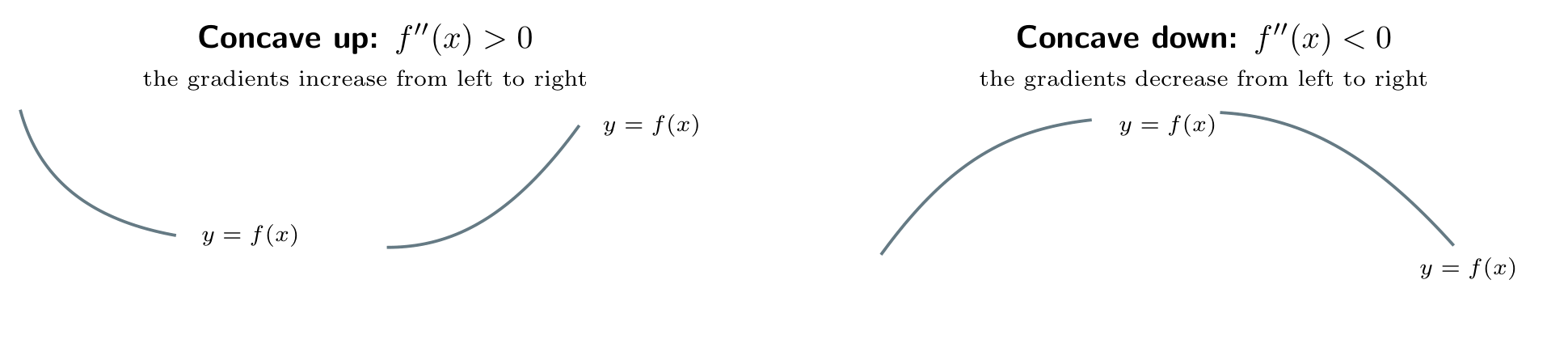
The first derivative \(f'(x)\) is the gradient of \(f\). Therefore the second derivative tells us the rate at which the gradient itself is changing. At IB level, the most useful first picture is usually the concavity of the graph.
Start by looking for concavity
- If \(f''(x)>0\), the graph is concave up.
- If \(f''(x)<0\), the graph is concave down.
So ask: does the curve bend upward or downward as \(x\) increases?
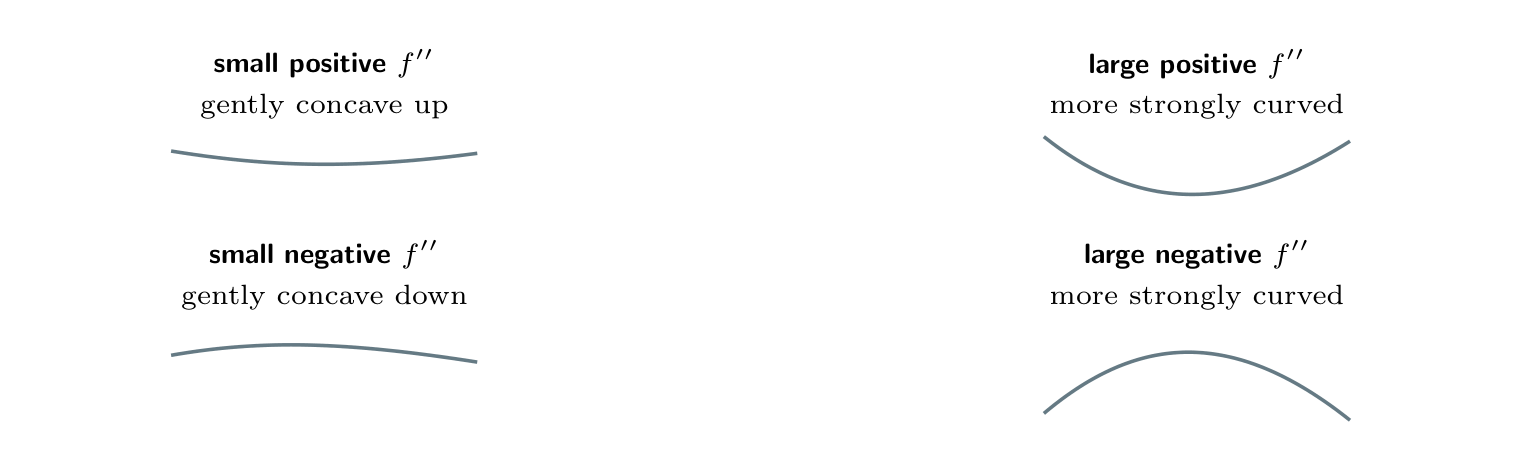
What larger or smaller values of \(f''\) look like informally
A small positive \(f''\) gives a gently concave-up curve; a larger positive \(f''\) means the gradient is increasing more rapidly. Similarly, a small negative \(f''\) gives gentle concave-down curvature, while a larger negative magnitude means stronger concave-down curvature.
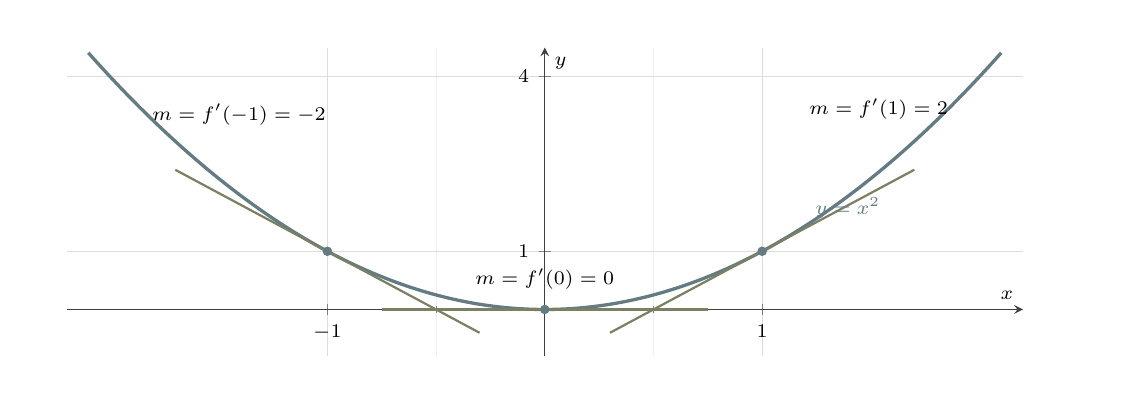
For example, if \(f(x)=x^2\), then \(f'(x)=2x\) and \(f''(x)=2\). The tangent gradients move from negative to zero to positive at a constant rate, so the graph is concave up throughout.
Think in two stages
- \(f'(x)\) tells us the gradient of \(f\).
- \(f''(x)\) tells us whether that gradient is increasing or decreasing.
- The sign of \(f''(x)\) therefore tells us the concavity of \(f\).
Reading \(f\) to understand \(f'\) and \(f''\)
When the graph of \(f\) is given, we can learn a great deal about \(f'\) and \(f''\) without knowing an explicit formula. Read the graph first by looking at its gradient, and then by looking at how that gradient is changing.
Features to read from the graph of \(f\)
- Where \(f\) is increasing or decreasing — this gives the sign of \(f'\).
- Where \(f\) has a horizontal tangent — there \(f'(x)=0\).
- Whether tangent gradients are becoming more positive or more negative — this tells whether \(f'\) is increasing or decreasing.
- Where the graph is concave up or concave down — this gives the sign of \(f''\).
- Where the graph changes concavity — this indicates a point of inflexion and a change in the sign of \(f''\).
Example 1: starting with a straight line
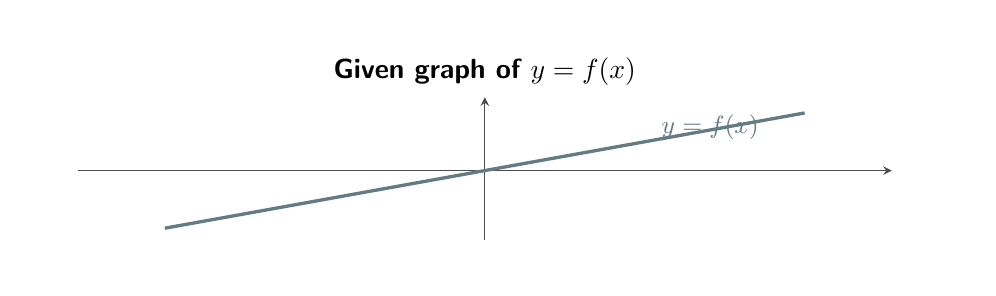
Question. Suppose the graph of \(y=f(x)\) is a straight line rising from left to right. What can we say about \(f'\) and \(f''\)?
Solution
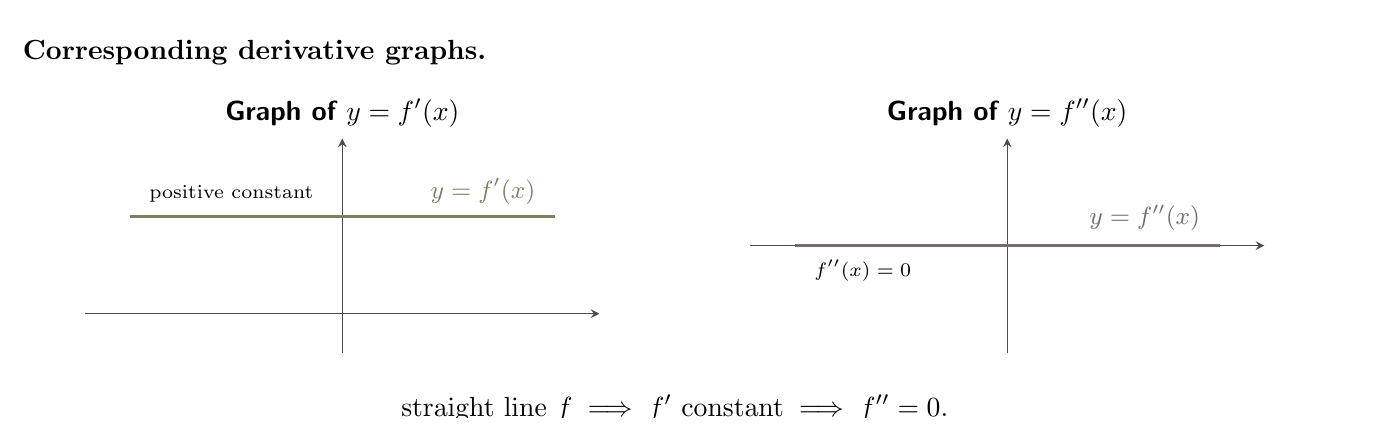
The gradient of a straight line is constant. Since the line rises, the constant gradient is positive. Therefore \(f'(x)>0\) and is constant, while \(f''(x)=0\).
Example 2: starting with a concave-up parabola
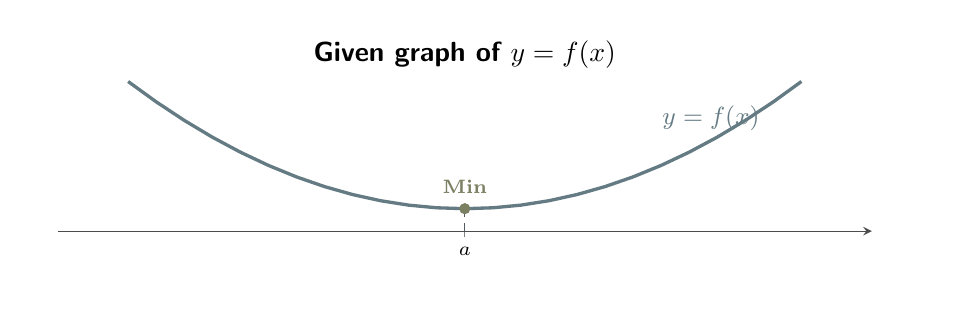
Question. Suppose \(y=f(x)\) is a concave-up parabola with a minimum at \(x=a\). What can we say about \(f'\) and \(f''\)?
Solution
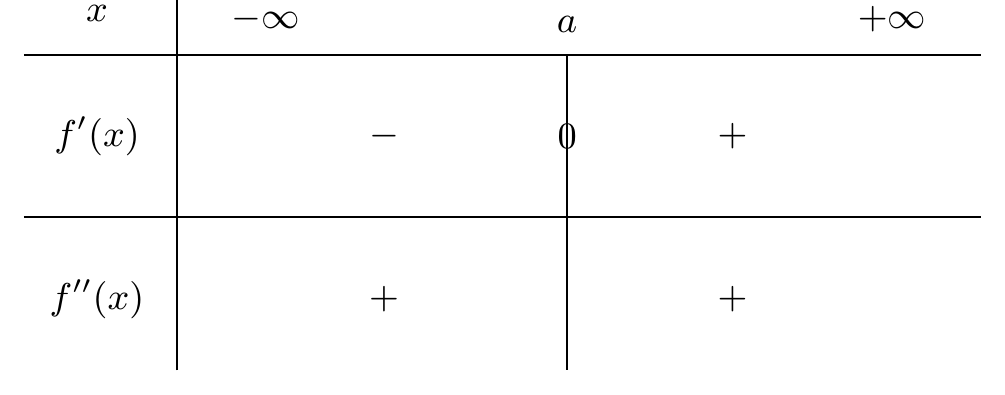
To the left of \(a\), the graph is decreasing, so \(f'(x)<0\). At the minimum, \(f'(a)=0\). To the right, the graph is increasing, so \(f'(x)>0\). The graph is concave up throughout, so \(f''(x)>0\) throughout. For a parabola, \(f''\) is a positive constant and \(f'\) is an increasing straight line.
Example 3: starting with a cubic-like graph
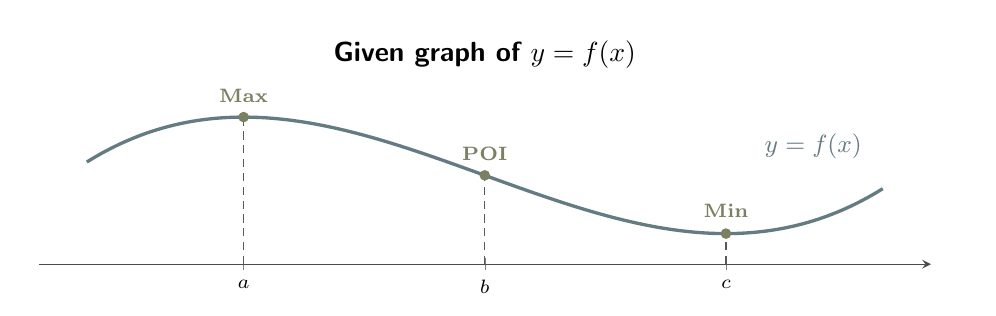
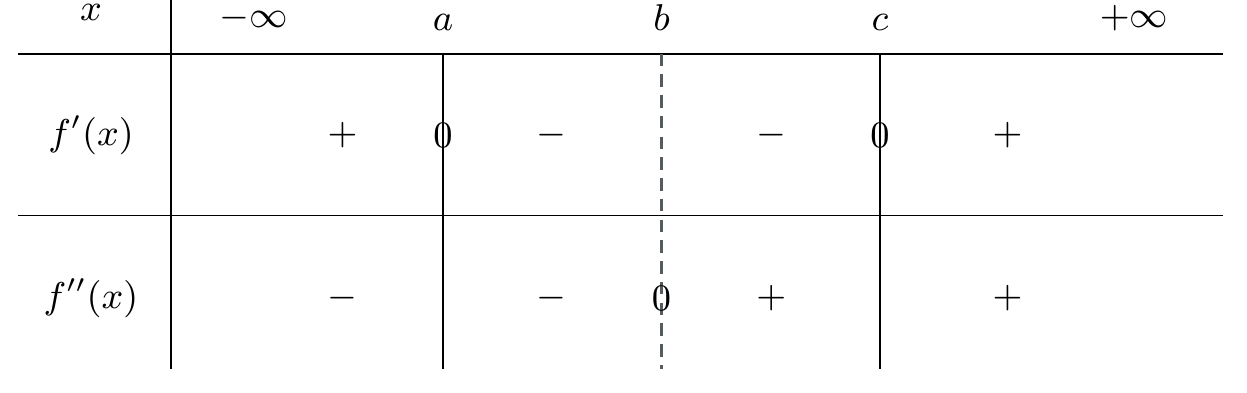
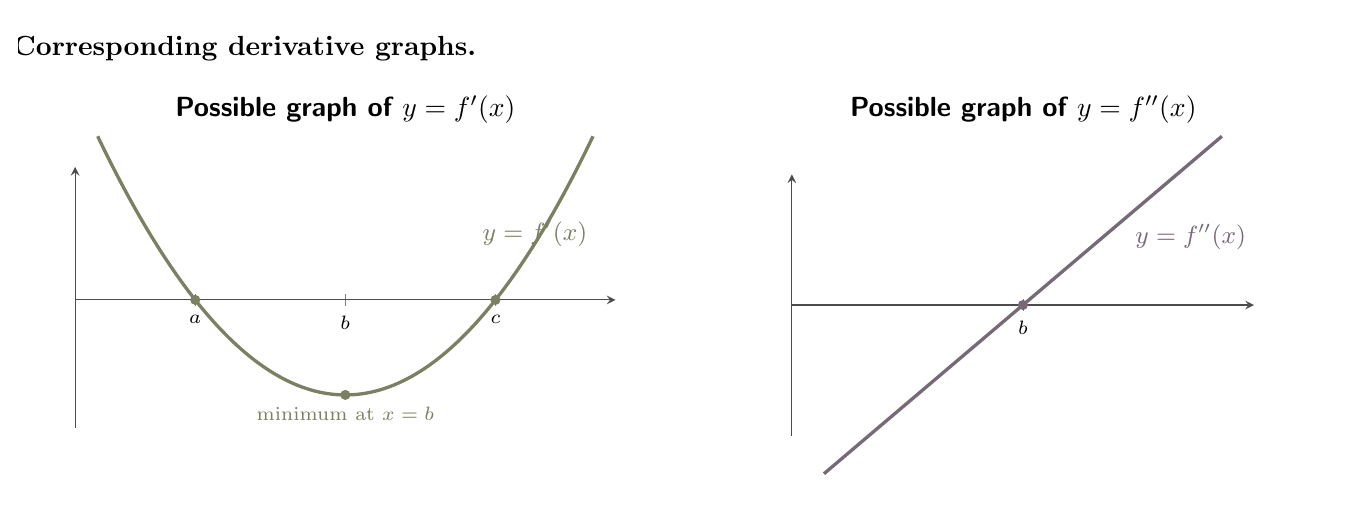
Question. Suppose \(y=f(x)\) has a local maximum at \(x=a\), a point of inflexion at \(x=b\), and a local minimum at \(x=c\), where \(a<b<c\). What can we say about \(f'\) and \(f''\)?
Solution
At the local maximum and minimum, the tangent is horizontal, so \(f'(a)=0\) and \(f'(c)=0\). The graph is increasing for \(x<a\), decreasing for \(a<x<c\), and increasing again for \(x>c\). Hence the sign pattern of \(f'\) is \(+,-,+\).
The graph is concave down before \(b\) and concave up after \(b\). Therefore \(f''(x)<0\) for \(x<b\), \(f''(b)=0\), and \(f''(x)>0\) for \(x>b\).
Worked example 3: interpreting a cubic and its derivative
Question. Let \(f(x)=x^3-3x\). Find \(f'(x)\), then use \(f'\) to state where \(f\) is increasing and decreasing.
Solution
Thus \(f'(x)=0\) at \(x=-1\) and \(x=1\). Study the sign of the factors:
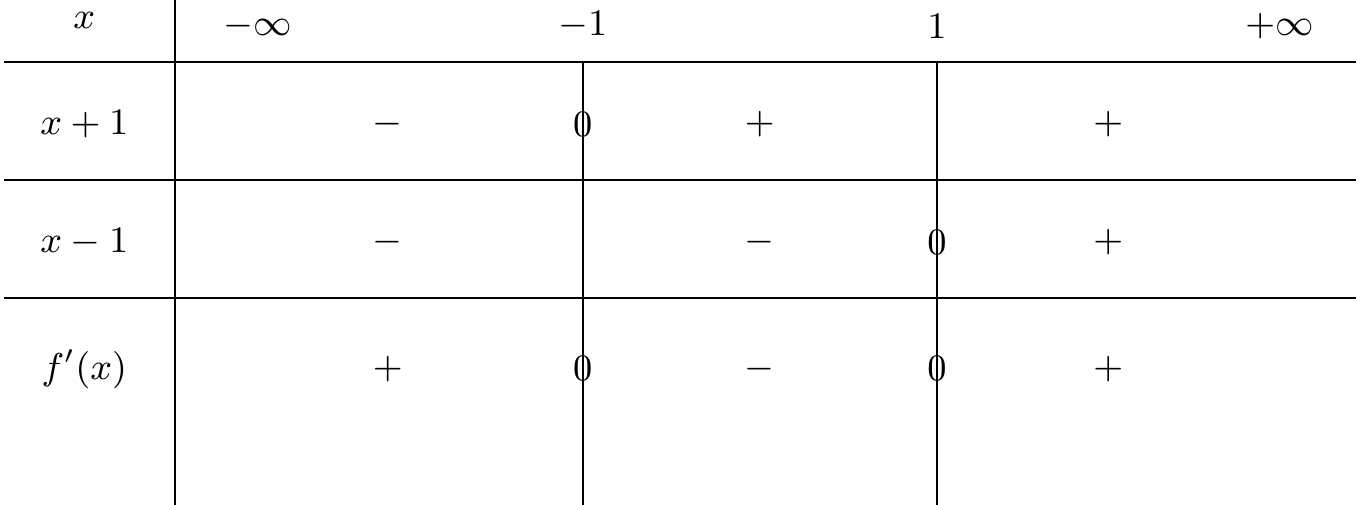
Therefore \(f\) is increasing for \(x<-1\) and \(x>1\), and decreasing for \(-1<x<1\). The zeros of \(f'\) are exactly the \(x\)-values where the original graph has horizontal tangents.
Interpreting the graph of \(f'\): relationships with \(f\) and \(f''\)
When the graph of \(y=f'(x)\) is given, use it to reconstruct the main graphical behaviour of both \(f\) and \(f''\). In each example, read the sign of \(f'\) to decide whether \(f\) increases or decreases, and read the behaviour of \(f'\) to determine the sign of \(f''\) and hence the concavity of \(f\).
Related tutorial: from \(f'\) to possible graphs of \(f\) and \(f''\)
This tutorial follows the same reading process used in the worked examples: first read the sign and behaviour of \(f'\), then translate that information into possible graphs of \(f\) and \(f''\).
Worked example 1
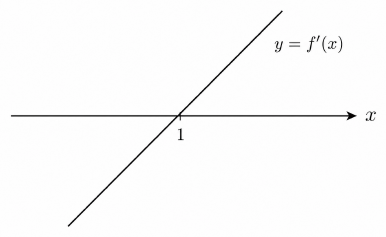
Question. Given the graph of \(y=f'(x)\) below, sketch possible graphs of \(y=f(x)\) and \(y=f''(x)\).
Solution
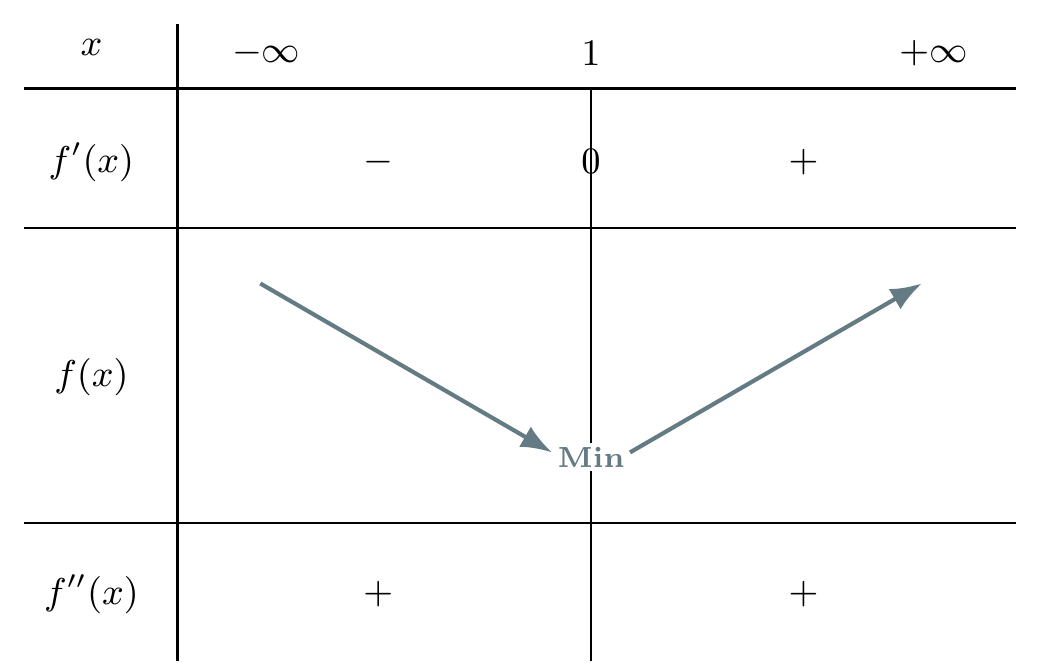
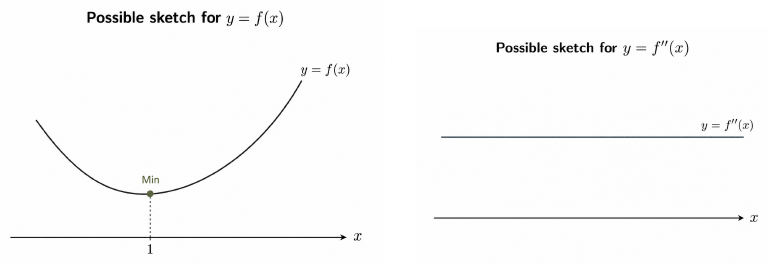
- Row for \(f'\): \(f'(x)<0\) for \(x<1\), \(f'(1)=0\), and \(f'(x)>0\) for \(x>1\). Therefore \(f\) decreases, reaches a local minimum at \(x=1\), then increases.
- Row for \(f''\): the graph of \(f'\) is increasing everywhere, so \(f''(x)>0\) everywhere and \(f\) is concave up throughout.
Worked example 2
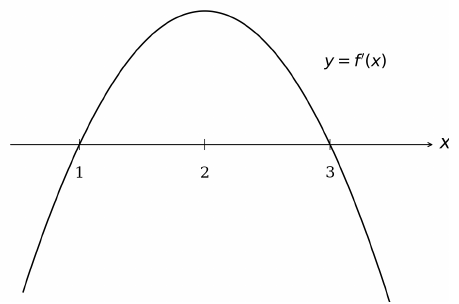
Question. Given the graph of \(y=f'(x)\) below, sketch possible graphs of \(y=f(x)\) and \(y=f''(x)\).
Solution
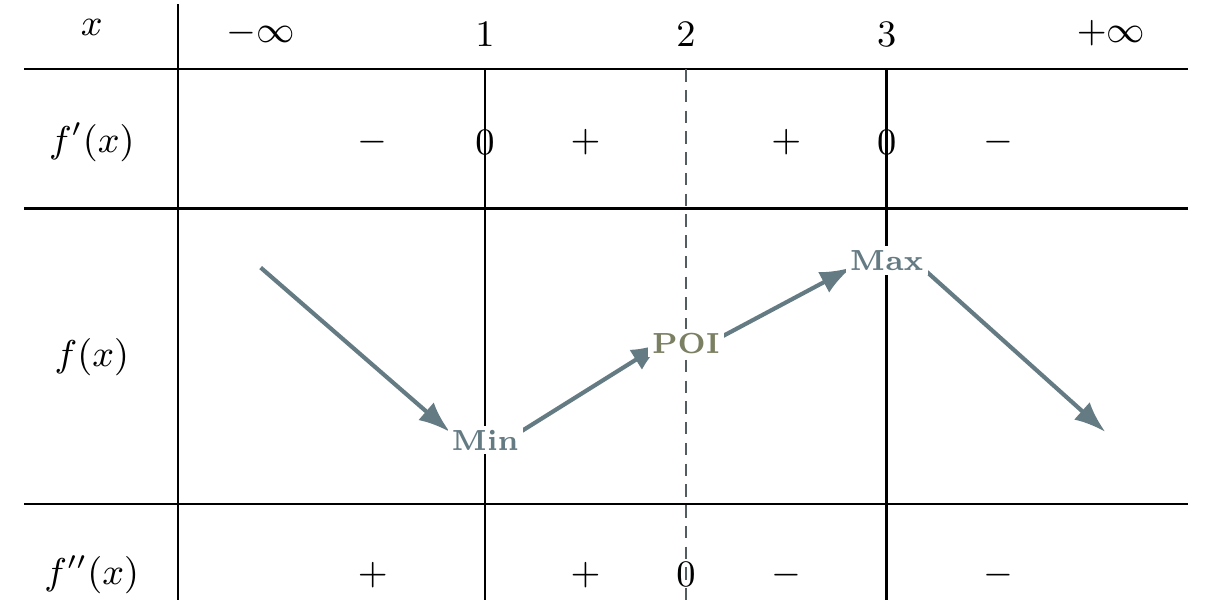
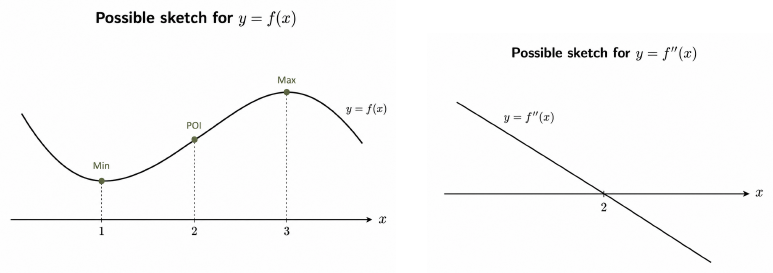
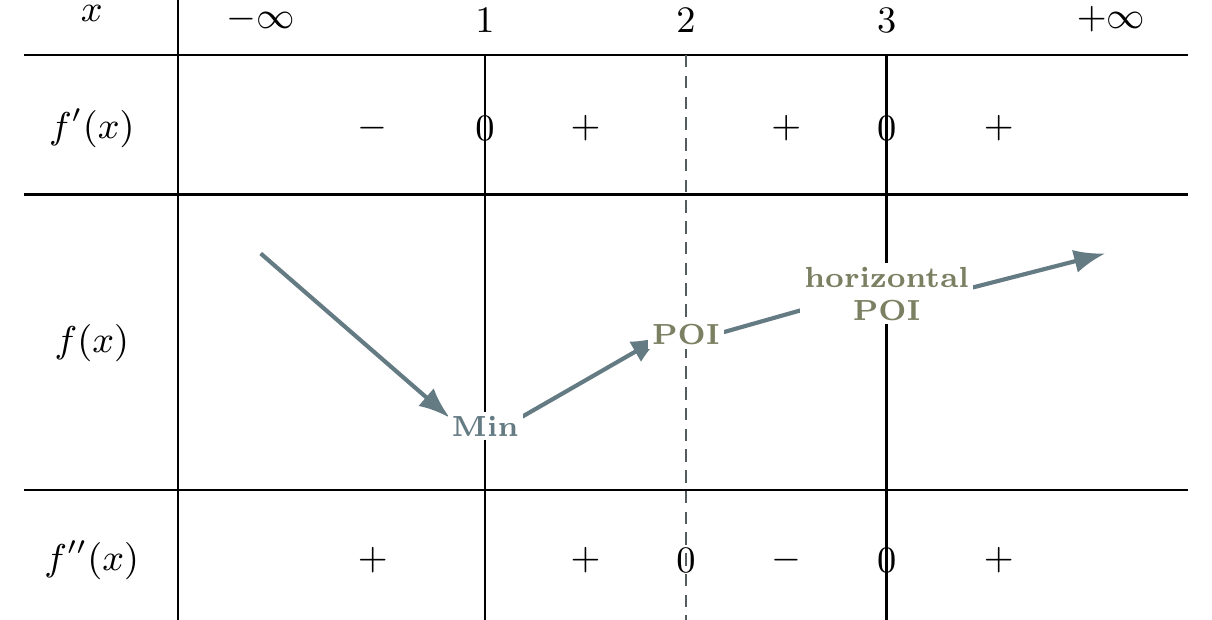
The zeros of \(f'\) occur at \(x=1\) and \(x=3\), so these are stationary points of \(f\). The graph of \(f'\) has a turning point at \(x=2\), so \(f''(2)=0\).
Since \(f'\) is increasing for \(x<2\) and decreasing for \(x>2\),
Therefore \(f\) changes from concave up to concave down at \(x=2\) and has a point of inflexion there.
Worked example 3
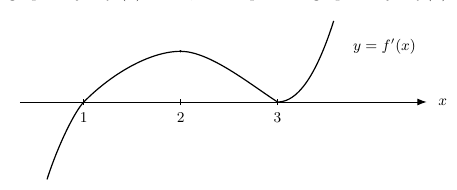
Question. Given the graph of \(y=f'(x)\) below, sketch possible graphs of \(y=f(x)\) and \(y=f''(x)\).
Solution
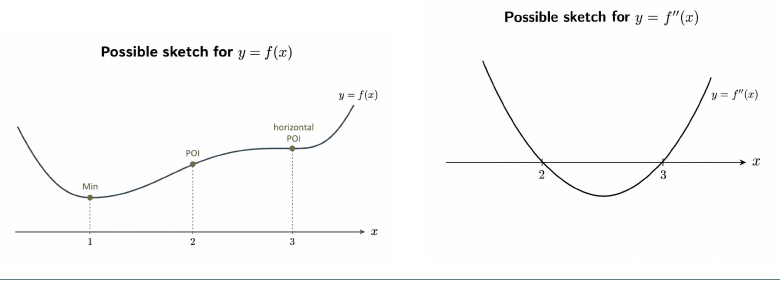
The graph of \(f'\) crosses the \(x\)-axis at \(x=1\), so \(f\) has a stationary point there. It also touches the \(x\)-axis at \(x=3\), so \(f'(3)=0\) but the sign of \(f'\) does not change.
The graph of \(f'\) has turning points at \(x=2\) and \(x=3\). Therefore \(f''(2)=0\) and \(f''(3)=0\). At \(x=2\), \(f'\) changes from increasing to decreasing, so \(f''\) changes from positive to negative and \(f\) has a point of inflexion. At \(x=3\), \(f'\) changes from decreasing to increasing, so \(f''\) changes from negative to positive. Because \(f'(3)=0\) as well, this is a horizontal point of inflexion.
Reading \(f''\) to understand \(f\) and \(f'\)
Starting from the graph of \(f''\) is more indirect than starting from \(f\) or \(f'\), but the reading process is still systematic.
Read \(f''\) in two directions
Sign of \(f''\)
↓
\(f'\) increasing or decreasing
Sign of \(f''\)
↓
concavity of \(f\)
If \(f''\) changes sign, then \(f\) changes concavity and has a point of inflexion. Remember that \(f''(a)=0\) on its own is not enough: the sign must change.
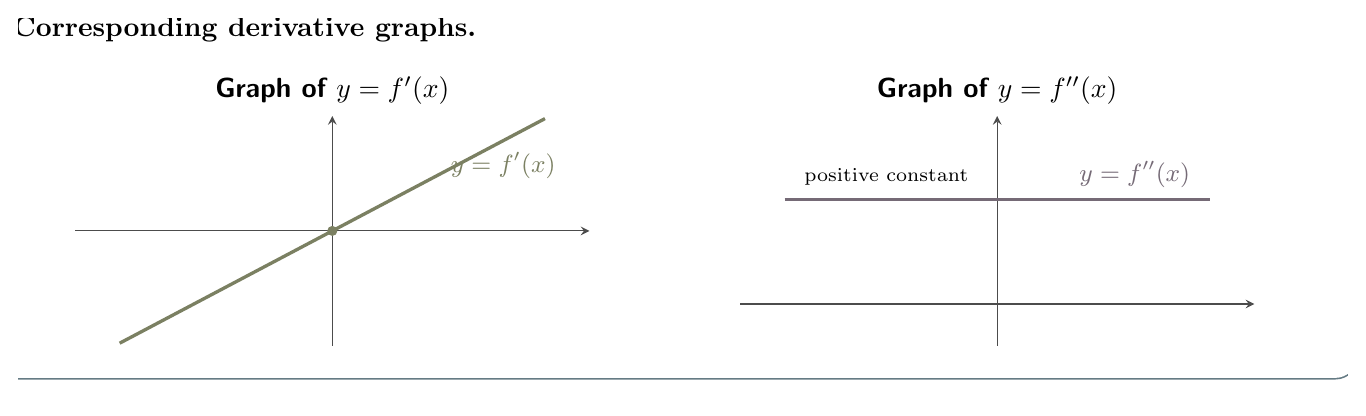
Example 1: a constant positive second derivative
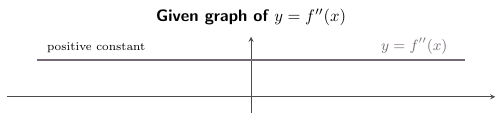
Question. Suppose \(y=f''(x)\) is the positive constant shown below. Describe what this tells us about \(f'\) and \(f\), then sketch one possible graph of each.
Solution
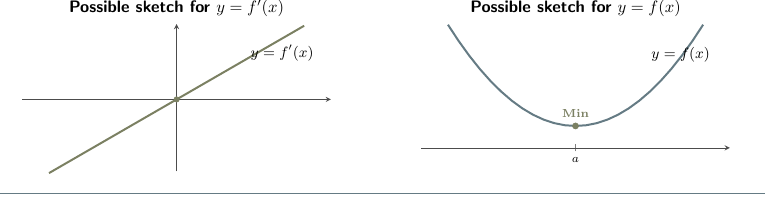
Since \(f''(x)>0\) everywhere, \(f'\) is increasing everywhere and \(f\) is concave up everywhere. Because \(f''\) is constant, \(f'\) is a straight line and \(f\) is a quadratic curve.
The integration constants are not known, so the exact vertical positions of \(f'\) and \(f\) are not fixed.
Example 2: when \(f''\) changes sign
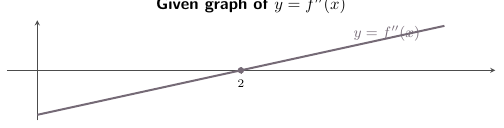
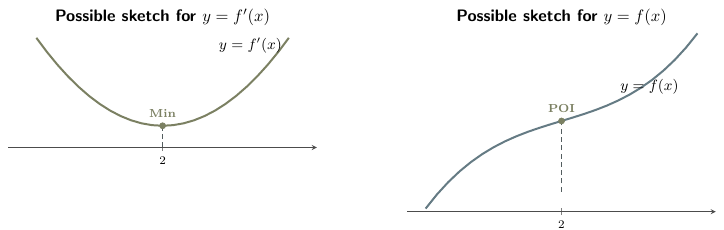
Question. Suppose \(f''(x)=2x-4\). Use the graph of \(f''\) to describe the behaviour of \(f'\) and the concavity of \(f\). Then sketch one possible graph of each.
Solution
The graph of \(f''\) is below the \(x\)-axis before \(x=2\) and above it after \(x=2\):
Thus \(f'\) decreases then increases, so \(f'\) has a local minimum at \(x=2\). The graph of \(f\) changes from concave down to concave up, so \(f\) has a point of inflexion at \(x=2\).
What \(f''\) does not tell us
The graph of \(f''\) tells us how \(f'\) is changing and how \(f\) bends. It does not tell us the sign of \(f'\). Therefore it does not, by itself, determine where \(f\) is increasing or decreasing or where the stationary points of \(f\) occur.
A reliable graphical workflow
From \(f\) to \(f'\)
- Mark where \(f\) has horizontal tangents: these give zeros of \(f'\).
- Decide where \(f\) is increasing or decreasing: this gives the sign of \(f'\). If a formula is given, organise the sign study in a sign table.
- Compare steepness: steeper positive slopes give larger positive values of \(f'\); steeper negative slopes give more negative values of \(f'\).
- Sketch a smooth derivative graph consistent with those facts.
From \(f'\) to \(f''\)
- Mark where \(f'\) has horizontal tangents: these give zeros of \(f''\).
- Decide where \(f'\) is increasing or decreasing: this gives the sign of \(f''\).
- Translate the sign into concavity: \(f''>0\) means concave up; \(f''<0\) means concave down.
- Compare the steepness of \(f'\): a large positive gradient means a large positive \(f''\); a large negative gradient means a large negative \(f''\).
- Sketch \(f''\) using the same horizontal scale.
Graph-sketching warning
A derivative graph is not obtained by copying the shape of the original graph and shifting it. Each point on the derivative graph records a gradient, not a height from the original graph.
Technology: checking the relationships
The syllabus explicitly allows technology to explore graphs and calculate derivatives. A useful check is to display all three graphs together:
Use the same viewing window and compare the same \(x\)-values.
What to check on the screen
- Do the zeros of \(f'\) line up with horizontal tangents on \(f\)?
- Where \(f'\) is above the axis, is \(f\) increasing?
- Do the zeros of \(f''\) line up with horizontal tangents on \(f'\)?
- Where \(f''\) is positive, is \(f\) concave up?
- Where \(f''\) is negative, is \(f\) concave down?
Technology is most useful as a way to test and refine your graphical reasoning, not as a replacement for it.
Practice
- Second derivatives of polynomials. Find \(f''(x)\) for (a) \(f(x)=5x^4-2x^3+7x-1\); (b) \(f(x)=\frac32x^5-4x^2+6\).
- Standard functions and the chain rule. Find \(g''(x)\) if \(g(x)=e^{3x}-2\cos(4x)\).
- Interpreting signs. At a particular point, \(f'(x)<0\) and \(f''(x)>0\). Describe what the graph of \(f\) is doing there, including its concavity.
- From \(f'\) to \(f\). Suppose \(f'(x)=(x+3)(x-1)\). Using a sign table, determine where \(f\) is increasing and decreasing. Then find \(f''(x)\) and use a sign table to state where \(f\) is concave up.
- From \(f''\) to \(f'\). Suppose \(f''(x)=6(x-2)\). Use a sign table to state where \(f'\) is increasing and decreasing. Hence state where \(f\) is concave up and concave down. At what \(x\)-value does \(f'\) have a horizontal tangent?
- Full chain. Let \(f(x)=x^3-6x^2+9x+2\). (a) Find \(f'(x)\) and \(f''(x)\). (b) Find where \(f\) has horizontal tangents. (c) Find where \(f'\) has a horizontal tangent. (d) Use a sign table to state where \(f\) is concave up and concave down.
- Graph reasoning without a formula. A graph of \(f'\) is below the \(x\)-axis on \((-4,1)\), crosses the axis at \(x=1\), and is increasing throughout \((-4,5)\). What can you say about \(f\), its concavity, and \(f''\) on these intervals?
- Challenge. A function satisfies \(f'(x)=x^3-3x^2\). Without finding \(f(x)\): (a) find all \(x\)-values where \(f\) has a horizontal tangent; (b) find \(f''(x)\); (c) use a sign table to determine concavity; (d) explain what is special about the graph of \(f'\) at each zero of \(f''\).
Answer key
1. Second derivatives of polynomials
(a) \(f'(x)=20x^3-6x^2+7\), so \(\boxed{f''(x)=60x^2-12x}\).
(b) \(f'(x)=\frac{15}{2}x^4-8x\), so \(\boxed{f''(x)=30x^3-8}\).
2. Standard functions and the chain rule
3. Interpreting signs
Since \(f'<0\), the function is decreasing. Since \(f''>0\), its gradient is increasing: the slope is becoming less negative as \(x\) increases. Therefore the graph is decreasing and concave up.
4. From \(f'\) to \(f\)
\(f'(x)=(x+3)(x-1)\) and \(f''(x)=2x+2=2(x+1)\). From the sign of \(f'\), \(f\) is increasing on \((-\infty,-3)\) and \((1,\infty)\), and decreasing on \((-3,1)\). From the sign of \(f''\), the graph is concave up for \(x>-1\).
5. From \(f''\) to \(f'\)
Since \(f''(x)=6(x-2)\), \(f''<0\) for \(x<2\) and \(f''>0\) for \(x>2\). Hence \(f'\) is decreasing for \(x<2\) and increasing for \(x>2\); \(f\) is concave down then concave up. The graph of \(f'\) has a horizontal tangent at \(x=2\).
6. Full chain
(a) as above. (b) Horizontal tangents on \(f\) occur at \(x=1,3\). (c) \(f'\) has a horizontal tangent where \(f''=0\), so \(x=2\). (d) \(f\) is concave down for \(x<2\) and concave up for \(x>2\).
7. Graph reasoning without a formula
On \((-4,1)\), \(f'<0\), so \(f\) is decreasing. At \(x=1\), \(f'(1)=0\), so \(f\) has a horizontal tangent. Since \(f'\) is increasing throughout \((-4,5)\), \(f''>0\) throughout that interval and \(f\) is concave up there.
8. Challenge
(a) \(f'(x)=0\) at \(x=0,3\). (b) \(f''(x)=3x(x-2)\). (c) \(f\) is concave up on \((-\infty,0)\) and \((2,\infty)\), and concave down on \((0,2)\). (d) The graph of \(f'\) has horizontal tangents at \(x=0\) and \(x=2\). At \(x=0\) the horizontal tangent lies on the \(x\)-axis because \(f'(0)=0\); at \(x=2\) it lies below the axis because \(f'(2)=-4\).
Summary: what each graph tells you
| Graph | Its height tells you | Its sign / gradient tells you |
|---|---|---|
| \(f\) | the value \(f(x)\) | its gradient is \(f'(x)\) |
| \(f'\) | the gradient of \(f\) | its sign gives increasing/decreasing behaviour; its gradient is \(f''(x)\) |
| \(f''\) | whether \(f\) is concave up or concave down | information about how the concavity itself is changing |
One sentence to remember
\(f'\) is the gradient of \(f\), and the sign of \(f''\) tells us the concavity of \(f\). Equivalently, \(f''\) is the gradient of \(f'\). Compare the same \(x\)-value across the graphs.