IB Mathematics: Analysis and Approaches SL/HL — Topic 5 Calculus
Stationary Points and Their Nature
Locate stationary points analytically, then classify maxima, minima and horizontal points of inflexion using first- and second-derivative tests.
Learning goal
Find stationary points and justify their nature using first-derivative sign analysis or the second-derivative test.
Syllabus link
IB Mathematics AA SL/HL: SL 5.8. Stationary points, local extrema, horizontal points of inflexion and derivative tests.
Big idea
Finding \(f'(x)=0\) locates a stationary point; classification is a separate step.
Key relationship
At a stationary point \(x=a\), \(f'(a)=0\).
What is a stationary point?
A stationary point is a point on the graph where the tangent is horizontal. Therefore its derivative is zero.
Definition
The full stationary point is \((a,f(a))\), not just the \(x\)-value.
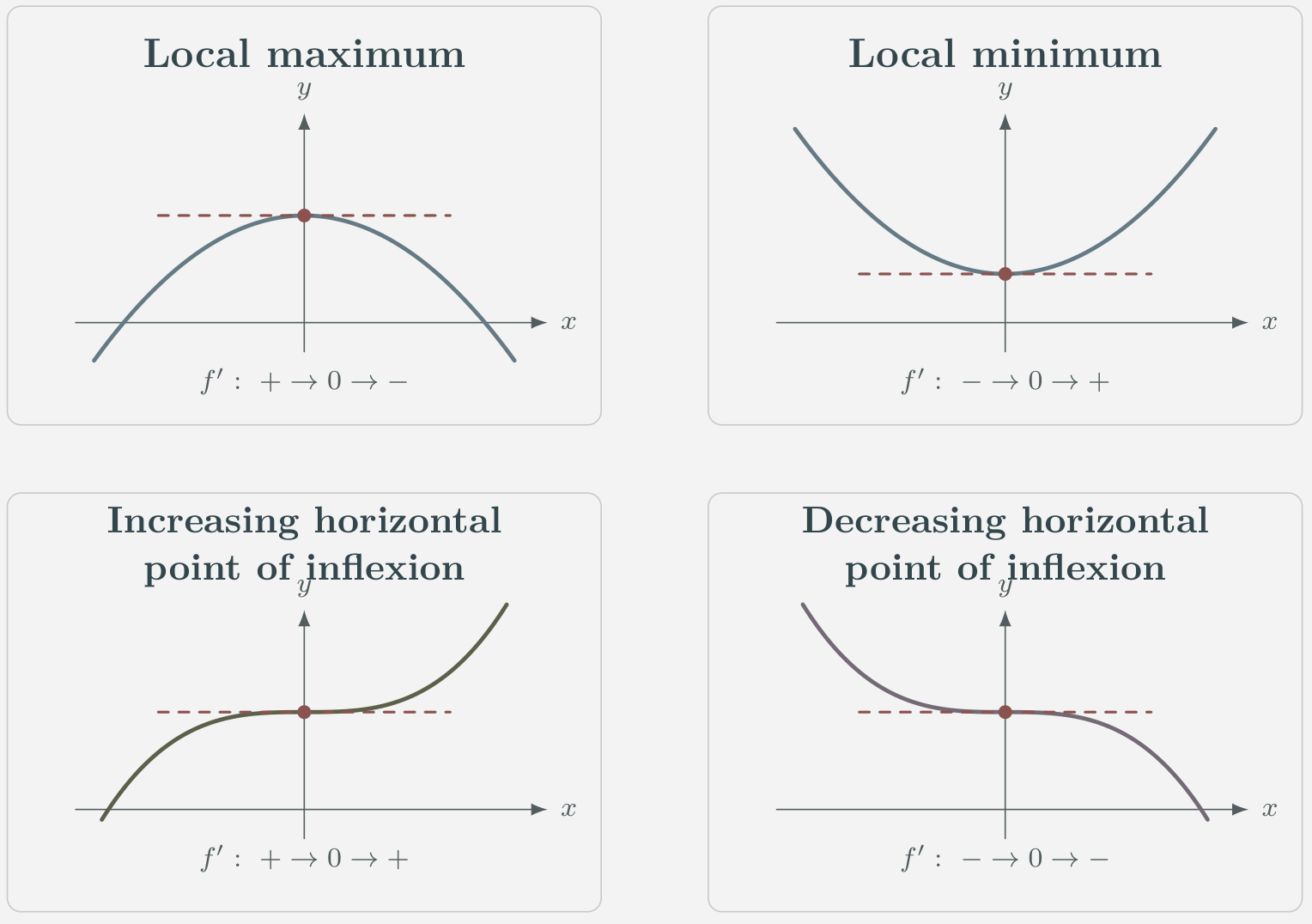
Stationary point versus turning point
A local maximum or minimum is a turning point. A horizontal point of inflexion is stationary but is not a turning point, because the function keeps moving in the same overall direction.
We will build the method in stages: locate the coordinates, use first-derivative signs to classify them, then introduce the second derivative as a quicker test for maxima and minima. Optimisation is treated in the next lesson.
How to find stationary points
Three-step locating method
- Differentiate to find \(f'(x)\).
- Solve \(f'(x)=0\) to find every stationary \(x\)-value.
- Substitute each value into \(f(x)\) to find the full coordinates.
Only then classify each point.
Worked example 1: finding a stationary point
Find the stationary point of \(f(x)=2x^2-8x+7\).
Solution
Step 1: differentiate.
Step 2: solve \(f'(x)=0\).
Step 3: find the corresponding y-coordinate.
Therefore the stationary point is \(\boxed{(2,-1)}\).
We have located the point, but we have not yet determined whether it is a maximum, a minimum or a horizontal point of inflexion. To do that, study how the function behaves on either side of the stationary value.
TI-Nspire: generate f′ and solve f′(x)=0
For calculator-allowed work, the TI-Nspire CX can generate \(y=f'(x)\) directly from \(y=f(x)\) and solve \(f'(x)=0\). Analytical differentiation remains essential; this is a useful check and a method for technology-based questions.
Stationary points from the graph of f′
Read stationary values from the graph of the derivative, whether the question supplies \(f'\) graphically or you generate its graph with technology. Substitute into \(f\) for the corresponding y-coordinates.
The first derivative sign test
The sign of \(f'(x)\) tells us the direction of motion of the function:
Local maximum
\(+\to0\to-\): increasing then decreasing.
Local minimum
\(-\to0\to+\): decreasing then increasing.
No sign change
\(+\to0\to+\) or \(-\to0\to-\): horizontal tangent without turning.
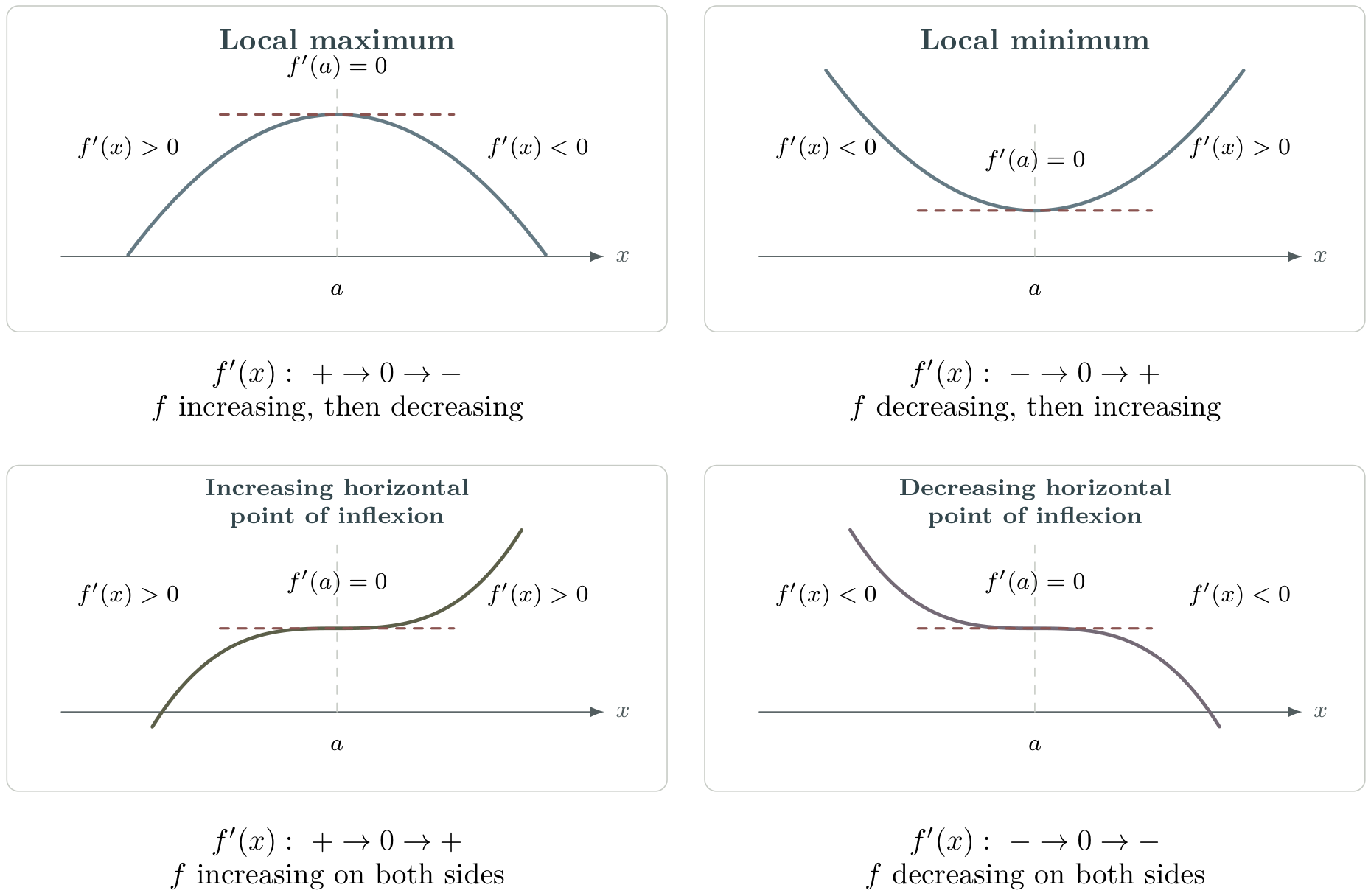
Standard stationary-point sign tables
| \(x\) | \(-\infty\) | \(a\) | \(+\infty\) |
|---|---|---|---|
| \(f'(x)\) | + | 0 | − |
| \(f(x)\) | Max |
| \(x\) | \(-\infty\) | \(a\) | \(+\infty\) |
|---|---|---|---|
| \(f'(x)\) | − | 0 | + |
| \(f(x)\) | Min |
| \(x\) | \(-\infty\) | \(a\) | \(+\infty\) |
|---|---|---|---|
| \(f'(x)\) | + | 0 | + |
| \(f(x)\) |
| \(x\) | \(-\infty\) | \(a\) | \(+\infty\) |
|---|---|---|---|
| \(f'(x)\) | − | 0 | − |
| \(f(x)\) |
Constructing a full sign table
You may already have met sign tables when solving inequalities in algebra. Here the same process is applied to \(f'(x)\).
- Factor \(f'(x)\) completely, including the denominator when necessary.
- Put each zero and excluded value in the top \(x\)-row.
- Add one sign row for each factor, then combine the signs to obtain the \(f'(x)\)-row.
- Use the tall \(f(x)\)-row to show where the function increases or decreases and hence classify each stationary point.
Use a double vertical guide at a vertical asymptote and split the variation arrows into separate branches. A zero is aligned directly below its \(x\)-value; signs lie between the guides and the table stays open at the bottom.
First derivative sign tables
A full lesson on constructing and interpreting sign tables.
Applying the first derivative test
Worked example 2: classify using the first derivative sign test
Find and classify all stationary points of
Solution
1. Find the stationary \(x\)-values.
2. Find the coordinates.
So the stationary points are \((-1,10)\) and \((3,-22)\).
3. Determine the sign of \(f'(x)\). Use the fully factored form and show how the signs of the factors combine.
| \(x\) | \(-\infty\) | \(-1\) | \(3\) | \(+\infty\) | |
|---|---|---|---|---|---|
| \(3\) | + | + | + | ||
| \(x+1\) | − | 0 | + | + | |
| \(x-3\) | − | − | 0 | + | |
| \(f'(x)\) | + | 0 | − | 0 | + |
| \(f(x)\) | Max | Min |
At \(x=-1\), \(f'(x)\) changes from positive to negative, so \((-1,10)\) is a local maximum.
At \(x=3\), \(f'(x)\) changes from negative to positive, so \((3,-22)\) is a local minimum.
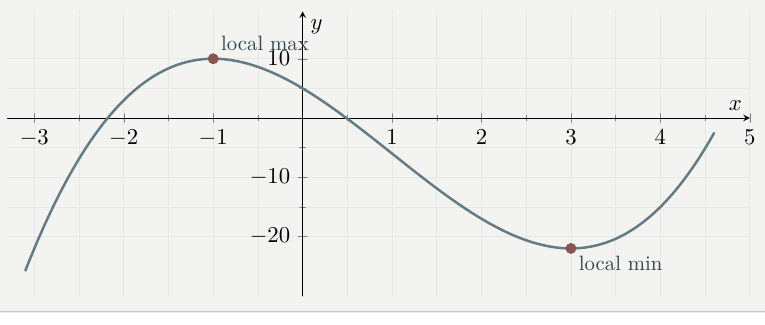
Classifying two stationary points
This tutorial uses \(f(x)=x^3+6x^2-15x+3\): differentiate, factor \(f'\), find the coordinates, construct separate factor rows, and classify the local maximum and minimum.
Extending the method: a vertical asymptote
Worked example 3: factor rows and two separate branches
Find and classify the stationary points of \(f(x)=3x+\frac{12}{x}\), where \(x\ne0\).
Solution
The stationary values are \(-2\) and \(2\), while \(x=0\) is a vertical asymptote and must be included as a domain break, not a stationary point.
| \(x\) | \(-\infty\) | \(-2\) | \(0\) | \(2\) | \(+\infty\) | ||
|---|---|---|---|---|---|---|---|
| \(3\) | + | + | + | + | |||
| \(x+2\) | − | 0 | + | + | + | ||
| \(x-2\) | − | − | − | 0 | + | ||
| \(x^2\) | + | + | 0 | + | + | ||
| \(f'(x)\) | + | 0 | − | undefined | − | 0 | + |
| \(f(x)\) | Max | Min |
Since \(f(-2)=-12\) and \(f(2)=12\), \((-2,-12)\) is a local maximum and \((2,12)\) is a local minimum.
Sign table with a vertical asymptote
Work through \(f(x)=3x+12/x\), factor \(f'\), mark the vertical asymptote with a double guide, and classify both stationary points.
When the sign does not change: horizontal points of inflexion
What must be shown?
At an isolated stationary point \(x=a\), first establish \(f'(a)=0\). If \(f'\) has the same sign immediately before and after \(a\), the function continues in the same direction and the point is not a turning point.
For the standard examples below, \(+\to0\to+\) gives an increasing horizontal point of inflexion and \(-\to0\to-\) gives a decreasing one. The graphs and the sign changes in \(f''\) confirm the change of concavity. Zero gradient alone does not prove an inflexion.
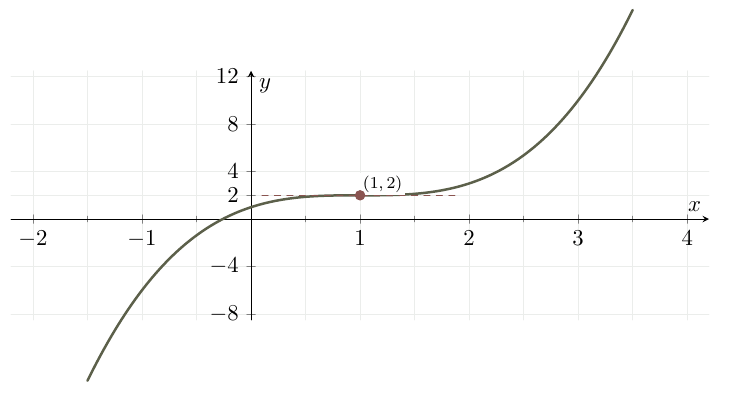
Worked example 4: an increasing horizontal point of inflexion
Let
Solution
Thus \(f'(x)=0\) only when \(x=1\), and \(f(1)=2\). The stationary point is \((1,2)\). Since \(3(x-1)^2>0\) on both sides of \(x=1\), the function is increasing before and after the point.
| \(x\) | \(-\infty\) | \(1\) | \(+\infty\) |
|---|---|---|---|
| \(3\) | + | + | |
| \((x-1)^2\) | + | 0 | + |
| \(f'(x)\) | + | 0 | + |
| \(f(x)\) |
The sign pattern is \(+\to0\to+\), so
Answer \((1,2)\) is an increasing horizontal point of inflexion.
Optional confirmation using \(f''\). Since \(f''(x)=6(x-1)\), the second derivative changes from negative to positive at \(x=1\), confirming a change of concavity.
Worked example 5: a decreasing horizontal point of inflexion
Let
Solution
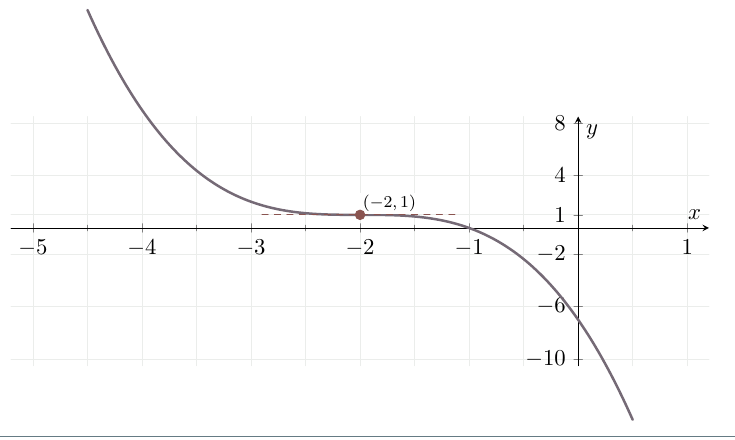
Thus \(g'(x)=0\) only when \(x=-2\), and \(g(-2)=1\). The stationary point is \((-2,1)\). Since \(-3(x+2)^2<0\) on both sides of \(x=-2\), the function is decreasing before and after the point.
| \(x\) | \(-\infty\) | \(-2\) | \(+\infty\) |
|---|---|---|---|
| \(-3\) | − | − | |
| \((x+2)^2\) | + | 0 | + |
| \(g'(x)\) | − | 0 | − |
| \(g(x)\) |
The sign pattern is \(-\to0\to-\), so
Answer \((-2,1)\) is a decreasing horizontal point of inflexion.
Optional confirmation using \(g''\). Since \(g''(x)=-6(x+2)\), \(g''(x)>0\) for \(x<-2\) and \(g''(x)<0\) for \(x>-2\). The concavity therefore changes from concave up to concave down.
A quicker alternative: the second derivative test
The second derivative describes concavity: \(f''(x)>0\) means concave up, and \(f''(x)<0\) means concave down. At a stationary point this lets us classify a local maximum or minimum from a single value of \(f''\).
Second derivative test
At a stationary point \(x=a\), where \(f'(a)=0\):
- if \(f''(a)>0\), the point is a local minimum;
- if \(f''(a)<0\), the point is a local maximum;
- if \(f''(a)=0\), the test is inconclusive — use first-derivative signs (and concavity if needed).
Second Derivative Test
Apply the second derivative test to \(f(x)=2x^3-21x^2+60x+8\). Solve \(f'(x)=0\), find \((2,60)\) and \((5,33)\), then classify the first as a local maximum and the second as a local minimum.
Worked example 6: three stationary points using the second derivative test
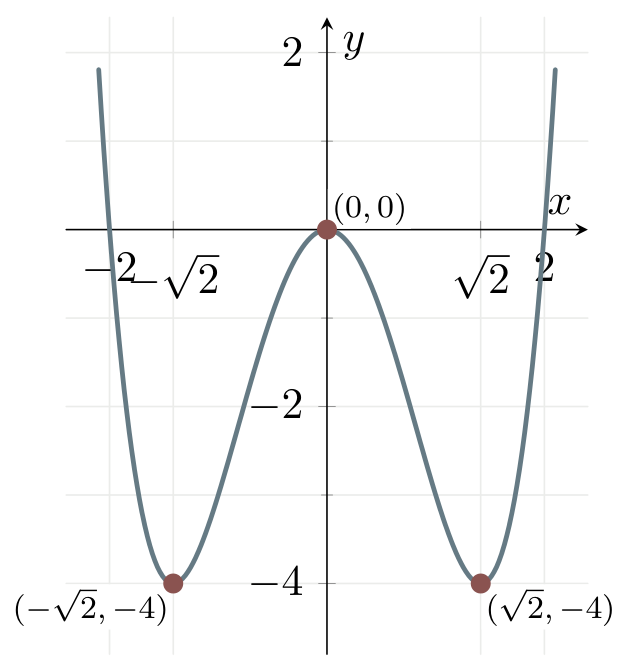
Find and classify all stationary points of
Solution
First,
Hence
The corresponding coordinates are
Now differentiate again:
At \(x=-\sqrt2\), \(f''(-\sqrt2)=16>0\), so \((-\sqrt2,-4)\) is a local minimum.
At \(x=0\), \(f''(0)=-8<0\), so \((0,0)\) is a local maximum.
At \(x=\sqrt2\), \(f''(\sqrt2)=16>0\), so \((\sqrt2,-4)\) is a local minimum.
Second derivative test: x ln x
The method also applies to non-polynomial functions. For \(f(x)=x\ln x\), \(x>0\), apply the product rule, solve \(f'(x)=0\), find exact coordinates and use \(f''\) to establish a local minimum.
Why \(f''(a)=0\) is inconclusive
All three functions satisfy \(f'(0)=0\) and \(f''(0)=0\), but their stationary points have different natures:
- \(f(x)=x^4\): local minimum at \((0,0)\);
- \(f(x)=x^3\): increasing horizontal point of inflexion at \((0,0)\);
- \(f(x)=-x^4\): local maximum at \((0,0)\).
Therefore \(f''(a)=0\) does not mean “point of inflexion”. Return to the first derivative sign test; use the graph or concavity to confirm an inflexion when needed.
When f″(a)=0
Compare \(f(x)=x^3-6x^2+12x-5\) and \(f(x)=x^4+1\). In each case the second derivative test is inconclusive; a first-derivative sign table distinguishes an increasing horizontal inflexion from a local minimum.
Bringing the methods together
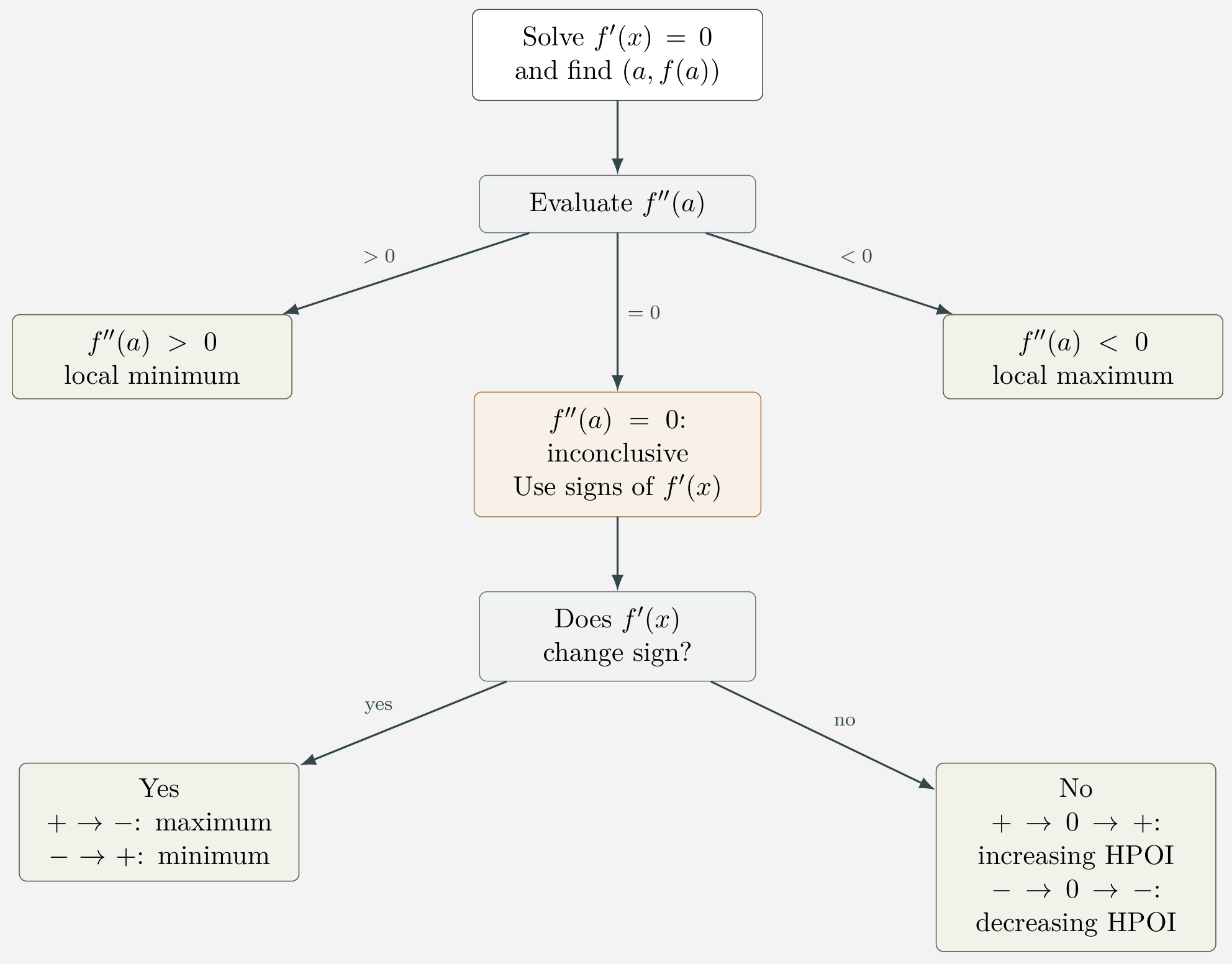
Both classification methods begin with the same locating step: solve \(f'(x)=0\) and find the coordinates.
Decision process
- Solve \(f'(x)=0\) and find every stationary coordinate.
- Evaluate \(f''(a)\) if convenient.
- If \(f''(a)>0\): minimum. If \(f''(a)<0\): maximum.
- If \(f''(a)=0\): inconclusive. Study signs of \(f'\) on either side.
- If the sign of \(f'\) does not change, the stationary point is not a turning point; classify the horizontal point of inflexion using the established behaviour/concavity.
Common mistakes
- Giving only the stationary x-value instead of the full coordinate.
- Saying “maximum” or “minimum” without a valid derivative test.
- Assuming every solution of \(f''(x)=0\) is a point of inflexion.
- Assuming every stationary point is a turning point.
- Failing to distinguish increasing and decreasing horizontal points of inflexion.
- Skipping factor rows, so the sign of a product or quotient is not justified.
- Treating a vertical asymptote as a stationary point instead of marking a double guide.
Practice questions
Instructions
For each question, show how the stationary points are found and justify their nature. Use the requested method where specified. Whenever you construct a first derivative sign table, factor the derivative and include a separate row for each factor. Give exact coordinates unless told otherwise.
- Find and classify the stationary point of \(f(x)=3x^2-12x+5\). Use the second derivative test.
- Find and classify all stationary points of \(f(x)=x^3-6x^2+9x+1\). Use a full first derivative sign table, including factor rows.
- Find and classify all stationary points of \(f(x)=x^4-2x^2\). Use the second derivative test.
- Show that \(f(x)=(x-2)^3+8\) has an increasing horizontal point of inflexion. State its coordinates.
- Show that \(g(x)=-2(x+1)^3+4\) has a decreasing horizontal point of inflexion. State its coordinates.
- For \(f(x)=x^4\), the second derivative test is inconclusive at \(x=0\). Use the first derivative sign test to classify the stationary point.
- For \(f(x)=-x^4\), the second derivative test is inconclusive at \(x=0\). Use the first derivative sign test to classify the stationary point.
- Find and classify all stationary points of \(f(x)=x^4-8x^2+3\).
- Find and classify all stationary points of \(f(x)=\frac14x^4-x^3\). Distinguish between a turning point and a horizontal point of inflexion.
- Find and classify all stationary points of \(f(x)=x^5-5x^3\). Use a combination of first- and second-derivative reasoning.
Answer key
1. Quadratic
Therefore \((2,-7)\) is a local minimum.
2. Cubic: first derivative test
The stationary x-values are 1 and 3. Substitution gives \(f(1)=1-6+9+1=5\) and \(f(3)=27-54+27+1=1\).
| \(x\) | \(-\infty\) | \(1\) | \(3\) | \(+\infty\) | |
|---|---|---|---|---|---|
| \(3\) | + | + | + | ||
| \(x-1\) | − | 0 | + | + | |
| \(x-3\) | − | − | 0 | + | |
| \(f'(x)\) | + | 0 | − | 0 | + |
| \(f(x)\) | Max | Min |
At \(x=1\), \(f'\) changes from positive to negative: \((1,5)\) is a local maximum. At \(x=3\), it changes from negative to positive: \((3,1)\) is a local minimum.
3. Quartic: second derivative test
So \(x=-1,0,1\), giving points \((-1,-1),(0,0),(1,-1)\).
Since \(f''(\pm1)=8>0\), the points \((-1,-1)\) and \((1,-1)\) are local minima. Since \(f''(0)=-4<0\), \((0,0)\) is a local maximum.
4. Increasing horizontal point of inflexion
The only stationary x-value is 2 and \(f(2)=8\). The derivative is positive on both sides of 2, so the function remains increasing.
This changes from negative to positive at 2, confirming concavity changes from down to up. Hence \((2,8)\) is an increasing horizontal point of inflexion.
5. Decreasing horizontal point of inflexion
The stationary value is \(-1\), giving \(g(-1)=4\). The derivative is negative on both sides, so the function remains decreasing.
This changes from positive to negative at \(-1\). Hence \((-1,4)\) is a decreasing horizontal point of inflexion.
6. Positive quartic
Here \(f(0)=0\) and \(f''(0)=0\), so the second derivative test is inconclusive.
The sign of the first derivative changes from negative to positive at \(x=0\). Therefore \((0,0)\) is a local minimum.
7. Negative quartic
Here \(f(0)=0\) and \(f''(0)=0\), so the second derivative test is inconclusive.
The sign of the first derivative changes from positive to negative at \(x=0\). Therefore \((0,0)\) is a local maximum.
8. Two minima and one maximum
Thus \(x=-2,0,2\). The stationary points are \((-2,-13),(0,3),(2,-13)\).
Since \(f''(\pm2)=32>0\), the two points \((-2,-13)\) and \((2,-13)\) are local minima. Since \(f''(0)=-16<0\), \((0,3)\) is a local maximum.
9. One horizontal point of inflexion and one minimum
So \(x=0,3\), giving \((0,0)\) and \((3,-27/4)\). At 0 the derivative is negative on both sides, so the function continues decreasing.
The second derivative changes from positive to negative at 0, confirming that \((0,0)\) is a decreasing horizontal point of inflexion. At 3 the first derivative changes from negative to positive, so \((3,-27/4)\) is a local minimum.
10. Mixed stationary points
Thus \(x=-\sqrt3,0,\sqrt3\). The coordinates are \((-\sqrt3,6\sqrt3)\), \((0,0)\), \((\sqrt3,-6\sqrt3)\).
At \(-\sqrt3\), \(f''=-30\sqrt3<0\), so \((-\sqrt3,6\sqrt3)\) is a local maximum. At \(\sqrt3\), \(f''=30\sqrt3>0\), so \((\sqrt3,-6\sqrt3)\) is a local minimum.
At 0 the second derivative test is inconclusive. Since \(f'<0\) on both sides of 0, the pattern is \(-\to0\to-\). Also \(f''\) changes from positive to negative near 0. Hence \((0,0)\) is a decreasing horizontal point of inflexion.
Summary
- A stationary point satisfies \(f'(a)=0\). Calculate \(f(a)\) to find its full coordinate.
- In a full first derivative sign table, factor \(f'\), show each factor row and combine the signs.
- A double vertical guide marks a vertical asymptote and separates the branches.
- At a stationary value, \(+\to-\) gives a local maximum and \(-\to+\) gives a local minimum.
- At a stationary point, \(f''<0\) means concave down and a local maximum; \(f''>0\) means concave up and a local minimum.
- If \(f''(a)=0\), return to the first derivative sign test.
- For the standard examples in this lesson, \(+\to0\to+\) and \(-\to0\to-\) describe increasing and decreasing horizontal inflexions respectively; the graphs or concavity confirm their nature.