
IB Mathematics: Analysis and Approaches SL/HL — Topic 1 Number and algebra
Geometric Sequences and Series
Recognise multiplicative patterns, move flexibly between terms, sum finite geometric series, solve threshold problems and model repeated percentage change.
Learning goal
Recognise and model geometric sequences; calculate terms and finite partial sums; use sigma notation; solve growth, decay and threshold problems; and interpret models in context.
Syllabus link
AA SL/HL: SL 1.3. Geometric sequences and series; the nth term; the sum of the first n terms; sigma notation; technology and applications.
Big idea
Arithmetic sequences repeatedly add the same amount; geometric sequences repeatedly multiply by the same factor.
Key relationship
Once the first term \(u_1\) and common ratio \(r\) are known, every term and every finite partial sum is determined.
Unless a question specifies another accuracy, give non-exact numerical answers to three significant figures. Keep full calculator values during working and round only the final answer.
Scope of this lesson
This lesson treats finite geometric sequences and finite geometric series only. Infinite geometric series and \(S_\infty\) belong to the separate infinite-series section. Compound-interest and annuity formulae are also treated separately in financial applications.
Recognising a geometric sequence
A sequence is an ordered list of numbers. A geometric sequence is obtained by multiplying each term by the same constant, called the common ratio.
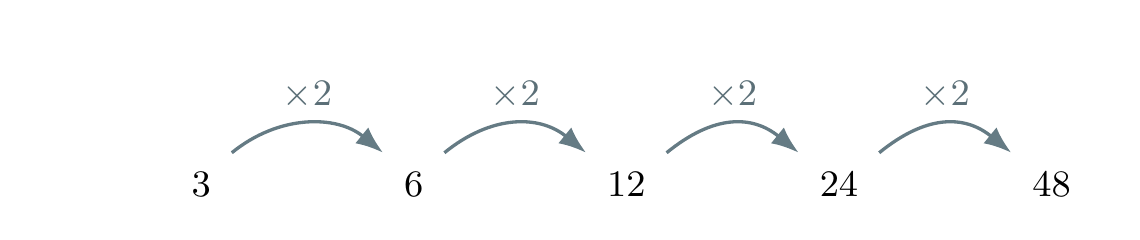
For a geometric sequence, this quotient has the same value for every pair of consecutive non-zero terms.
Worked example 1: is the pattern geometric?
Decide whether each sequence is geometric. If it is, state the common ratio.
- \(5,15,45,135,\ldots\)
- \(64,-32,16,-8,\ldots\)
- \(4,8,14,22,\ldots\)
Solution. Compare consecutive ratios.
- \(15/5=45/15=135/45=3\), so \(\boxed{r=3}\).
- \(-32/64=16/(-32)=-8/16=-\tfrac12\), so \(\boxed{r=-\tfrac12}\). The negative ratio makes the signs alternate.
- \(8/4=2\) but \(14/8=1.75\), so the sequence is not geometric.
| Arithmetic | Geometric | |
|---|---|---|
| What stays constant? | Difference \(u_{n+1}-u_n\) | Ratio \(u_{n+1}/u_n\) |
| Typical change | Add/subtract a fixed amount | Multiply by a fixed factor |
| Typical context | +$500 salary each year | +4% salary each year |
What does the sign and size of \(r\) tell us?
Geometric sequences and progressions: the foundations
This introductory tutorial reviews what makes a sequence geometric, how to find \(r=u_{n+1}/u_n\), and develops the nth-term idea used next.
The nth term of a geometric sequence
Starting from \(u_1\), each new term multiplies by another factor of \(r\):
\[u_1=u_1,\qquad u_2=u_1r,\qquad u_3=u_1r^2,\qquad u_4=u_1r^3.\]Worked example 2: find a distant term
The geometric sequence begins \(7,21,63,189,\ldots\). Find \(u_8\).
First identify \(u_1=7\) and \(r=21/7=3\). Then
\[u_8=7(3)^{8-1}=7(3^7)=\boxed{15309}.\]Why is the exponent \(n-1\)?
To reach the nth term from the first term, we multiply by \(r\) exactly \(n-1\) times. Reaching \(u_{10}\) therefore requires nine multiplications by \(r\).
A sequence is discrete
The points may suggest an exponential curve, but the sequence itself contains values only at integer term numbers \(n=1,2,3,\ldots\). This becomes essential in threshold questions.
A flexible term formula
If one term \(u_p\) is already known, there is no need to return to \(u_1\). Moving from term \(p\) to term \(n\) requires \(n-p\) multiplications by \(r\).
Geometric Sequences: A BETTER nth-Term Formula | IB Maths AA & AI
Move directly between known terms and use the same idea efficiently when finding a common ratio.
Worked example 3: start from a known middle term
A geometric sequence has \(u_4=40\) and \(r=\tfrac32\). Find \(u_9\).
Finding a term number: thresholds and logarithms
When a question asks when a sequence first crosses a target, the unknown is the term number \(n\). A GDC can use a table or graph; logarithms can solve the exponential equation or inequality algebraically. In either case, \(n\) must finally be an integer.
Worked example 4: which term first exceeds a target?
A training plan begins at 4 km and increases each session by 15%. Find the first session on which the planned distance exceeds 20 km.
The multiplier is \(r=1.15\), so \(u_n=4(1.15)^{n-1}\). A table gives
\[u_{12}\approx18.6,\qquad u_{13}\approx21.4.\]Therefore the first session above 20 km is \(n=13\).
Technology note
The continuous crossing point tells you where to look, but the sequence only exists at integer term numbers. Always check the integer on each side of a threshold.
Must-know 1: growth — find the least \(n\) above a threshold
Given \(u_n=3.14(2.7)^{n-1}\), find the least \(n\) such that \(u_n>10^6\).
Logarithmic method.
\[3.14(2.7)^{n-1}>10^6\]\[(2.7)^{n-1}>\frac{10^6}{3.14}\]\[(n-1)\ln(2.7)>\ln\!\left(\frac{10^6}{3.14}\right)\]\[n-1>\frac{\ln(10^6/3.14)}{\ln(2.7)}\approx12.7574.\]So \(n>13.7574\), and the least integer is \(\boxed{14}\). Check:
\[u_{13}\approx4.71\times10^5<10^6,\quad u_{14}\approx1.27\times10^6>10^6.\]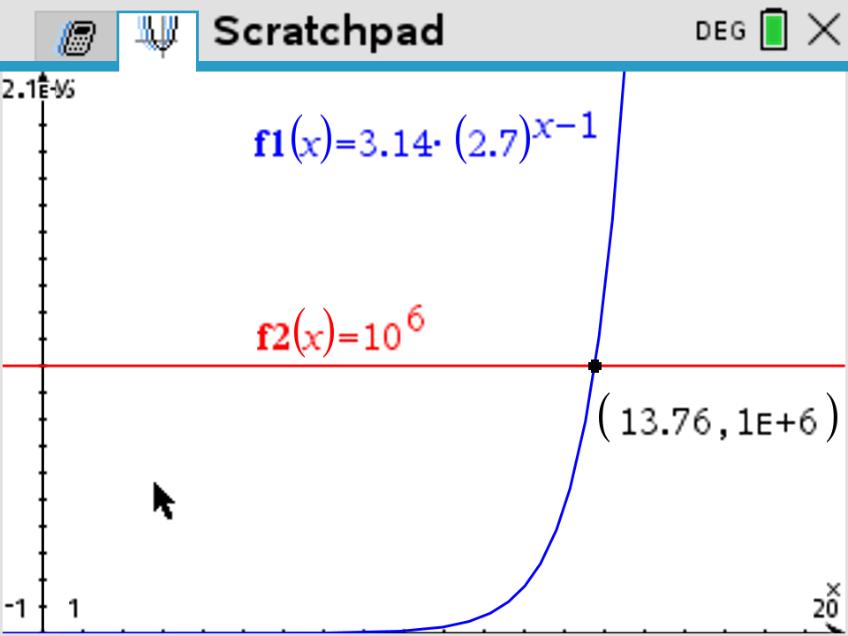
Growth case: \(r>1\Rightarrow\ln r>0\), so dividing by \(\ln r\) preserves the inequality.
Important logarithm fact: inputs between 0 and 1
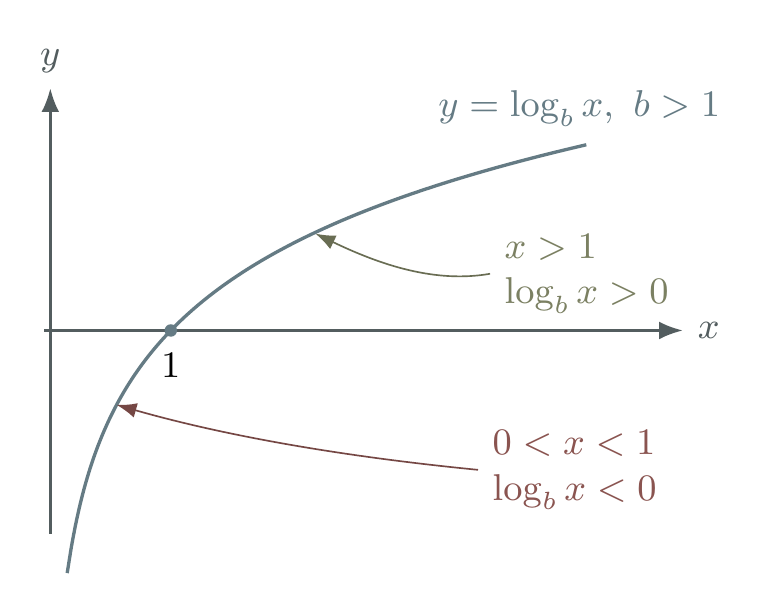
For any logarithm base \(b>1\),
\[\boxed{0<x<1\Rightarrow\log_bx<0},\qquad \boxed{\log_b1=0},\qquad \boxed{x>1\Rightarrow\log_bx>0}.\]Therefore, whenever \(0<r<1\), \(\log_b(r)<0\). If you divide an inequality by \(\log_b(r)\), you are dividing by a negative number and the inequality sign must reverse.
Must-know 2: decay — find the largest \(n\) above a threshold
Given \(u_n=31\,420(0.7)^{n-1}\), find the largest \(n\) such that \(u_n>100\).
Now \(\ln(0.7)<0\), so dividing by it reverses the sign:
\[n-1<\frac{\ln(100/31\,420)}{\ln(0.7)}\approx16.1212.\]Thus \(n<17.1212\), so the largest integer is \(\boxed{17}\). Check:
\[u_{17}\approx104>100,\qquad u_{18}\approx73.1<100.\]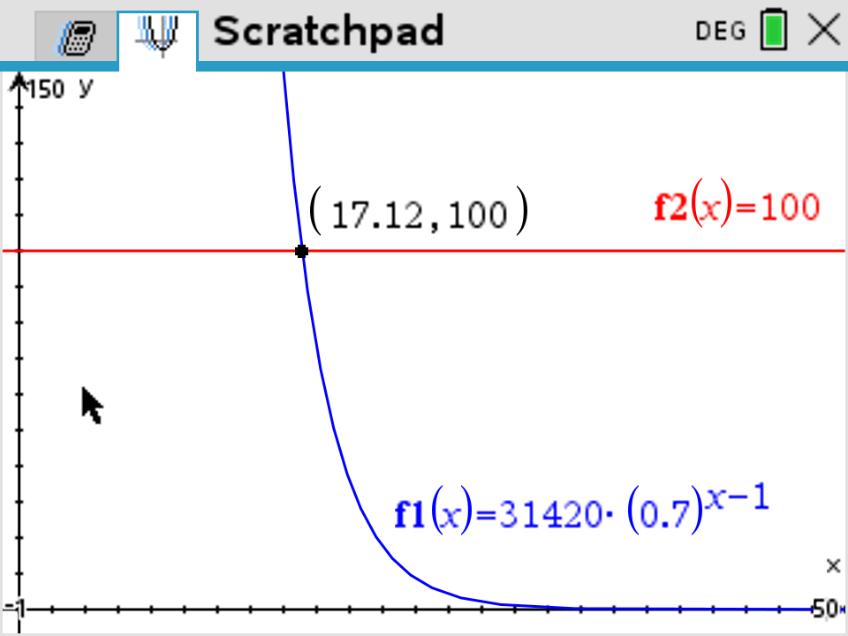
Decay case: \(0<r<1\Rightarrow\ln r<0\), so dividing by \(\ln r\) reverses the inequality.
The logarithm inequality trap
Taking \(\ln\) of both sides does not reverse an inequality because \(\ln x\) is increasing. The reversal happens later only if you divide by a negative quantity such as \(\ln(0.7)\).
First term greater than a target: GDC and logarithms
Set up the inequality and solve the threshold problem with both a TI-Nspire CX and logarithms, then choose the correct integer term number.
Finding the ratio and first term from known terms
If \(u_p\) and \(u_q\) are known, use the flexible formula \(u_q=u_pr^{q-p}\).
Then use either known term to recover \(u_1\).
Worked example 5: two possible real ratios
A geometric sequence satisfies \(u_2=6\) and \(u_6=96\). Find all possible real values of \(r\) and the corresponding values of \(u_1\).
Because the power is even, \(\boxed{r=2}\) or \(\boxed{r=-2}\). From \(u_2=u_1r\):
\[r=2\Rightarrow u_1=3,\qquad r=-2\Rightarrow u_1=-3.\]\((u_1,r)=(3,2)\) or \((-3,-2)\)
Do not automatically choose the positive root
If \(q-p\) is even, an equation such as \(r^4=16\) can give both \(r=2\) and \(r=-2\). A real-world context may force \(r>0\), but a purely algebraic sequence may allow a negative ratio.
Using equal consecutive ratios with three consecutive terms
For three consecutive non-zero terms \(u_{n-1},u_n,u_{n+1}\), both consecutive ratios must equal the same common ratio.
Worked example 6: find a parameter using equal consecutive ratios
The first three terms are \(11-k,\ 5k-7,\ 7k+19\). Find all real values of \(k\) for which they are geometric.
So \(\boxed{k=5}\) or \(\boxed{k=-1}\). The corresponding sequences are \(6,18,54\) with \(r=3\), and \(12,-12,12\) with \(r=-1\).
From a sequence to its associated series: partial sums
The associated series is formed by adding the terms: \(u_1+u_2+u_3+\cdots\). The sum of the first \(n\) terms is the nth partial sum:
\[\boxed{S_n=u_1+u_2+\cdots+u_n}.\]The sequence \(u_1,u_2,\ldots\) and the partial-sum sequence \(S_1,S_2,\ldots\) are different objects: \(u_n\) is one term, while \(S_n\) is the accumulated total.
Recovering a term from partial sums
Subtract consecutive partial sums:
\[\boxed{u_n=S_n-S_{n-1}}\qquad(n\ge2).\]In words: the new term is the increase from one partial sum to the next. Also \(u_1=S_1\); if \(S_0=0\), the same relationship works for every \(n\ge1\).
Worked example 7: recover \(u_n\) from \(S_n\)
The sum of the first \(n\) terms is \(S_n=4(3^n-1)\). Find \(u_n\), then state \(u_1\) and \(r\).
Hence \(\boxed{u_n=8\cdot3^{n-1}}\), so \(\boxed{u_1=8}\) and \(\boxed{r=3}\).
The sum of the first n terms of a geometric sequence
For a geometric sequence \(u_1,u_1r,u_1r^2,\ldots\),
\[S_n=u_1+u_1r+u_1r^2+\cdots+u_1r^{n-1}.\]Deriving the finite-sum formula
\[S_n=u_1+u_1r+u_1r^2+\cdots+u_1r^{n-1}\] \[rS_n=u_1r+u_1r^2+\cdots+u_1r^{n-1}+u_1r^n.\]Subtract:
\[S_n-rS_n=u_1-u_1r^n.\]Geometric Series: Sum of the First n Terms
Distinguish a sequence from its associated series and apply the finite-sum formula for both growth and decay examples.
Two useful special cases: \(r=1\) and \(r=-1\)
If \(r=1\), every term equals \(u_1\), so
\[\boxed{S_n=nu_1}.\]If \(r=-1\), terms alternate and cancel in pairs:
\[\boxed{S_{2m}=0},\qquad\boxed{S_{2m+1}=u_1}.\]Worked example 8: special cases
- If \(u_1=14\) and \(r=1\), \(S_{25}=25(14)=\boxed{350}\).
- If \(u_1=9\) and \(r=-1\), \(S_{40}=\boxed{0}\) and \(S_{41}=\boxed{9}\).
Worked example 9: sum the first n terms
Find the sum of the first eight terms of \(3,6,12,24,\ldots\).
\(u_1=3\), \(r=2\), \(n=8\).
\[S_8=\frac{3(1-2^8)}{1-2}=3(255)=\boxed{765}.\]Looking ahead: infinite geometric series
Infinite sums are not taught on this page. When you reach that separate syllabus section, this tutorial is the natural follow-on for converging geometric series and \(S_\infty\).
Working with finite geometric sums
IB questions commonly use sigma notation, selected blocks of terms and cumulative-total thresholds.
Sigma notation
Need a sigma-notation refresher?
If you need to review the parts of a sigma expression, how to expand one, how to write a series in sigma notation, or how shifted indices work, use the separate Reading and Writing Sigma Notation reference lesson.
Worked example 10: read and evaluate a geometric sigma sum
Evaluate \(\sum_{k=1}^{9}7(\tfrac32)^{k-1}\).
The first term is 7, the common ratio is \(3/2\), and there are 9 terms.
\[S_9=7\frac{1-(3/2)^9}{1-3/2}=\boxed{\frac{134197}{256}}\approx\boxed{524}.\]Number of terms in a sigma sum
\[\sum_{k=a}^{b}f(k)\quad\text{contains}\quad\boxed{b-a+1}\text{ terms}.\]Block sums
Worked example 11: total for the second year only
A new product sells 60 units in month 1; monthly sales grow geometrically with \(r=1.08\). Find the modelled total during months 13–24.
Using full calculator precision, \(S_{24}-S_{12}\approx2.87\times10^3\). So the model predicts about \(\boxed{2.87\times10^3\text{ units}}\).
Cumulative thresholds
Worked example 12: the first partial sum to exceed a target
\(u_1=18\), \(r=1.2\). Find the smallest \(n\) such that \(S_n>300\).
Therefore \(\boxed{n=9}\).
Term threshold versus sum threshold
\(u_n>A\) asks about one term. \(S_n>A\) asks about the accumulated total of the first \(n\) terms. They are different equations.
Percentage growth and decay models
A constant percentage change creates a geometric sequence because the same multiplier is applied each period.
Worked example 13: salary growth
A starting annual salary is $42,000 and increases by 3.5% at the start of each new year. Find the salary in year 8.
\(r=1.035\), \(u_1=42000\).
\[u_8=42000(1.035)^7\approx5.34\times10^4.\]The year-8 salary is approximately \(\boxed{\$53\,400}\).
Indexing matters
If \(u_1\) is the amount in year 1, then the amount in year \(n\) is \(u_1r^{n-1}\). Using \(r^n\) applies one percentage change too many.
Worked example 14: population threshold
A colony contains 240 organisms at the end of week 1 and grows by 18% each week. Find the first week in which the model predicts more than 1000 organisms.
\(u_n=240(1.18)^{n-1}\).
\[u_9\approx902<1000,\qquad u_{10}\approx1.06\times10^3>1000.\]Therefore the first such week is \(\boxed{10}\).
Typical SL 1.3 contexts
Population growth, spread of disease, repeated salary increases/decreases, production or sales growth and repeated-motion models. A geometric model assumes a constant ratio, so it should always be interpreted critically.
Repeated motion: bouncing balls and total distance
Repeated-motion problems hide a geometric sequence inside the rebound heights. Suppose a ball is dropped from height \(H\) and each rebound reaches a fraction \(r\) of the previous maximum height, with \(0<r<1\).
\[\boxed{h_1=Hr},\qquad \boxed{h_n=h_1r^{n-1}}.\]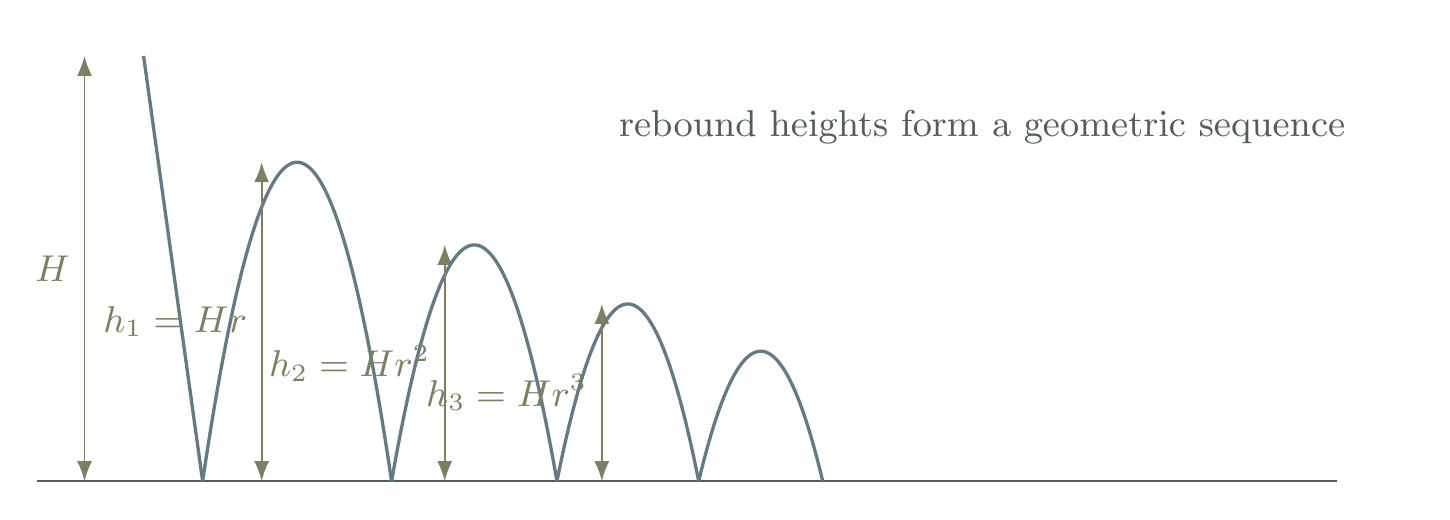
If the ball has completed the first \(m\) rebound arcs, first add the rebound heights with the ordinary finite sum formula. The total distance is the initial drop plus twice that rebound-height sum.
Worked example 15: finite bouncing-ball distance
A ball is dropped from 2.4 m and rebounds to 75% of its previous maximum height.
- Find the maximum height after the fifth bounce.
- Find the total vertical distance travelled immediately before the fifth bounce.
\(r=0.75\), so \(h_1=2.4(0.75)=1.8\) m and \(h_n=1.8(0.75)^{n-1}\).
(a)
\[h_5=1.8(0.75)^4\approx\boxed{0.570\text{ m}}.\](b) Before the fifth bounce, the initial drop is complete and four rebound arcs have been completed.
\[S_4=\frac{1.8(1-0.75^4)}{1-0.75}=4.921875.\]\[D=2.4+2S_4\approx\boxed{12.2\text{ m}}.\]Read the endpoint carefully
“Immediately before the fifth bounce”, “at the fifth maximum height” and “after five complete bounces” count different pieces of the motion. Sketch the bounces before writing the sum.
Interpreting and checking a geometric model
Questions to ask about a model
- Is a constant percentage change realistic over the full interval?
- Are the quantities discrete, so final values should be whole objects or people?
- Does the model eventually predict impossible values because of limited capacity or changing conditions?
- Is the sequence describing signed positions or positive distances/magnitudes?
Worked example 16: signed sequence versus total distance
A runner finishes day 1 at coordinate +1.5 km on an east–west road. Each day's finishing coordinate is -1.4 times the previous day's coordinate.
- Find the finishing coordinate on day 6.
- Find the total distance run over the first six days if each day begins at home and runs directly to that coordinate.
The signed coordinates have \(u_1=1.5\), \(r=-1.4\).
\[u_6=1.5(-1.4)^5\approx\boxed{-8.07\text{ km}}.\]The negative sign means west of home. Distances are positive magnitudes, so use ratio 1.4:
\[D_6=1.5\frac{1-1.4^6}{1-1.4}\approx\boxed{24.5\text{ km}}.\]Past-paper-informed exam patterns: worked sister questions
The questions below are original sister questions. Their wording, multi-part structure and recurring skills reflect the IB-style sequence-and-series patterns used in the finalized handout; no past-paper question is copied verbatim.
Exam-style question 1 — direct term and finite sum [5 marks]
The first three terms are \(6,15,37.5\).
- Write down the common ratio. [1]
- Find the seventh term. [2]
- Find the sum of the first eight terms. [2]
- \(\boxed{r=2.5}\).
- \(u_7=6(2.5)^6\approx\boxed{1.46\times10^3}\).
- \(S_8=6\frac{1-2.5^8}{1-2.5}\approx\boxed{6.10\times10^3}\).
Exam-style question 2 — algebraic consecutive terms [7 marks]
The first three terms are \(k+6,2k+6,3k+7\).
- Show that geometric terms give \((k-3)(k+2)=0\). [3]
- For each possible \(k\), find the common ratio. [4]
\[\frac{2k+6}{k+6}=\frac{3k+7}{2k+6}\Rightarrow(2k+6)^2=(k+6)(3k+7)\Rightarrow(k-3)(k+2)=0.\]
For \(k=3\), the terms are \(9,12,16\), so \(r=\boxed{4/3}\). For \(k=-2\), the terms are \(4,2,1\), so \(r=\boxed{1/2}\).
Exam-style question 3 — non-consecutive terms and possible ratios [5 marks]
\(u_2=-10\), \(u_6=-160\).
\[-160=-10r^4\Rightarrow r^4=16\Rightarrow\boxed{r=2\text{ or }r=-2}.\]Since \(u_2=u_1r\), \(\boxed{u_1=-5}\) for \(r=2\), and \(\boxed{u_1=5}\) for \(r=-2\).
Exam-style question 4 — percentage growth threshold [5 marks]
A colony contains 320 cells at the end of week 1 and grows by 22% each week.
- Write an expression for \(u_n\). [2]
- Find the first week above 1500 cells. [3]
\(\boxed{u_n=320(1.22)^{n-1}}\). A GDC gives \(u_8\approx1290<1500\) and \(u_9\approx1570>1500\), so \(\boxed{9}\).
Exam-style question 5 — first partial sum above a target [5 marks]
A campaign receives 1200 responses in month 1; responses grow by 6% monthly. Find the smallest number of months for which the cumulative total exceeds 10000.
\[S_n=1200\frac{1-1.06^n}{1-1.06}.\]\(S_6\approx8.37\times10^3<10000\), \(S_7\approx1.01\times10^4>10000\), so \(\boxed{7}\).
Exam-style question 6 — a later block of terms [6 marks]
A subscription service gains 80 new subscribers in month 1, with \(r=1.05\).
- Find month 10. [2]
- Find the total for months 11–18 inclusive. [4]
\(u_{10}=80(1.05)^9\approx\boxed{124}\).
\[u_{11}+\cdots+u_{18}=S_{18}-S_{10}\approx\boxed{1.24\times10^3}.\]Exam-style question 7 — finite bouncing-ball model [6 marks]
A ball is dropped from 3.2 m and rebounds to 60% of its previous maximum height.
- Find the height after the fourth bounce. [2]
- Find the total distance immediately before the fourth bounce. [4]
\(h_1=1.92\) m, so \(h_4=1.92(0.6)^3\approx\boxed{0.415\text{ m}}\). The first three rebound heights sum to \(S_3=3.7632\), hence \(D=3.2+2S_3\approx\boxed{10.7\text{ m}}\).
Exam-style question 8 — alternating positions and total distance [7 marks]
Day 1 coordinate is +2.4 km and \(r=-1.3\).
- Find day 5. [2]
- Interpret the sign. [1]
- Find total distance over the first five days if every day starts at home. [4]
\(u_5=2.4(-1.3)^4\approx\boxed{6.85\text{ km}}\): positive means east/positive side. Distances use ratio 1.3:
\[D=2.4\frac{1-1.3^5}{1-1.3}\approx\boxed{21.7\text{ km}}.\]Exam-style question 9 — sigma notation with shifted index [6 marks]
\(S=\sum_{k=2}^{7}4(1.5)^k\).
- Number of terms. [1]
- First term and ratio. [2]
- Evaluate \(S\). [3]
There are \(7-2+1=\boxed{6}\) terms. The first term is \(4(1.5)^2=\boxed{9}\), with \(r=\boxed{1.5}\). Thus \(S=9\frac{1-1.5^6}{1-1.5}\approx\boxed{187}\).
Exam-style question 10 — recover a sequence from two terms and a total [7 marks]
The third term is 18 and the sixth term is 486.
- Find \(r\). [2]
- Find \(u_1\). [2]
- If the total is 6560, find the number of stages. [3]
\[486=18r^3\Rightarrow r^3=27\Rightarrow\boxed{r=3}.\]\[18=u_1(3)^2\Rightarrow\boxed{u_1=2}.\]\[6560=2\frac{1-3^n}{1-3}=3^n-1\Rightarrow3^n=6561=3^8\Rightarrow\boxed{n=8}.\]
Practice
Try these without looking at the answer key. Exact answers are preferred unless a decimal approximation is requested.
- Decide whether each sequence is geometric; if it is, state \(r\): (a) \(4,12,36,108,\ldots\) (b) \(81,-27,9,-3,\ldots\) (c) \(2,6,18,50,\ldots\).
- \(u_1=9\), \(r=2\). Find \(u_9\).
- \(u_1=160\), \(r=0.8\). Find \(u_{12}\) to 3 s.f.
- The sequence \(5,15,45,135,\ldots\) contains 10935. Find its term number.
- A quantity is 6.5 on day 1 and grows by 12% each day. Find the first day on which it exceeds 20.
- \(u_3=20\), \(u_7=320\). Find all possible real values of \(r\).
- For Question 6, find the corresponding possible values of \(u_1\).
- The first three terms are \(k+3,2k-1,5k-7\). Find all \(k\) for which they are geometric.
- \(u_1=-7\), \(r=-2\). Find \(u_6\) and state its sign.
- Find the sum of the first nine terms of \(2,6,18,54,\ldots\).
- \(u_1=11\), \(r=1\). Find \(S_{35}\).
- \(u_1=4\), \(r=2\). Find \(u_6+u_7+\cdots+u_{10}\).
- Evaluate \(\sum_{j=1}^{8}3(\tfrac54)^{j-1}\).
- In \(\sum_{k=3}^{11}2(1.4)^k\), state the number of terms and the first term.
- A starting salary is $36,000 and rises by 2.8% each year. Find the salary in year 10, nearest dollar.
- A population is 12500 in year 1 and decreases by 6% each year. Find the population in year 7, nearest whole number.
- A video receives 900 views in week 1 and weekly views rise by 10%. Find the first week for which the cumulative total exceeds 10000.
- A ball is dropped from 3 m and rebounds to 70% of the previous maximum height. Find the total distance immediately before the fourth bounce.
- A point has coordinate 2 on day 1; each day's coordinate is -1.5 times the previous one. Find day-5 coordinate and the sum of the distances from the origin over the first five days.
- Student A studies 20 minutes on day 1 and adds 5 minutes daily. Student B studies 20 minutes and increases by 12% daily. Find the first day B studies longer than A.
- A bacterial population grows by 25% every hour. Give one reason why this model may become unrealistic over a very long time.
- \(u_1=13\), \(r=-1\). Find \(S_{100}\) and \(S_{101}\).
Detailed answer key and solutions
Answers 1–5: recognition, terms and thresholds
- Geometric, \(r=3\).
- Geometric, \(r=-1/3\).
- Not geometric.
- \(u_9=9(2)^8=\boxed{2304}\).
- \(u_{12}=160(0.8)^{11}\approx\boxed{13.7}\).
- \(10935=5(3)^{n-1}\Rightarrow3^{n-1}=2187=3^7\), so \(\boxed{n=8}\).
- \(u_n=6.5(1.12)^{n-1}\); \(u_{10}\approx18.0\), \(u_{11}\approx20.2\), so \(\boxed{11}\).
Answers 6–9: reconstructing sequences
- \(320=20r^4\Rightarrow r^4=16\Rightarrow\boxed{r=2\text{ or }-2}\).
- \(20=u_1r^2=4u_1\Rightarrow\boxed{u_1=5}\) for either ratio.
- \((2k-1)^2=(k+3)(5k-7)\Rightarrow k^2+12k-22=0\Rightarrow\boxed{k=-6\pm\sqrt{58}}\).
- \(u_6=-7(-2)^5=\boxed{224}\), positive.
Answers 10–14: finite sums, blocks and sigma notation
- \(S_9=2\frac{1-3^9}{1-3}=\boxed{19682}\).
- \(S_{35}=35(11)=\boxed{385}\).
- \(S_{10}=4092\), \(S_5=124\); difference \(=\boxed{3968}\).
- \(S=12[(5/4)^8-1]=\boxed{975267/16384}\approx59.5\).
- \(11-3+1=\boxed{9}\) terms; first term \(2(1.4)^3=5.488\approx\boxed{5.49}\).
Answers 15–18: applications and finite motion
- \(u_{10}=36000(1.028)^9\approx\boxed{\$46157}\).
- \(u_7=12500(0.94)^6\approx8623.37\Rightarrow\boxed{8623}\).
- \(S_n=9000(1.1^n-1)\); \(S_7\approx8.54\times10^3\), \(S_8\approx1.03\times10^4\), so \(\boxed{n=8}\).
- Three complete rebound arcs: \(D=3+2\sum_{k=1}^{3}3(0.7)^k\). The rebound-height sum is 4.599, so \(D\approx\boxed{12.2\text{ m}}\).
Answers 19–22: interpretation and challenge
- \(u_5=2(-1.5)^4=10.125\approx\boxed{10.1}\). Distances use ratio 1.5: \(2\frac{1-1.5^5}{1-1.5}=26.375\approx\boxed{26.4}\).
- \(A_n=20+5(n-1)\), \(B_n=20(1.12)^{n-1}\). \(B_{13}\approx77.9<80=A_{13}\), but \(B_{14}\approx87.3>85=A_{14}\), so \(\boxed{\text{day }14}\).
- Example: resources and space are finite, so a constant 25% hourly growth rate cannot continue indefinitely.
- With \(r=-1\), terms cancel in pairs: \(\boxed{S_{100}=0}\), \(\boxed{S_{101}=13}\).
Formula summary
| Common ratio | \(r=u_{n+1}/u_n\) |
|---|---|
| nth term | \(u_n=u_1r^{n-1}\) |
| Flexible term form | \(u_n=u_pr^{n-p}\) |
| Two known terms | \(r^{q-p}=u_q/u_p\) |
| Three consecutive terms | \(u_n/u_{n-1}=u_{n+1}/u_n\) |
| Finite partial sum | \(S_n=u_1(1-r^n)/(1-r)\), \(r\ne1\) |
| Special case \(r=1\) | \(S_n=nu_1\) |
| Special case \(r=-1\) | \(S_{2m}=0\), \(S_{2m+1}=u_1\) |
| Term from partial sums | \(u_n=S_n-S_{n-1}\) |
| Block sum | \(u_p+\cdots+u_q=S_q-S_{p-1}\) |
| Sigma form | \(S_n=\sum_{k=1}^{n}u_1r^{k-1}\) |
| Percentage change | \(r=1\pm p/100\) |
Checklist: what you should now be able to do
- Recognise a constant ratio.
- Distinguish arithmetic and geometric change.
- Use \(u_n=u_1r^{n-1}\) and \(u_n=u_pr^{n-p}\).
- Recover \(r\) from non-consecutive terms.
- Keep both real ratios when an even power allows them.
- Set consecutive ratios equal for three consecutive terms.
- Interpret negative ratios.
- Derive and use the finite-sum formula.
- Handle \(r=1\) and \(r=-1\).
- Use sigma notation and block sums.
- Recover terms from partial sums.
- Convert percentage change to a multiplier.
- Solve term and sum thresholds.
- Use the logarithm sign rule in decay cases.
- Model growth, decay and bouncing balls.
- Distinguish signed values from distance/magnitude.
- Critique whether a geometric model is realistic.
Premium printable resource
This free web lesson follows the finalized Radford Mathematics SL 1.3 teaching sequence. The polished printable handout and complete resource packs are premium resources; the protected PDF is not linked from this page.
Lesson content converted from the finalized Radford Mathematics “SL 1.3 – Geometric Sequences and Series – AA SL-HL” handout. Graphs, diagrams and calculator screenshots are taken as clean crops from the finalized PDF where they add genuine visual guidance; ordinary mathematics is recreated as accessible HTML + MathJax. The former sigma-notation appendix is now maintained as a separate reference lesson.