IB Mathematics: Applications and Interpretation SL — Topic 1 Number and Algebra
Geometric Sequences and Series
Recognise repeated multiplication, build geometric models, find terms and finite sums, and use the GDC to solve for an unknown index.
Learning goal
Model repeated multiplicative change using geometric sequences and finite geometric series, and use technology intelligently when the unknown appears in an exponent.
Syllabus link
IB Mathematics AI SL SL 1.3: geometric sequences and series; nth term; sum of the first n terms; sigma notation; applications; technology to generate and display sequences.
Big idea
Arithmetic sequences repeatedly add. Geometric sequences repeatedly multiply by the same ratio.
Technology focus
The algebraic structure still matters: identify \(u_1\) and \(r\), write the model, then use the GDC for numerical solving, tables and graphs.
Recognising a geometric sequence
A sequence is geometric when each term is obtained by multiplying the previous term by the same constant number, called the common ratio \(r\).
Worked example 1: repeated multiplication
Consider the sequence
\[ 2,\ 6,\ 18,\ 54,\ 162,\ldots \]Solution

Each term is obtained by multiplying the previous term by \(3\). Therefore this is a geometric sequence with common ratio
Worked example 2: identify the common ratio
Consider \(160,\ 120,\ 90,\ 67.5,\ldots\)
Solution
Divide each term by the previous term:
The ratio is constant, so the sequence is geometric.
Each term is \(75\%\) of the previous term, so the sequence decreases by \(25\%\) each step.
- \(r>1\): multiplicative growth;
- \(0<r<1\): multiplicative decay;
- \(r<0\): the signs alternate.
A percentage increase of \(p\%\) corresponds to \(r=1+\frac{p}{100}\); a percentage decrease of \(p\%\) corresponds to \(r=1-\frac{p}{100}\).
The nth term
If the first term is \(u_1\) and the common ratio is \(r\), then
The exponent is \(n-1\) because moving from term 1 to term \(n\) requires \(n-1\) multiplications by \(r\).
Worked example 3: find a term
The first term is \(240\) and each term is \(82\%\) of the previous term. Find \(u_{12}\).
Solution
So \(u_1=240\), \(r=0.82\) and \(n=12\). Using \(u_n=u_1r^{n-1}\),
\[ u_{12}=240(0.82)^{11}. \]Using the GDC,
\[ u_{12}\approx27.0498. \]A more flexible formula
Sometimes the first term is not given. If we know any term \(u_p\), we can move directly from term \(p\) to term \(n\).
This is the same geometric pattern, but it avoids unnecessarily finding \(u_1\) first.
Worked example 4: use two non-consecutive terms
A geometric sequence has \(u_4=54\) and \(u_9=12.804\). Find \(r\) and then \(u_{15}\).
Solution
From term 4 to term 9 there are \(9-4=5\) multiplicative steps, so
\[u_9=u_4r^{9-4}.\]Substituting the known terms gives
\[12.804=54r^5.\]Therefore
\[ r^5=\frac{12.804}{54}=0.237111\ldots \]Use the GDC to evaluate the fifth root:
\[r=\left(\frac{12.804}{54}\right)^{1/5}.\] \[r\approx0.749878\approx0.750.\]Now move directly from \(u_9\) to \(u_{15}\):
\[u_{15}=u_9r^{15-9}=12.804(0.749878)^6.\] \[u_{15}\approx2.2766.\]Using the GDC to generate and inspect a sequence
AI Mathematics expects technology to be used naturally. A table is especially useful for checking a model and locating the first integer index satisfying a condition.
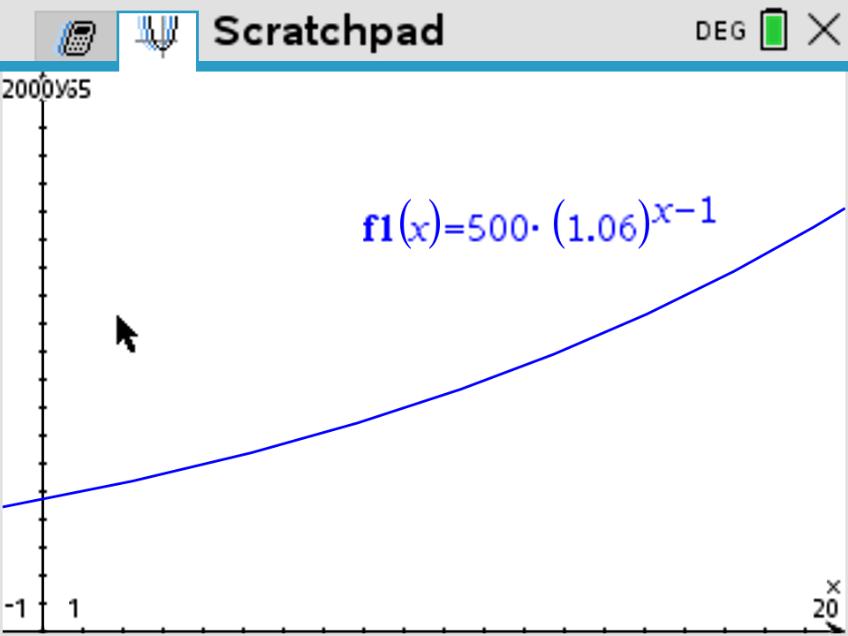
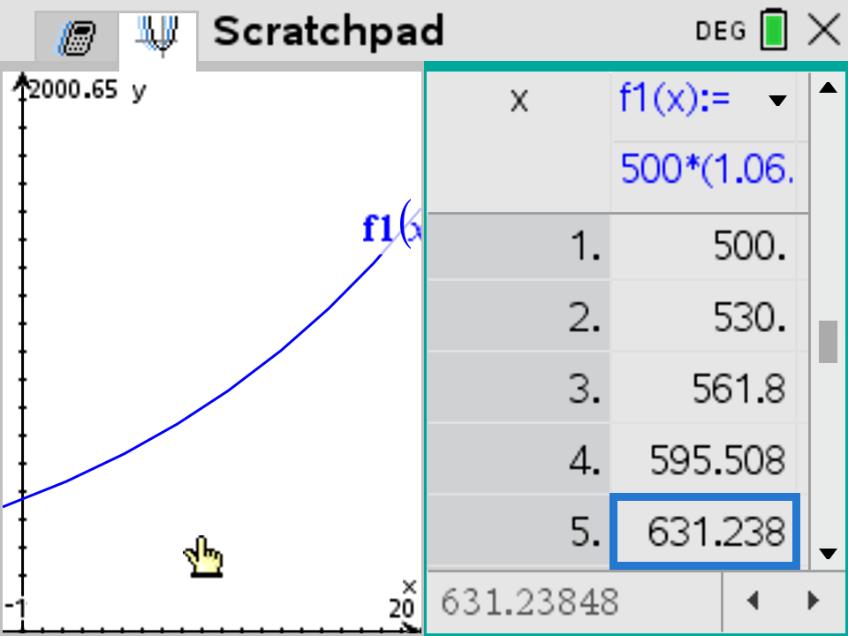
So, for example, \(u_1=500\), \(u_2=530\) and \(u_5=631.23848\). Notice that each term is obtained by multiplying the previous term by \(1.06\).
Finite geometric series
A series can be thought of as a new sequence whose nth term is equal to the sum of the first \(n\) terms of the original sequence. We use \(S_n\) to represent this sum.
Therefore, if we need to calculate the sum of the first \(n\) terms of a geometric sequence, we need to find the nth term, \(S_n\), of the corresponding geometric series.
For \(r\ne1\),
If \(r=1\), every term is \(u_1\), so \(S_n=nu_1\).
Worked example 5: total over a finite number of stages
A social-media campaign reaches \(1200\) people in week 1. Each week, the number reached is modelled as \(1.18\) times the previous week. Estimate the total number of weekly reaches during the first 8 weeks.
Solution
The question asks for a total over the first 8 weeks, so we need \(S_8\). Here
Use the finite geometric-sum formula:
\[S_8=1200\left(\frac{1-1.18^8}{1-1.18}\right).\]The GDC gives
\[S_8\approx18392.4.\]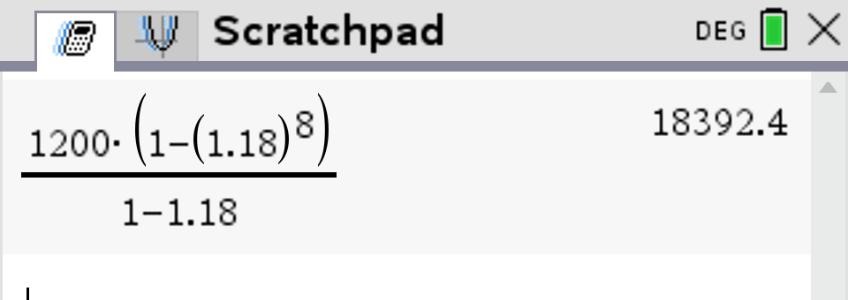
The sum counts weekly reaches, not necessarily distinct people; this is a limitation of the model and interpretation.
Sigma notation
Sigma notation is a compact way of writing a sum. For a geometric sequence,
means
\[ u_1+u_1r+u_1r^2+\cdots+u_1r^{n-1}. \]The index letter is a counter. The exponent \(k-1\) makes the first exponent equal to \(0\) when \(k=1\).
Worked example 6: interpret sigma notation
Evaluate
\[ \sum_{k=1}^{7}80(1.12)^{k-1}. \]Solution
When \(k=1\), the exponent is \(0\), so the first term is \(80\). Each increase of \(k\) multiplies the term by \(1.12\). Therefore
\[ u_1=80,\qquad r=1.12,\qquad n=7. \]Use the sum formula:
\[ S_7=80\left(\frac{1-1.12^7}{1-1.12}\right)\approx807.12. \]Finding an unknown index with the GDC
Problems in which the unknown term number appears in the exponent can also be solved using logarithms. In this lesson, however, we focus on solving them using the GDC.
Worked example 7: find when a term reaches a given value
A population is modelled by
\[ u_n=850(1.07)^{n-1}. \]Find the first term number for which the model exceeds \(1500\).
Solution
Enter
\[ y_1=850(1.07)^{x-1},\qquad y_2=1500. \]Graph both functions and find their intersection.
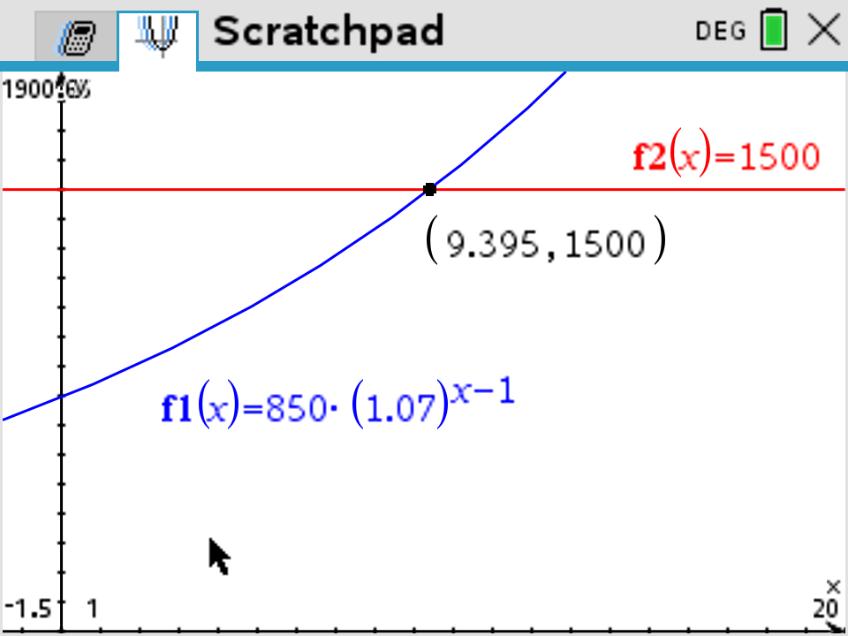
This means the continuous model crosses \(1500\) between terms 9 and 10. A sequence term number must be an integer, so check the neighbouring terms:
\[ u_9<1500,\qquad u_{10}>1500. \]Applications: building the model from words
The main skill is translating repeated percentage or multiplicative change into a geometric model.
- Identify what one term represents and decide which observation is \(u_1\).
- Convert the repeated change into a ratio \(r\).
- Write \(u_n=u_1r^{n-1}\), or use \(u_n=u_pr^{n-p}\) if another known term is more convenient.
- Decide whether the question asks for a single term \(u_n\) or a total \(S_n\).
- Use the GDC for numerical evaluation or for solving an unknown index.
- Interpret the result with units, sensible rounding and any model limitations.
Worked example 8: repeated percentage decrease
A medicine has \(640\) mg of active substance at the first recorded measurement. At each later measurement, \(86\%\) of the previous amount remains.
- Find the amount at measurement 9.
- Find the first measurement at which the amount is below \(200\) mg.
Solution
Since \(86\%\) of the previous amount remains each time, the amount is multiplied by
\[ \frac{86}{100}=0.86. \]Therefore the measurements form a geometric sequence with \(u_1=640\) and \(r=0.86\).
(a) Amount at measurement 9
We need one particular term, so use \(u_n=u_1r^{n-1}\):
\[u_9=640(0.86)^{9-1}=640(0.86)^8.\] \[u_9\approx191.5\text{ mg}.\]Thus the amount at measurement 9 is approximately \(192\) mg to 3 significant figures.
(b) First measurement below 200 mg
Now the unknown is the index. Enter
\[ y=640(0.86)^{x-1} \]on the GDC and use a table or graph. Measurement 8 is still above \(200\) mg, while measurement 9 is below \(200\) mg:
Worked example 9: term or sum?
A training programme starts with \(3.0\) km in week 1 and increases the weekly distance by \(8\%\) each week.
- Find the distance run in week 10.
- Find the total distance run over the first 10 weeks.
Solution
An increase of \(8\%\) means that each week’s distance is \(108\%\) of the previous week’s distance. Therefore
\[ r=\frac{108}{100}=1.08, \]so this is a geometric sequence with \(u_1=3\) and \(r=1.08\).
| Question asks for | Quantity | Formula |
|---|---|---|
| Week 10 only | \(u_{10}\) | \(u_n=u_1r^{n-1}\) |
| Total of weeks 1–10 | \(S_{10}\) | finite geometric sum |
(a) Week 10 only
\[u_{10}=3(1.08)^{10-1}=3(1.08)^9.\] \[u_{10}\approx5.997\text{ km}.\]Therefore the distance run in week 10 is approximately \(6.00\) km.
(b) Total over the first 10 weeks
Now we need \(S_{10}\), not \(u_{10}\):
\[S_{10}=3\left(\frac{1-(1.08)^{10}}{1-1.08}\right).\] \[S_{10}\approx43.46\text{ km}.\]When a geometric model is only an approximation
Real data rarely follows a constant ratio forever. AI Mathematics places importance on interpretation, so ask whether the repeated multiplier is reasonable.
- Is the ratio approximately constant in the observed data?
- Is extrapolation far beyond the observed data sensible?
- Are there natural limits such as population capacity, market size or physical constraints?
- Does rounding or measurement uncertainty affect the apparent ratio?
- Does the quantity represent distinct objects or people, or repeated counts?
Worked example 10: estimating a ratio from data
A culture contains \(420,\ 500,\ 596,\ 706\) cells in four consecutive observations. Decide whether a geometric model is reasonable for these data and estimate an appropriate common ratio.
Solution
For a perfectly geometric sequence, dividing each term by the previous term would always give exactly the same common ratio. Calculate the successive ratios:
| Successive pair | Ratio |
|---|---|
| \(500\div420\) | \(\approx1.190\) |
| \(596\div500\) | \(=1.192\) |
| \(706\div596\) | \(\approx1.185\) |
The ratios are not exactly equal, so the data does not form a perfect geometric sequence. However, the ratios are all close to \(1.19\).
\[ r\approx1.19. \]This corresponds to an increase of approximately \(19\%\) from one observation to the next. Because the original data is only approximately geometric, values predicted by this model should be described as estimates, not exact values. We should also be cautious about extending the model far beyond the observed data.
Quick practice
- State whether \(48,36,27,20.25,\ldots\) is geometric and find \(r\).
- A geometric sequence has \(u_1=75\) and \(r=1.14\). Find \(u_{11}\).
- A geometric sequence has \(u_5=96\) and \(r=0.8\). Find \(u_{13}\) using the flexible formula.
- A geometric sequence has \(u_3=50\) and \(u_7=25.628\). Find \(r\) using the GDC.
- Find \(S_{12}\) for \(u_1=40\), \(r=1.05\).
- Write \(25+30+36+\cdots\) as a sigma expression for the first 9 terms.
- A population is modelled by \(P_n=1200(1.045)^{n-1}\). Use a GDC to find the first \(n\) for which \(P_n>2000\).
- A quantity begins at \(900\) and decreases by \(12\%\) per period. Find the value in period 8 and the total of the first 8 period-values.
- Explain why a constant-ratio model for the number of users of a new app is unlikely to remain realistic indefinitely.
Answer key
Show the quick-practice answers
- Yes; \(r=0.75\).
- \(u_{11}=75(1.14)^{10}\approx278.0\).
- \(u_{13}=96(0.8)^8\approx16.11\).
- \(25.628=50r^4\), so \(r\approx0.846\) (GDC).
- \(S_{12}=40\dfrac{1-1.05^{12}}{1-1.05}\approx636.7\).
- \(\displaystyle\sum_{k=1}^{9}25(1.2)^{k-1}\).
- Graph or table \(1200(1.045)^{n-1}\) against \(2000\): first integer solution \(n=13\).
- \(r=0.88\). Period 8: \(900(0.88)^7\approx368.0\). Total: \(900\dfrac{1-0.88^8}{1-0.88}\approx4802.7\).
- For example, a fixed percentage growth rate ignores saturation, competition, finite population or market size, and changing behaviour; the ratio will generally change over time.
IB exam-style practice
The following are original sister questions modelled on the wording, mark allocations, multi-part structure and GDC emphasis of recent IB Mathematics: Applications and Interpretation SL questions. Try each question before turning to the worked solutions in Section 13.
Question 1: terms and a finite sum[6 marks]
The first three terms of a geometric sequence are
\[ 18,\qquad27,\qquad40.5. \]- Write down the common ratio, \(r\). [1]
- Find \(u_9\). [2]
- Find the sum of the first 12 terms of the sequence. [3]
Question 2: monthly growth[7 marks]
A science channel receives \(2400\) views in its first month. The number of views each month is modelled by a geometric sequence. The channel receives \(12\%\) more views each month than in the previous month.
- Write down the common ratio. [1]
- Find the number of views predicted in month 10. [2]
- Find the total number of views predicted during the first 10 months. [2]
- Explain why the answer to part (c) is different from the answer to part (b). [2]
Question 3: first value below a threshold[7 marks]
A water tank contains \(18\,000\) litres at the first recorded measurement. Because of controlled drainage, each later measurement contains \(91\%\) of the amount at the previous measurement.
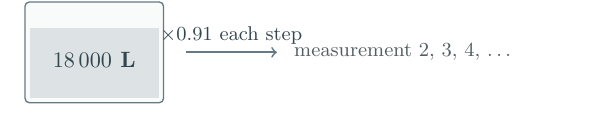
- Write down a model for the amount of water, \(V_n\), at measurement \(n\). [2]
- Find the amount of water at measurement 8. [2]
- Use your GDC to find the first measurement at which the amount of water is less than \(9000\) litres. [3]
Question 4: modelling from observed data[10 marks]
A wildlife group records the estimated number of nesting birds at a reserve at the same time each year.
| Year number, \(n\) | 1 | 2 | 3 | 4 | 5 |
|---|---|---|---|---|---|
| Estimated birds | 620 | 681 | 752 | 823 | 907 |
The group wishes to model the number of birds using a geometric sequence.
- Calculate the four successive ratios. [2]
- Hence suggest a suitable value of \(r\) for a geometric model. [1]
- Using \(u_1=620\) and your value of \(r\), write down a model for \(u_n\). [1]
- Use the model to estimate the number of birds in year 10. [2]
- Estimate the total of the yearly bird-count estimates from year 1 to year 10. [2]
- Comment on the suitability of using this geometric model to predict the bird population many years into the future. [2]
Worked solutions to the IB exam-style practice
Show the worked exam-style solutions
Solution 1: terms and a finite sum
Solution
(a) Common ratio
Divide a term by the previous term:
\[ r=\frac{27}{18}=1.5. \](b) Find \(u_9\)
We need one term, so use \(u_n=u_1r^{n-1}\):
\[ u_9=18(1.5)^8\approx461.320. \](c) Sum of the first 12 terms
We need a total, so use the finite-sum formula:
\[ S_{12}=18\left(\frac{1-(1.5)^{12}}{1-1.5}\right)\approx4634.87. \]Solution 2: monthly growth
Solution
A \(12\%\) increase means that each new value is \(112\%\) of the previous value.
(a) Common ratio
\[ r=\frac{112}{100}=1.12. \](b) Month 10
Month 10 is a single term:
\[ u_{10}=2400(1.12)^9\approx6655.39. \](c) Total for months 1 to 10
\[ S_{10}=2400\left(\frac{1-(1.12)^{10}}{1-1.12}\right)\approx42116.96. \](d) Interpretation
\(u_{10}\) counts the views in month 10 only, whereas \(S_{10}\) adds the predicted views from all of months 1 to 10. This is the difference between a term and a sum of terms.
Solution 3: first value below a threshold
Solution
Since \(91\%\) remains after each measurement,
\[ r=0.91,\qquad V_1=18\,000. \](a) Model
Using \(u_n=u_1r^{n-1}\),
\[ \boxed{V_n=18\,000(0.91)^{n-1}}. \](b) Measurement 8
Measurement 8 corresponds to seven multiplications by \(0.91\):
\[ V_8=18\,000(0.91)^7\approx9301.70. \](c) First measurement below 9000 L
On the GDC, graph
\[ y_1=18\,000(0.91)^{x-1},\qquad y_2=9000, \]or inspect a table of integer values. The threshold is crossed between measurements 8 and 9. Check the neighbouring integers:
\[ V_8\approx9302>9000,\qquad V_9=18\,000(0.91)^8\approx8464.55<9000. \]Solution 4: modelling from observed data
Solution
(a) Successive ratios
A geometric model would have an approximately constant ratio. Dividing each observation by the previous observation gives
\[ \frac{681}{620}\approx1.0984,\qquad \frac{752}{681}\approx1.1043, \] \[ \frac{823}{752}\approx1.0944,\qquad \frac{907}{823}\approx1.1021. \]The ratios are close to one another.
(b) Choose \(r\)
\[ \boxed{r\approx1.10}. \]This corresponds to growth of about \(10\%\) per year.
(c) Model
With \(u_1=620\),
\[ \boxed{u_n=620(1.10)^{n-1}}. \](d) Year 10
\[ u_{10}=620(1.10)^9\approx1461.93. \](e) Total of the first 10 yearly estimates
\[ S_{10}=620\left(\frac{1-(1.10)^{10}}{1-1.10}\right)\approx9881.20. \](f) Suitability of the model
The model is reasonable over the short observed interval because the successive ratios are close to \(1.10\). However, a bird population cannot normally grow by a fixed percentage indefinitely. Food, habitat, disease, migration and carrying capacity may change the growth rate, so long-term extrapolation should be treated cautiously.