IB Mathematics: Analysis and Approaches SL/HL — Topic 5 Calculus
Power Rule Differentiation
Turn a function into its gradient function efficiently, then use the derivative to answer gradient and rate-of-change questions.
Learning goal
Differentiate integer powers and sums of powers, then use the derivative to find gradients and rates of change.
Syllabus link
IB Mathematics AA SL/HL: SL 5.3. Derivatives of \(ax^n\), \(n\in\mathbb Z\), and sums of these functions.
Big idea
Differentiation creates a new function: \(f'(x)\). Evaluating \(f'(a)\) gives the gradient of the original curve at \(x=a\).
Key relationship
\(\boxed{ax^n\longrightarrow anx^{n-1}}\). Multiply by the old power, then reduce the power by 1.
The derivative function: what are we finding?
In 5.1, \(f'(x)\) was introduced as the function that gives the gradient of \(f\) at each x-value. This lesson gives us an efficient algebraic rule for finding that derivative.
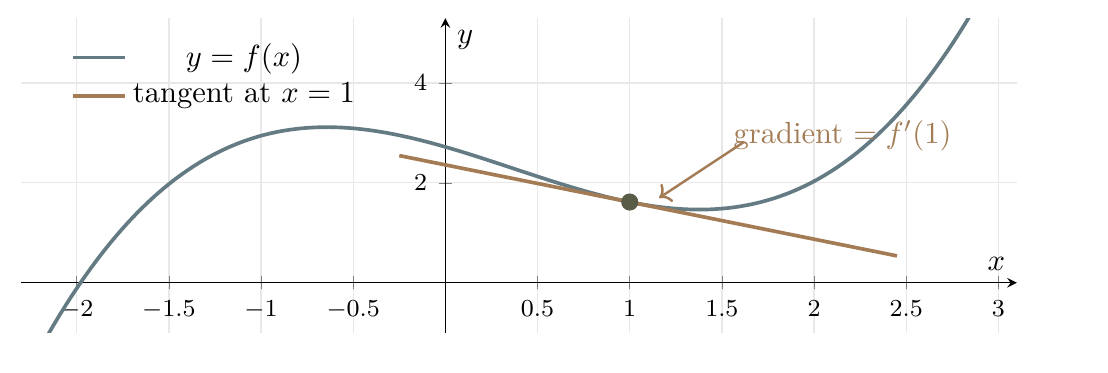
If \(y=f(x)\), then \(f'(x)\) or \(dy/dx\) tells us the tangent gradient at each input value. Once we have the derivative function, a gradient question becomes an evaluation question.
From function to tangent gradient
The power rule

Constant multiple
Keep the constant coefficient and differentiate the power.
Sums and differences
Differentiate term by term.
Simple cases, constants and negative powers
| Function | Derivative | Reason |
|---|---|---|
| \(7x^4\) | \(28x^3\) | \(7\times4=28\), then \(4-1=3\) |
| \(-3x\) | \(-3\) | Think of \(x\) as \(x^1\) |
| \(5\) | 0 | A constant does not change |
| \(\frac8x=8x^{-1}\) | \(-8x^{-2}=-\frac8{x^2}\) | Rewrite as a power first |
| \(\frac6{x^3}=6x^{-3}\) | \(-18x^{-4}=-\frac{18}{x^4}\) | Negative integer power |
Rewrite reciprocals before differentiating
For this syllabus point, it is often much clearer to write \(1/x^k=x^{-k}\) first. Then the same power rule applies without introducing a new formula.
Worked example 1: differentiate term by term
Differentiate \(f(x)=4x^5-3x^3+7x-11\).
The constant \(-11\) differentiates to 0.
Worked example 2: rewrite a reciprocal
Differentiate
Now apply the power rule:
Using the derivative to find a gradient
Worked example 3: gradients at selected points
For
first differentiate:
Then evaluate the derivative at the required inputs:
Gradients At \(x=2\), the curve has gradient \(-4\); at \(x=-1\), it has gradient 5.
Worked example 4: tangent gradient for a reciprocal expression
For \(y=x^2+\frac{64}{x}\), find the tangent gradient at \(x=4\).
From worked example 2,
Substitute \(x=4\):
Answer The tangent gradient is 4.
Products and quotients of powers: simplify first
At this stage of the course, if an expression is a product or quotient of polynomial powers that can be expanded or simplified, do that algebra first. Then differentiate the resulting sum of powers.
Index laws remain useful
Worked example 5: simplify, then differentiate
(a) \(y=x^2(4x^2+3x-5)\)
(b) \(y=(x^3+2x)(3x^2-1)\)
(c) \(y=\frac{8x^5-3x^2+10}{x^2}\)
IB-style worked examples
Worked example A: equation of a tangent
Let \(f(x)=x^3-2x^2+5x-7\). Find the equation of the tangent at \(x=1\).
Step 1: differentiate.
Step 2: find the point and gradient.
Step 3: use point-gradient form.
Worked example B: determine an unknown coefficient
Suppose \(f(x)=3x^{-2}+bx^{-1}+c\), and the gradient at \(x=4\) is \(5/32\). Find \(b\), then determine whether the function is increasing at \(x=5\).
Use \(f'(4)=5/32\):
Multiplying by 32 gives \(-3-2b=5\), so \(b=-4\).
Then
Therefore the function is increasing at \(x=5\).
Worked example C: rate of change in context
A liquid volume is modelled by
Differentiate:
At \(t=5\),
For a stationary volume, solve \(V'(t)=0\):
Only \(t=10\) is in the model domain. At that instant the volume is momentarily neither increasing nor decreasing.
Common mistakes
Check these before finalising a derivative
- Do not keep the same exponent. The exponent must decrease by 1.
- Do not forget to multiply by the old exponent. \(x^5\) differentiates to \(5x^4\), not \(x^4\).
- Do not differentiate a reciprocal as written if a negative power is clearer. Rewrite \(1/x^3=x^{-3}\).
- Constants differentiate to zero.
- Simplify expandable products and quotients first. The power rule can then be applied term by term.
- A derivative value needs interpretation. In a context, include the units and explain whether the quantity is increasing or decreasing.
Practice
A. Differentiate
- \(y=x^7\)
- \(y=5x^3-4x+9\)
- \(y=12x^5-7x^2+3\)
- \(y=x^{-3}\)
- \(y=\frac6{x^2}\)
- \(y=4x^2-\frac{10}{x}+7\)
B. Simplify first, then differentiate
- \(y=x^2(3x^3-2x+1)\)
- \(y=(x^2-3x)(4x^2+1)\)
- \(y=\frac{4x^6-3x^3+8}{x^2}\)
- \(y=\frac{5x^4+2x^2-1}{x}\)
C. Gradients, tangents and context
- For \(f(x)=x^3-5x^2+6x\), find \(f'(2)\).
- For \(y=x^2+\frac{25}{x}\), find the tangent gradient at \(x=5\).
- Find the equation of the tangent to \(f(x)=2x^3-x\) at \(x=1\).
- For \(f(x)=kx^3-4x\), the gradient at \(x=2\) is 20. Find \(k\).
- A height is modelled by \(h(t)=2t^3-9t^2+12t+5\). Find \(h'(t)\) and \(h'(3)\).
- For \(f(x)=x^3-3x^2-9x+1\), find the x-values where the tangent is horizontal.
Concise answer key
1. \(7x^6\)
2. \(15x^2-4\)
3. \(60x^4-14x\)
4. \(-3x^{-4}\)
5. \(-12/x^3\)
6. \(8x+10/x^2\)
7. \(15x^4-6x^2+2x\)
8. \(16x^3-36x^2+2x-3\)
9. \(16x^3-3-16/x^3\)
10. \(15x^2+2+1/x^2\)
11. \(-2\)
12. 9
13. \(y=5x-4\)
14. \(k=2\)
15. \(h'=6t^2-18t+12\), \(h'(3)=12\)
16. \(x=-1,3\)
Related tutorials
Power rule for integer powers
Build fluency with positive and negative integer powers and sums of power functions.
Gradient of a curve = gradient of the tangent
Reinforce the geometric meaning behind the derivative value you calculate.
Products and quotients of powers
See how to expand or simplify expressions before applying the power rule term by term.