IB Mathematics: Analysis and Approaches SL/HL — Topic 5 Calculus
Increasing and Decreasing Functions
Read the sign of the derivative to understand where a function rises, falls, turns and remains increasing through a stationary point.
Learning goal
Use the sign of \(f'(x)\) to decide where \(f\) is increasing or decreasing and to interpret stationary behaviour.
Syllabus link
IB Mathematics AA SL/HL: SL 5.2. Increasing and decreasing functions; graphical interpretation of derivatives and stationary points.
Big idea
The derivative is a gradient function. Its sign tells us whether the original function is going up or down.
Key relationship
\(f'(x)>0\Rightarrow f\) increasing; \(f'(x)<0\Rightarrow f\) decreasing; \(f'(x)=0\Rightarrow\) horizontal tangent.
What are we trying to understand?
A graph does not have one gradient. Its gradient changes as we move along it. The derivative lets us describe those changes systematically.
Increasing and decreasing are interval properties
We describe a function as increasing or decreasing on an interval, not just at a single point. A stationary point may separate two different behaviours—or the function may continue increasing or decreasing through it.
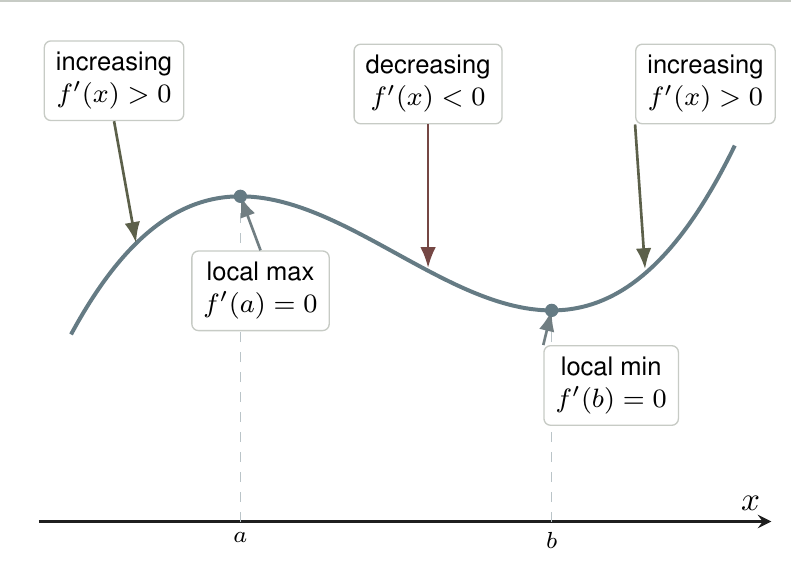
Increasing, decreasing and horizontal tangents
Sign rule
If \(f'(x)=0\), the tangent is horizontal. This makes the point stationary, but it does not by itself tell us whether the point is a maximum, a minimum or a horizontal point of inflexion.
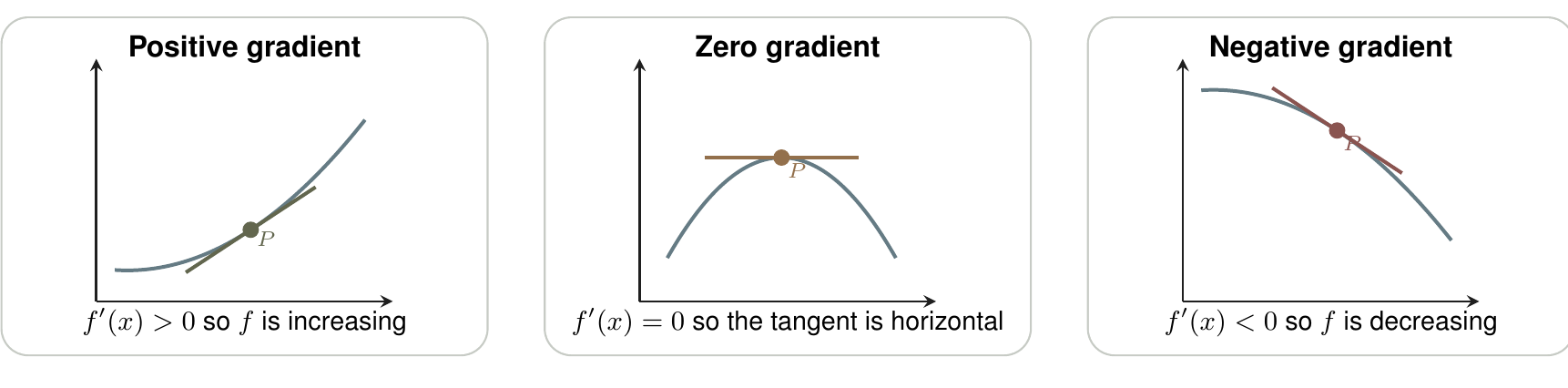
Three local pictures
Think in terms of the tangent gradient
- If the tangent slopes upwards from left to right, the derivative is positive.
- If the tangent is horizontal, the derivative is zero.
- If the tangent slopes downwards from left to right, the derivative is negative.
This is the bridge between the geometry of a graph and an algebraic sign table. We use the same information whether it comes from a sketch, a derivative graph or a formula for \(f'(x)\).
Reading increasing and decreasing intervals from the graph of \(f\)
Worked example 1: read the intervals directly from \(f\)
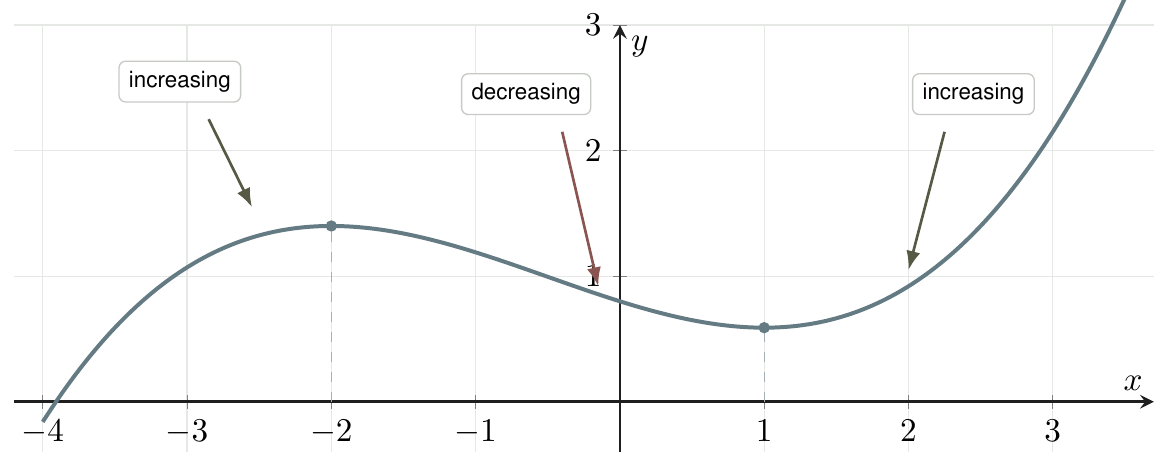
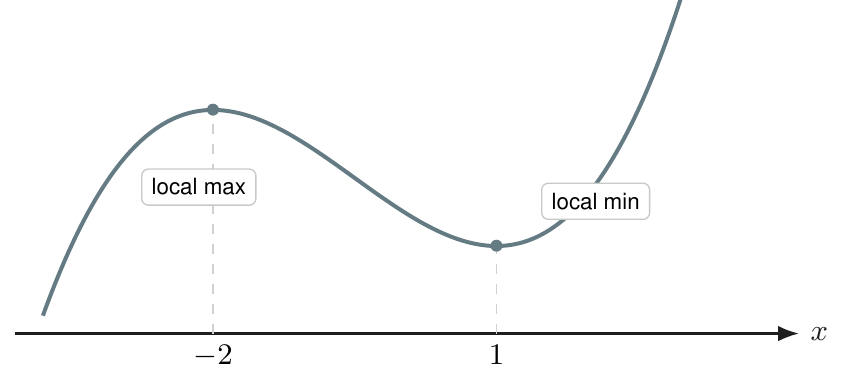
Suppose the graph rises to a local maximum at \(x=-2\), falls to a local minimum at \(x=1\), then rises again.
Reading from left to right:
- \(f\) is increasing on \(( -\infty,-2)\);
- \(f\) is decreasing on \((-2,1)\);
- \(f\) is increasing on \((1,\infty)\).
At \(x=-2\), the behaviour changes from increasing to decreasing, so there is a local maximum. At \(x=1\), it changes from decreasing to increasing, so there is a local minimum.
Reading behaviour from the graph of \(f'\)
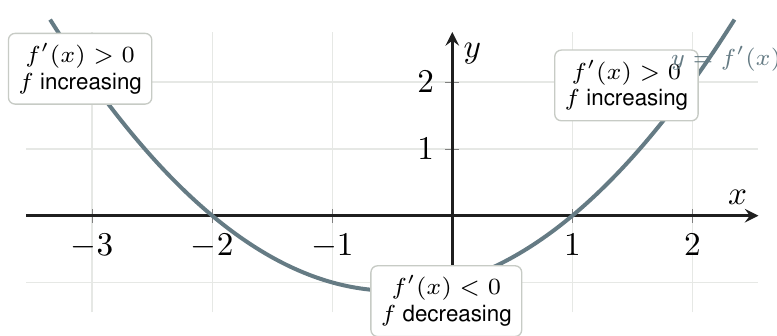
Worked example 2: derivative graph crossing at \(x=-2\) and \(x=1\)
The derivative graph is above the x-axis before \(-2\), below the x-axis between \(-2\) and 1, and above again after 1.
Therefore \(f\) increases, then decreases, then increases. The sign change \(+\to-\) gives a local maximum at \(x=-2\); the sign change \(-\to+\) gives a local minimum at \(x=1\).
Video: Increasing and decreasing functions
Revisit how the sign of a derivative controls the direction of the original graph.
Video: Sketching \(f\) from \(f'\)
Work from derivative sign and stationary points to a possible sketch of the original function.
A second derivative-graph example
Worked example 3: three stationary points
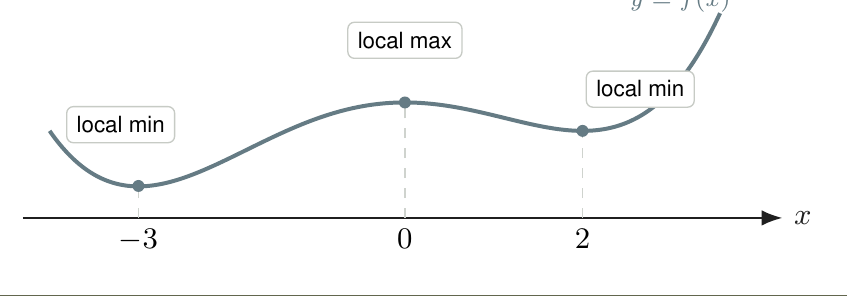
Suppose \(f'\) crosses the x-axis at \(x=-3\), \(x=0\) and \(x=2\), with sign pattern
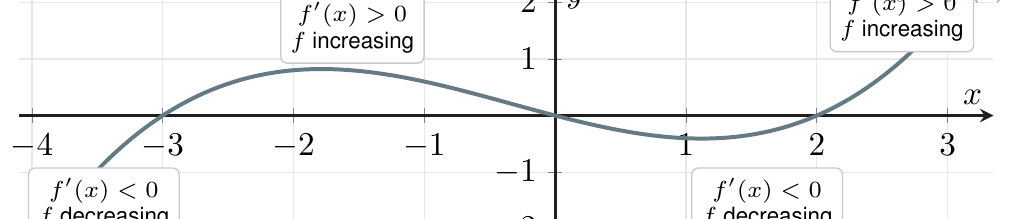
- \(f\) decreases for \(x<-3\);
- increases for \(-3
- decreases for \(0
- increases for \(x>2\).
- decreases for \(0
So \(x=-3\) and \(x=2\) are local minima, while \(x=0\) is a local maximum.
Common trap: a horizontal point of inflexion
The equation \(f'(a)=0\) tells us that the tangent is horizontal. It does not automatically mean maximum or minimum.
Worked example 4: stationary, but still increasing
Suppose \(f'(0)=0\), but \(f'(x)>0\) on both sides of 0.
The function is increasing before and after \(x=0\). There is no change from increasing to decreasing or vice versa, so the point is not a local maximum or minimum.
When the concavity changes there, the stationary point is a horizontal point of inflexion.

When the derivative expression is already given
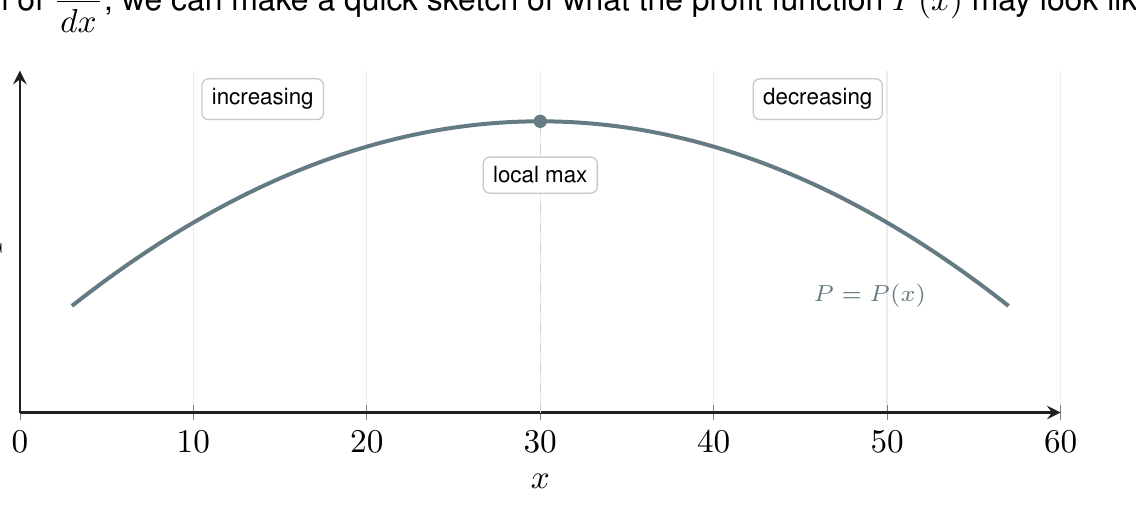
Worked example 5: interpreting a profit derivative
The derivative of a profit function is
where \(x\) is the number of items produced, measured in hundreds.
Set the derivative equal to zero:
For \(x<30\), \(dP/dx>0\), so profit is increasing. For \(x>30\), \(dP/dx<0\), so profit is decreasing. Therefore there is a local maximum at \(x=30\), corresponding to 3000 items.
Video: Using a sign table
See the derivative-sign method organised as a sign table, with stationary values aligned vertically and function behaviour shown underneath.
Summary checklist
When reading or building a derivative sign analysis
- Find where \(f'(x)=0\).
- Determine the sign of \(f'(x)\) on each interval.
- Translate \(+\) into increasing and \(-\) into decreasing.
- Use sign changes to classify stationary points: \(+\to-\) gives a local maximum; \(-\to+\) gives a local minimum.
- If the derivative is zero but keeps the same sign, do not call the point a maximum or minimum.
Looking ahead to 5.3
So far, the derivative may be given graphically or as an expression. In the next lesson we learn the power rule so that we can generate derivative expressions ourselves.
Practice
Questions
- Complete the statements: if \(f'(x)>0\), \(f\) is ________; if \(f'(x)<0\), \(f\) is ________; if \(f'(x)=0\), the tangent is ________.
- Suppose \(f'(x)>0\) for \(x<2\) and \(f'(x)<0\) for \(x>2\). State the increasing/decreasing intervals and classify the stationary point at \(x=2\).
- A derivative graph is above the x-axis for \(x<-3\) and \(x>4\), and below it for \(-3
- A sign table for \(g'\) is \(-,0,+,0,-\) at the critical values \(-1\) and 3. State the intervals of increase/decrease and classify the stationary points.
- The graph of \(h'\) touches the x-axis at \(x=1\) but stays above it on both sides. What can you conclude about \(h\) at \(x=1\)?
- A function \(f\) is increasing on \(( -\infty,-2)\) and \((1,\infty)\), and decreasing on \((-2,1)\). Sketch the corresponding sign table for \(f'\).
- Given \(f'(x)=5-x\), determine where \(f\) is increasing and decreasing.
- Given \(g'(x)=2x+6\), determine where \(g\) is increasing and decreasing.
- Given \(f'(x)=\frac{4-x}{x^2+1}\), determine where \(f\) is increasing and decreasing.
- A population model satisfies \(\frac{dN}{dt}=120-5t\), for \(0\le t\le40\). Determine when the population is increasing and decreasing.
- A height model satisfies \(\frac{dh}{dt}=-0.2t+3\), for \(0\le t\le20\). Determine when the height is increasing and decreasing.
- Explain why the statement \(f'(0)=0\) alone is not enough to prove that \(f\) has a local maximum or minimum at \(x=0\).
Concise answer key
1. increasing; decreasing; horizontal.
2. Increasing \(x<2\), decreasing \(x>2\); local maximum at 2.
3. Increasing for \(x<-3\) and \(x>4\); decreasing for \(-3
4. Decreasing \(x<-1\), increasing \(-1
5. Horizontal tangent, but no maximum/minimum; the function remains increasing.
6. Sign pattern \(+\ 0\ -\ 0\ +\).
7. Increasing \(x<5\), decreasing \(x>5\).
8. Decreasing \(x<-3\), increasing \(x>-3\).
9. Increasing \(x<4\), decreasing \(x>4\), since \(x^2+1>0\).
10. Increasing for \(0\le t<24\), decreasing for \(24 11. Increasing for \(0\le t<15\), decreasing for \(15 12. Need the sign of \(f'\) on either side; zero derivative only proves a horizontal tangent.