IB Mathematics: Analysis and Approaches SL — Topic 5 Calculus
Anti-Differentiation and Boundary Conditions
Reverse differentiation carefully, keep the constant of integration, and use a boundary condition to select one particular function.
Learning goal
Find general anti-derivatives using the power rule and determine particular anti-derivatives from boundary conditions.
Syllabus link
IB Mathematics AA SL: SL 5.5. This lesson develops the anti-differentiation and boundary-condition strand. The AA learning path develops definite integrals and areas later, after the standard-integrals material.
Big idea
Differentiation loses constants. Anti-differentiation must therefore produce a family of functions until extra information determines the vertical shift.
Key relationship
\(\displaystyle \int f(x)\,dx=F(x)+C\) when \(F' = f\).
What is anti-differentiation?
Differentiation takes a function and finds its derivative. Anti-differentiation reverses that process: from a derivative, we recover a function whose derivative is the expression we started with.
Definition
If \(F'(x)=f(x)\), then \(F(x)\) is an anti-derivative of \(f(x)\). We write
The symbol \(\int\) is the integral sign and \(dx\) tells us the variable of integration.
Key vocabulary: integrand
The integrand is the expression being integrated: the part after the integral sign and before \(dx\).
For example, in \(\int(4x^3-6x+7)\,dx\), the integrand is \(4x^3-6x+7\).
Quick example
Since \(\dfrac{d}{dx}(x^3)=3x^2\), one anti-derivative of \(3x^2\) is \(x^3\). Therefore
Why do we need \(+C\)?
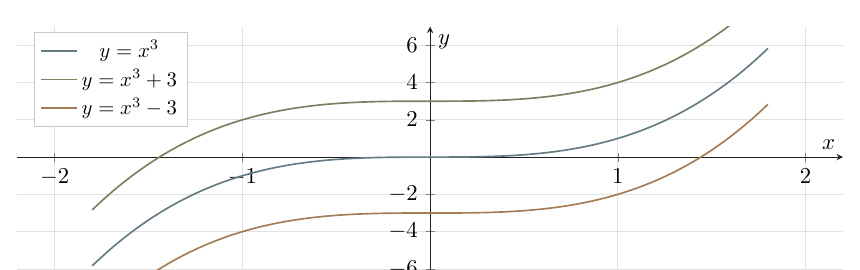
The derivative of a constant is zero. Differentiation therefore cannot distinguish between functions that differ only by a vertical shift.
Important habit
For an indefinite integral, include \(+C\) unless a condition is supplied that allows you to determine \(C\).
The basic power rule
Power rule for anti-differentiation
Increase the power by 1, then divide by the new power.
| Integrand | Anti-derivative | Reason |
|---|---|---|
| \(x^2\) | \(\dfrac{x^3}{3}+C\) | Add 1 to the power, then divide by 3. |
| \(x\) | \(\dfrac{x^2}{2}+C\) | Think of \(x\) as \(x^1\). |
| \(1\) | \(x+C\) | Think of \(1\) as \(x^0\). |
| \(x^{-2}\) | \(-x^{-1}+C\) | Add 1: \(-2\to-1\), then divide by \(-1\). |
| \(5x^3\) | \(\dfrac{5x^4}{4}+C\) | Keep the coefficient and apply the power rule. |
Worked example 1: one term
Find \(\int 6x^2\,dx\).
Solution
Check: \(\dfrac{d}{dx}(2x^3+C)=6x^2\).
The exception
The rule above does not work for \(n=-1\), because it would require division by zero. The integral of \(1/x\) is treated separately later in Topic 5.
Worked examples
Worked example 2: several polynomial terms
Find \(\int(4x^3-6x+7)\,dx\).
Solution
Worked example 3: negative powers
Find \(\int\left(3x^2-\dfrac4{x^2}+5\right)\,dx\).
Solution
Rewrite \(-4/x^2\) as \(-4x^{-2}\):
Worked example 4: from derivative notation
Given \(F'(x)=12x^3-8x+1\), find the general form of \(F(x)\).
Solution
Because \(F'(x)\) is the derivative, integrate to recover \(F(x)\):
Worked example 5: a context without a boundary condition
A particle has velocity \(v(t)=3t^2-2t\). Find a general expression for its position \(s(t)\).
Solution
Velocity is the derivative of position, so \(s'(t)=v(t)\). Therefore
The unknown \(C\) represents the starting position.
How to check an anti-derivative
Differentiate your answer
If you claim that \(F(x)\) is an anti-derivative of \(f(x)\), differentiate \(F\). You should recover the original integrand exactly.
Common traps
Things to check every time
- Forgetting \(+C\): an indefinite integral represents a family of functions.
- Not rewriting powers: expressions such as \(1/x^2\) are usually easier to integrate as \(x^{-2}\).
- Using the differentiation power rule backwards incorrectly: for integration, add 1 to the exponent before dividing.
- Trying to use the power rule on \(x^{-1}\): that case needs the logarithm rule.
Quick recap: indefinite integrals give a family of functions
An indefinite integral does not usually produce one unique function. It produces every vertical translation whose derivative is the required function.
To identify one particular member of the family, we need additional information.
What is a boundary condition?
Boundary condition
A boundary condition gives the value of the function at a particular input, for example \(y=5\) when \(x=1\), or \(F(0)=3\). It allows the constant \(C\) to be determined.
General method
Five-step method
- Integrate to find the general anti-derivative.
- Include \(+C\).
- Substitute the given boundary condition into the anti-derivative.
- Solve for \(C\).
- Write the particular anti-derivative and check it by differentiating and substituting the condition.
Key habit
Do not substitute the condition into the derivative. First integrate, then substitute the condition into the anti-derivative.
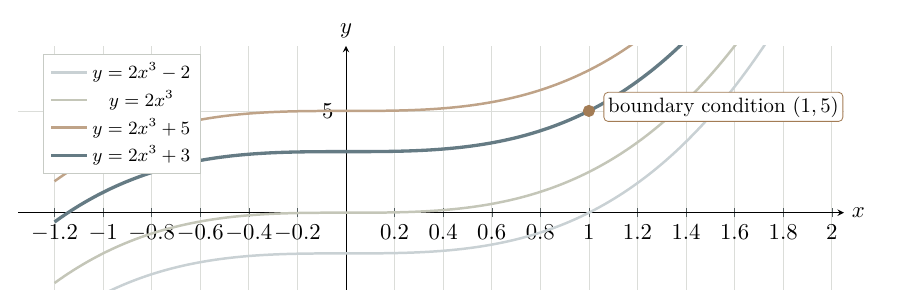
Visual idea: one condition selects one curve
The derivative determines the shape of a family. The constant \(C\) shifts the graph vertically. A boundary condition selects the one curve through the stated point.
Worked examples with boundary conditions
Worked example 1: \(dy/dx\) notation
Given \(\dfrac{dy}{dx}=6x^2\) and \(y=5\) when \(x=1\), find \(y\).
Solution
Use the condition:
Answer \(y=2x^3+3\).
Worked example 2: function notation
Given \(F'(x)=4x^3-6x+2\) and \(F(0)=3\), find \(F(x)\).
Solution
Answer \(F(x)=x^4-3x^2+2x+3\).
Worked example 3: curve through a point
Given \(\dfrac{dy}{dx}=3x^2-4x+1\) and the curve passes through \((2,7)\), find the equation of the curve.
Solution
Substitute \((2,7)\): \(7=8-8+2+C\), so \(C=5\).
Answer \(y=x^3-2x^2+x+5\).
Worked example 4: velocity to position
A particle has velocity \(v(t)=6t-4\) and position \(s(0)=10\). Find \(s(t)\).
Solution
Answer \(s(t)=3t^2-4t+10\).
Worked example 5: negative powers
Given \(F'(x)=2x^{-3}+5\) and \(F(1)=4\), find \(F(x)\).
Solution
At \(x=1\), \(4=5-1+C\), so \(C=0\).
Answer \(F(x)=5x-\dfrac1{x^2}\).
Common traps with boundary conditions
Boundary-condition traps
- Do not forget \(+C\) before applying the condition.
- Substitute the condition into the anti-derivative, not the derivative.
- If the condition is given as a point \((a,b)\), use \(x=a\) and \(y=b\).
- After finding \(C\), write the final particular function explicitly.
- Check both the derivative and the condition.
Practice
Part A — General anti-derivatives and \(+C\)
Basic powers
- \(\int x^4dx\)
- \(\int7x^6dx\)
- \(\int5dx\)
- \(\int-3x^2dx\)
- \(\int x^{-3}dx\)
- \(\int9x^{-4}dx\)
Sums and differences
- \(\int(6x^2+4x-1)dx\)
- \(\int(10x^4-3x^2+8)dx\)
- \(\int(2x^3-6/x^2)dx\)
- \(\int(5x^2+4/x^3-7)dx\)
- Find \(F(x)\) if \(F'(x)=15x^2-4x+6\).
- Find \(s(t)\) if \(v(t)=6t^2+2t-5\).
Part B — Boundary conditions
- \(dy/dx=4x\), and \(y=9\) when \(x=2\).
- \(F'(x)=9x^2\), \(F(1)=10\).
- \(dy/dx=5x^4-2\), and \(y=0\) when \(x=1\).
- \(F'(x)=8x^3-6x\), \(F(0)=-4\).
- \(dy/dx=3x^2+4x-1\), curve through \((1,6)\).
- \(F'(x)=-6x^{-4}+2x\), \(F(1)=5\).
- \(F'(x)=12x^3-4x+1\), \(F(0)=-2\).
- A curve has gradient \(2x-3\) and passes through \((4,1)\).
- \(v(t)=4t+3\), \(s(0)=2\).
- \(a(t)=6t\), \(v(0)=-1\).
- \(F'(x)=5x^2-4x^{-3}\), \(F(2)=3\).
- A student writes \(y=2x^3+4\) for \(dy/dx=6x^2\), \(y=5\) at \(x=1\). Explain the error.
Answer key
Part A
1. \(x^5/5+C\)
2. \(x^7+C\)
3. \(5x+C\)
4. \(-x^3+C\)
5. \(-1/(2x^2)+C\)
6. \(-3/x^3+C\)
7. \(2x^3+2x^2-x+C\)
8. \(2x^5-x^3+8x+C\)
9. \(x^4/2+6/x+C\)
10. \(5x^3/3-2/x^2-7x+C\)
11. \(F=5x^3-2x^2+6x+C\)
12. \(s=2t^3+t^2-5t+C\)
Part B
1. \(y=2x^2+1\)
2. \(F=3x^3+7\)
3. \(y=x^5-2x+1\)
4. \(F=2x^4-3x^2-4\)
5. \(y=x^3+2x^2-x+4\)
6. \(F=2/x^3+x^2+2\)
7. \(F=3x^4-2x^2+x-2\)
8. \(y=x^2-3x-3\)
9. \(s=2t^2+3t+2\)
10. \(v=3t^2-1\)
11. \(F=\frac53x^3+\frac2{x^2}-\frac{65}{6}\)
12. The proposed function gives 6, not 5, at \(x=1\); correct: \(y=2x^3+3\).