IB Mathematics: Analysis and Approaches SL — Topic 5 Calculus
Differentiation Rules
Differentiate standard functions and combinations using sums, constant multiples, the chain rule, product rule and quotient rule.
Learning goal
Differentiate standard functions and combinations of functions using the correct rule, with clear notation and working.
Syllabus link
IB Mathematics AA SL/HL: SL 5.6. Derivatives of \(x^n\), \(\sin x\), \(\cos x\), \(e^x\) and \(\ln x\); sums and multiples; chain, product and quotient rules.
Big idea
A derivative measures instantaneous rate of change. The main skill in this section is recognising the structure of a function and choosing the correct differentiation rule before doing the algebra.
Core habit
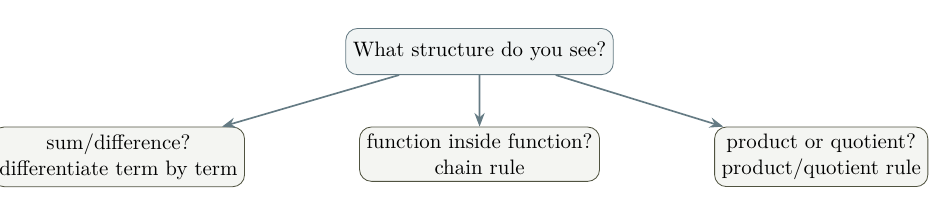
Identify the structure first: sum, composite, product or quotient. Then apply the corresponding rule and simplify only after differentiating correctly.
The derivative as a function
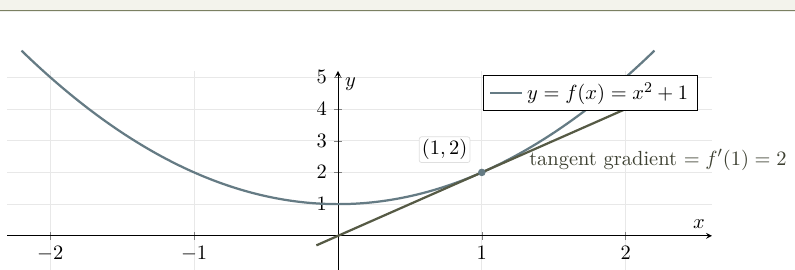
A derivative is itself a function. It gives the gradient of the original function at each value of \(x\).
Notation
If \(y=f(x)\), the derivative can be written as \(f'(x)\) or \(\dfrac{dy}{dx}\). Both mean the rate of change of \(y\) with respect to \(x\).
Standard derivatives to know
| Function | Derivative | Note |
|---|---|---|
| \(x^n\) | \(nx^{n-1}\) | \(n\in\mathbb{Q}\) |
| \(\sin x\) | \(\cos x\) | angles in radians |
| \(\cos x\) | \(-\sin x\) | angles in radians |
| \(e^x\) | \(e^x\) | unchanged |
| \(\ln x\) | \(\dfrac1x\) | \(x>0\) |
Common trap
The derivative of \(\ln x\) is \(1/x\), not \(\ln x\). Trigonometric derivative rules in calculus use radians.
Worked example 1: standard derivatives and notation
Differentiate: (a) \(f(x)=x^{5/2}\); (b) \(y=3\sin x-4e^x+7\ln x\).
Solution
For part (b), differentiate each term separately:
Sums, differences and constant multiples
Differentiation is linear. Constants multiply through, and sums or differences can be differentiated term by term.
Worked example 2: differentiating a sum
Find \(f'(x)\) for \(f(x)=4x^3-\dfrac5{x^2}+6\cos x-2\ln x\).
Solution
Rewrite the fraction as a power: \(-5/x^2=-5x^{-2}\). Then differentiate term by term:
The chain rule for composite functions
The chain rule is used when one function is inside another. Differentiate the outer function, keeping the inner function in place, then multiply by the derivative of the inner function.

Chain Rule tutorial
A full walkthrough of the chain rule and its notation.
Watch the full Chain Rule tutorial
Then watch Chain Rule Shortcuts
Worked example 3: chain rule with a power
Differentiate \(y=(3x^2-5x+1)^4\).
Solution
Function notation. Let \(h(x)=3x^2-5x+1\) and \(g(u)=u^4\). Then
Therefore
Leibniz notation. Put \(u=3x^2-5x+1\), so \(y=u^4\). Then
and multiply the two derivatives before substituting back.
Worked example 4: exponential and trigonometric composites
Differentiate (a) \(f(x)=e^{x^2+2x}\); (b) \(g(x)=\sin(3x-1)\).
Solution
The product rule
Use the product rule when two functions of \(x\) are multiplied together.
Do not differentiate a product factor-by-factor
In general, \((fg)'\ne f'g'\). You need both cross-terms from the product rule.
Worked example 5: product rule
Differentiate \(y=x^2\ln x\).
Solution
Let \(u=x^2\) and \(v=\ln x\). Then \(u'=2x\) and \(v'=1/x\). Therefore
The quotient rule
Use the quotient rule when one function of \(x\) is divided by another.
Quotient Rule tutorial
Use this tutorial for a complete worked explanation of the quotient structure and numerator order.
Worked example 6: quotient rule
Differentiate \(y=\dfrac{e^x}{x^2+1}\).
Solution
Let \(u=e^x\), \(v=x^2+1\). Then \(u'=e^x\) and \(v'=2x\).
Choosing the correct rule
| Structure | Rule | Example |
|---|---|---|
| Sum/difference | Differentiate term by term | \(x^3+\sin x\) |
| Function inside a function | Chain rule | \(\sin(x^2)\) |
| Two functions multiplied | Product rule | \(x^2e^x\) |
| One function divided by another | Quotient rule | \(\ln x/x\) |
Worked example 7: product rule with a chain rule inside
Differentiate \(f(x)=x^2e^{3x-1}\).
Solution
Use the product rule with \(u=x^2\) and \(v=e^{3x-1}\). The derivative of \(v\) also needs the chain rule:
Worked example 8: quotient rule and a stationary tangent
Let \(y=\dfrac{\ln x}x\), \(x>0\). Find \(dy/dx\) and the gradient at \(x=e\).
Solution
Use the quotient rule with \(u=\ln x\), \(v=x\):
At \(x=e\), \(\ln e=1\), so
The tangent is horizontal at \(x=e\).
Video tutorials
Radford Mathematics differentiation tutorials
Practice
Differentiate each function
- \(7x^4-3x^2+5x-9\)
- \(2\sin x+5\cos x-3e^x\)
- \(4\ln x-\dfrac6x\), \(x>0\)
- \(x^{3/2}-x^{-1/2}\)
- \((5x-2)^6\)
- \(\sin(4x+1)\)
- \(e^{2x^2-3x}\)
- \(\ln(3x^2+1)\)
- \(x^3\sin x\)
- \(e^x\cos x\)
- \(\dfrac{x^2+1}{x-1}\)
- \(\dfrac{\ln x}{x^2}\)
- \(x^2\ln(2x+1)\)
- \(\dfrac{e^{3x}}{x^2+4}\)
- For \(f(x)=x^2e^{-x}\), find \(f'(x)\) and hence the gradient when \(x=2\).
- Explain why \(x\sin x\) needs the product rule but \(\sin(x^2)\) needs the chain rule.
Answer key
Answers 1–8
- \(28x^3-6x+5\)
- \(2\cos x-5\sin x-3e^x\)
- \(\dfrac4x+\dfrac6{x^2}\)
- \(\dfrac32x^{1/2}+\dfrac12x^{-3/2}\)
- \(30(5x-2)^5\)
- \(4\cos(4x+1)\)
- \((4x-3)e^{2x^2-3x}\)
- \(\dfrac{6x}{3x^2+1}\)
Answers 9–16
- \(3x^2\sin x+x^3\cos x\)
- \(e^x(\cos x-\sin x)\)
- \(\dfrac{x^2-2x-1}{(x-1)^2}\)
- \(\dfrac{1-2\ln x}{x^3}\)
- \(2x\ln(2x+1)+\dfrac{2x^2}{2x+1}\)
- \(\dfrac{e^{3x}(3x^2-2x+12)}{(x^2+4)^2}\)
- \(f'(x)=e^{-x}(2x-x^2)\), so \(f'(2)=0\).
- \(x\sin x\) is a product of two functions of \(x\); \(\sin(x^2)\) is a composite function with \(x^2\) inside sine.