← AI SL Topic 1: Number and algebra
IB Mathematics: Applications and Interpretation SL — Topic 1
Exponents and logarithms
Simplify integer powers, read logarithms as exponents, and calculate confidently in bases 10 and e.
Learning goal
Simplify integer powers, understand logarithms as exponents, and evaluate logarithms in bases 10 and \(e\).
Syllabus link
AI SL SL 1.5: integer exponent laws, logarithms in bases 10 and \(e\), and numerical evaluation using technology.
Big idea
A logarithm answers the question: “What exponent do I need?”
Key relationship
\(a^x=b\Longleftrightarrow\log_a b=x\)
\(a>0,\ b>0,\ a\ne1\).
Integer powers: multiplying and dividing
In \(a^n\), \(a\) is the base and \(n\) is the exponent (or index). For a positive integer \(n\), \(a^n\) means \(n\) factors of \(a\): for example, \(3^4=3\times3\times3\times3=81\).
Worked example 1 | Count the factors
Question: Simplify \(5^3\times5^2\).
Solution
Using \(a^m a^n=a^{m+n}\), \[5^3\times5^2=(5\times5\times5)(5\times5)=5^{3+2}=5^5.\] The base stays 5; there are five factors of 5 altogether.
Worked example 2 | Cancel common factors
Question: Simplify \(\dfrac{6^4}{6^3}\).
Solution
Using \(a^m/a^n=a^{m-n}\), \[\frac{6^4}{6^3}=\frac{6\times6\times6\times6}{6\times6\times6}=6^{4-3}=6.\]
Zero and negative exponents
Reduce the exponent by 1 each time. To keep the pattern working, divide the value by the base each time.
| Power | \(2^3\) | \(2^2\) | \(2^1\) | \(2^0\) | \(2^{-1}\) | \(2^{-2}\) |
|---|---|---|---|---|---|---|
| Value | \(8\) | \(4\) | \(2\) | \(1\) | \(\frac12\) | \(\frac14\) |
Worked example 3 | What is raised to the power zero?
Question: Evaluate
\(7^0\)
\((-4)^0\)
\(5x^0\), where \(x\ne0\).
Solution
Every non-zero base to the power zero is 1. \[\begin{aligned} \text{(a)}\quad 7^0&=1,\\ \text{(b)}\quad (-4)^0&=1,\\ \text{(c)}\quad 5x^0&=5\times1=5. \end{aligned}\] In (c), only \(x\) is raised to the power zero: read \(5x^0\) as \(5\times(x^0)\). By contrast, \((5x)^0=1\), because the whole non-zero product \(5x\) is the base.
Worked example 4 | Rewrite, then evaluate
Question: Evaluate
\(2^{-3}\)
\(\left(\frac23\right)^{-2}\)
\((-2)^{-3}\).
Solution
First use \(a^{-n}=1/a^n\). Then calculate the positive power.
(a) \(\displaystyle 2^{-3}=\frac{1}{2^3}=\frac{1}{2\times2\times2}=\boxed{\frac18}\).
(b) \(\displaystyle \left(\frac23\right)^{-2}=\frac{1}{(2/3)^2} =1\div\frac49=1\times\frac94=\boxed{\frac94}\).
Dividing by a fraction means multiplying by its reciprocal. Equivalently, invert \(2/3\) first and calculate \((3/2)^2\).
(c) \(\displaystyle (-2)^{-3}=\frac{1}{(-2)^3}=\frac{1}{(-2)(-2)(-2)}=\frac1{-8}=\boxed{-\frac18}\).
Worked example 5 | Combining negative exponents
Question: Simplify
\(5^3\times5^{-6}\)
\(\dfrac{x^{-2}}{x^{-5}}\), where \(x\ne0\).
Solution
Choose the rule from the operation between the powers.
(a) Multiplication: use \(a^m a^n=a^{m+n}\). \[5^3\times5^{-6}=5^{3+(-6)}=5^{3-6}=5^{-3}=\frac1{5^3}=\boxed{\frac1{125}}.\]
(b) Division: use \(a^m/a^n=a^{m-n}\). Put the exponent being subtracted in brackets. \[\frac{x^{-2}}{x^{-5}}=x^{-2-(-5)}=x^{-2+5}=\boxed{x^3}.\] Subtracting \(-5\) means adding \(5\). Do not replace \(-2-(-5)\) by \(-2-5\).
Brackets and algebraic expressions
Worked example 6 | Multiply, do not add
Question: Simplify \((2^3)^{-4}\).
Solution
Use \((a^m)^n=a^{mn}\): the outer power acts on the whole inner power. \[\begin{aligned} (2^3)^{-4}&=2^{3\times(-4)} &&\text{multiply the exponents}\\ &=2^{-12} &&\text{because }3\times(-4)=-12\\ &=\frac1{2^{12}}=\boxed{\frac1{4096}} &&\text{use the reciprocal rule.} \end{aligned}\]
Worked example 7 | Include the numerical coefficient
Question: Simplify
\((2x)^4\)
\(\left(\dfrac{3x}{2}\right)^2\).
Solution
Use \((ab)^n=a^nb^n\) and \((a/b)^n=a^n/b^n\).
(a) The brackets include both 2 and \(x\), so both receive the power 4: \[(2x)^4=(2x)(2x)(2x)(2x)=2^4x^4=\boxed{16x^4}.\]
(b) Square the numerator and the denominator, then square each factor in the numerator: \[\left(\frac{3x}{2}\right)^2=\frac{(3x)^2}{2^2}=\frac{3^2x^2}{2^2}=\boxed{\frac{9x^2}{4}}.\]
Worked example 8 | Use several rules in sequence
Question: Simplify \(\dfrac{(2x^{-3}y^2)^2}{4x^{-1}y^{-3}}\), giving your answer with positive exponents. Assume \(x,y\ne0\).
Solution
Step 1: expand the numerator. Use \((ab)^n=a^nb^n\) and \((a^m)^n=a^{mn}\): \[(2x^{-3}y^2)^2=2^2(x^{-3})^2(y^2)^2=4x^{-6}y^4.\] Step 2: divide like factors. Use \(a^m/a^n=a^{m-n}\) separately for \(x\) and \(y\): \[\begin{aligned} \frac{4x^{-6}y^4}{4x^{-1}y^{-3}} &=\frac44\times\frac{x^{-6}}{x^{-1}}\times\frac{y^4}{y^{-3}}\\ &=1\times x^{-6-(-1)}\times y^{4-(-3)}\\ &=x^{-6+1}y^{4+3}=x^{-5}y^7. \end{aligned}\] Step 3: use positive exponents. Since \(x^{-5}=1/x^5\), \[x^{-5}y^7=\frac1{x^5}\times y^7=\boxed{\frac{y^7}{x^5}}.\] Only the factor with a negative exponent moves to the denominator. Keep the original restrictions \(x,y\ne0\).
A logarithm is an exponent
The general conversion below uses any valid base \(a\). For AI SL 1.5, the numerical focus is on bases 10 and \(e\).
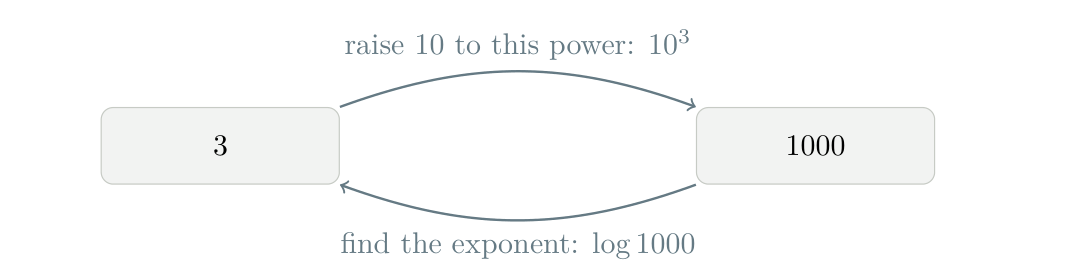
You know that \(10^3=1000\). Now reverse the question: to what power must we raise 10 to get 1000? The answer is 3. We write this as \(\log_{10}1000=3\).
Worked example 9 | Translate in both directions
Question:
Write \(2^5=32\) in logarithmic form.
Write \(\log_{10}0.01=-2\) in exponential form.
Solution
Use \(a^x=b\Longleftrightarrow\log_a b=x\). Identify three things: the base, the exponent, and the result.
(a) In \(2^5=32\), the base is 2, the exponent is 5, and the result is 32. \[\underbrace{2}_{\text{base}}^{\,5}=32 \quad\Longrightarrow\quad\boxed{\log_2 32=5}.\] Read this as: “The power of 2 needed to produce 32 is 5.”
(b) In \(\log_{10}0.01=-2\), the base is 10 and the required exponent is \(-2\): \[\boxed{10^{-2}=0.01}.\] Check: \(10^{-2}=1/10^2=1/100=0.01\).
Worked example 10 | Exact logarithms without a calculator
Question: Evaluate
\(\log1000\)
\(\log0.001\)
\(\log1\).
Solution
Ask which power of 10 produces each number. \[\begin{aligned} \text{(a)}\quad 10^3=1000&\quad\Rightarrow\quad \log1000=3,\\ \text{(b)}\quad 10^{-3}=0.001&\quad\Rightarrow\quad \log0.001=-3,\\ \text{(c)}\quad 10^0=1&\quad\Rightarrow\quad \log1=0. \end{aligned}\]
Natural logarithms: base \(e\)
The number \(e=2.718281828\ldots\) is a special positive constant, like \(\pi\). It is irrational: its decimal expansion does not terminate or repeat. It appears naturally in continuous growth and later in calculus. Here, we use it simply as a base.
Worked example 11 | Recognise powers of \(e\)
Question: Evaluate
\(\ln e\)
\(\ln1\)
\(\ln(e^4)\)
\(\ln(1/e^2)\).
Solution
Identify the exponent on \(e\) in each case. \[\begin{aligned} \text{(a)}\quad e^1=e&\quad\Rightarrow\quad \ln e=1,\\ \text{(b)}\quad e^0=1&\quad\Rightarrow\quad \ln1=0,\\ \text{(c)}\quad e^4=e^4&\quad\Rightarrow\quad \ln(e^4)=4,\\ \text{(d)}\quad \frac1{e^2}=e^{-2}&\quad\Rightarrow\quad \ln(1/e^2)=-2. \end{aligned}\] These are exact answers; no decimal approximation to \(e\) is needed.
Worked example 12 | Translate and interpret
Question:
Express \(e^x=7\) in logarithmic form.
Express \(\ln y=-2\) in exponential form and find the exact value of \(y\).
Solution
Recall \(\ln b=\log_e b\), so \(e^x=b\Longleftrightarrow x=\ln b\).
(a) The base is \(e\) and the unknown is its exponent. Therefore \[e^x=7\quad\Longrightarrow\quad\log_e7=x\quad\Longrightarrow\quad\boxed{x=\ln7}.\]
(b) First make the base visible: \(\ln y=-2\) means \(\log_e y=-2\). Thus \[\log_e y=-2\quad\Longrightarrow\quad e^{-2}=y \quad\Longrightarrow\quad\boxed{y=\frac1{e^2}}.\] A negative logarithm is an exponent below zero; it does not mean \(y\) is negative.
| Common logarithm | Natural logarithm | |
|---|---|---|
| Notation | \(\log x\) or \(\log_{10}x\) | \(\ln x\) or \(\log_e x\) |
| Base | \(10\) | \(e\approx2.71828\) |
| Question asked | \(10^{\,?}=x\) | \(e^{\,?}=x\) |
| Examples | \(\log10=1\), \(\log1=0\) | \(\ln e=1\), \(\ln1=0\) |
Numerical evaluation on the TI-Nspire CX
Worked example 13 | Calculate and check the size [GDC]
Question: Evaluate to 3 significant figures:
\(\log50\);
\(\ln7\);
\(\ln0.2\).
Solution
Enter each complete expression in Scratchpad Calculate.
| Part | Input | Decimal value | 3 significant figures |
|---|---|---|---|
| (a) | log(50) |
\(1.698970004\ldots\) | \(1.70\) |
| (b) | ln(7) |
\(1.945910149\ldots\) | \(1.95\) |
| (c) | ln(0.2) |
\(-1.609437912\ldots\) | \(-1.61\) |
For \(1.698970\ldots\), the first three significant digits are 1, 6 and 9. The next digit is 8, so rounding gives \(1.70\); keep the final zero to show 3 significant figures.
Since \(10^1<50<10^2\), \(\log50\) must lie between 1 and 2. Since \(0<0.2<1\), its natural logarithm must be negative.
TI-Nspire CX: Evaluate logarithms
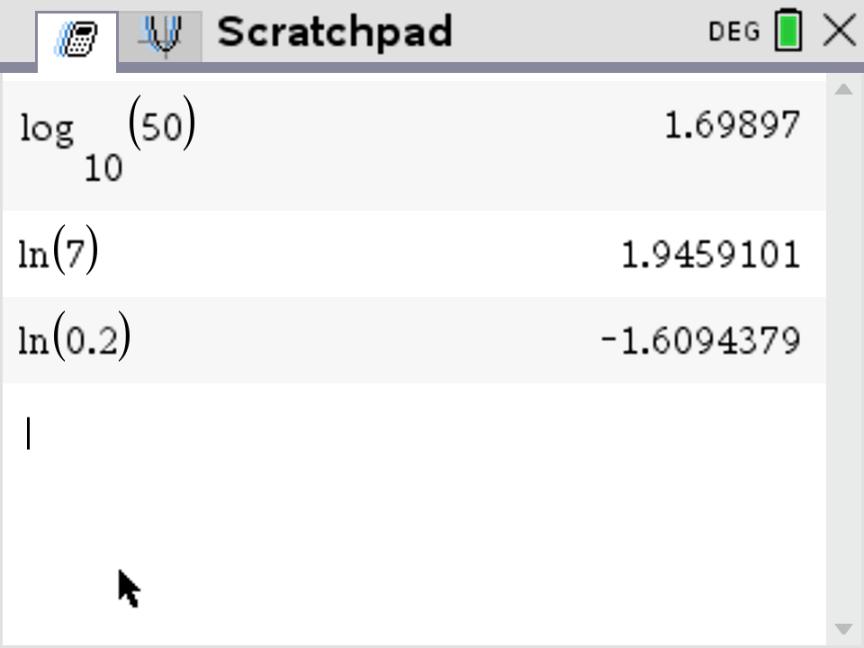
The screen shows \(\log_{10}50\), \(\ln7\) and \(\ln0.2\) before rounding.
Use Ctrl, then \(10^x\) for \(\log\); use Ctrl, then \(e^x\) for \(\ln\).
To 3 significant figures, the answers are \(1.70\), \(1.95\) and \(-1.61\).
Worked example 14 | A logarithm between integer powers [GDC]
Question: The number \(x\) satisfies \(10^x=350\). Write \(x\) exactly, then give its value to 3 significant figures.
Solution
Step 1: identify the unknown. We need the exponent on 10, so use the conversion \(a^x=b\Longleftrightarrow x=\log_a b\). \[10^x=350\quad\Longrightarrow\quad\boxed{x=\log_{10}350=\log350}\quad\text{(exact)}.\] Step 2: evaluate. Enter log(350) in Scratchpad Calculate: \[x=2.544068044\ldots\quad\Longrightarrow\quad\boxed{x\approx2.54}\quad\text{(3 s.f.)}.\] Step 3: check. Since \(100<350<1000\), we need \(2<x<3\). To check the conversion, enter 10^(log(350)); this returns 350, up to numerical rounding. Using the rounded \(2.54\) instead gives only an approximate check.
TI-Nspire CX: Find and check an exponent
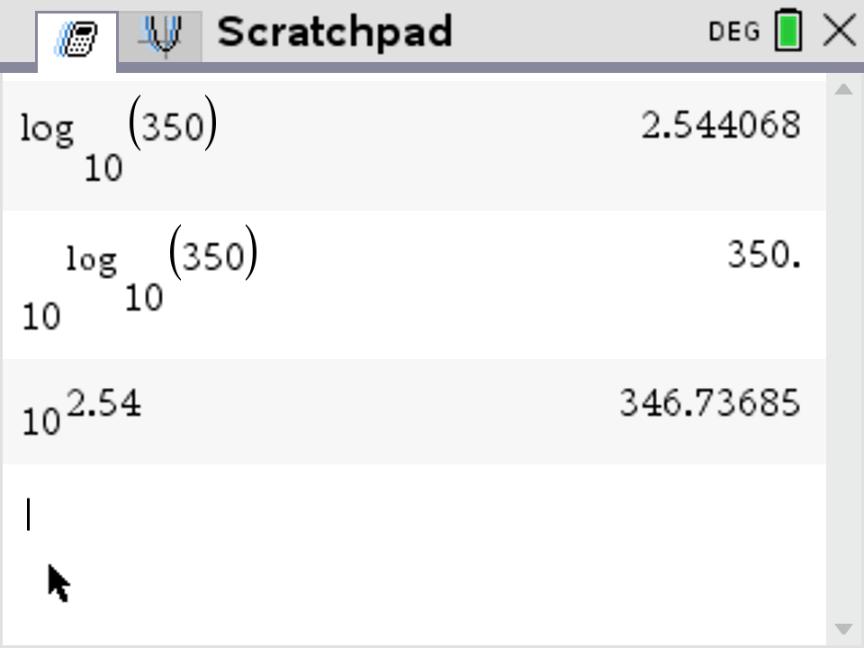
Using the full expression gives \(10^{\log350}=350\).
Using the rounded exponent gives \(10^{2.54}\approx346.737\), so it does not return 350 exactly.
Keep full precision in intermediate calculations; round only the final answer.
Worked example 15 | Recover the number from its logarithm [GDC]
Question: Find \(y\), to 3 significant figures, when
\(\log y=1.6\);
\(\ln y=-0.8\).
Solution
The answer to a logarithm is an exponent. Use that exponent with the correct base.
(a) \(\log y=\log_{10}y\). Using \(\log_a b=x\Longleftrightarrow b=a^x\), \[\log_{10}y=1.6\quad\Longrightarrow\quad y=10^{1.6}=39.810717\ldots
\quad\Longrightarrow\quad\boxed{y\approx39.8}.\] In Scratchpad, enter 10^(1.6). Check that \(\log(39.810717\ldots)\approx1.6\).
(b) \(\ln y=\log_e y\), so \[\log_e y=-0.8\quad\Longrightarrow\quad y=e^{-0.8}=0.449328\ldots
\quad\Longrightarrow\quad\boxed{y\approx0.449}.\] Use the calculator’s \(e^x\) template or insert its built-in constant \(e\) from the symbols palette/Catalog, then raise it to \(-0.8\). Use the negative-number key for the exponent. Do not enter a variable named e or round \(e\) to 2.72. Request a decimal with Ctrl + Enter.
Both values of \(y\) are positive, as required for a real logarithm.
TI-Nspire CX: Undo a logarithm
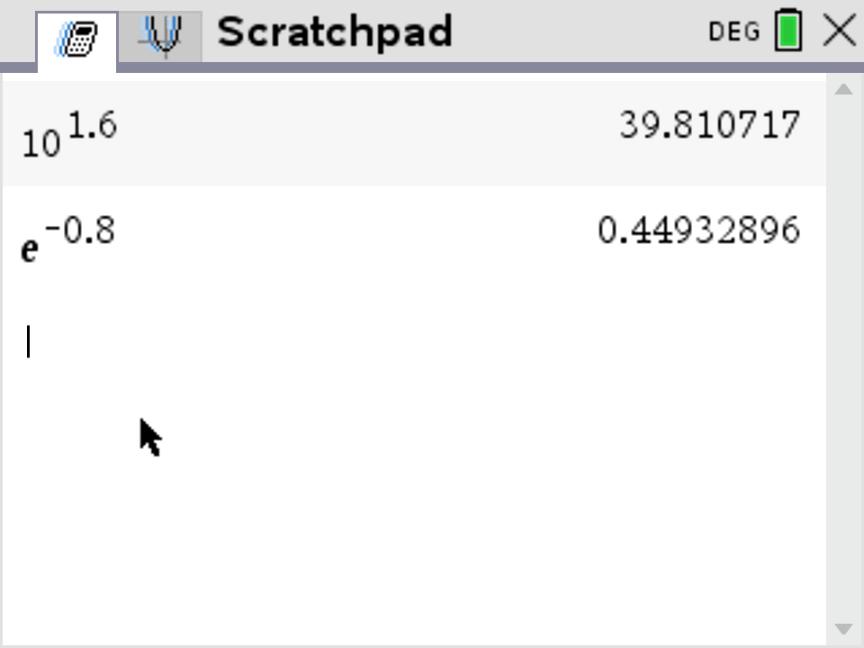
The screen shows the values of \(10^{1.6}\) and \(e^{-0.8}\) before rounding.
To 3 significant figures:
(a) \(y\approx39.8\)
(b) \(y\approx0.449\)
In (b), the exponent is negative, but the value of \(y\) is positive.
Worked example 16 | Use a supplied model [GDC]
Question: A simplified sound model is \(L=10\log R\), where \(L\) is a sound level in decibels (dB) and \(R>0\) is an intensity ratio.
Find \(L\) when \(R=400\), to 1 decimal place.
Find \(R\) when \(L=20\).
Solution
(a) Write the model first, substitute, then calculate: \[\begin{aligned}
L&=10\log R\\
&=10\log400\\
&=10(2.602059991\ldots)=26.02059991\ldots\\
&\approx\boxed{26.0\text{ dB}}\quad\text{(1 d.p.).}
\end{aligned}\] Enter the whole expression 10*log(400). Do not round the logarithm before multiplying.
(b) Substitute \(L=20\) and divide both sides by 10: \[20=10\log R\quad\Longrightarrow\quad2=\log R \quad\Longrightarrow\quad R=10^2=\boxed{100}.\] The intensity is 100 times the reference intensity. No logarithm law is needed: use the definition.
Formula booklet: this sound model is supplied for the example; it is not a section 1.5 formula to memorise.
Practice A: integer exponents
Build fluency by hand; use your GDC to check. Show the exponent rule you use. AI SL examinations require a GDC; this practice develops the reasoning behind the calculations. Give exact answers and use positive exponents in your final algebraic expressions. All variables below are non-zero. Use separate paper for your working.
Evaluate:
\(3^4\)
\((-3)^4\)
\(-3^4\).
Write each as a single power:
\(7^3\times7^5\)
\(\dfrac{11^7}{11^2}\)
\((3^2)^4\).
Evaluate:
\(9^0\)
\(4^{-2}\)
\((-2)^{-3}\).
Evaluate:
\(\left(\dfrac35\right)^{-2}\)
\(5^2\times5^{-4}\).
Simplify:
\(x^4x^{-7}\)
\(\dfrac{y^{-3}}{y^{-8}}\).
Simplify:
\((3x^2)^3\)
\((-2a^{-2})^3\).
Practice A (continued)
Simplify \(\displaystyle\frac{12x^5y^{-2}}{3x^{-1}y^3}\).
Simplify \(\displaystyle\frac{(2a^{-2}b^3)^2}{8a^{-1}b}\).
A student writes \(2x^{-3}=\dfrac1{2x^3}\).
Explain the error and give the correct expression.
Rewrite \((2x)^{-3}\) with positive exponents.
A student writes \(3^2+3^4=3^6\). Explain why the exponent rule does not apply, and find the correct numerical answer.
Simplify \(\displaystyle\frac{(x^2y^{-1})^{-2}}{x^{-3}y^4}\).
Challenge: combine the skills. Let \(\displaystyle E=\frac{(2x^{-1}y^2)^3}{4x^{-5}y}\).
Simplify \(E\) with positive exponents.
Hence find \(E\) when \(x=2\) and \(y=-1\).
Practice B: logarithms and interpretation
Try Questions 13–18 by reasoning first; you may check with a GDC. Questions marked [GDC] require numerical evaluation. Give approximate answers to 3 significant figures unless stated otherwise.
Write in logarithmic form:
\(10^4=10000\)
\(e^{-3}=\dfrac1{e^3}\)
\(2^6=64\).
Write in exponential form:
\(\log0.01=-2\)
\(\ln9=k\)
\(\log_3 81=4\).
Evaluate exactly:
\(\log100000\)
\(\log0.0001\)
\(\log1\).
Evaluate exactly:
\(\ln(e^5)\)
\(\ln(e^{-2})\)
\(\ln1\)
\(\ln e\).
Which expressions have real values? Explain your choices.
\(\log(-100)\)
\(\ln0\)
\(\log0.1\)
\(\ln(e^{-1})\).
Explain why
\(2<\log500<3\)
\(\ln0.5<0\).
Practice B (continued)
[GDC] Evaluate
\(\log75\)
\(\ln12\)
\(\log0.04\)
\(\ln0.75\).
[GDC] In each case write an exact logarithmic expression for \(x\), then find a decimal approximation:
\(10^x=240\)
\(e^x=0.08\).
[GDC] Use the definition of a logarithm to find \(y\):
\(\log y=-2.4\)
\(\ln y=1.7\).
[GDC] A simplified sound model is \(L=10\log R\), where \(L\) is the sound level in decibels (dB) and \(R>0\) is a dimensionless intensity ratio.
Find \(L\) when \(R=1000\).
Find \(L\) when \(R=2500\), to 1 decimal place.
Explain why \(L=0\) when \(R=1\). Does this mean the intensity is zero?
A student claims, “A negative logarithm is impossible because negative numbers cannot go inside a logarithm.” Explain the confusion and give an exact counterexample.
Challenge: combine the skills. By recognising powers, let \(p=\log0.001\) and \(q=\ln(e^2)\).
Find \(p\) and \(q\).
Evaluate \(10^p e^q\) exactly.
The model in Question 22 is supplied for the question; it is not a formula to learn for section 1.5.
Worked answers: Practice A
Question 1: worked answer
(a) \(3^4=3\times3\times3\times3=\boxed{81}\).
(b) \((-3)^4=(-3)(-3)(-3)(-3)=9\times9=\boxed{81}\).
(c) \(-3^4=-(3\times3\times3\times3)=\boxed{-81}\). The minus sign is outside the power.
Question 2: worked answer
(a) Multiply powers of the same base: \(7^3\times7^5=7^{3+5}=\boxed{7^8}\).
(b) Divide powers of the same base: \(\dfrac{11^7}{11^2}=11^{7-2}=\boxed{11^5}\).
(c) Raise a power to a power: \((3^2)^4=3^{2\times4}=\boxed{3^8}\).
Question 3: worked answer
(a) A non-zero base to the power zero is 1, so \(9^0=\boxed{1}\).
(b) \(4^{-2}=\dfrac1{4^2}=\dfrac1{4\times4}=\boxed{\dfrac1{16}}\).
(c) \((-2)^{-3}=\dfrac1{(-2)^3}=\dfrac1{(-2)(-2)(-2)}=\dfrac1{-8}=\boxed{-\dfrac18}\).
Question 4: worked answer
(a) Invert the base, then square: \(\left(\dfrac35\right)^{-2}=\left(\dfrac53\right)^2=\dfrac{5^2}{3^2}=\boxed{\dfrac{25}{9}}\).
(b) Add exponents for multiplication, then use the reciprocal rule: \[5^2\times5^{-4}=5^{2+(-4)}=5^{-2}=\frac1{5^2}=\boxed{\frac1{25}}.\]
Question 5: worked answer
(a) \(x^4x^{-7}=x^{4+(-7)}=x^{-3}=\boxed{\dfrac1{x^3}}\).
(b) \(\dfrac{y^{-3}}{y^{-8}}=y^{-3-(-8)}=y^{-3+8}=\boxed{y^5}\).
Question 6: worked answer
(a) Raise each factor to the power 3: \[(3x^2)^3=3^3(x^2)^3=27x^{2\times3}=\boxed{27x^6}.\]
(b) Keep the negative coefficient inside its brackets: \[(-2a^{-2})^3=(-2)^3(a^{-2})^3=-8a^{-6}=\boxed{-\frac8{a^6}}.\]
Question 7: worked answer
Divide coefficients and use \(a^m/a^n=a^{m-n}\): \[\begin{aligned} \frac{12x^5y^{-2}}{3x^{-1}y^3} &=\frac{12}{3}x^{5-(-1)}y^{-2-3}\\ &=4x^{5+1}y^{-5}\\ &=4x^6\times\frac1{y^5}=\boxed{\frac{4x^6}{y^5}}. \end{aligned}\]
Question 8: worked answer
Expand the numerator, then divide like factors: \[\begin{aligned} \frac{(2a^{-2}b^3)^2}{8a^{-1}b} &=\frac{2^2a^{-2\times2}b^{3\times2}}{8a^{-1}b^1}\\ &=\frac48a^{-4-(-1)}b^{6-1}\\ &=\frac12a^{-3}b^5=\boxed{\frac{b^5}{2a^3}}. \end{aligned}\] Remember that \(b\) means \(b^1\).
Question 9: worked answer
(a) The exponent \(-3\) applies only to \(x\). Using \(x^{-3}=1/x^3\), \[2x^{-3}=2\times\frac1{x^3}=\boxed{\frac2{x^3}}.\] The coefficient 2 is not inverted because it is outside the power.
(b) Here the whole product \(2x\) is the base: \[(2x)^{-3}=\frac1{(2x)^3}=\frac1{2^3x^3}=\boxed{\frac1{8x^3}}.\]
Question 10: worked answer
The rule \(a^ma^n=a^{m+n}\) applies to multiplication, not addition. Calculate each power first: \[3^2+3^4=9+81=\boxed{90}.\]
Question 11: worked answer
Multiply exponents inside the numerator, then subtract exponents when dividing: \[\begin{aligned} \frac{(x^2y^{-1})^{-2}}{x^{-3}y^4} &=\frac{x^{2(-2)}y^{(-1)(-2)}}{x^{-3}y^4}\\ &=\frac{x^{-4}y^2}{x^{-3}y^4}=x^{-4-(-3)}y^{2-4}\\ &=x^{-1}y^{-2}=\frac1x\times\frac1{y^2}=\boxed{\frac1{xy^2}}. \end{aligned}\]
Question 12: worked answer
(a) \(\displaystyle E=\frac{2^3x^{-3}y^6}{4x^{-5}y^1} =\frac84x^{-3-(-5)}y^{6-1}=\boxed{2x^2y^5}\).
(b) Substitute using brackets for the negative value of \(y\): \[E=2(2)^2(-1)^5=2\times4\times(-1)=\boxed{-8}.\]
Worked answers: Practice B
Question 13: worked answer
Keep the base; the logarithm equals the exponent.
(a) \(10^4=10000\ \Longrightarrow\ \boxed{\log10000=4}\).
(b) \(e^{-3}=1/e^3\ \Longrightarrow\ \log_e(1/e^3)=-3\ \Longrightarrow\ \boxed{\ln(1/e^3)=-3}\).
(c) \(2^6=64\ \Longrightarrow\ \boxed{\log_2 64=6}\).
Question 14: worked answer
Use \(\log_a b=x\Longleftrightarrow a^x=b\).
(a) \(\log_{10}0.01=-2\ \Longrightarrow\ \boxed{10^{-2}=0.01}\).
(b) \(\ln9=k\) means \(\log_e9=k\), so \(\boxed{e^k=9}\).
(c) \(\log_3 81=4\ \Longrightarrow\ \boxed{3^4=81}\).
Question 15: worked answer
Find the power of 10 that gives the argument.
(a) \(100000=10^5\), so \(\log100000=\boxed{5}\).
(b) \(0.0001=1/10000=10^{-4}\), so \(\log0.0001=\boxed{-4}\).
(c) \(1=10^0\), so \(\log1=\boxed{0}\).
Question 16: worked answer
A natural logarithm asks for the exponent on \(e\).
(a) \(\ln(e^5)=\boxed{5}\), since \(e^5\) is \(e\) to the power 5.
(b) \(\ln(e^{-2})=\boxed{-2}\), since the required exponent is \(-2\).
(c) \(e^0=1\ \Longrightarrow\ \ln1=\boxed{0}\).
(d) \(e^1=e\ \Longrightarrow\ \ln e=\boxed{1}\).
Question 17: worked answer
For a real logarithm, the argument must be strictly positive.
(a) \(\log(-100)\) has no real value: its argument is \(-100<0\).
(b) \(\ln0\) has no real value: \(e^x\) never equals 0 for a real \(x\).
(c) \(\log0.1\) is real: \(0.1>0\) and \(10^{-1}=0.1\), so it equals \(\boxed{-1}\).
(d) \(\ln(e^{-1})\) is real: \(e^{-1}=1/e>0\), so it equals \(\boxed{-1}\).
Question 18: worked answer
(a) \(10^2=100<500<1000=10^3\). Powers of 10 increase as the exponent increases, so the exponent producing 500 lies between 2 and 3: \[\boxed{2<\log500<3}.\]
(b) \(e>1\), so \(e^0=1\) and a negative exponent on \(e\) gives a value between 0 and 1. Since \(0<0.5<1\), \(\boxed{\ln0.5<0}\).
Question 19 [GDC]: worked answer
Use Scratchpad Calculate; round each full result to 3 significant figures.
(a) log(75) gives \(1.875061\ldots\approx\boxed{1.88}\).
(b) ln(12) gives \(2.484906\ldots\approx\boxed{2.48}\).
(c) log(0.04) gives \(-1.397940\ldots\approx\boxed{-1.40}\). Keep the zero.
(d) ln(0.75) gives \(-0.287682\ldots\approx\boxed{-0.288}\).
Question 20 [GDC]: worked answer
Use \(a^x=b\Longleftrightarrow x=\log_a b\). The logarithmic expression is exact.
(a) \(10^x=240\ \Longrightarrow\ x=\log240\).
Enter log(240): \(x=2.380211\ldots\approx\boxed{2.38}\).
(b) \(e^x=0.08\ \Longrightarrow\ x=\ln0.08\).
Enter ln(0.08): \(x=-2.525728\ldots\approx\boxed{-2.53}\).
Question 21 [GDC]: worked answer
Use \(\log_a y=x\Longleftrightarrow y=a^x\) before calculating.
(a) \(\log y=-2.4\) has base 10, so \(y=10^{-2.4}\).
Enter 10^(-2.4): \(y=0.003981071\ldots\approx\boxed{0.00398}\).
(b) \(\ln y=1.7\) has base \(e\), so \(y=e^{1.7}\).
Use the calculator’s built-in \(e^x\) template: \(y=5.473947\ldots\approx\boxed{5.47}\).
Question 22 [GDC]: worked answer
Write the supplied model \(L=10\log R\) before substituting.
(a) \(R=1000\), so \(L=10\log1000=10\times3=\boxed{30\text{ dB}}\).
(b) \(R=2500\), so \(L=10\log2500\).
Enter 10*log(2500): \(L=33.979400\ldots\approx\boxed{34.0\text{ dB}}\) (1 d.p.).
(c) \(R=1\), so \(L=10\log1=10\times0=\boxed{0\text{ dB}}\).
The ratio is 1: the intensity equals the reference intensity. It is not zero intensity.
Question 23: worked answer
The argument must be positive, but the value of the logarithm can be negative. For example, \(10^{-2}=0.01\), so \(\boxed{\log0.01=-2}\). Here the argument \(0.01\) is positive and the answer \(-2\) is a negative exponent.
Question 24: worked answer
(a) \(10^{-3}=0.001\ \Longrightarrow\ \boxed{p=-3}\).
Also, the exponent on \(e\) in \(e^2\) is 2, so \(\boxed{q=2}\).
(b) Substitute those values and use \(10^{-3}=1/1000\): \[10^p e^q=10^{-3}e^2=\frac1{1000}\times e^2=\boxed{\frac{e^2}{1000}}.\]
Reference notes. Syllabus: IB Mathematics: applications and interpretation guide (first assessment 2021), SL 1.5, pp. 28–29. Formula-booklet labels checked against the IB Mathematics: applications and interpretation formula booklet, section 1.5. Calculator guidance: Texas Instruments, TI-Nspire CX Scratchpad calculations. Some introductory examples follow the syllabus guidance; the sound model is supplied as an illustrative application. Prepared by John Radford / Radford Mathematics.