IB Mathematics: Applications and Interpretation SL — Topic 2: Functions
Functions, Domain, Range and Inverses
Understand inputs and outputs, read graphs and reverse a function’s effect.
Learning goal
Read function notation, identify inputs and outputs, determine domain and range, and explain what an inverse does.
Syllabus link
AI SL: SL 2.2. Functions, domain, range, notation, models and the informal concept of an inverse.
Big idea
A function assigns exactly one output to each allowed input.
Key relationship
\(f(a)=b\Longleftrightarrow f^{-1}(b)=a\).
An inverse takes an output back to its original input.
What is a function?
Think of a function as a rule or machine. You choose an allowed input, the rule acts on it, and you obtain exactly one output.

The letter \(f\) names the function. The expression \(f(x)\) is read “\(f\) of \(x\)” and means “the value of \(f\) at input \(x\)”. It does not mean \(f\) multiplied by \(x\).
Worked example 1: reading function notation
Question. Let \(f(x)=3x+2\).
Find \(f(-2)\).
Find \(f(a+1)\).
Solve \(f(x)=17\).
Solution
Replace every \(x\) by the input, using brackets when necessary.
(a) \(f(-2)=3(-2)+2=\boxed{-4}\).
(b) \(f(a+1)=3(a+1)+2=\boxed{3a+5}\).
(c) The output is given; find the input: \[3x+2=17\quad\Longrightarrow\quad3x=15\quad\Longrightarrow\quad\boxed{x=5}.\] Thus \(f(5)=17\): input \(5\) gives output \(17\).
Different names, the same idea
\(v(t)\) can represent velocity at time \(t\); \(C(n)\) can represent the cost of \(n\) items. The letter inside the brackets names the input variable. For example, \(C(4)=18\) means that four items cost 18 currency units.
Domain, range and the graph
Two sets to distinguish
The domain is the set of allowed input values, usually the \(x\)-values.
The range is the set of output values that the function actually produces, usually the \(y\)-values.
A curve is a collection of input–output pairs
The graph contains every point \((x,f(x))\) for the allowed inputs: \[\boxed{(x,f(x))=(\text{input},\text{corresponding output})}.\]
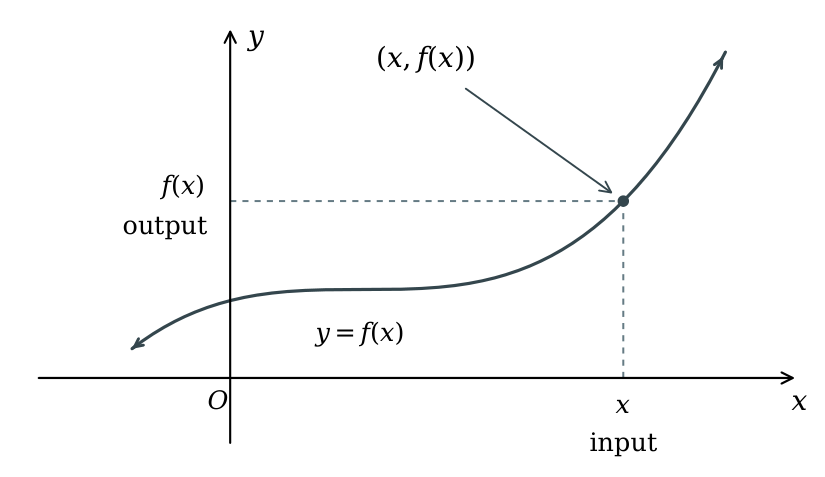
The first coordinate gives the input on the horizontal axis.
The second coordinate gives its matching output on the vertical axis.
A continuous curve collects these pairs over an interval. A discrete function has separate points.
Worked example 2: reading inputs and outputs from a curve
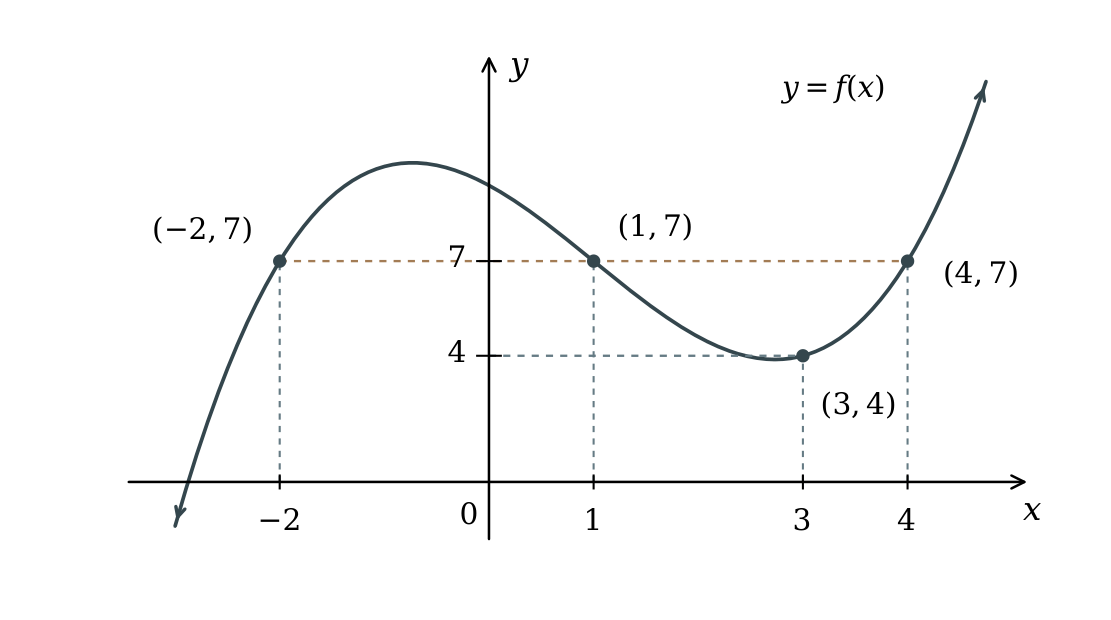
Question. No formula for \(f\) is given. Use the marked points on \(y=f(x)\).
Find \(f(3)\).
Solve \(f(x)=7\).
Solution
(a) From input \(3\), move vertically to \((3,4)\), then across to output \(4\). Thus \(\boxed{f(3)=4}\): the point \((3,4)\) is the pair (input, output).
(b) The line \(y=7\) meets the curve at \((-2,7)\), \((1,7)\) and \((4,7)\). Read the three inputs: \[\boxed{x=-2,\quad x=1\quad\text{or}\quad x=4}.\] Here \(f(-2)=f(1)=f(4)=7\): three different inputs give the same output.
Remember: \(f(3)\) asks for an output (\(y\)); solving \(f(x)=7\) asks for inputs (\(x\)).
Read across for the domain; read up and down for the range. A graph can help you see both, but the visible calculator window may show only part of the graph.
Worked example 3: a restricted graph
Question. Let \(f(x)=(x-1)^2\), with \(-1\leq x\leq3\).
State the domain.
State the range.
Solution
(a) The allowed inputs are stated: \[\boxed{D=[-1,3]}.\] (b) A square cannot be negative. The smallest output is \(f(1)=0\). At the endpoints, \[f(-1)=(-2)^2=4,\qquad f(3)=2^2=4.\] All outputs between \(0\) and \(4\) occur, so \[\boxed{R=[0,4]}.\]
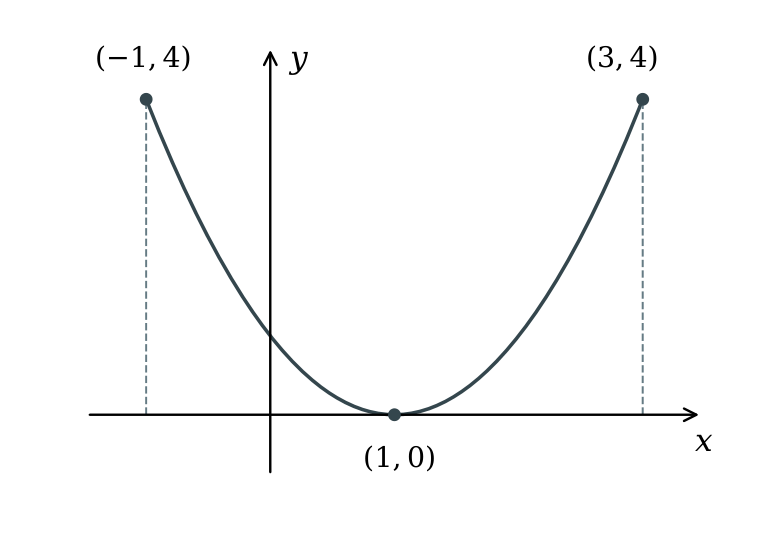
The filled endpoints show that \(x=-1\) and \(x=3\) are included. Checking only the endpoints would miss the minimum at \(x=1\).
Interval notation
| Description | Interval | Meaning |
|---|---|---|
| \(-1\leq x\leq3\) | \([-1,3]\) | Both endpoints included |
| \(-1<x<3\) | \((-1,3)\) | Both endpoints excluded |
| \(x\geq0\) | \([0,\infty)\) | Zero included; no upper bound |
| \(x>0\) | \((0,\infty)\) | Zero excluded; no upper bound |
| \(x\neq0\) | \(\mathbb{R}\setminus\{0\}\) | All real values except zero |
\(\mathbb{R}\) means all real numbers. Use round brackets at \(\pm\infty\): infinity is not an endpoint that can be included. The notation \([a,b[\) also means \([a,b)\).
The domain is part of the function
The rule \(f(x)=x^2\) with domain \(\mathbb{R}\) has range \([0,\infty)\). The same rule with domain \([2,5]\) has range \([4,25]\). Always use the domain given in the question.
Finding the allowed inputs
If no domain is stated, use the largest real domain for which the expression is defined. If a context or a stated interval restricts the inputs further, apply that restriction too.
Two checks to remember
| Expression | Requirement for real inputs |
|---|---|
| A fraction | Denominator \(\neq0\) |
| A square root | Expression inside the root \(\geq0\) |
Worked example 4: a square root
Question. Let \(g(x)=\sqrt{5-2x}\).
Find the domain.
Find the range.
Solution
(a) The expression inside a real square root must be non-negative: \[5-2x\geq0\quad\Longrightarrow\quad -2x\geq-5\quad\Longrightarrow\quad x\leq\frac52.\] The inequality reverses when we divide by \(-2\). Thus \(\boxed{D=(-\infty,\frac52]}\).
(b) A square root is non-negative, and \(g(\frac52)=0\). As \(x\) becomes more negative, \(5-2x\) grows without bound. Every non-negative output occurs, so \(\boxed{R=[0,\infty)}\).
Worked example 5: combining restrictions
Question. Find the largest real domain of \(h(x)=\dfrac{\sqrt{x+2}}{x-1}\).
Solution
Both conditions must hold at the same time: \[\underbrace{x+2\geq0}_{\text{square root defined}}\ \Longrightarrow\ x\geq-2, \qquad\underbrace{x-1\neq0}_{\text{denominator nonzero}}\ \Longrightarrow\ x\neq1.\] Therefore \(\boxed{D=[-2,1)\cup(1,\infty)}\). The symbol \(\cup\) joins the two allowed intervals. The input \(-2\) is allowed because it gives \(0/(-3)=0\); input \(1\) is not allowed.
Worked example 6: checking individual inputs
Question. For \(h(x)=\dfrac{\sqrt{x+2}}{x-1}\), decide whether each input is allowed:
\(x=-2\);
\(x=-3\);
\(x=1\).
Solution
(a) Yes: \(h(-2)=\dfrac{\sqrt0}{-3}=0\). A zero numerator is allowed.
(b) No: \(x+2=-1\), so the square root is not real.
(c) No: the denominator is \(1-1=0\). Division by zero is undefined.
Functions as mathematical models
A mathematical model uses a function to describe a relationship in a real situation. Identify the input, the output, their units, and the inputs that make sense.
Worked example 7: a discrete cost model
Question. A school trip costs a fixed booking fee of € 24 plus € 6 per student. There can be at most 30 students. Let \(C(n)\) be the total cost for \(n\) students, including a booking with no students yet registered.
Write a model for \(C(n)\).
State its domain.
State its range.
Find \(C(12)\) and interpret your answer.
Find the number of students when the total cost is € 126.
Solution
(a) Fixed cost \(+\) cost per student \(\times\) number of students gives \[\boxed{C(n)=24+6n}.\] (b) Students are counted in whole numbers, and the capacity is 30: \(D=\{0,1,2,\ldots,30\}\).
(c) \(R=\{24,30,36,\ldots,204\}\). These are separate costs, not every value in \([24,204]\).
(d) \(C(12)=24+6(12)=96\). The total cost for 12 students is € 96.
(e) Set the cost equal to 126 and solve: \[24+6n=126\quad\Longrightarrow\quad6n=102\quad\Longrightarrow\quad\boxed{n=17}.\] Seventeen students is an allowed input, so this solution makes sense.
Discrete or continuous?
A discrete input takes separate values, such as a number of students. Its graph consists of separate points.
A continuous input can take every real value in an interval, such as time during a journey. A continuous graph is appropriate when the model produces continuously varying outputs.
Worked example 8: a continuous model
Question. A tank contains 80 litres and drains at a constant rate of 4 litres per minute.
Write a volume model \(V(t)\), where \(t\) is the time in minutes.
Give a sensible domain while the tank drains.
Give the corresponding range.
Solution
(a) After \(t\) minutes, \(4t\) litres have left, so \(\boxed{V(t)=80-4t}\) litres.
(b) The tank is empty when \[80-4t=0\quad\Longrightarrow\quad t=20.\] Hence \(\boxed{0\leq t\leq20}\) minutes; negative time is excluded.
(c) The volume decreases from 80 litres to 0 litres, so \(\boxed{0\leq V(t)\leq80}\) litres.
Inverse functions: undoing the rule
An inverse function reverses the input-output relationship. If \(f\) takes \(a\) to \(b\), its inverse takes \(b\) back to \(a\): \[\boxed{f(a)=b\quad\Longleftrightarrow\quad f^{-1}(b)=a}.\]
Reading inverse notation
If \(f(3)=7\), then \(f^{-1}(7)=3\): the inverse takes the output \(7\) back to the input \(3\). Read \(f^{-1}\) as “\(f\) inverse”.
For an inverse to be a function, each output must lead back to exactly one input. The original function must be one-to-one.
Worked example 9: undoing a function
Question. Let \(f(x)=2x+1\), for \(x\in\mathbb{R}\).
Find \(f(3)\).
Find \(f^{-1}(7)\) by undoing the operations.
Solve \(f(x)=10\) and write the result using inverse notation.
Solution
(a) \(f(3)=2(3)+1=\boxed{7}\).
(b) The function doubles the input, then adds 1. To go back, subtract 1, then divide by 2: \[7\ \xrightarrow{\text{subtract }1}\ 6\ \xrightarrow{\text{divide by }2}\ 3.\] Hence \(\boxed{f^{-1}(7)=3}\). This reverses the input–output pair \((3,7)\).
(c) The required output is 10. Find the input that produces it: \[2x+1=10\quad\Longrightarrow\quad2x=9\quad\Longrightarrow\quad\boxed{x=4.5}.\] Equivalently, \(\boxed{f^{-1}(10)=4.5}\), since \(f(4.5)=10\).
Inverse does not mean reciprocal
\(f^{-1}(x)\) means the inverse function. It does not mean \(\dfrac{1}{f(x)}\). For the example above, \(f^{-1}(7)=3\), whereas \(\dfrac1{f(7)}=\dfrac1{15}\).
The domain and range swap when we take an inverse
If \(f\) has an inverse function on its range, then \[\boxed{D_{f^{-1}}=R_f}\qquad\text{and}\qquad\boxed{R_{f^{-1}}=D_f}.\] Domain of the inverse = range of the original function.
Range of the inverse = domain of the original function.
Why? Every output of \(f\) becomes an input of \(f^{-1}\), and every input of \(f\) becomes an output of \(f^{-1}\). Here \(D_f=R_f=\mathbb{R}\), so both sets for the inverse are also \(\mathbb{R}\).
Does an inverse function exist?
One output per input; one input per output
To be a function, every allowed input must have exactly one output. Different inputs are allowed to share the same output.
To have an inverse function on its range, the function must also be one-to-one: different inputs must produce different outputs.
The vertical line test
A graph represents \(y\) as a function of \(x\) if no vertical line intersects it more than once.
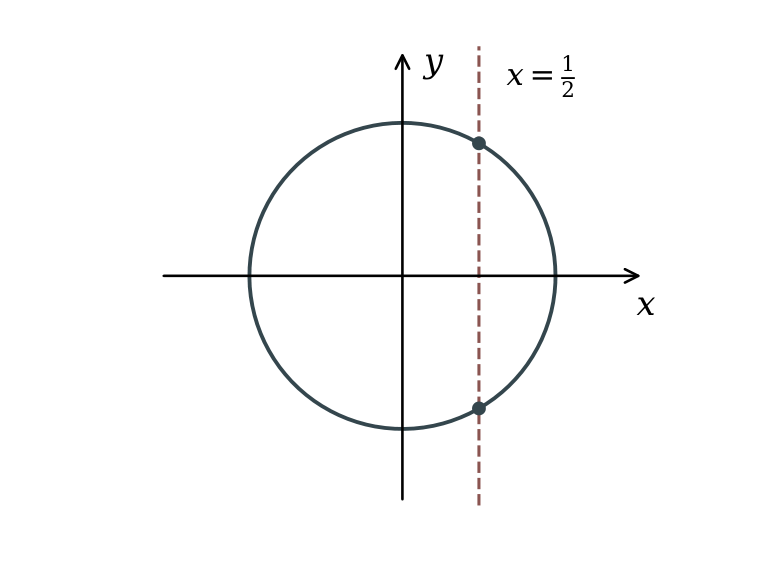
The circle \(x^2+y^2=1\) fails: the input \(x=\frac12\) gives two outputs. The whole circle is not the graph of a function \(y=f(x)\).
The horizontal line test
A function is one-to-one if no horizontal line intersects its graph more than once.
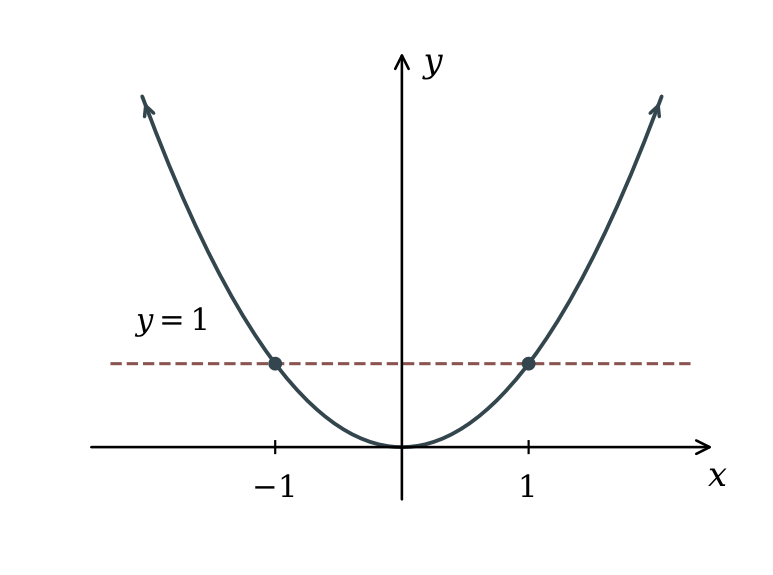
\(y=x^2\) passes the vertical test but fails the horizontal test: \(f(-1)=f(1)=1\). On \(\mathbb{R}\), it has no inverse function.
Worked example 10: deciding from a table
Question. The complete domain of \(f\) is \(\{-2,0,3\}\). The table gives its outputs. \[\begin{array}{c|rrr}x&-2&0&3\\\hline f(x)&5&1&7\end{array}\]
Does an inverse function exist? Explain your answer.
If it exists, find \(f^{-1}(7)\).
State the domain of \(f^{-1}\).
State the range of \(f^{-1}\).
Solution
(a) Yes. The outputs \(5,1,7\) are all different, so \(f\) is one-to-one.
(b) Since \(f(3)=7\), we have \(\boxed{f^{-1}(7)=3}\).
(c) The original outputs become inputs: \(\boxed{D_{f^{-1}}=\{1,5,7\}}\).
(d) The original inputs become outputs: \(\boxed{R_{f^{-1}}=\{-2,0,3\}}\).
Why a repeated output causes a problem
For \(f(x)=x^2\) on \(\mathbb{R}\), both \(-1\) and \(1\) produce the output \(1\). Reversing this would assign two outputs to the inverse’s input \(1\). That would not be a function.
Sketching an inverse from a given graph
Every point \((a,b)\) on \(y=f(x)\) becomes \((b,a)\) on \(y=f^{-1}(x)\). This reflects the whole graph in the line \(y=x\), not in either coordinate axis.
Worked example 11: build the inverse sketch in three stages
Question. Step 1 shows the complete graph of a one-to-one function \(f\), with three labelled points and included endpoints. No formula for \(f\) is given.
Sketch \(y=f^{-1}(x)\).
State the domain of \(f^{-1}\).
State the range of \(f^{-1}\).
Solution
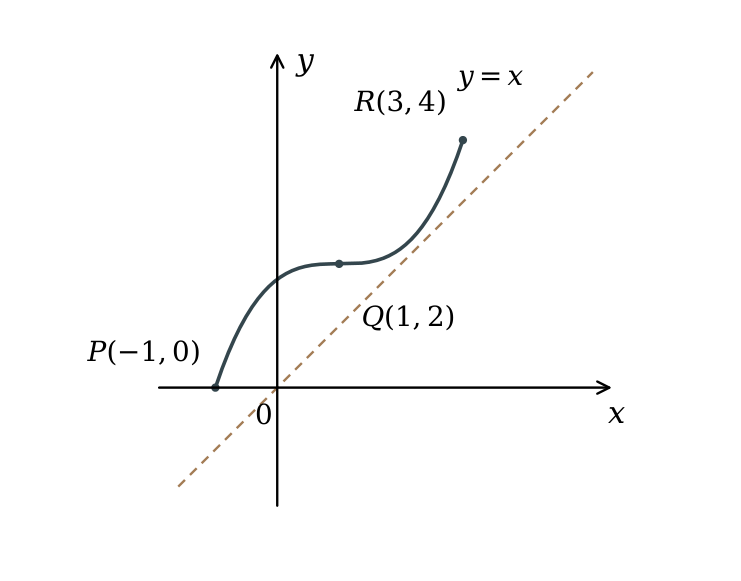
(a) Step 1: draw the mirror line.
Copy the given graph and draw the dashed line \(y=x\). Use the same scale on both axes so that this is a \(45^\circ\) line.
The given points are \(P(-1,0)\), \(Q(1,2)\) and \(R(3,4)\). The graph increases from \(P\) to \(R\), so \[D_f=[-1,3],\qquad R_f=[0,4].\]
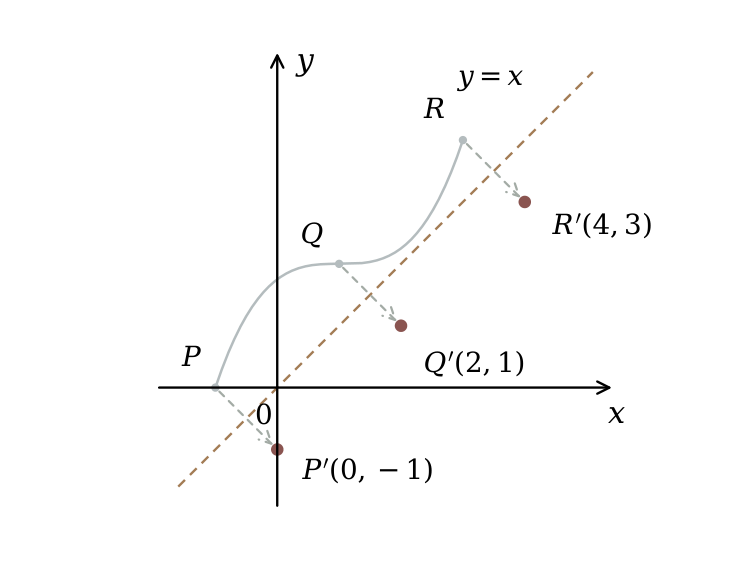
Step 2: swap each point’s coordinates.
Plot the corresponding points on the inverse: \[\begin{aligned} P(-1,0)&\longmapsto P'(0,-1),\\ Q(1,2)&\longmapsto Q'(2,1),\\ R(3,4)&\longmapsto R'(4,3). \end{aligned}\] Each pair of points lies at equal distances on opposite sides of \(y=x\).
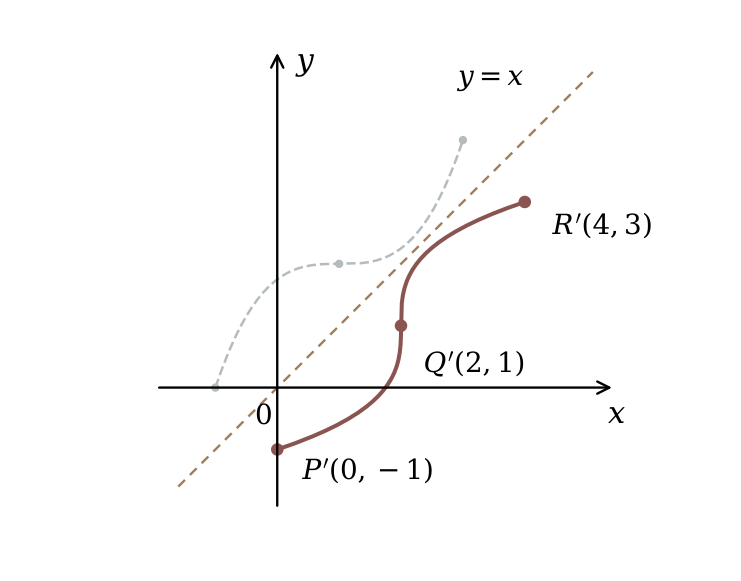
Step 3: reflect the rest of the curve.
Draw a smooth reflection through the new points, keeping the endpoints filled.
The brick curve is \(y=f^{-1}(x)\); the pale dashed curve is the original.
(b) Use the original range: \[\boxed{D_{f^{-1}}=[0,4]}.\] (c) Use the original domain: \[\boxed{R_{f^{-1}}=[-1,3]}.\]
Practice: notation, domains, ranges and models
Work on separate paper. Show the key steps in your reasoning. A calculator may be used to check your work.
Let \(f(x)=2x^2-3\).
Find \(f(-2)\).
Find and simplify \(f(a+1)\).
Find all inputs for which \(f(x)=15\).
Each relation has complete domain \(\{1,2,3\}\). For each, decide whether it is a function and, if so, whether it is one-to-one. Explain your answers.
\(\{(1,4),(2,4),(3,7)\}\).
\(\{(1,4),(1,5),(2,6),(3,7)\}\).
State the largest real domain of each function. Give a reason.
\(\displaystyle f(x)=\frac1{x+4}\).
\(g(x)=\sqrt{3-x}\).
\(\displaystyle h(x)=\frac{\sqrt{x+1}}{x-2}\).
Find the range of \(f(x)=x^2\) when its domain is:
\(\mathbb{R}\);
\([-2,3]\);
\((1,4]\).
Let \(g(x)=\sqrt{x+4}-2\).
State the domain.
State the range, explaining whether \(-2\) belongs to it.
A club charges a fixed fee of € 18 plus € 5 per session. A member can attend 0 to 12 sessions.
Write a function \(C(n)\) for the total cost.
State its domain and range.
Find \(C(7)\) and interpret the answer.
A member pays € 63. How many sessions does this represent?
A tank contains 72 litres and drains at 3 litres per minute.
Write a volume function \(V(t)\), where \(t\) is measured in minutes.
Give a sensible domain while the tank drains.
State the corresponding range.
Practice: inverse functions and graphs
Let \(f(x)=4x-7\), for \(x\in\mathbb{R}\).
Describe the two operations needed to undo \(f\).
Find \(f^{-1}(9)\).
Explain what your answer to part (b) tells you about the equation \(f(x)=9\).
State the domain and range of the inverse.
A one-to-one function \(g\) has domain \([-2,5]\), range \([1,8]\) and \(g(3)=7\).
Find \(g^{-1}(7)\).
State the domain of \(g^{-1}\).
State the range of \(g^{-1}\).
State the point on \(y=g^{-1}(x)\) corresponding to \((3,7)\) on \(y=g(x)\).
The table lists every input of \(h\) and its output. \[\begin{array}{c|rrrr}x&-1&0&2&4\\\hline h(x)&3&5&3&8\end{array}\]
State the domain and range of \(h\).
Explain why \(h\) is a function.
Does \(h\) have an inverse function on its range? Explain.
The complete graph of a one-to-one function \(p\) is shown. Both endpoints are included.
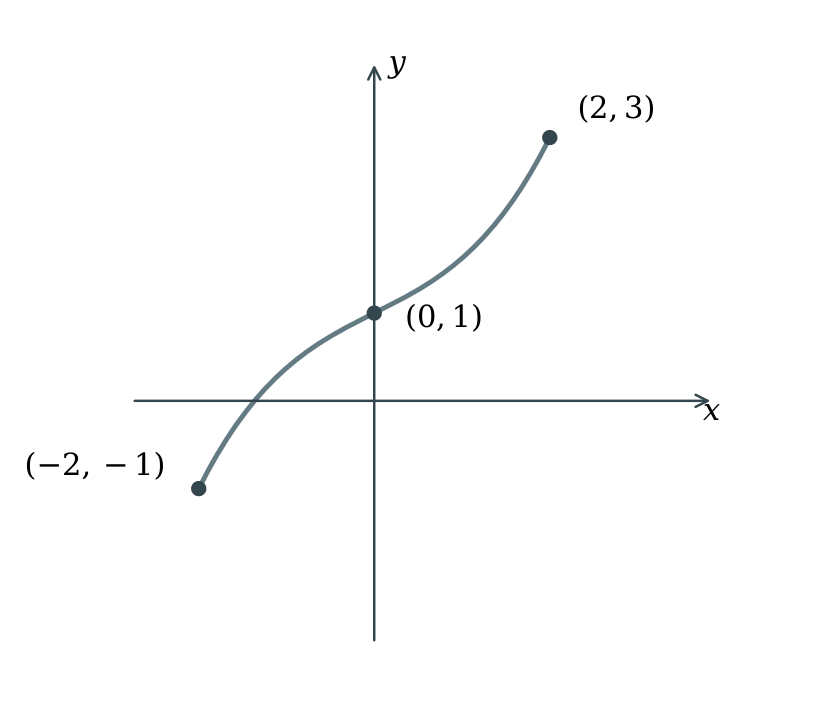
Find \(p(0)\) and solve \(p(x)=3\).
State the domain and range of \(p\).
Sketch \(y=p^{-1}(x)\), labelling the three corresponding points.
State the domain and range of \(p^{-1}\).
A quick self-check
Can you read a point as an (input, output) pair? Distinguish domain from range? Explain why an inverse needs a one-to-one function? Reflect a graph in \(y=x\) and swap its domain and range?
Answers: notation, domains, ranges and models
1–3. Notation, functions and domains
1. (a) \(f(-2)=2(-2)^2-3=2(4)-3=\boxed5\).
(b) \(f(a+1)=2(a+1)^2-3=2(a^2+2a+1)-3=\boxed{2a^2+4a-1}\).
(c) \(2x^2-3=15\Rightarrow2x^2=18\Rightarrow x^2=9\Rightarrow\boxed{x=\pm3}\).
2. (a) It is a function: every input has exactly one output. It is not one-to-one because inputs 1 and 2 both give 4. (b) It is not a function: input 1 has two different outputs.
3. (a) \(x+4\neq0\), so \(\boxed{D=\mathbb{R}\setminus\{-4\}}\).
(b) \(3-x\geq0\Rightarrow x\leq3\), so \(\boxed{D=(-\infty,3]}\).
(c) We need both \(x+1\geq0\) and \(x-2\neq0\). Thus \(x\geq-1\) but \(x\neq2\), giving \(\boxed{D=[-1,2)\cup(2,\infty)}\).
4–5. Ranges
4. (a) \(\boxed{[0,\infty)}\): squares are non-negative, 0 occurs at \(x=0\), and there is no upper bound.
(b) \(\boxed{[0,9]}\): the minimum is \(f(0)=0\). At the endpoints, \(f(-2)=4\) and \(f(3)=9\), so the maximum is 9.
(c) \(\boxed{(1,16]}\): squaring positive inputs preserves their order. The input 1 is excluded; the input 4 is included.
5. (a) \(x+4\geq0\Rightarrow\boxed{D=[-4,\infty)}\).
(b) Since \(\sqrt{x+4}\geq0\), we have \(g(x)\geq-2\). All these outputs occur, so \(\boxed{R=[-2,\infty)}\). The output \(-2\) is included because \(g(-4)=\sqrt0-2=-2\).
6–7. Mathematical models
6. (a) Fixed fee plus session charges gives \(\boxed{C(n)=18+5n}\).
(b) \(\boxed{D=\{0,1,\ldots,12\}}\) and \(\boxed{R=\{18,23,28,\ldots,78\}}\). The inputs and outputs are discrete.
(c) \(C(7)=18+5(7)=53\): seven sessions cost € 53 in total.
(d) \(18+5n=63\Rightarrow5n=45\Rightarrow\boxed{n=9}\) sessions.
7. (a) Initial volume minus volume drained gives \(\boxed{V(t)=72-3t}\) litres.
(b) The tank is empty when \(72-3t=0\Rightarrow t=24\). Therefore \(\boxed{0\leq t\leq24}\) minutes.
(c) The volume goes continuously from 72 litres to 0 litres: \(\boxed{0\leq V(t)\leq72}\) litres.
Answers: inverse functions and graphs
8–9. Reversing the input–output relationship
8. (a) Add 7, then divide by 4: undo the original operations in reverse order.
(b) \(9\to16\to4\), so \(\boxed{f^{-1}(9)=4}\).
(c) The input that gives output 9 is 4: \(f(4)=4(4)-7=9\). Hence the solution of \(f(x)=9\) is \(\boxed{x=4}\).
(d) The original function has domain and range \(\mathbb{R}\). Swapping them gives \(\boxed{D_{f^{-1}}=\mathbb{R}}\) and \(\boxed{R_{f^{-1}}=\mathbb{R}}\).
9. (a) Since \(g(3)=7\), \(\boxed{g^{-1}(7)=3}\).
(b) The original range becomes the inverse’s domain: \(\boxed{D_{g^{-1}}=[1,8]}\).
(c) The original domain becomes the inverse’s range: \(\boxed{R_{g^{-1}}=[-2,5]}\).
(d) \(\boxed{(7,3)}\): swap the coordinates, reflecting in \(y=x\).
10. Deciding whether an inverse exists
(a) \(\boxed{D_h=\{-1,0,2,4\}}\), \(\boxed{R_h=\{3,5,8\}}\). List each output only once in the range.
(b) Each allowed input has exactly one output, so \(h\) is a function.
(c) No. The output 3 occurs for two inputs, \(-1\) and 2. Reversing this would give two outputs for the inverse’s input 3. Thus \(h\) is not one-to-one and has no inverse function on its range.
11. Reading and reflecting a graph
(a) The point \((0,1)\) gives \(\boxed{p(0)=1}\). The output 3 occurs at \((2,3)\), so \(\boxed{x=2}\).
(b) Reading across and up the complete graph gives \(\boxed{D_p=[-2,2]}\) and \(\boxed{R_p=[-1,3]}\).
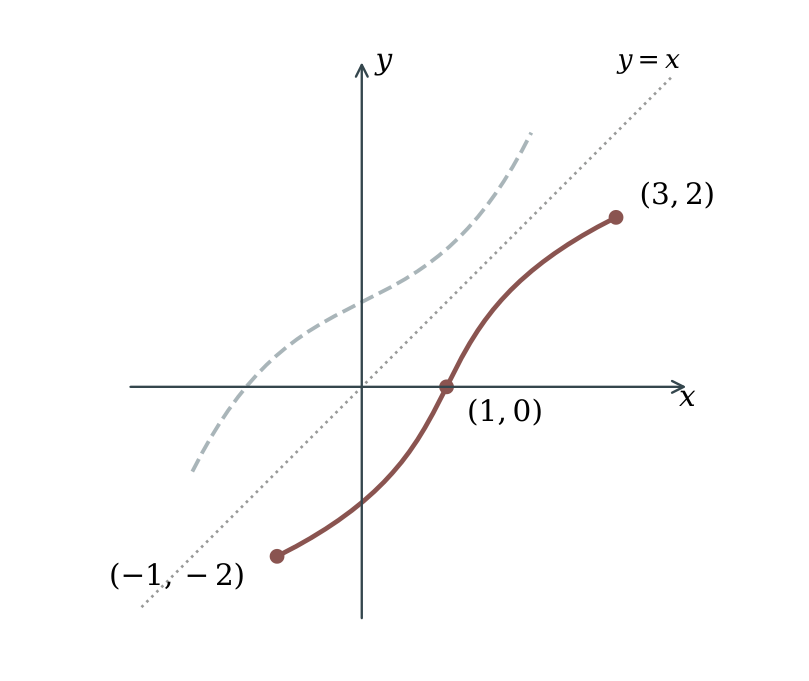
(c) Reflect in \(y=x\): \[\begin{aligned} (-2,-1)&\longmapsto(-1,-2),\\ (0,1)&\longmapsto(1,0),\\ (2,3)&\longmapsto(3,2). \end{aligned}\] The solid curve is the inverse; the pale dashed curve is the original. Keep both endpoints filled.
(d) \(\boxed{D_{p^{-1}}=[-1,3]}\) and \(\boxed{R_{p^{-1}}=[-2,2]}\).