IB Mathematics: Applications and Interpretation SL — Topic 5 Calculus
Anti-differentiation, Definite Integrals and Area
Reverse differentiation, use boundary conditions, evaluate definite integrals with technology and interpret area and accumulation.
Learning goal
Understand integration as the reverse of differentiation, use a boundary condition to find a particular function, use technology to evaluate definite integrals, and calculate the area under a curve when the function is positive.
Syllabus link
IB Mathematics AI SL: SL 5.5. Anti-differentiation; boundary conditions; definite integrals using technology; area enclosed by a positive curve and the x-axis.
Big idea
A derivative describes a rate of change. Integration rebuilds the original function or accumulates a total amount.
Key relationship
If \(F'(x)=f(x)\), then \(\int f(x)\,dx=F(x)+C\). For a positive curve, \(A=\int_a^b f(x)\,dx\).
Integration as anti-differentiation
If differentiation asks “What is the gradient function?”, integration asks “What function could have produced this derivative?”
Key notation
If \(F'(x)=f(x)\), then an anti-derivative of \(f\) is \(F\), and
The \(+C\) is essential because infinitely many functions can have the same derivative.
Power-rule habit
For each power of \(x\): increase the exponent by 1, then divide by the new exponent. This works for positive and negative integer powers, provided the original exponent is not \(-1\).
Worked example 1A: positive integer power
Find \(\int 5x^3\,dx\).
Solution
Check: \(\frac{d}{dx}(\frac54x^4)=5x^3\).
Worked example 1B: negative integer power
Find \(\int 4x^{-3}\,dx\).
Solution
Check: \(\frac{d}{dx}(-2x^{-2})=4x^{-3}\).
Worked example 1C: combining several terms
Find \(\int(6x^2-4x+5)\,dx\).
Solution
Make the hidden powers explicit: \(-4x=-4x^1\) and \(5=5x^0\). Integrate term by term:
Differentiating the result gives \(6x^2-4x+5\), confirming the anti-derivative.
Common trap
Every indefinite integral needs \(+C\). For example, \(\int(6x-4)\,dx=3x^2-4x+C\), not just \(3x^2-4x\).
Using a boundary condition
A derivative determines a family of functions. A point or other boundary condition allows us to determine the constant \(C\).
Boundary-condition routine
- Anti-differentiate to obtain a general function containing \(C\).
- Substitute the given point or value.
- Solve for \(C\), then write the particular function.
Worked example 2: using a boundary condition
Given \(\frac{dy}{dx}=3x^2+x\) and \(y=10\) when \(x=1\), find \(y\) in terms of \(x\).
Solution
First anti-differentiate:
Now use the boundary condition:
so \(C=8.5\). Therefore
Definite integrals using technology
A definite integral accumulates a total amount over an interval. In AI SL 5.5, you should be able to write the correct definite integral and then use technology to evaluate it.
Meaning of the notation
means that values of \(f(x)\) are accumulated from \(x=a\) to \(x=b\). In context this may represent area, total change, distance, volume, money or another accumulated quantity.
Calculator habit
Before pressing buttons, identify the integrand, variable, lower limit, upper limit, and the meaning of the answer.
TI-Nspire CX tutorial: definite integrals
The finalized handout links this tutorial for the first calculator workflow. It shows how to enter a definite integral using the TI-Nspire CX Scratchpad.
TI-Nspire CX walkthrough: entering a definite integral
The handout demonstrates \(\int_1^5(3x^2+4)\,dx\) in six calculator steps.
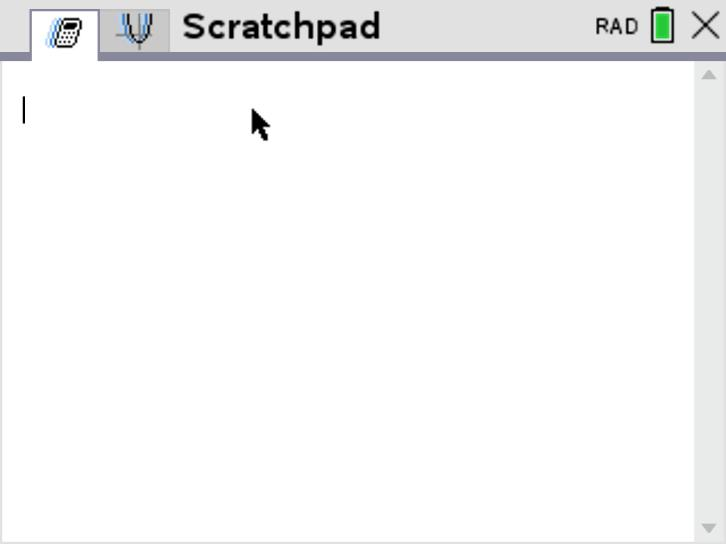
1. Start with a clear Scratchpad.
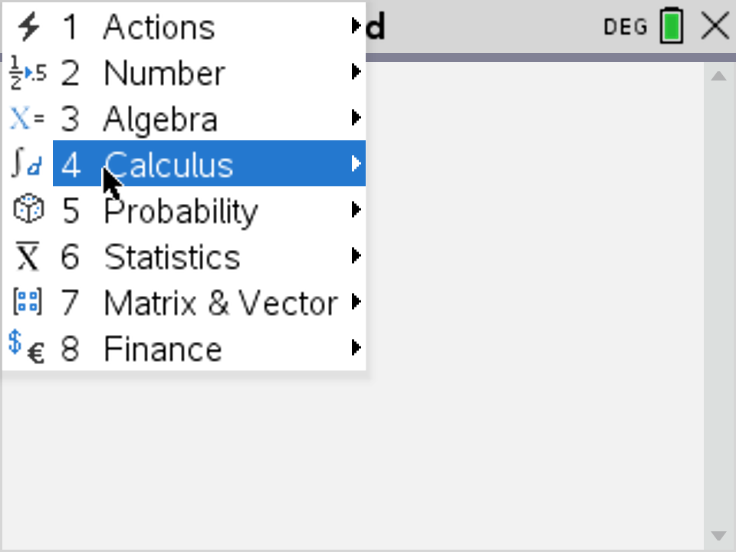
2. Open Menu and choose Calculus.
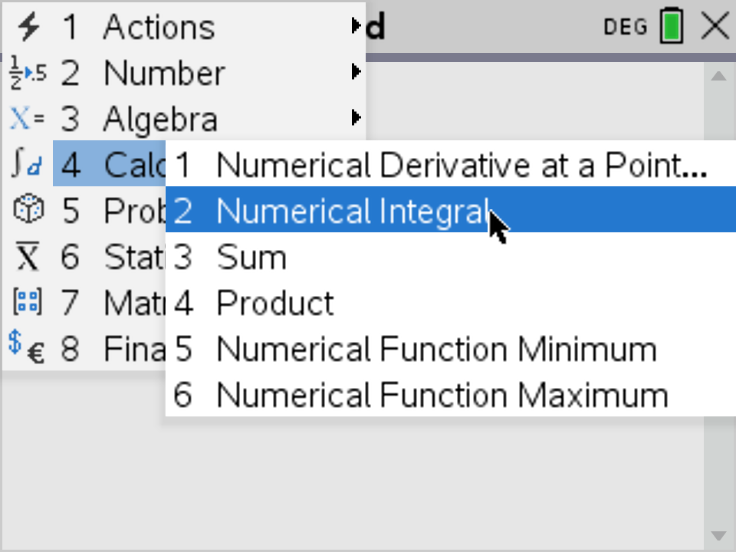
3. Choose Numerical Integral.
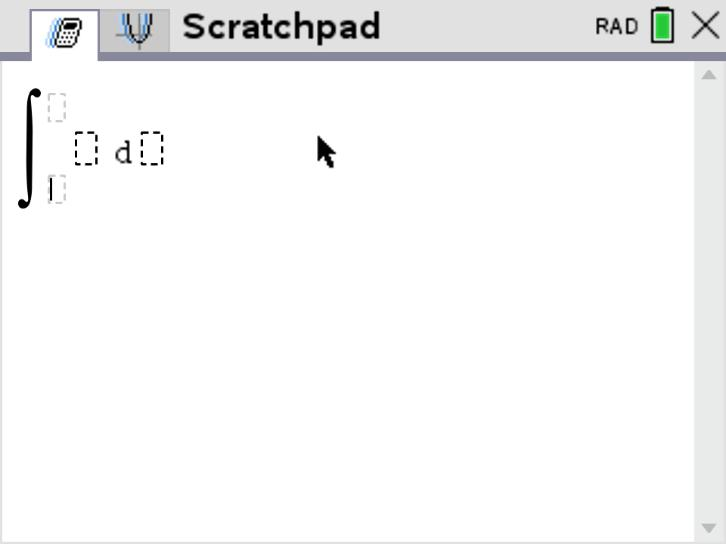
4. The integral template appears.
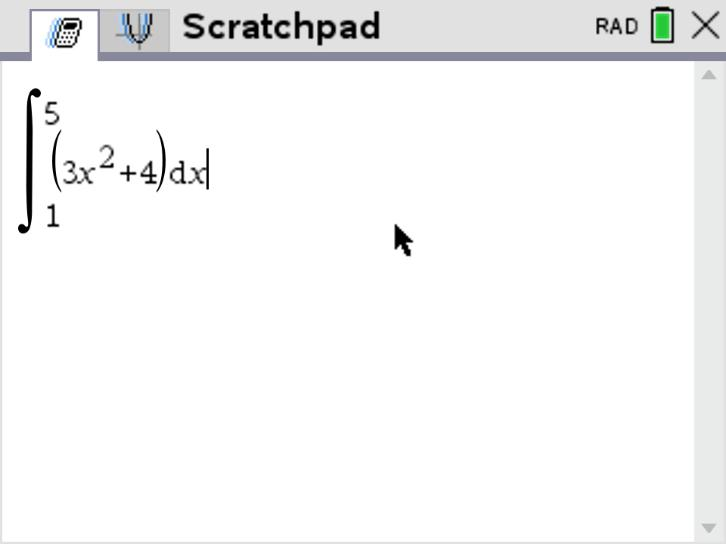
5. Enter limits, integrand and variable.
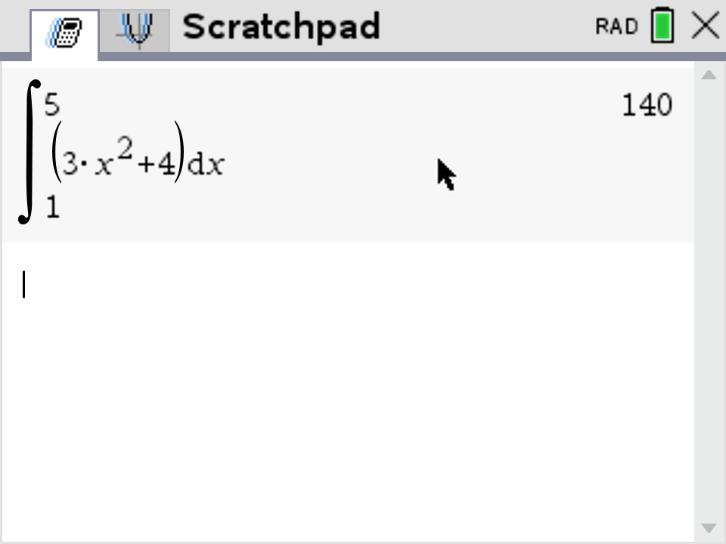
6. Press Enter: the result is \(140\).
Worked example 3: evaluating a definite integral on the GDC
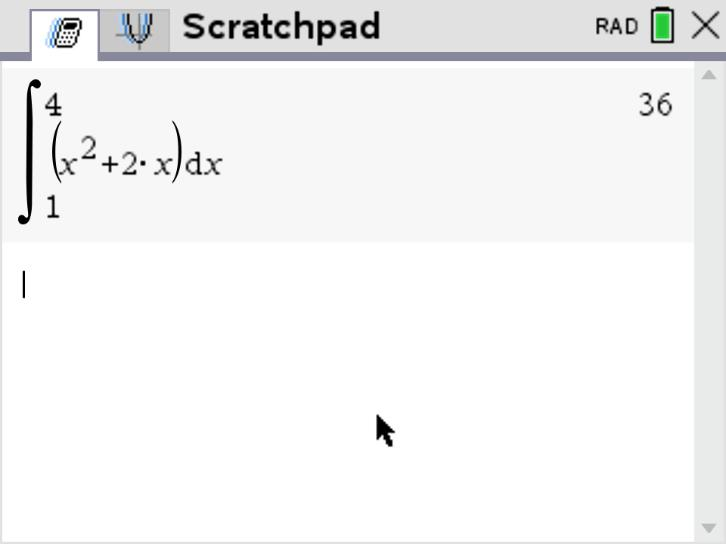
Use technology to evaluate \(\int_1^4(x^2+2x)\,dx\).
Solution
First write the correct expression, then enter the integrand \(x^2+2x\), the variable \(x\), and the limits 1 and 4.
Answer The accumulated total over \([1,4]\) is 36 units.
Area under a positive curve
When the curve lies above the x-axis on the whole interval, the definite integral directly gives the geometrical area.
Important AI SL condition
At AI SL 5.5, this area formula is used when the curve stays above the x-axis. Questions involving sign changes and total geometrical area require additional ideas developed elsewhere.
TI-Nspire CX tutorial: area under a curve
The handout places this tutorial before the first area example. It demonstrates the graphical calculator method for finding the area between a positive curve and the x-axis.
Worked example 4: area enclosed by a parabola and the x-axis
Find the area enclosed by \(y=2x-x^2\) and the x-axis.
Solution
First find the intercepts:
On \(0\le x\le2\), the curve is above the axis, so
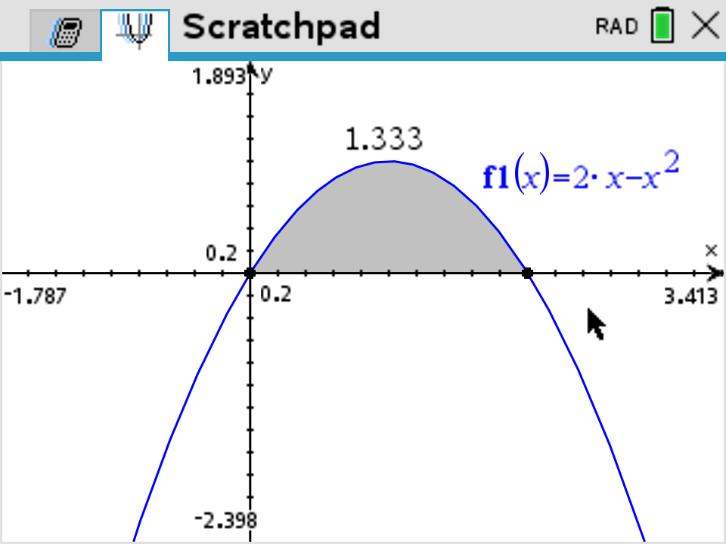
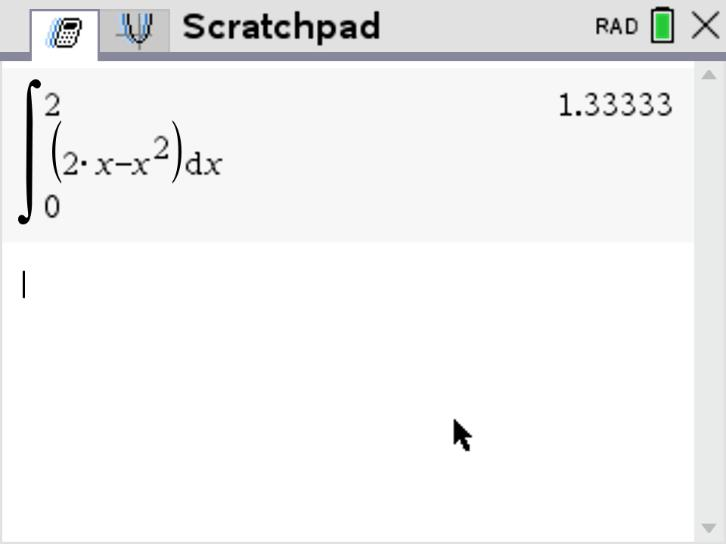
Answer Approximately \(1.333\) square units.
Worked example 5: area over a stated interval
Find the area between \(y=3x+4\) and the x-axis from \(x=2\) to \(x=4\).
Solution
Since \(3x+4>0\) on \([2,4]\),
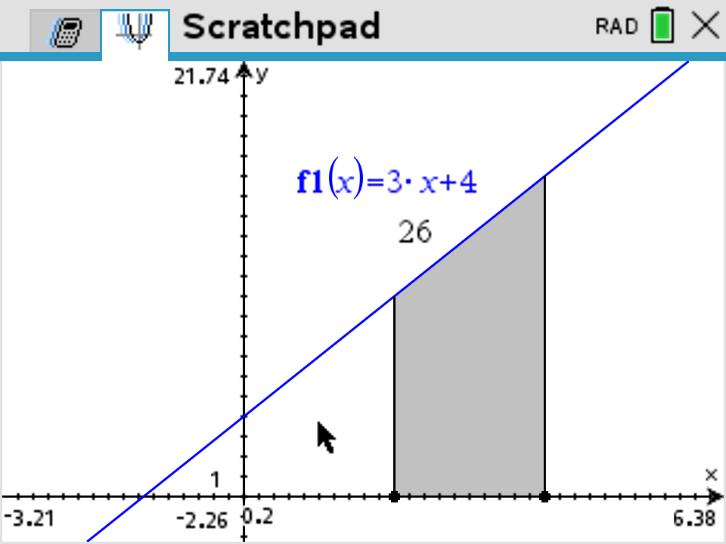
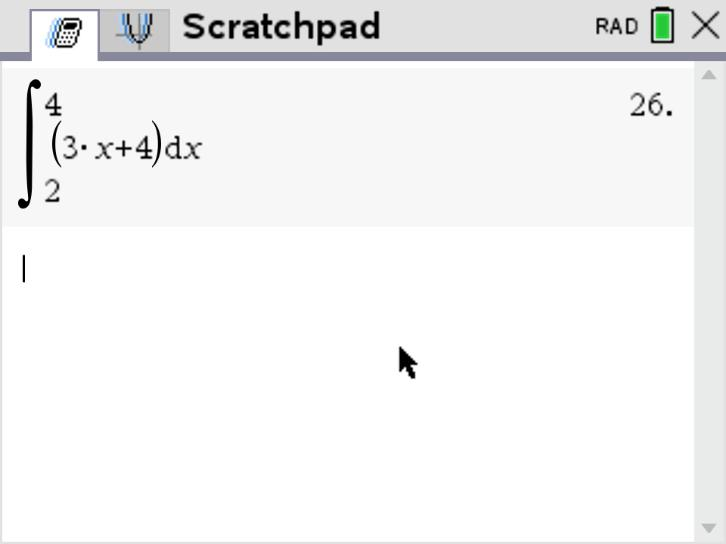
Answer \(26\) square units.
Interpreting a definite integral in context
The shaded region on a graph is geometrical, but the units and meaning of a definite integral depend on the quantities shown on the axes.
Units of an accumulated quantity
Multiply the horizontal-axis units by the vertical-axis units.
| Context | Horizontal units | Vertical units | Integral meaning |
|---|---|---|---|
| Geometrical region | m | m | \(\mathrm{m^2}\): physical area |
| Earning rate | h | €/h | €: total earnings |
| Speed-time graph | h | km/h | km: distance when speed is non-negative |
| Flow rate | min | L/min | L: total volume |
Interpret the units, not just the picture
Do not automatically write “square units”. Determine the product of the axis units and then explain what that accumulated quantity means.
Worked example 6: interpreting an integral in context
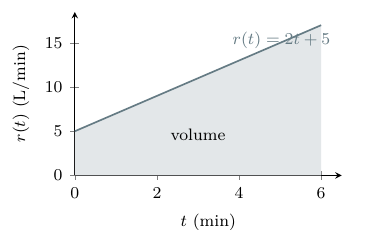
Water enters a tank at \(r(t)=2t+5\) litres per minute for \(0\le t\le6\). Find the total volume entering the tank during the first 6 minutes.
Solution
The units are \((\mathrm{L/min})(\mathrm{min})=\mathrm L\).
Answer The total volume is 66 litres.
Putting the ideas together
Many AI SL questions link the ideas in this order:
Worked example 7: from a derivative to an area
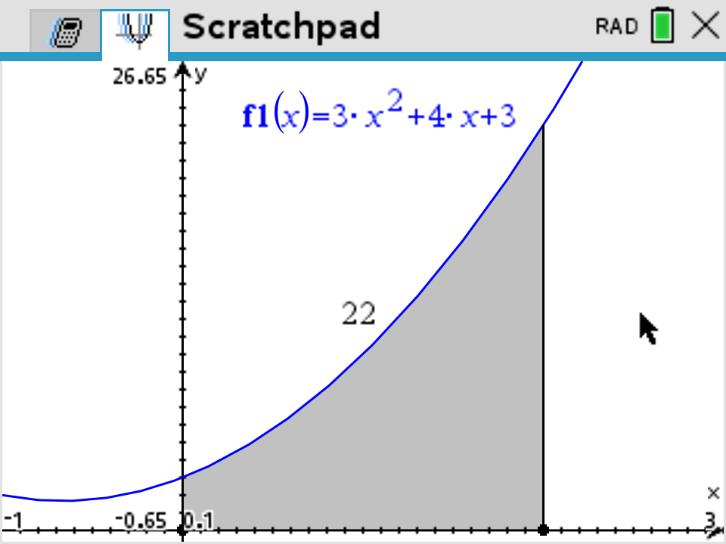
Given \(f'(x)=6x+4\) and \(f(0)=3\), find \(f(x)\), then find the area between \(y=f(x)\) and the x-axis from \(x=0\) to \(x=2\).
Solution
Anti-differentiate:
Using \(f(0)=3\) gives \(C=3\), so \(f(x)=3x^2+4x+3\). This is positive on \([0,2]\), hence
Answer \(f(x)=3x^2+4x+3\) and \(A=22\) square units.
Practice questions
Questions 1–4: anti-differentiation and definite integrals
- Find \(\int(8x^3-6x+5)\,dx\).
- Given \(\frac{dy}{dx}=4x-3\) and \(y=7\) when \(x=2\), find \(y\) in terms of \(x\).
- Given \(f'(x)=12x^2-2x\) and \(f(1)=5\), find \(f(x)\).
- Use technology to evaluate \(\int_0^5(3x+4)\,dx\).
Questions 5–9: area and interpretation
- Find the area enclosed by \(y=-x^2+6x\) and the x-axis.
- Given \(f'(x)=2x+1\) and \(f(0)=2\), find \(f(x)\), then find the area between \(y=f(x)\) and the x-axis from \(x=0\) to \(x=3\).
- Water flows into a tank at \(q(t)=3t+8\) litres per minute for \(0\le t\le5\). Write and evaluate a definite integral for the total volume. State the units.
- A particle has velocity \(v(t)=t^2+2t+3\) for \(0\le t\le4\). Write a definite integral for its displacement and use technology to find the value.
- IB-style. \(\frac{dy}{dx}=12-2x\), and the curve passes through \((0,5)\).
(a) Find \(y\) in terms of \(x\).
(b) Write a definite integral for the area between the curve and the x-axis from \(0\) to \(2\).
(c) Use technology to find the area.
Answer key
Answers 1–4
- \(\int(8x^3-6x+5)\,dx=2x^4-3x^2+5x+C\).
- \(y=2x^2-3x+C\). Using \(y(2)=7\) gives \(C=5\), so \(\boxed{y=2x^2-3x+5}\).
- \(f(x)=4x^3-x^2+C\). Since \(f(1)=5\), \(C=2\), so \(\boxed{f(x)=4x^3-x^2+2}\).
- \(\int_0^5(3x+4)\,dx=57.5\).
Answers 5–9
- The intercepts are 0 and 6, and the curve is positive between them: \(A=\int_0^6(-x^2+6x)\,dx=36\) square units.
- \(f(x)=x^2+x+2\). Then \(A=\int_0^3(x^2+x+2)\,dx=16.5\).
- \(\int_0^5(3t+8)\,dt=77.5\). Units: litres.
- \(\int_0^4(t^2+2t+3)\,dt\approx45.333\).
- (a) \(y=12x-x^2+5\). (b) \(A=\int_0^2(12x-x^2+5)\,dx\). (c) \(A\approx28.667\).
Summary checklist
AI SL 5.5 checklist
- If you see a derivative and want the original function, anti-differentiate.
- For an indefinite integral, include \(+C\).
- Use a point or value as a boundary condition to determine \(C\).
- For a definite integral, write the integrand, variable and limits correctly before using the GDC.
- Use technology to evaluate definite integrals in AI SL.
- If the curve stays above the x-axis, area is \(\int_a^b f(x)\,dx\).
- In context, interpret the integral as an accumulated quantity instead of automatically writing “square units”.
- State the interval and contextual units clearly.
The finalized printable handout/book for this lesson is a paid Radford Mathematics product and is not offered as a free website download.
Visit the Radford Mathematics Store →