IB Mathematics: Applications and Interpretation SL — Topic 5 Calculus
Stationary Points
Find stationary points, classify local maxima and minima using \(f'(x)\), and distinguish local extrema from greatest and least values on a domain.
Learning goal
Find stationary points, use the sign of \(f'\) to classify local maxima and minima, and distinguish local extrema from the greatest or least value on a stated domain.
Syllabus link
IB Mathematics AI SL: SL 5.6. Values of \(x\) where the gradient is zero; solving \(f'(x)=0\); local maximum and minimum points; technology to generate and solve with \(f'(x)\).
Big idea
A stationary point occurs where the tangent is horizontal, so the gradient is zero. The graph and sign of \(f'\) tell us what the original function is doing nearby.
Core condition
If \(x=a\) is stationary, then \(f'(a)=0\). The point on the curve is \((a,f(a))\).
Stationary points, local extrema and greatest/least values
At the top of a smooth hill or the bottom of a smooth valley, the tangent is horizontal. A horizontal line has gradient \(0\).
Stationary point
A stationary point on \(y=f(x)\) occurs at \(x=a\) when \(f'(a)=0\). Solving \(f'(x)=0\) finds its \(x\)-coordinate; substitute into \(f\) to find the full point \((a,f(a))\).
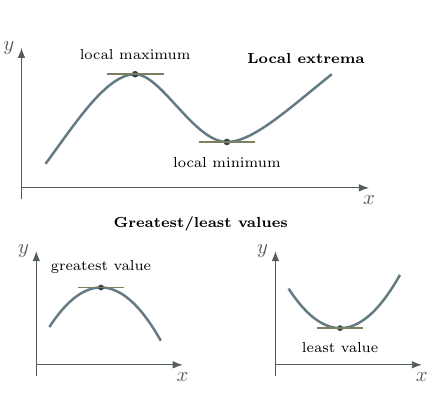
Local is not the same as global
A local maximum or minimum only compares values nearby. The greatest or least value on a closed domain may occur at an endpoint rather than at a stationary point.
The four-step method
Four-step method
- Graph \(f\). Use the stated domain and choose a sensible viewing window.
- Find or generate \(f'(x)\). Differentiate by hand when the function is within the algebra you know; otherwise generate the derivative with the GDC.
- Solve \(f'(x)=0\). Use algebra or the zero/root command on the graph of \(f'\). Keep only solutions in the stated domain.
- Return to \(f\). Find the corresponding \(y\)-values and classify the stationary points. For a greatest/least value on a closed domain, compare the endpoints too.
TI-Nspire CX: plot \(y=f'(x)\) and solve \(f'(x)=0\)
This tutorial shows how to generate the derivative curve, solve \(f'(x)=0\), evaluate \(f'(x)\) at chosen values and use the derivative graph to classify stationary points.
Why use the derivative route?
The GDC Maximum and Minimum tools can be useful, but SL 5.6 specifically develops the link with \(f'(x)=0\), and the sign of \(f'\) explains why a stationary point is a maximum or minimum.
Worked example: a polynomial
Worked example 1
For \(f(x)=x^3-6x^2+9x+1\), find and classify all stationary points.
Solution
Differentiate:
Stationary points occur where \(f'(x)=0\), so
Return to the original function:
Now inspect the sign of \(f'\): it is positive before \(1\), negative between \(1\) and \(3\), and positive after \(3\).
increasing
\(f'=0\)
decreasing
\(f'=0\)
increasing
Answer \((1,5)\) is a local maximum and \((3,1)\) is a local minimum.
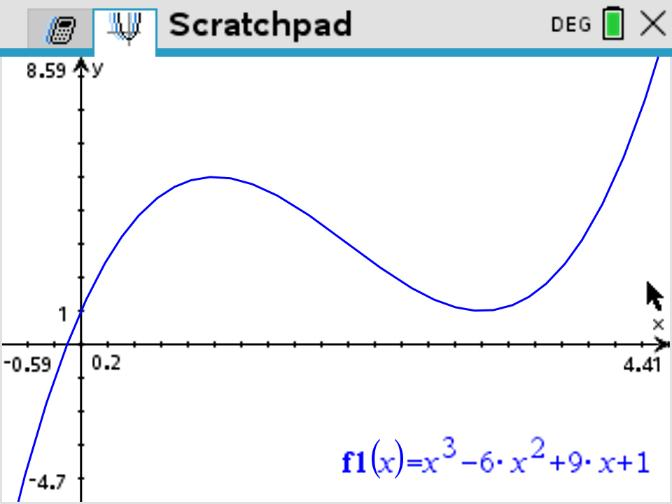
1. Graph \(f(x)\).
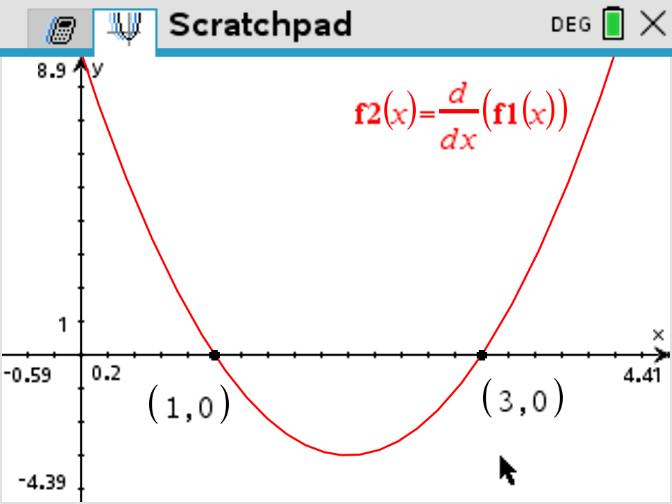
2. Solve \(f'(x)=0\).
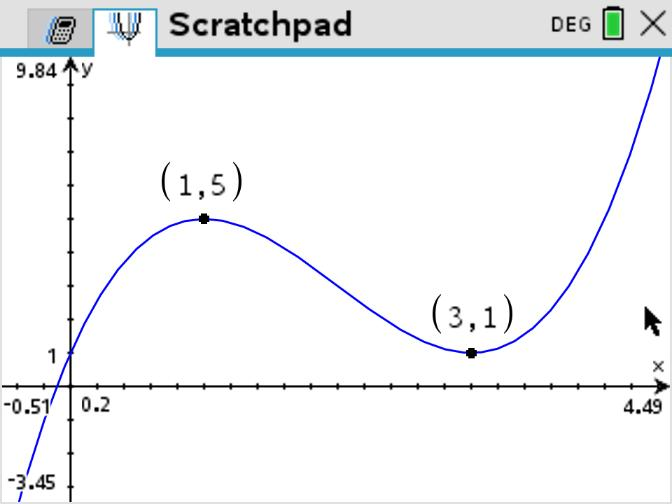
3. Return to \(f\) for coordinates and classification.
Classifying from the sign of \(f'\)
Sign-change test
- \(f'\) changes from \(+\) to \(-\): local maximum.
- \(f'\) changes from \(-\) to \(+\): local minimum.
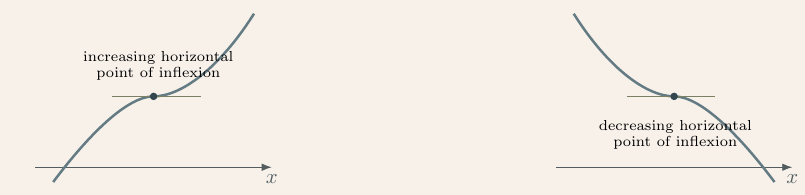
- \(f'\) has the same sign on both sides: the stationary point is neither a local maximum nor a local minimum.
Justify, do not just label
If the question asks you to classify a stationary point, state the sign change of \(f'\) and what that means for \(f\): increasing then decreasing, or decreasing then increasing.
Worked example: technology is essential
Worked example 2
Let \(P(t)=20e^{-0.2t}+t\), for \(0\le t\le15\). Find and classify the stationary point.
Solution
This function is beyond the simple polynomial differentiation expected earlier in AI SL, so generate \(P'(t)\) using technology and solve \(P'(t)=0\).
The GDC gives
Evaluate the original function:
The derivative changes from negative to positive, so \(P\) changes from decreasing to increasing.
Answer The stationary point is approximately \((6.931,11.931)\), and it is a local minimum.
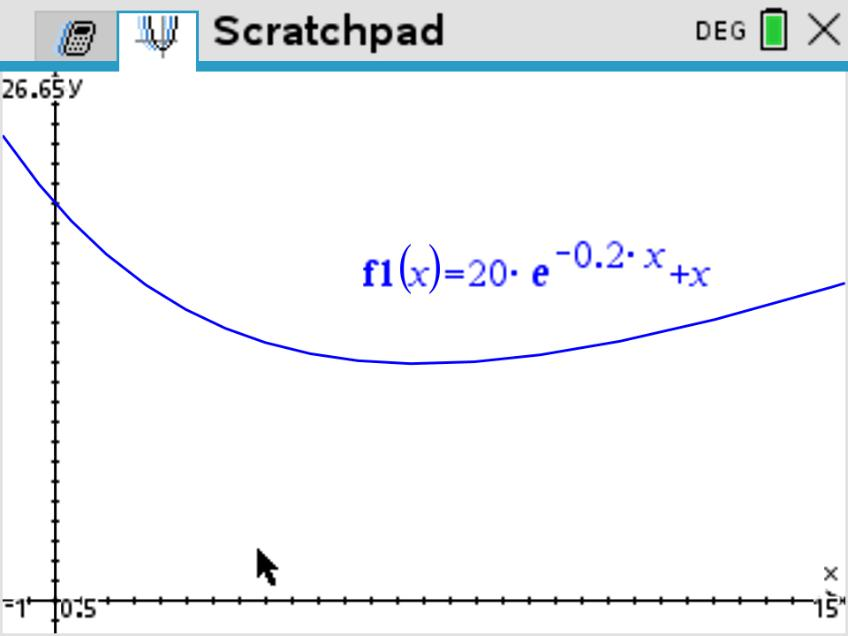
Graph the original function.
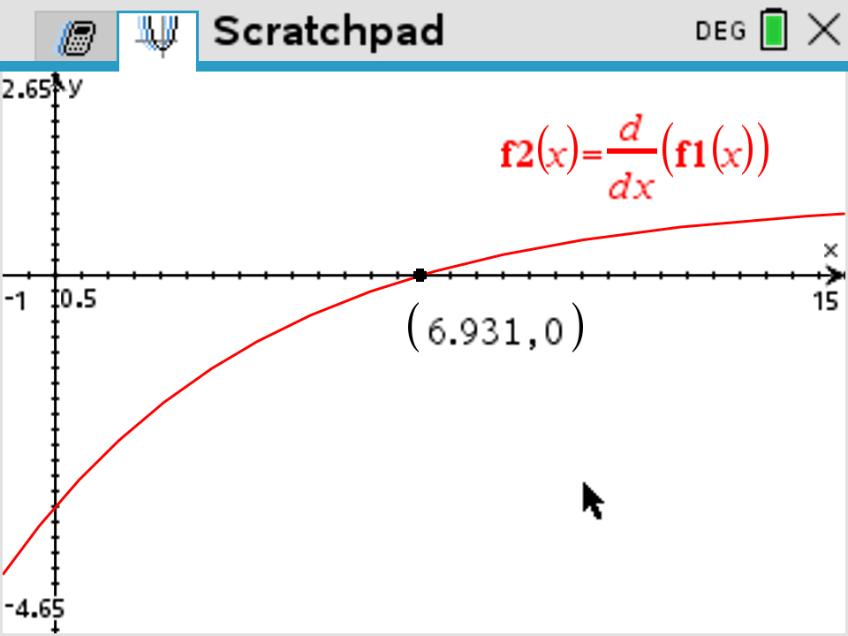
Find the root of \(P'(t)\).
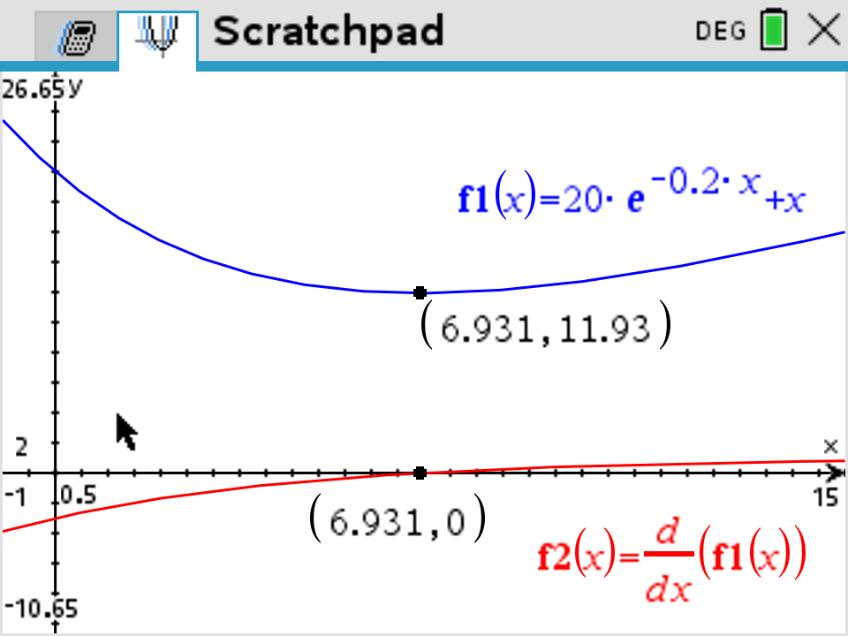
Read the point on \(P(t)\).
Local extrema versus greatest and least values
Worked example 3: a restricted domain
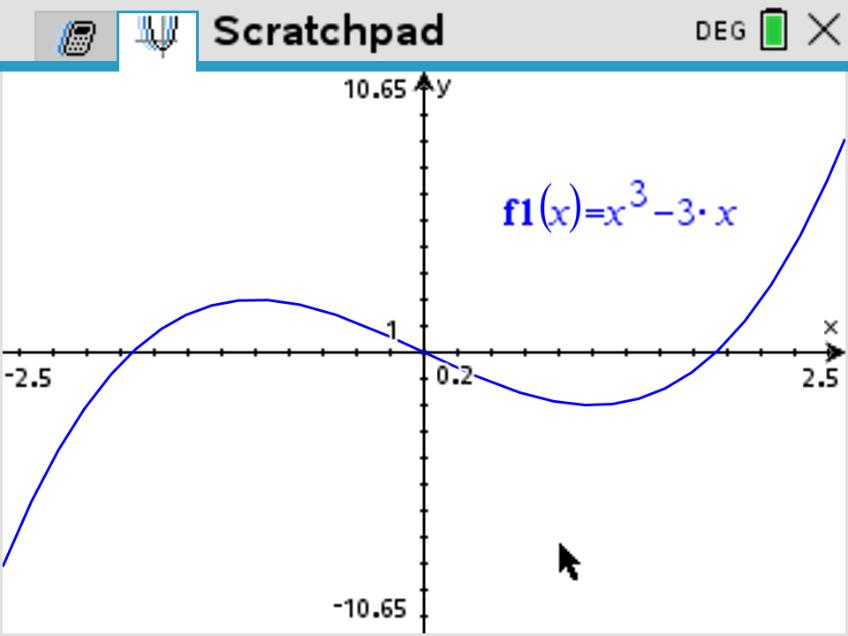
For \(g(x)=x^3-3x\) on \(-2.5\le x\le2.5\), find the local extrema and the greatest and least values on the domain.
Solution
Differentiate:
So the stationary \(x\)-values are \(-1\) and \(1\). Then
The sign of \(g'\) gives a local maximum at \((-1,2)\) and a local minimum at \((1,-2)\).
For global extrema on a closed interval, we must also check the endpoints:
Answer Greatest value \(8.125\) at \(x=2.5\); least value \(-8.125\) at \(x=-2.5\).
Interpreting stationary points in context
Worked example 4: profit model
A profit index, measured in hundreds of euros, is modelled by
Use technology to find and interpret the relevant stationary point.
Solution
Generate \(P'(x)\) and solve \(P'(x)=0\). The GDC gives \(x\approx11.49\).
Evaluate the original function: \(P(11.49)\approx66.032\). The derivative changes from positive to negative, so this is a local maximum.
Interpretation The model predicts a maximum profit of approximately \(66.032\times100\approx€6603\) when \(x\approx11.49\).
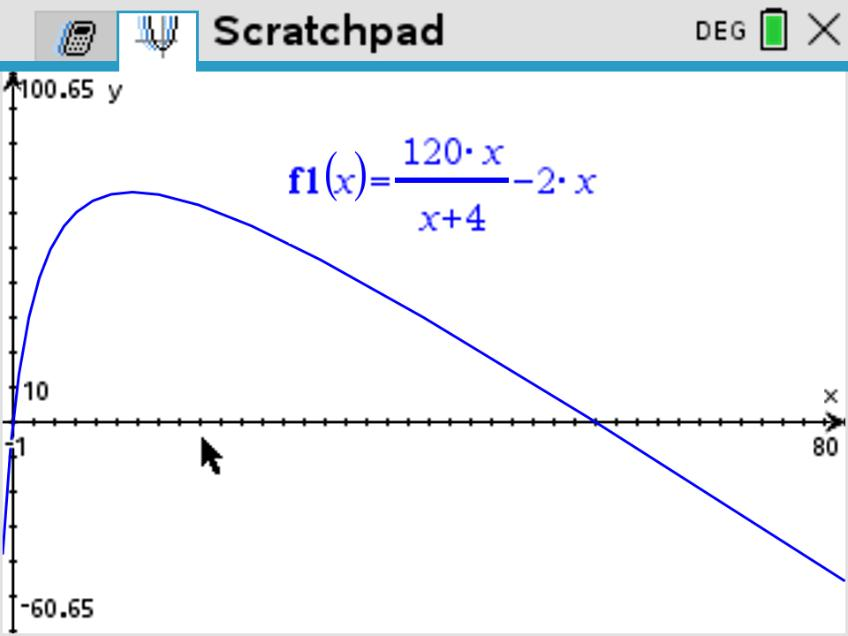
Graph the model.
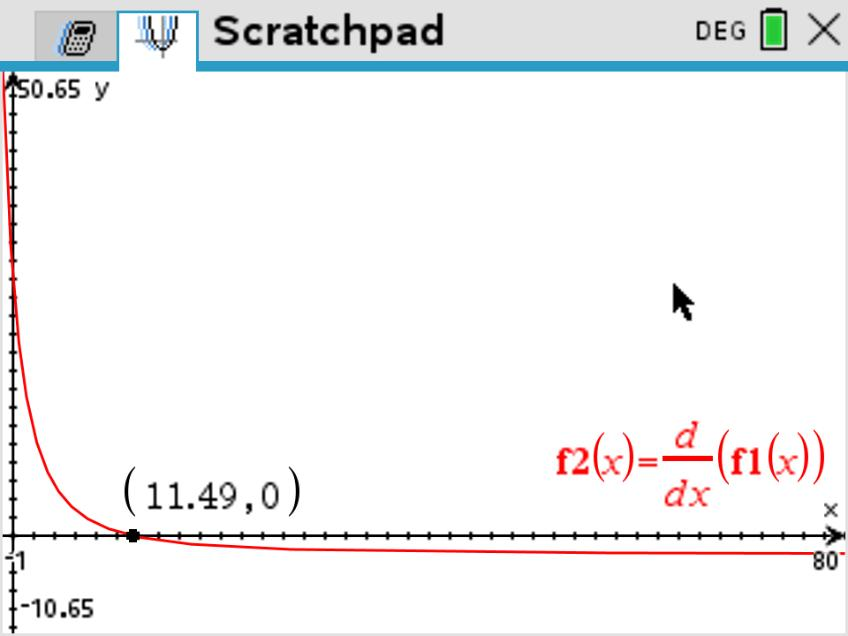
Solve \(P'(x)=0\).
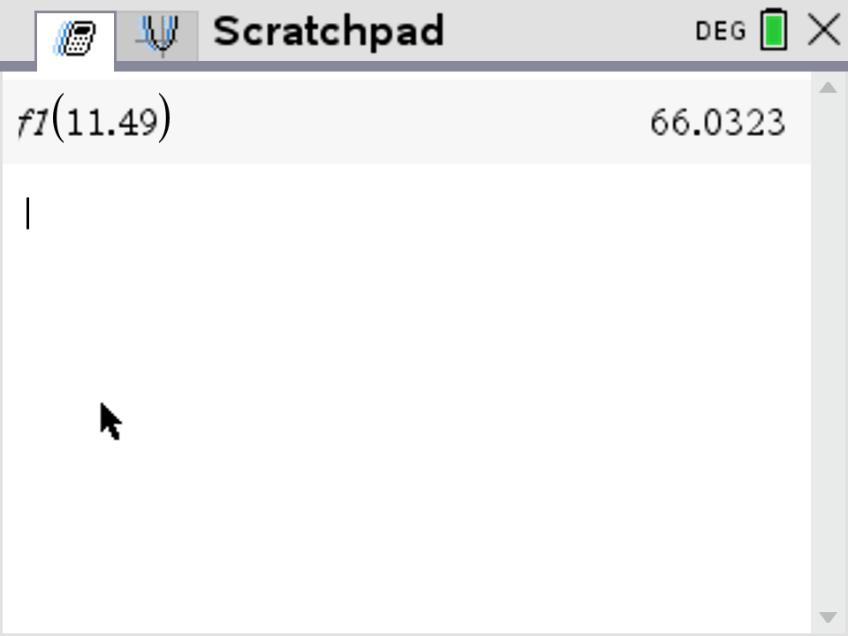
Evaluate and interpret \(P(x)\).
Common mistakes and exam wording
Common mistakes
- Giving only the \(x\)-value when the question asks for the stationary point.
- Assuming every root of \(f'\) is automatically a maximum or minimum.
- Ignoring the stated domain.
- Giving a classification without a derivative sign-change justification.
- When trigonometric functions are involved in this AI SL workflow, checking that the GDC is in DEGREE mode, as specified in the source handout.
- Reporting only a calculator result instead of showing the mathematical condition \(f'(x)=0\).
Useful exam language
“Solving \(f'(x)=0\) gives \(x=\cdots\). Since \(f'\) changes from positive to negative, \(f\) changes from increasing to decreasing; therefore the point is a local maximum.”
Practice
Core practice
- For \(f(x)=x^2-6x+5\), find \(f'(x)\), solve \(f'(x)=0\), find the stationary point and classify it.
- For \(g(x)=-x^2+4x+1\), find the stationary point and classify it.
- For \(h(x)=x^3-3x^2-9x+5\), find \(h'(x)\), solve \(h'(x)=0\), find the stationary points and classify them using a sign chart.
- The graph of \(f'\) has zeros at \(x=-2\) and \(x=1\). It is positive for \(x<-2\), negative for \(-2<x<1\), and positive for \(x>1\). State the stationary \(x\)-values, intervals where \(f\) increases/decreases, and classify both points.
- Use technology for \(q(x)=30e^{-0.15x}+0.8x\), \(0\le x\le20\). Find the stationary point to 3 d.p. and classify it.
- Use technology for \(S(t)=50-25e^{-0.25t}-0.8t\), \(0\le t\le16\). Find the stationary point to 3 s.f. and classify it.
Domain, context and enrichment
- For \(p(x)=2x^3-9x^2+12x+1\) on \([0,3.5]\), find the local extrema and then the greatest and least values on the domain. Explain why endpoints must be tested.
- For \(C(x)=2x+\dfrac{200}{x+5}\), \(0\le x\le50\), use the GDC derivative route to find and interpret the stationary point.
- For \(A(w)=120w-3w^2+0.02w^3\), \(0\le w\le70\), differentiate by hand, solve \(A'(w)=0\), classify all stationary points in the domain, and find the greatest value including endpoints.
- Enrichment. A function \(r\) satisfies \(r'(0)=0\), is increasing just before and just after \(x=0\), and changes concavity at \(x=0\). Explain why the point is stationary but neither a local maximum nor a local minimum.
Answer key
Answers 1–6
- \(f'(x)=2x-6\). Stationary point \((3,-4)\), local minimum.
- \(g'(x)=-2x+4\). Stationary point \((2,5)\), local maximum.
- \(h'(x)=3(x+1)(x-3)\). \((-1,10)\) is a local maximum; \((3,-22)\) is a local minimum.
- \(f\) increases on \((-\infty,-2)\) and \((1,\infty)\), decreases on \((-2,1)\). \(x=-2\) is a local maximum; \(x=1\) is a local minimum.
- Approximately \((11.515,14.545)\), local minimum.
- \(t\approx8.223\), \(S\approx40.222\); to 3 s.f. \((8.22,40.2)\), local maximum.
Answers 7–10
- \(p'(x)=6(x-1)(x-2)\). Local maximum \((1,6)\); local minimum \((2,5)\). \(p(0)=1\), \(p(3.5)=18.5\). Greatest value \(18.5\) at \(x=3.5\); least value \(1\) at \(x=0\).
- Stationary at \(x=5\), where \(C=30\). It is a local minimum, so the cost index is minimized at \(x=5\).
- \(A'(w)=120-6w+0.06w^2\). Roots are approximately \(27.639\) and \(72.361\), so only \(27.639\) lies in the domain. Local maximum \(A\approx1447.21\). Since \(A(0)=0\) and \(A(70)=560\), the greatest value is about \(1447\) at \(w\approx27.6\).
- The derivative is zero, but its sign does not change: the function remains increasing. With the concavity change, the point is a horizontal point of inflexion.
Summary checklist
AI SL 5.6 checklist
- Stationary points satisfy \(f'(x)=0\).
- Use the original function \(f\) to obtain the \(y\)-coordinate.
- Use the sign of \(f'\) to classify local maxima and minima.
- Keep only values in the stated domain.
- For greatest/least values on a closed domain, compare stationary points and endpoints.
- In context, interpret both coordinates and units.