IB Mathematics: Analysis and Approaches SL/HL — Topic 5 Calculus
Areas Using Definite Integrals
From signed area to total geometrical area, area to the x-axis, and area between two curves.
Learning goal
Interpret a definite integral as signed area and calculate total geometrical area by splitting appropriately at roots, intersections or changes of upper curve.
Syllabus link
SL 5.11 Definite integrals, signed area and area between curves.
Big idea
The definite integral is signed. Geometric area is always non-negative, so sign changes and changes of upper curve require splitting.
Key formula
\(\displaystyle A=\int_a^b|f(x)|dx\), and between curves \(\displaystyle A=\int_a^b(\text{upper}-\text{lower})dx\).
Areas Using Definite Integrals — Signed Area
Use the full Radford Mathematics lesson to review the handout. Pause after each example, try the next line yourself, then check the solution.
Interpreting a definite integral as signed area
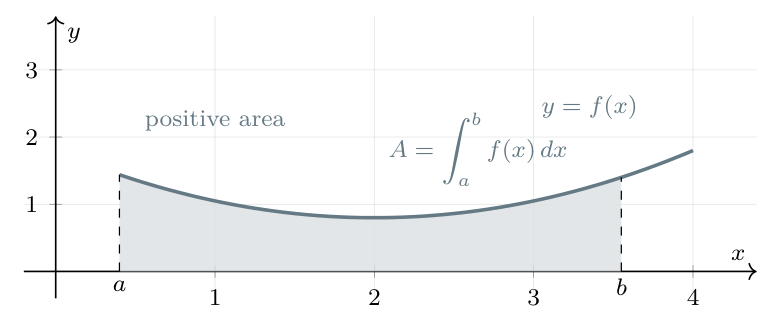
Following what we saw in Part 1, a definite integral accumulates values of a function over an interval. Graphically, it represents a signed area: contributions above the \(x\)-axis are positive and contributions below the \(x\)-axis are negative.
Signed-area interpretation
For a continuous function \(f\) on \([a,b]\),
is the sum of the signed areas between the graph of \(y=f(x)\) and the \(x\)-axis from \(x=a\) to \(x=b\). If the graph stays above the \(x\)-axis, this signed area is positive and matches the ordinary area for that special case.
Worked example: positive signed area
Worked example 1: a definite integral as signed area
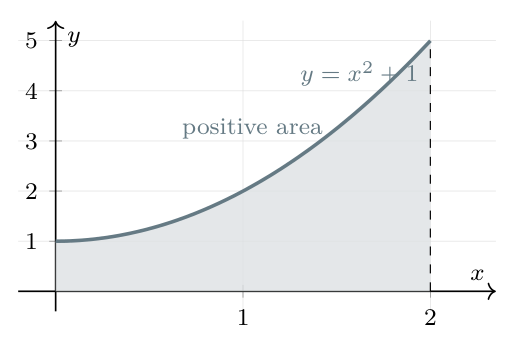
Question. Evaluate and interpret the definite integral
Solution
The graph lies entirely above the \(x\)-axis on the interval \([0,2]\), so every signed contribution is positive.
Now evaluate the integral:
Answer:
Interpretation: the sum of the signed areas is positive, since the graph is above the \(x\)-axis throughout the interval.
What changes when the curve crosses the \(x\)-axis?
Signed area
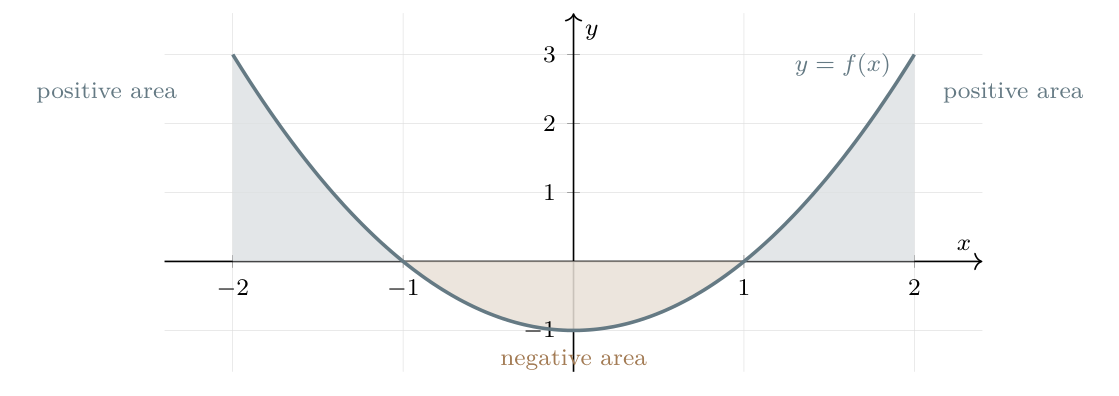
If a graph crosses the \(x\)-axis, some signed contributions are positive and some are negative.
Instead,
gives the sum of the signed areas:
regions above the \(x\)-axis contribute positively
regions below the \(x\)-axis contribute negatively.
So in this example,
Important distinction
This handout focuses on definite integrals and signed areas. A definite integral may be positive, zero, or negative because signed contributions can cancel.
Questions about total geometrical area (surface area enclosed by a curve and the \(x\)-axis, where every region is counted positively) are treated in the next section.
A note before moving on
What to focus on here
In this handout, when you see
think:
We are not yet calculating total geometrical area. That topic is treated in the next section, where all enclosed regions are counted positively.
More worked examples
Example 2: a negative signed area
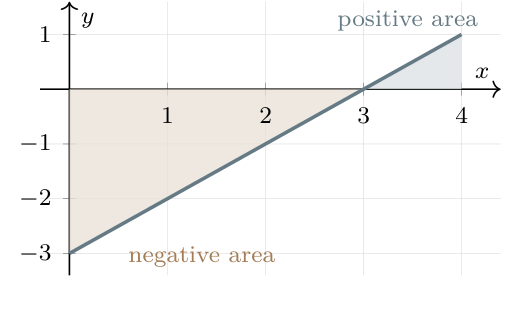
Question. Evaluate \(\displaystyle \int_0^4 (x-3)\,dx\) and interpret the answer.
Solution
First evaluate using an anti-derivative:
The integral is negative because the negative contribution from \(0\) to \(3\) is larger than the positive contribution from \(3\) to \(4\).
Answer: The signed area is \(-4\).
Example 3: signed area when the graph crosses the \(x\)-axis
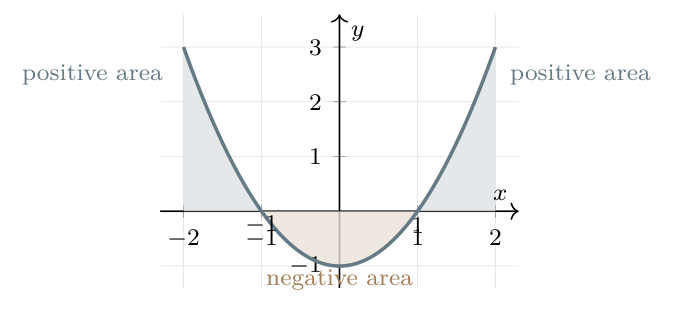
Question. Evaluate and interpret
Solution
The graph crosses the \(x\)-axis when
So the positive regions and the negative region contribute with different signs.
Interpretation: the sum of the signed areas is positive:
The negative contribution between \(-1\) and \(1\) cancels part of the positive contribution from the two outer regions.
Example 4: cancellation can give a zero integral
Question. Explain why
does not mean that the function has no positive or negative contributions.
Solution
The function \(x^3\) is below the \(x\)-axis on \([-2,0]\) and above the \(x\)-axis on \([0,2]\).
The negative contribution on \([-2,0]\) exactly cancels the positive contribution on \([0,2]\).
Conclusion: the integral is zero because the signed contributions cancel, not because nothing is happening on the graph.
Applications of definite integrals and signed area
Units of area and interpretation
If the quantity on the vertical axis has units \(U_y\) and the quantity on the horizontal axis has units \(U_x\), then the units of area on the graph are
So, in an applications question, the definite integral
is not interpreted as “square units”, but as the product of the axis units. Geometrically we see a shaded area; contextually we interpret the sum of the signed areas using its units.
Common unit pairings
| Vertical-axis units | Horizontal-axis units | Integral units | Interpretation |
|---|---|---|---|
| dollars/day | day | dollars | Net profit or net loss |
| euros/hour | hour | euros | Net money earned or lost |
| metres/second | second | metres | Displacement: change in position |
| litres/minute | minute | litres | Net volume added or removed |
| people/hour | hour | people | Net change in number of people |
Cashflow rate
Let \(r(t)\) be measured in \(\$ /\text{day}\), and let \(t\) be measured in days.
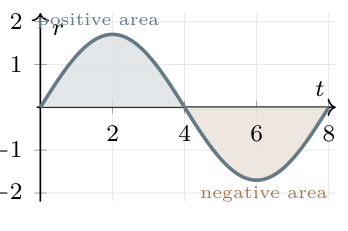
The sum of the signed areas represents total money in minus total money out: net cashflow in dollars.
Earnings rate
Let \(e(t)\) be measured in Euros/hour, and let \(t\) be measured in hours.
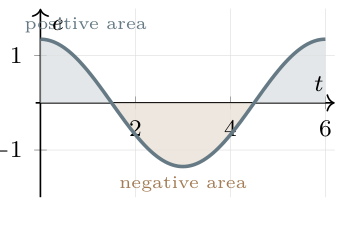
The sum of the signed areas represents earnings gained minus deductions or losses: net earnings in Euros.
Velocity-time graph
Let \(v(t)\) be measured in metres/second, and let \(t\) be measured in seconds.
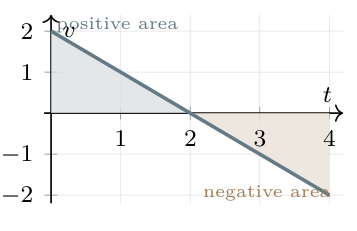
The sum of the signed areas represents forward movement minus backward movement: displacement in metres.
Positive and negative contributions still matter
In all three contexts above, regions above the horizontal axis represent positive contributions and regions below the horizontal axis represent negative contributions. So the signed area tells us the net change in the quantity being accumulated.
Example 5: a hotel’s net profit over 12 months
Suppose \(p(t)\) is a hotel’s profit rate, measured in thousand Euros per month, where \(t\) is time in months and
Find the hotel’s net profit over the 12 months.
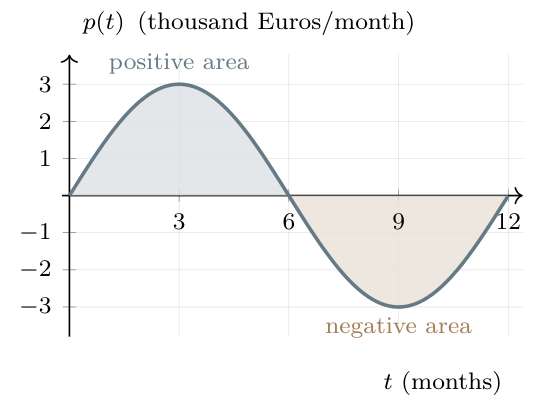
Solution
The units of the signed area are
So the integral represents the hotel’s net profit over the year.
Interpretation: the positive signed area from the profitable months exactly cancels the negative signed area from the loss-making months. So the hotel has
This does not mean “nothing happened”; it means the gains and losses balance overall.
Example 6: velocity-time graph - displacement as signed area
Question. A particle has velocity
Find its displacement from \(t=0\) to \(t=4\).
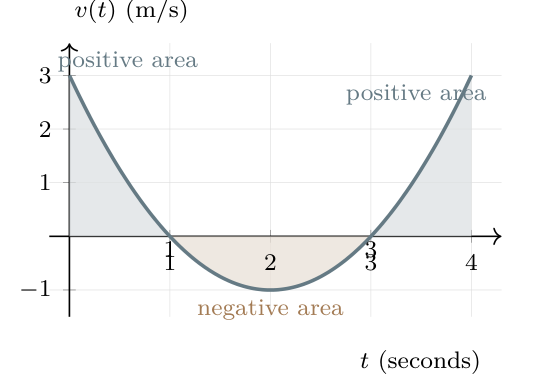
Solution
Displacement is the signed area under the velocity-time graph:
The velocity changes sign at
This means that some parts of the journey contribute positively to displacement and some contribute negatively.
Answer: the displacement is
Distance travelled is a total geometrical-area idea, and is treated in the next section.
Using technology appropriately
GDC/calculator workflow
Graph the function and identify where it crosses the \(x\)-axis inside the interval.
If asked for a definite integral, compute \(\displaystyle \int_a^b f(x)\,dx\).
Decide which parts of the graph contribute positively and which parts contribute negatively.
Interpret the result in context. A signed-area answer can be positive, zero, or negative.
Looking ahead
If a question asks for total geometrical area enclosed by the curve and the \(x\)-axis, that is a different task. It is treated in the next section.
Exact versus technology
For IB Mathematics AA SL/HL, exact analytical work is often expected. Always write a correct expression and interpret what the answer means.
Optional extension: from rectangles to the definite integral
For deeper understanding
This section is included for students who want to understand why a definite integral represents an accumulated signed area. It connects the rectangle picture to sigma notation and then to the integral sign.
A definite integral can be understood as the limit of a sum of many thin rectangles.
Step 1: split the interval into \(n\) strips
Suppose the interval is \([a,b]\), and we divide it into \(n\) equal parts.
Then each rectangle has width
If \(x_i^*\) is a sample point in the \(i\)-th strip, then the \(i\)-th rectangle has approximate signed area
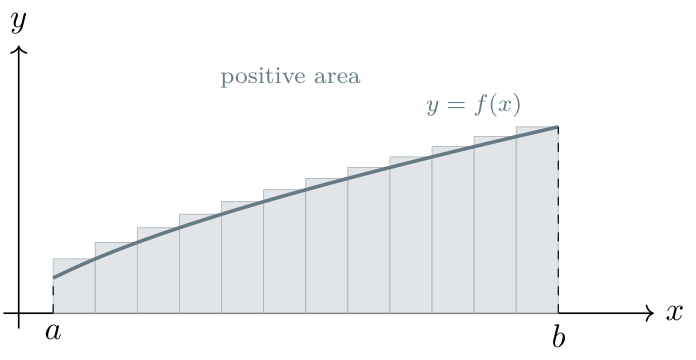
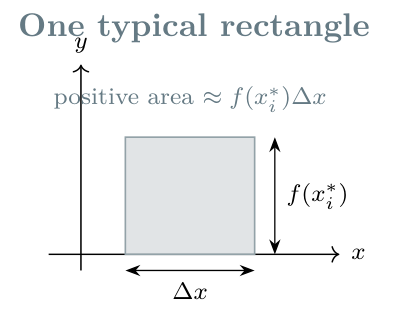
Step 2: add the \(n\) rectangle areas
So the total approximate signed area is
This is called a Riemann sum.
Step 3: make the rectangles thinner and thinner
As the number of rectangles increases,
In this limiting process, the width \(\Delta x\) becomes smaller and smaller. When it tends to \(0\), we replace it by the differential \(dx\), which represents an infinitely small change in \(x\). At the same time, the finite sum symbol \(\sum\) is replaced by the integral sign \(\int\), which can be viewed as a vertically stretched capital \(S\) for sum.
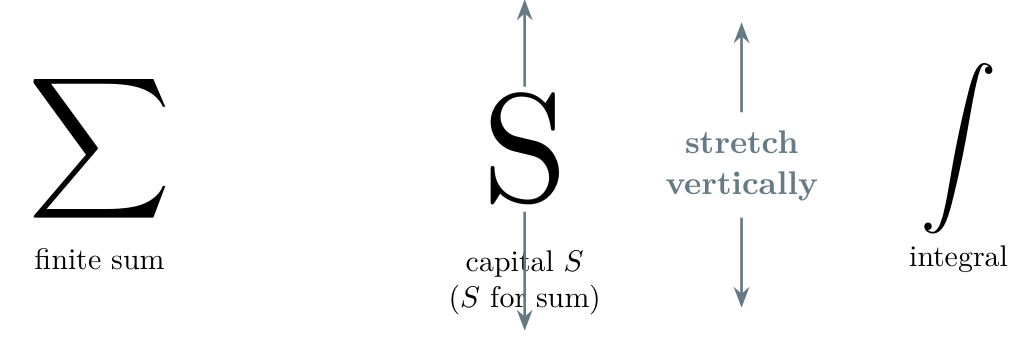
The integral sign comes from a vertically stretched \(S\), for sum.
So the approximation becomes exact:
This is the formal link between a definite integral and the sum of many signed rectangle areas.
Student-friendly interpretation
You can think of the definite integral as what happens when
is pushed to the limit:
the rectangles become extremely thin
\(\Delta x\) becomes the differential \(dx\)
the sigma sign \(\sum\) turns into the integral sign \(\int\), which you can think of as a stretched \(S\) for sum.
So, informally,
Summary checklist
Before answering a definite-integral question, ask:
What interval am I integrating over?
Does the graph cross the \(x\)-axis?
Which parts contribute positively?
Which parts contribute negatively?
Can signed contributions cancel?
Have I interpreted the units/context correctly?
Part B — Total geometrical area to the x-axis
We now turn signed accumulation into ordinary geometrical area by identifying where the graph changes sign.
Formula for the Area
The formula depends on where the curve lies relative to the x-axis. The three scenarios below are treated separately in the worked examples that follow: Example 1 stays above the x-axis, Example 2 stays below the x-axis, and Example 3 crosses the x-axis. Example 4 then shows the absolute value form.
Case 1: above the axis
If \(f(x)\geq 0\) on \([a,b]\), then
No sign adjustment is needed.
Case 2: below the axis
If \(f(x)\leq 0\) on \([a,b]\), then
The signed integral is negative, so change its sign.
Case 3: crosses the axis
If \(f\) changes sign, split at the roots and make each piece positive.
For exact working, write it as a sum of positive integrals.
The formula that always works. For total geometrical area between \(y=f(x)\) and the x-axis,
This is the most reliable formula, and it is definitely recommended when using a graphical calculator or GDC. For exact handwritten work, it is often clearer to split the interval at the roots and write each part as a positive integral.
Method for exact handwritten working
Sketch or analyse the function on the interval.
Find the x-intercepts by solving \(f(x)=0\). These are where the graph may change sign.
Split the interval at any roots that lie inside the interval.
Decide the sign of \(f(x)\) on each subinterval.
Make every area positive: integrate \(f(x)\) where the graph is above the x-axis, and \(-f(x)\) where it is below.
Add the pieces and check that the final area is positive.
Calculator/GDC form. Once the sketch is understood, a calculator can often evaluate
For IB AA, exact analytical splitting is often expected. Always write the correct area expression and interpret the answer.
Worked example 1: the curve stays above the x-axis
Worked example 1: the curve stays above the x-axis
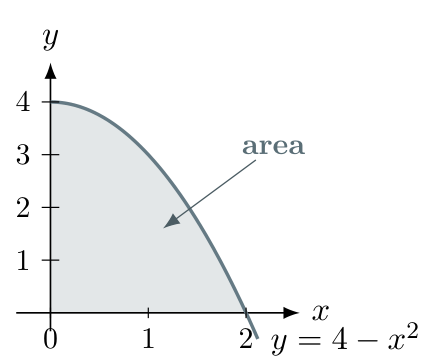
Question. Find the area enclosed by \(y=4-x^2\), the x-axis, \(x=0\), and \(x=2\).
Solution
Since \(4-x^2\geq0\) on \([0,2]\), the area is the definite integral:
Now evaluate:
Answer: \(\displaystyle \frac{16}{3}\) square units.
Worked example 2: the curve stays below the x-axis
Worked example 2: the curve stays below the x-axis
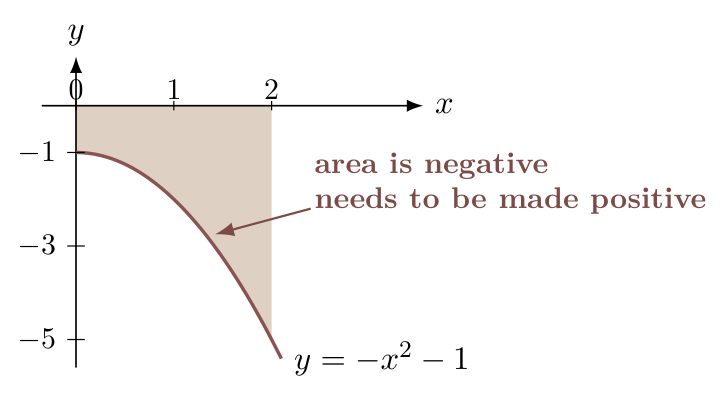
Question. Find the area enclosed by \(y=-x^2-1\), the x-axis, \(x=0\), and \(x=2\).
Solution
The curve is entirely below the x-axis, so the signed area would be negative. The total area is therefore found by considering the opposite of the definite integral \(\displaystyle \int_0^2(-x^2-1)\,dx\):
Therefore
Answer: \(\displaystyle \frac{14}{3}\) square units.
Worked example 3: the curve crosses the x-axis
Worked example 3: the curve crosses the x-axis
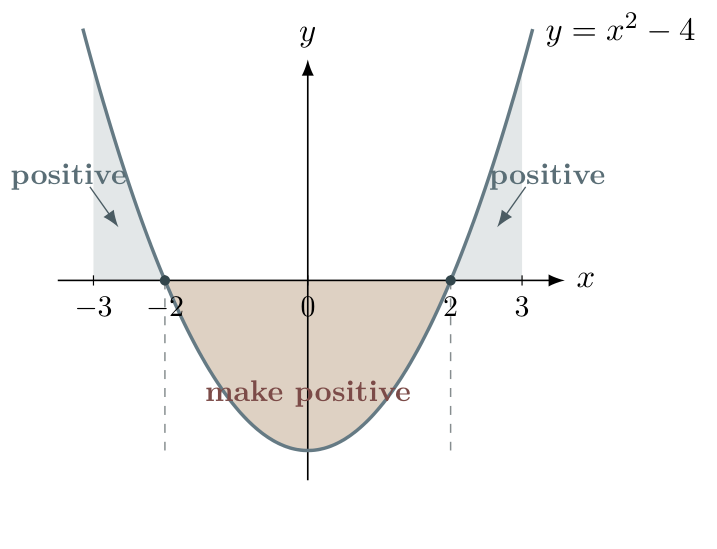
Question. Find the total area enclosed by \(y=x^2-4\) and the x-axis from \(x=-3\) to \(x=3\).
Solution
First find the roots:
The function is positive on \([-3,-2]\), negative on \([-2,2]\), and positive on \([2,3]\). The middle integral is a negative signed area, so the total area is found by subtracting that negative area:
Now evaluate each signed contribution:
Therefore subtracting the negative signed area gives
The final positive piece is
So
Answer: \(\displaystyle \frac{46}{3}\) square units.
Worked example 4: writing the absolute value form
Worked example 4: writing the absolute value form
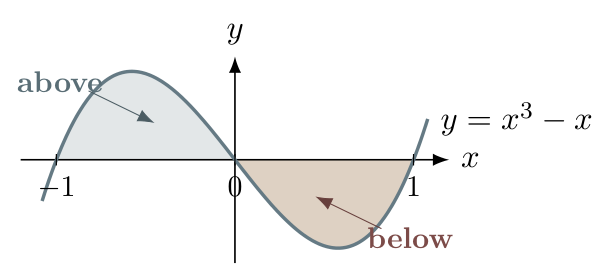
Question. Find the total area between \(y=x^3-x\) and the x-axis from \(x=-1\) to \(x=1\).
Solution
A calculator-friendly expression is
For exact handwritten work, split at the roots:
On \([-1,0]\), \(x^3-x\geq0\). On \([0,1]\), \(x^3-x\leq0\). The absolute value of a function keeps positive values as they are, but if \(f(x)\) is negative, then \(|f(x)|\) turns \(f(x)\) into its opposite, \(-f(x)\). In this example, on \([0,1]\),
Hence
The second part can be seen as subtracting the negative signed area:
So
Answer: \(\displaystyle \frac12\) square unit.
Why the absolute value method works
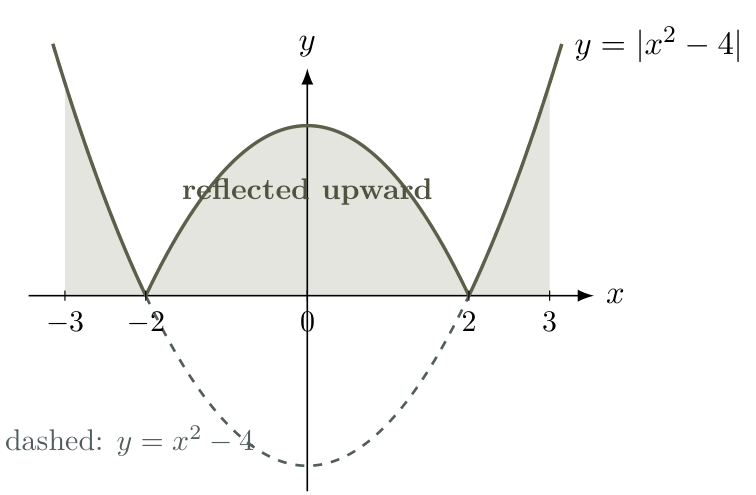
The graph of \(y=|f(x)|\) keeps the parts of \(y=f(x)\) above the x-axis and reflects the parts below the x-axis upward. This turns signed area into total geometrical area.
Common mistakes and how to avoid them
| Mistake | Fix |
| Using \(\int_a^b f(x)\,dx\) automatically as area | First check whether the graph goes below the x-axis. If it does, use absolute value or split at the roots. |
| Forgetting roots inside the interval | Solve \(f(x)=0\), then keep only the roots that lie between \(a\) and \(b\). |
| Changing sign at every root without checking | Use a sign table or test point on each interval. Some roots do not cause a sign change. |
| Giving a negative final answer for an area | Total area must be positive. A negative answer means you have calculated signed area instead. |
| Rounding too early | Keep exact values until the end, especially in AA-style questions. |
Quick decision checklist
Before calculating, ask:
Am I being asked for a definite integral or for total area?
What is the interval?
Where does the curve meet the x-axis?
On which intervals is the function positive or negative?
Should I use \(f(x)\), \(-f(x)\), or \(|f(x)|\)?
Does my final answer make sense from the diagram?
Part C — Area between two curves
On each interval, integrate upper curve minus lower curve.
What area are we trying to find?
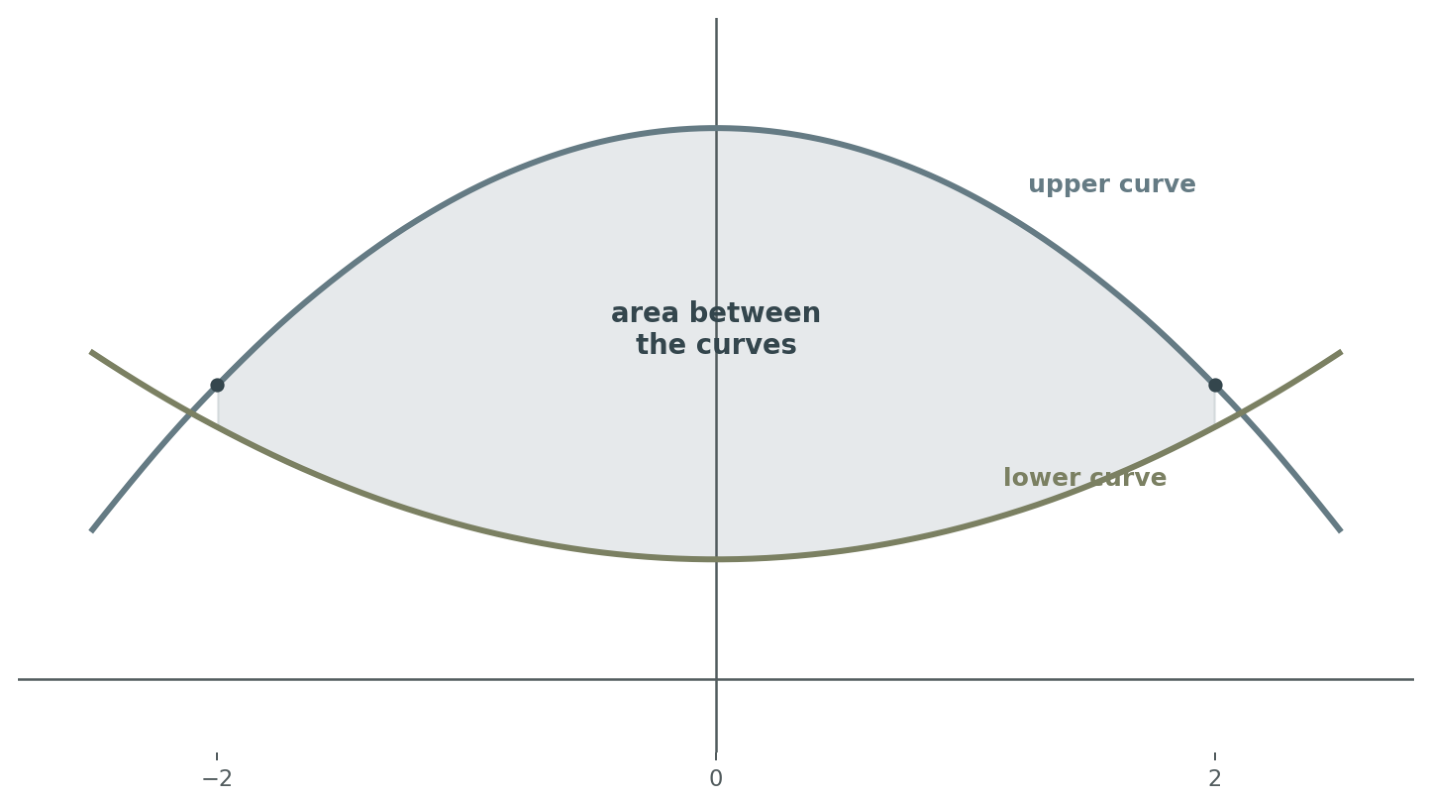
In this topic, we want the geometrical area enclosed between two curves. Visually, this is the region trapped between one graph above and another graph below over an interval from \(x=a\) to \(x=b\).
Key idea: vertical slices
The area is built from many thin vertical slices. On each slice, the height is
So the area is found by accumulating these vertical distances:
Before writing any integral, ask three questions:
Which region is being found?
Where do the left and right boundaries come from?
Which curve is above on the interval?
Once these are clear, the algebra becomes much easier.
Step 1: identify the scenario and the limits
The first decision is not the formula. The first decision is the scenario: are we finding the whole enclosed region, or only the area on a specified interval?
Scenario A: whole enclosed region
Find where the two curves intersect. The \(x\)-coordinates of these intersections usually become the limits of integration.
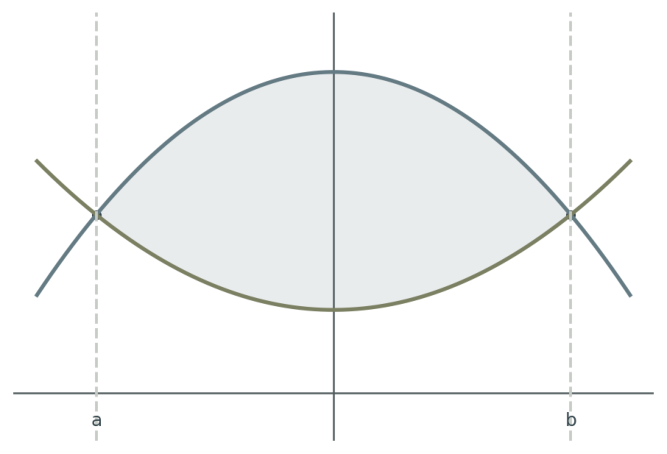
Scenario B: specified interval
Use the vertical boundaries given in the question, such as \(x=a\) and \(x=b\). These do not have to be intersection points.
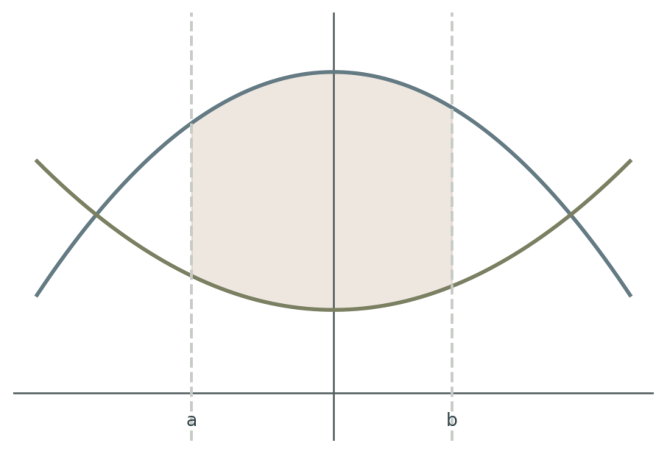
Common trap
Do not automatically solve for intersections if the question already gives the interval. Intersections are needed when they define the enclosed region, or when you need to check whether the upper curve changes inside the interval.
Step 2: write the formula using upper minus lower
If \(f(x)\) is above \(g(x)\) for every \(x\) in the interval \([a,b]\), then
A safer way to write the same idea is to name the two curves by position, not by letter:
where \(U(x)\) is the upper curve and \(L(x)\) is the lower curve on the interval.
Why this notation helps
The upper curve is not always the one called \(f\). Always decide which graph is above before writing the integral.
Step 3: understand why the formula works
The area between two curves can be understood as a subtraction of areas measured from the \(x\)-axis:
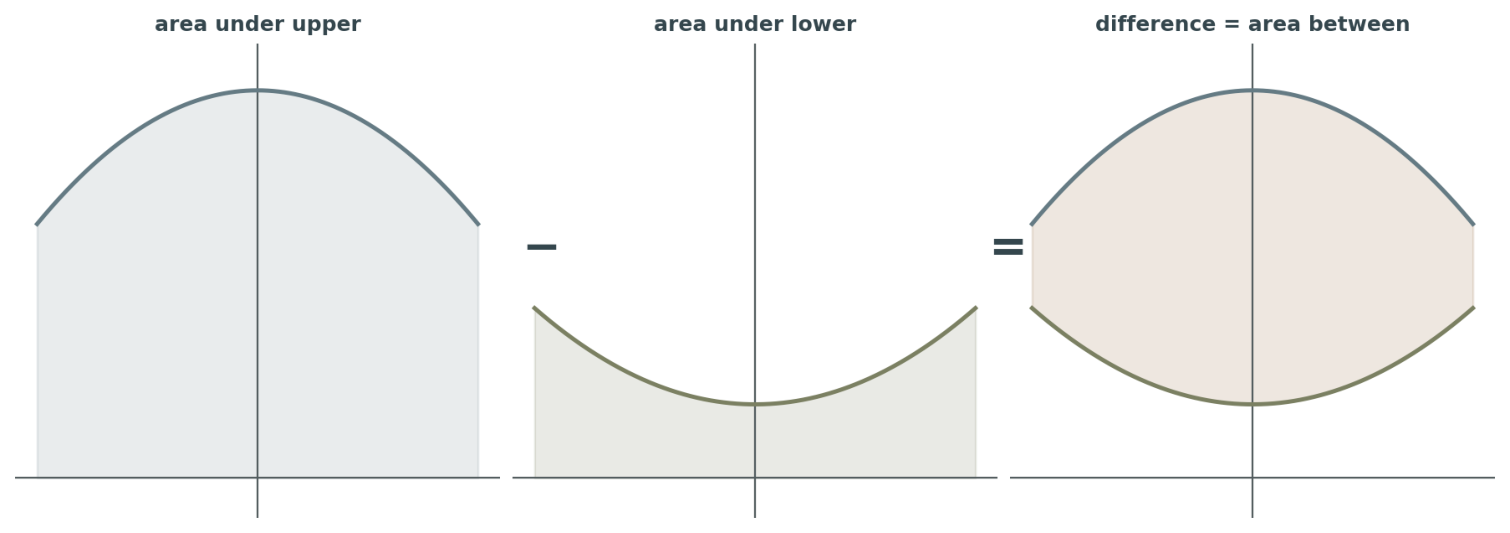
Therefore,
Interpretation
The integral is not measuring two separate areas and hoping for the best. It is accumulating the vertical distance between the upper and lower curve across the interval.
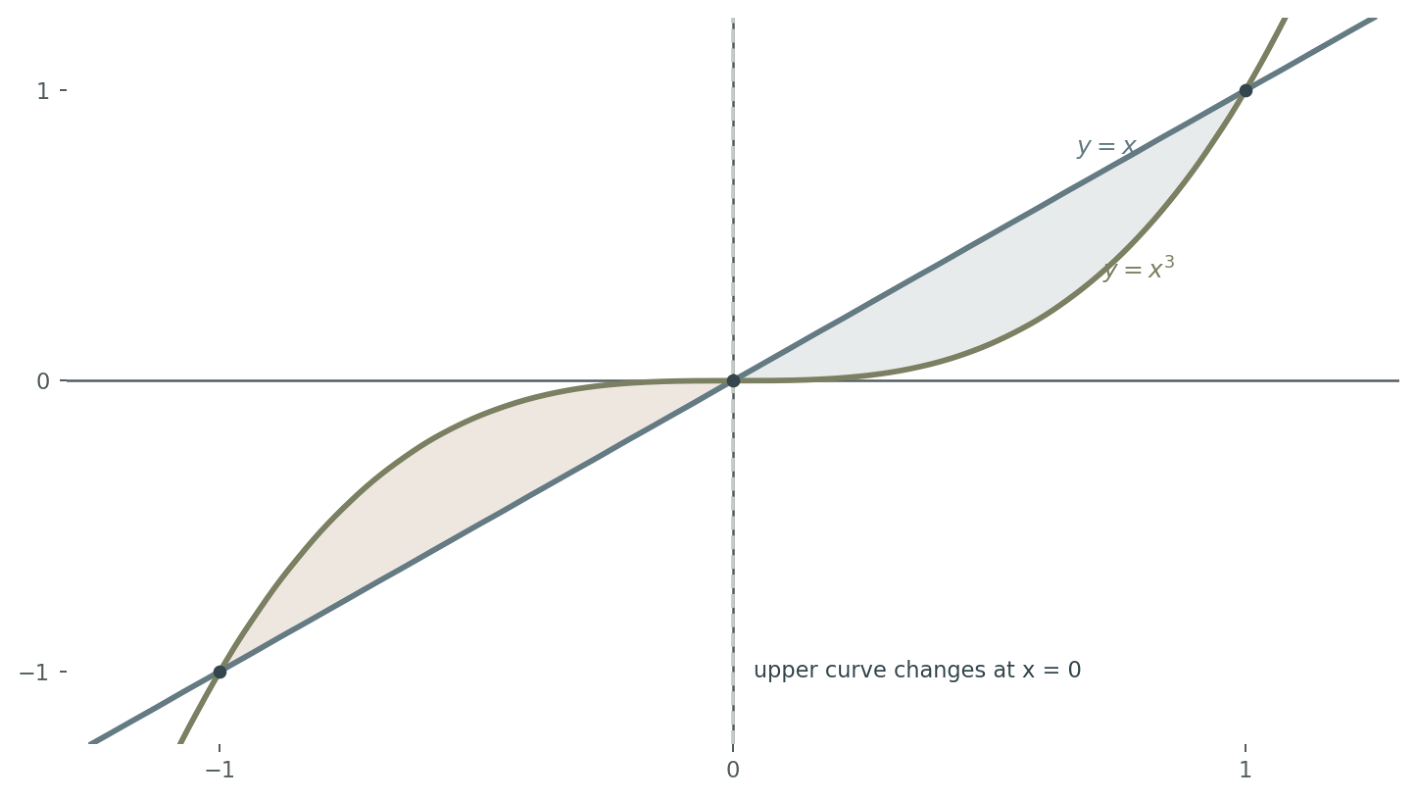
Step 4: handle changes of upper curve
Sometimes the curve that is above changes inside the interval. In that case, one single “upper minus lower” expression may not work on the whole interval.
Another way to write the total area between two curves is
The absolute value makes any negative difference positive. This is especially useful on a calculator or GDC, because the calculator can handle the change of upper curve automatically.
Exact handwritten working
For exact working, the absolute value form usually still needs to be interpreted. If \(f(x)-g(x)\) changes sign, split the interval at the crossing point and use upper minus lower on each part.
Worked examples
Worked example 1: a parabola and a line
Question. Find the area enclosed by \(y=4-x^2\) and \(y=x+2\).
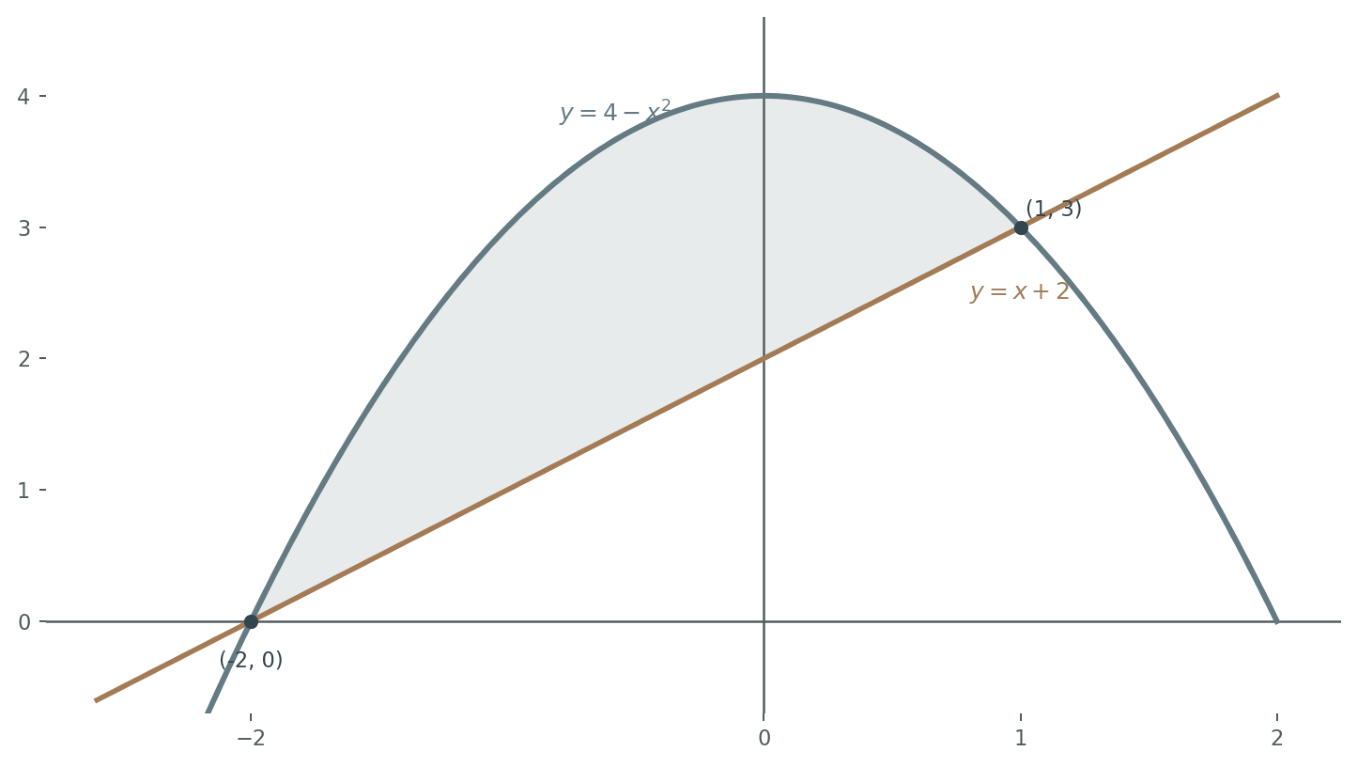
Solution
Step 1: find the intersection points.
So \(x=-2\) or \(x=1\). The corresponding intersection points are \((-2,0)\) and \((1,3)\).
Step 2: decide which curve is above. Between \(x=-2\) and \(x=1\), the parabola is above the line.
Answer: \(\dfrac92\) square units.
Worked example 2: specified vertical boundaries
Question. Find the area between \(y=4-x^2\) and \(y=x+2\) from \(x=-1\) to \(x=\frac12\).
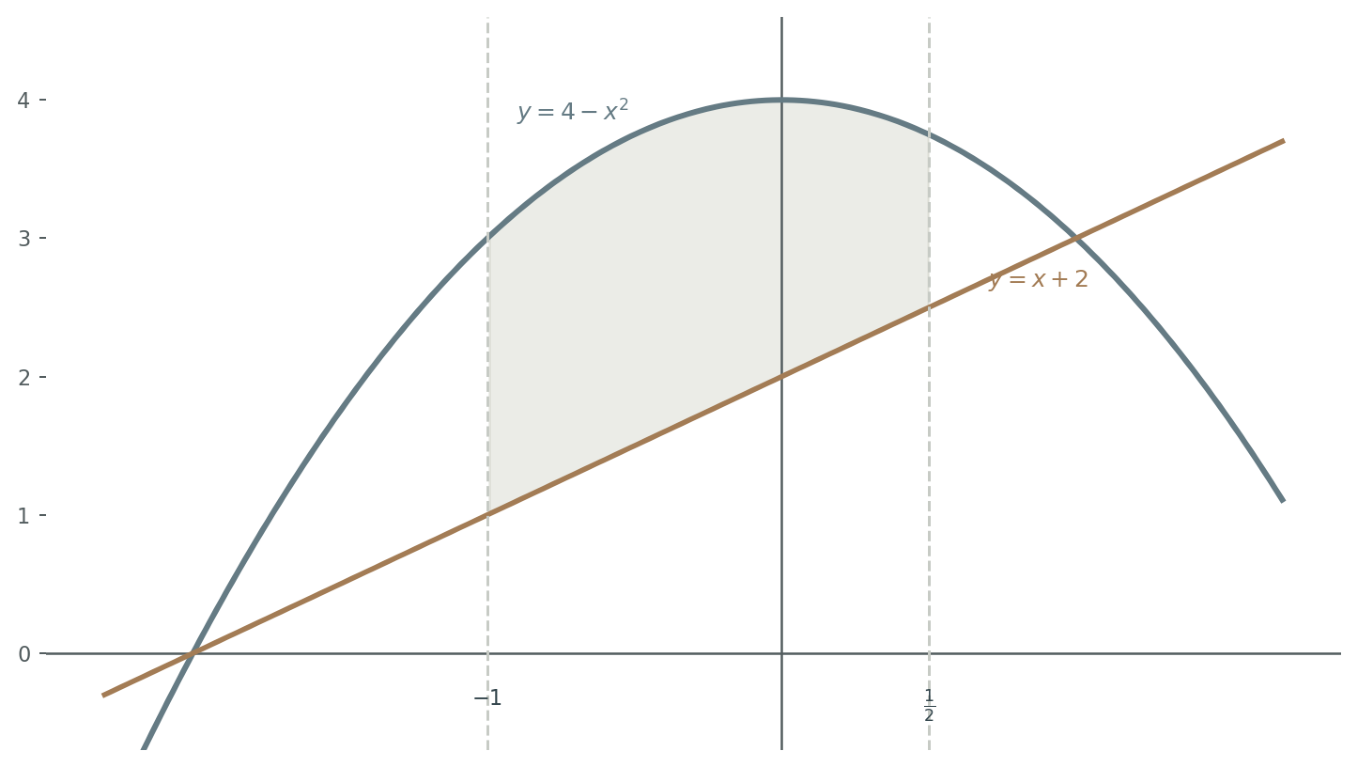
Solution
Here the limits are already given. We do not use the full intersection-to-intersection interval. On \(\left[-1,\frac12\right]\), the parabola \(4-x^2\) is above the line \(x+2\), so
Answer: \(3\) square units.
Worked example 3: the upper curve changes
Question. Find the area between \(y=x\) and \(y=x^3\) from \(x=-1\) to \(x=1\).
Solution
The curves intersect when
So they meet at \(x=-1\), \(x=0\), and \(x=1\).
The upper curve changes at \(x=0\):
on \([-1,0]\), \(x^3\) is above \(x\);
on \([0,1]\), \(x\) is above \(x^3\).
Answer: \(\dfrac12\) square unit. Equivalently, a calculator could evaluate \(\displaystyle\int_{-1}^{1}|x-x^3|\,dx\).
Step-by-step method
The method
Sketch both curves, or use technology to understand their positions.
Identify the vertical boundaries. They may be intersection points, or specified values such as \(x=a\) and \(x=b\).
Find intersections only when needed to define the region or to check whether the upper curve changes.
Decide which curve is above on each interval.
Integrate upper minus lower on each interval.
Use absolute value on a calculator when appropriate:
\[\displaystyle A=\int_a^b |f(x)-g(x)|\,dx\].
Check the answer is positive and matches the shaded region.
Check 1
Are the limits the right ones for the question?
Check 2
Is the integrand upper minus lower on the whole interval?
Check 3
Is the final area positive and given in square units?
Practice questions
Part A — Signed area and interpretation
Evaluate \(\displaystyle \int_0^4 (5-x)\,dx\) and interpret the result as a signed area.
Evaluate \(\displaystyle \int_0^5 (x-3)\,dx\). Explain why the answer is negative.
For \(f(x)=x^2-4\) on \([-3,3]\), find the signed area \(\displaystyle \int_{-3}^{3}(x^2-4)\,dx\) and interpret the sign of your answer.
Find \(k\) if
\[\displaystyle \int_0^2(kx+1)\,dx=8\].
Explain why
\[\displaystyle \int_0^{2\pi}\sin x\,dx=0\].
A velocity is given by \(v(t)=t-2\) for \(0\leq t\leq 5\). Find the displacement.
Given
\[\displaystyle \int_{-2}^{2}f(x)\,dx=-3\]and
\[\displaystyle \int_{-2}^{0}f(x)\,dx=5\], find \(\displaystyle \int_0^2 f(x)\,dx\).
Find the signed area \(\displaystyle \int_0^4 (x-1)(x-3)\,dx\).
Part B — Total area to the x-axis
Part A: core total-area practice
Find the area enclosed by \(y=x^2+1\), the x-axis, \(x=0\), and \(x=2\).
Find the area enclosed by \(y=-2x\), the x-axis, \(x=0\), and \(x=3\).
Find the total area between \(y=x^2-1\) and the x-axis from \(x=-2\) to \(x=2\).
Find the total area between \(y=6-3x\) and the x-axis from \(x=0\) to \(x=3\).
Find the total area between \(y=x^2-4x+3\) and the x-axis from \(x=0\) to \(x=4\).
Part B: reasoning and setup
Explain why \(\displaystyle \int_{-2}^{2}(x^2-4)\,dx\) is not the total area enclosed by \(y=x^2-4\) and the x-axis on \([-2,2]\).
Write, but do not evaluate, a correct integral expression for the total area between \(y=x^3-4x\) and the x-axis from \(x=-3\) to \(x=3\).
The graph of \(y=f(x)\) lies below the x-axis on \([1,4]\). Write an expression for the total area enclosed by the curve and the x-axis on this interval.
Part C: extension for AA
Find the total area between \(y=x^3-x\) and the x-axis from \(x=-2\) to \(x=2\).
Find the total area between \(y=\cos x\) and the x-axis from \(x=0\) to \(x=\pi\).
A particle has velocity \(v(t)=t^2-4t+3\), where \(0\leq t\leq4\). Write an integral expression for the total distance travelled. Then evaluate it. This is a useful connection to total area and absolute value.
Part C — Area between curves
Try these without looking at the answer key. Draw a quick sketch before setting up each integral.
A. Setup practice
For each question, write the correct integral expression for the area. You do not need to evaluate it.
The area between \(y=5-x^2\) and \(y=1\) between their intersections.
The area between \(y=3x\) and \(y=x^2+2\) from \(x=0\) to \(x=1\).
The area between \(y=x\) and \(y=x^3\) from \(x=-1\) to \(x=1\).
The area between \(y=e^x\) and \(y=1\) from \(x=0\) to \(x=\ln 3\).
B. Calculate the area
Find the area between \(y=2x\) and \(y=x^2\) from \(x=0\) to \(x=2\).
Find the area enclosed by \(y=9\) and \(y=x^2\).
Find the area enclosed by \(y=6-x^2\) and \(y=x\).
Find the area between \(y=x\) and \(y=x^3\) from \(x=-1\) to \(x=1\).
Find the area between \(y=4-x^2\) and \(y=x+2\) from \(x=-1\) to \(x=\frac12\).
Find the area between \(y=\cos x\) and \(y=\sin x\) from \(x=0\) to \(x=\frac{\pi}{2}\).
Find the area enclosed by \(y=x^2\) and \(y=2-x\).
Find the area between \(y=e^x\) and \(y=1\) from \(x=0\) to \(x=\ln 3\).
C. Conceptual checks
Explain why
\[\displaystyle\int_{-1}^{1}(x-x^3)\,dx=0\]is not the area between \(y=x\) and \(y=x^3\).
A student writes \(\displaystyle\int_a^b(f(x)-g(x))\,dx\) because the first function is called \(f\). What extra check must they make before this is correct?
A question asks for the area between two curves from \(x=1\) to \(x=4\). A student solves for all intersections and uses those as the limits. Explain the mistake.
Answer key
Part A — Signed area and interpretation
- \[\int_0^4(5-x)\,dx=\left[5x-\frac{x^2}{2}\right]_0^4=20-8=12.\]
The graph is above the \(x\)-axis on \([0,4]\), so the signed area is positive.
- \[\int_0^5(x-3)\,dx=\left[\frac{x^2}{2}-3x\right]_0^5=\frac{25}{2}-15=-\frac52.\]
The answer is negative because the negative contribution from \(0\) to \(3\) is larger than the positive contribution from \(3\) to \(5\).
- \[\int_{-3}^{3}(x^2-4)\,dx=\left[\frac{x^3}{3}-4x\right]_{-3}^{3}=-6.\]
The signed area is negative overall, meaning that the below-axis contribution is larger than the above-axis contribution.
- \[\int_0^2(kx+1)\,dx=\left[\frac{kx^2}{2}+x\right]_0^2=2k+2.\]
Hence \(2k+2=8\), so \(k=3\).
- \[\int_0^{2\pi}\sin x\,dx=[-\cos x]_0^{2\pi}=-1-(-1)=0.\]
The positive contribution on \([0,\pi]\) cancels the negative contribution on \([\pi,2\pi]\).
Displacement:
\[\int_0^5(t-2)\,dt=\left[\frac{t^2}{2}-2t\right]_0^5=\frac{25}{2}-10=\frac52.\]Using additivity,
\[\int_{-2}^{2}f(x)\,dx=\int_{-2}^{0}f(x)\,dx+\int_0^2 f(x)\,dx.\]So
\[-3=5+\displaystyle\int_0^2f(x)\,dx\], hence
\[\int_0^2f(x)\,dx=-8.\]Let \(f(x)=(x-1)(x-3)=x^2-4x+3\) and \(F(x)=\dfrac{x^3}{3}-2x^2+3x\).
\[\int_0^4f(x)\,dx=F(4)-F(0)=\frac43.\]
Part B — Total area to the x-axis
Part A
The curve is above the axis:
\[A=\int_0^2(x^2+1)\,dx=\left[\frac{x^3}{3}+x\right]_0^2=\frac{14}{3}.\]The curve is below the axis on \([0,3]\), so use \(-(-2x)=2x\):
\[A=\int_0^3 2x\,dx=\left[x^2\right]_0^3=9.\]Roots are \(-1\) and \(1\):
\[A=\int_{-2}^{-1}(x^2-1)\,dx+\int_{-1}^{1}(1-x^2)\,dx+\int_{1}^{2}(x^2-1)\,dx=4.\]Root is \(x=2\). The function is positive on \([0,2]\) and negative on \([2,3]\):
\[A=\int_0^2(6-3x)\,dx+\int_2^3(3x-6)\,dx=6+\frac32=\frac{15}{2}.\]\(x^2-4x+3=(x-1)(x-3)\). It is positive on \([0,1]\), negative on \([1,3]\), and positive on \([3,4]\):
\[A=\int_0^1(x^2-4x+3)\,dx+\int_1^3(-x^2+4x-3)\,dx+\int_3^4(x^2-4x+3)\,dx.\]Evaluating gives
\[A=\frac43+\frac43+\frac43=4.\]
Part B
On \([-2,2]\), \(x^2-4\leq0\). The definite integral is a signed area and is negative. Total area requires
\[A=\int_{-2}^{2}(4-x^2)\,dx=\int_{-2}^{2}|x^2-4|\,dx.\]Roots are \(-2\), \(0\), and \(2\). Since \(x^3-4x\) is negative on \([-3,-2]\), positive on \([-2,0]\), negative on \([0,2]\), and positive on \([2,3]\),
\[A=\int_{-3}^{-2}(4x-x^3)\,dx+\int_{-2}^{0}(x^3-4x)\,dx+\int_{0}^{2}(4x-x^3)\,dx+\int_{2}^{3}(x^3-4x)\,dx.\]Equivalently,
\[\displaystyle A=\int_{-3}^{3}|x^3-4x|\,dx\].
If \(f(x)\leq0\) on \([1,4]\), then
\[A=-\int_1^4 f(x)\,dx=\int_1^4 |f(x)|\,dx.\]
Part C
Roots are \(-1\), \(0\), and \(1\). The total area is
\[A=\int_{-2}^{-1}(x-x^3)\,dx+\int_{-1}^{0}(x^3-x)\,dx+\int_0^1(x-x^3)\,dx+\int_1^2(x^3-x)\,dx.\]Evaluating gives
\[A=\frac94+\frac14+\frac14+\frac94=5.\]\(\cos x\) changes sign at \(x=\frac{\pi}{2}\):
\[A=\int_0^{\pi/2}\cos x\,dx+\int_{\pi/2}^{\pi}(-\cos x)\,dx=1+1=2.\]\(v(t)=t^2-4t+3=(t-1)(t-3)\). The velocity is positive on \([0,1]\), negative on \([1,3]\), and positive on \([3,4]\). Total distance is
\[\int_0^4 |t^2-4t+3|\,dt =\int_0^1(t^2-4t+3)\,dt+\int_1^3(-t^2+4t-3)\,dt+\int_3^4(t^2-4t+3)\,dt.\]This gives
\[\frac43+\frac43+\frac43=4.\]
Part C — Area between curves
A. Setup practice
Intersections: \(5-x^2=1\Rightarrow x=\pm2\). Since \(5-x^2\) is above \(1\),
\[A=\int_{-2}^{2}\bigl((5-x^2)-1\bigr)\,dx.\]On \([0,1]\), \(x^2+2\) is above \(3x\), so
\[A=\int_0^1\bigl((x^2+2)-3x\bigr)\,dx.\]Split at \(x=0\):
\[A=\int_{-1}^{0}(x^3-x)\,dx+\int_{0}^{1}(x-x^3)\,dx.\]On \([0,\ln 3]\), \(e^x\) is above \(1\), so
\[A=\int_0^{\ln 3}(e^x-1)\,dx.\]
B. Calculate the area
- \[A=\int_0^2(2x-x^2)\,dx=\left[x^2-\frac{x^3}{3}\right]_0^2=4-\frac83=\frac43.\]
Intersections: \(x=\pm3\). Since \(9\) is above \(x^2\),
\[A=\int_{-3}^{3}(9-x^2)\,dx=36.\]Intersections:
\[6-x^2=x\Rightarrow x^2+x-6=0\Rightarrow x=-3,2.\]On \([-3,2]\), \(6-x^2\) is above \(x\), so
\[A=\int_{-3}^{2}\bigl((6-x^2)-x\bigr)\,dx=\frac{125}{6}.\]- \[A=\int_{-1}^{0}(x^3-x)\,dx+\int_0^1(x-x^3)\,dx=\frac12.\]
- \[A=\int_{-1}^{1/2}(2-x-x^2)\,dx=3.\]
The curves cross at \(x=\frac{\pi}{4}\), so
\[\begin{aligned} A&=\int_0^{\pi/4}(\cos x-\sin x)\,dx+\int_{\pi/4}^{\pi/2}(\sin x-\cos x)\,dx\\ &=2\sqrt2-2=2(\sqrt2-1). \end{aligned}\]Intersections:
\[x^2=2-x\Rightarrow x^2+x-2=0\Rightarrow x=-2,1.\]The line is above the parabola, so
\[A=\int_{-2}^{1}(2-x-x^2)\,dx=\frac92.\]- \[A=\int_0^{\ln 3}(e^x-1)\,dx=\left[e^x-x\right]_0^{\ln 3}=2-\ln 3.\]
C. Conceptual checks
The expression \(x-x^3\) changes sign at \(x=0\), so the signed areas cancel. Total area must be found using \(\displaystyle\int_{-1}^1 |x-x^3|\,dx\), or by splitting at \(x=0\).
They must check that \(f(x)\) is above \(g(x)\) for every \(x\) in the interval. If not, they must reverse the order or split the interval.
The question has already specified the vertical boundaries. The limits should be \(1\) and \(4\), unless intersections inside the interval are needed to check where the upper curve changes.
Where this fits in the sequence
This handout follows definite integrals and signed area. It develops the next geometric application: finding total area trapped between two graphs, where every vertical distance is counted positively.