IB Mathematics: Analysis and Approaches HL — Topic 5 Calculus
Implicit Differentiation
Differentiate relations involving both \(x\) and \(y\), then use the result for tangents, normals, special tangents and higher derivatives.
Learning goal
Differentiate equations in which \(y\) is not isolated, solve reliably for \(dy/dx\), and use the result in geometric problems.
Syllabus link
AHL 5.14 Implicit differentiation, related rates and optimisation.
Big idea
Regard \(y\) as a function of \(x\). Every differentiated \(y\)-expression gains a chain-rule factor \(dy/dx\).
One idea to remember
\(\frac{d}{dx}(y^n)=ny^{n-1}\frac{dy}{dx}\).
The one idea to remember
If \(y=y(x)\), then \(y\) changes when \(x\) changes. So
The extra factor \(\dfrac{dy}{dx}\) is simply the chain rule.
Why do we need implicit differentiation?
Many curves are most naturally given by an equation that mixes \(x\) and \(y\). For example,
describes a circle centred at the origin with radius 5. We could solve for \(y\), but this immediately creates two branches:
Implicit differentiation lets us differentiate the original relation directly, without choosing a branch first.
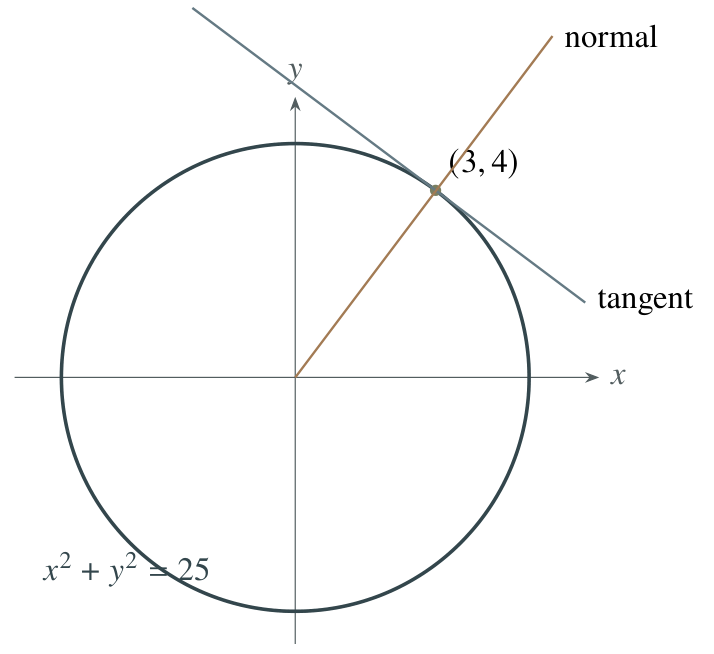
At the point \((3,4)\), implicit differentiation will give the gradient of the tangent without ever having to write \(y\) explicitly as a function of \(x\).
The chain rule is doing the work
To see why the method works, write \(y\) as \(y(x)\). Then
| Expression | Derivative with respect to \(x\) |
|---|---|
| \(y^n\) | \(n y^{n-1}\dfrac{dy}{dx}\) |
| \(\sin y\) | \(\cos y\dfrac{dy}{dx}\) |
| \(\cos y\) | \(-\sin y\dfrac{dy}{dx}\) |
| \(e^y\) | \(e^y\dfrac{dy}{dx}\) |
| \(\ln y\) | \(\dfrac{1}{y}\dfrac{dy}{dx}\) |
| \(xy\) | \(x\dfrac{dy}{dx}+y\) (product rule) |
Common trap
Do not treat \(y\) as a constant. For example,
The correct derivative is \(2y\dfrac{dy}{dx}\), because \(y\) depends on \(x\).
A reliable four-step method
Implicit differentiation routine
Differentiate both sides with respect to \(x\). Apply every ordinary rule you already know: power, product, quotient and chain rules.
Attach \(\dfrac{dy}{dx}\) whenever differentiating a \(y\)-expression.
Collect all terms containing \(\dfrac{dy}{dx}\) on one side.
Factor out \(\dfrac{dy}{dx}\), then divide to isolate it.
Your final derivative will often contain both \(x\) and \(y\). That is completely normal.
Worked example 1: the circle \(x^2+y^2=25\)
Find \(\dfrac{dy}{dx}\).
Solution
Differentiate both sides:
Collect the derivative term:
Divide by \(2y\):
At \((3,4)\), the gradient is
Worked example 2: a product containing \(x\) and \(y\)
For the curve
find \(\dfrac{dy}{dx}\).
Solution
Differentiate term by term. The middle term requires the product rule:
Collect the terms containing \(\dfrac{dy}{dx}\):
Therefore
More involved algebraic relations
Worked example 3: product rule on both variables
For
find \(\dfrac{dy}{dx}\).
Solution
Differentiate both sides:
Expand and collect the derivative terms:
Factor:
Hence
A useful habit
When you differentiate, do not try to isolate \(\dfrac{dy}{dx}\) after every line. First differentiate the entire relation correctly. Then gather all \(\dfrac{dy}{dx}\)-terms together. This greatly reduces sign errors.
Implicit differentiation with composite functions
The same chain-rule principle applies when \(y\) sits inside a trigonometric, exponential or logarithmic function.
Worked example 4: \(\sin(x+y)=xy\)
Find \(\dfrac{dy}{dx}\).
Solution
The left side is a composite function. Differentiate \(\sin(\,\cdot\,)\), then multiply by the derivative of \(x+y\):
Expand:
Collect the derivative terms:
Therefore
Worked example 5: an exponential containing \(xy\)
For
find \(\dfrac{dy}{dx}\).
Solution
The exponent \(xy\) also depends on \(x\), so the chain rule and product rule are both needed:
Collect \(\dfrac{dy}{dx}\):
Thus
Worked example 6: a logarithmic relation
For
find \(\dfrac{dy}{dx}\).
Solution
Differentiate using the chain rule:
Multiply through by \(x^2+y^2\):
Therefore
Tangents and normals to implicitly defined curves
Once \(\dfrac{dy}{dx}\) is known, tangent and normal questions work exactly as they did for explicit functions.
Line gradients
At a point \((x_0,y_0)\):
provided the tangent gradient is finite and non-zero.
Worked example 7: tangent and normal
The point \((1,2)\) lies on
Find the equations of the tangent and normal at this point.
Solution
From Worked example 2,
At \((1,2)\),
So the tangent is
or
The normal gradient is the negative reciprocal:
Hence the normal is
or
Always check the point
Before substituting a point into an implicit derivative, verify that the point actually lies on the curve. In an exam question this may be automatic, but in algebraic work it is an excellent error check.
Horizontal and vertical tangents
Suppose the derivative has the form
Then:
a horizontal tangent usually occurs when \(N(x,y)=0\) and \(D(x,y)\neq0\);
a vertical tangent usually occurs when \(D(x,y)=0\) and \(N(x,y)\neq0\).
The point must also satisfy the original curve equation.
Worked example 8: horizontal tangents
Find the points where
has a horizontal tangent.
Solution
We have
For a horizontal tangent,
Substitute into the original curve:
Thus
Therefore the two points are
Worked example 9: vertical tangents
Find the points on \(x^2+xy+y^2=7\) where the tangent is vertical.
Solution
A vertical tangent occurs when
Substitute into the curve:
Hence
So the vertical tangents occur at
Second derivatives implicitly
Implicit differentiation can be repeated. Differentiate the first-derivative relation again, remembering that \(\dfrac{dy}{dx}\) is itself a function of \(x\).
Worked example 10: finding \(\dfrac{d^2y}{dx^2}\) on a circle
For
find \(\dfrac{d^2y}{dx^2}\), and evaluate it at \((3,4)\).
Solution
We obtained
Differentiate this equation again:
Use the product rule on \(y\dfrac{dy}{dx}\):
So
and therefore
At \((3,4)\), \(\dfrac{dy}{dx}=-\dfrac34\), so
Why not solve for \(y\) first?
Sometimes it is possible to rearrange an implicit equation before differentiating, but this is often less efficient and can force us to choose between different branches of the curve.
For the circle
solving explicitly gives
If we differentiate the upper branch,
then
Since \(y=\sqrt{25-x^2}\) on this branch, this is exactly
The lower branch gives the same implicit formula once its negative value of \(y\) is substituted.
Efficiency principle
If the relation is already naturally written using both \(x\) and \(y\), implicit differentiation is usually the cleaner route. Rearranging first is useful mainly as a check, or when the explicit form is genuinely simpler.
Common mistakes and how to avoid them
Checklist before you move on
Missing the chain-rule factor: \(\dfrac{d}{dx}(y^n)=ny^{n-1}\dfrac{dy}{dx}\), not just \(ny^{n-1}\).
Forgetting the product rule: \(\dfrac{d}{dx}(xy)=x\dfrac{dy}{dx}+y\).
Using a final derivative that still has scattered \(\dfrac{dy}{dx}\)-terms: collect, factor and isolate the derivative.
Assuming the derivative must contain only \(x\): for an implicit curve, an answer in terms of both \(x\) and \(y\) is normal.
Finding a horizontal/vertical tangent from the derivative alone: also impose the original curve equation.
Taking the negative reciprocal mechanically: if the tangent is horizontal, the normal is vertical; if the tangent is vertical, the normal is horizontal.
Practice
Differentiate carefully and simplify your final result. Unless a decimal is requested, keep answers exact.
Find \(\dfrac{dy}{dx}\) if \(x^2+y^2=16\).
Find \(\dfrac{dy}{dx}\) if \(x^3+y^3=9\).
Find \(\dfrac{dy}{dx}\) if \(x^2+3xy-2y^2=10\).
Find \(\dfrac{dy}{dx}\) if \(x^2y+y^3=5\).
Find \(\dfrac{dy}{dx}\) if \(\sin y=x^2\).
Find \(\dfrac{dy}{dx}\) if \(e^y+xy=4\).
Find \(\dfrac{dy}{dx}\) if \(\ln(x+y)=x-y\).
Find \(\dfrac{dy}{dx}\) if \(\sin(x+y)=xy\).
The curve \(x^2+xy+y^2=7\) passes through \((1,2)\). Find the equations of the tangent and the normal at this point.
The ellipse \(x^2+4y^2=20\) passes through \((2,2)\). Find the equations of the tangent and the normal at this point.
For the circle \(x^2+y^2=25\), find the equations of the tangent and normal at \((3,4)\).
Find all points on \(x^2+xy+y^2=7\) where the tangent is horizontal.
Find all points on \(x^2+xy+y^2=7\) where the tangent is vertical.
For \(x^2+y^2=25\), find \(\dfrac{d^2y}{dx^2}\) at \((3,4)\).
The curve \(e^{xy}+y^2=2\) passes through \((0,1)\). Find the equations of the tangent and normal at this point.
Solution.
The curve \(x^2y+xy^2=6\) passes through \((2,1)\). Find \(\dfrac{dy}{dx}\), then find the gradient of the curve at \((2,1)\).
Answer key and solution outlines
Questions 1–4: algebraic relations
1.
2.
3.
so
4.
hence
Questions 5–8: composite functions
5.
6.
so
7.
Multiplying by \(x+y\) and collecting derivative terms gives
therefore
8.
so
Questions 9–11: tangents and normals
9. For \(x^2+xy+y^2=7\),
At \((1,2)\), \(m_t=-\dfrac45\), so
The normal gradient is \(\dfrac54\), so
10. For \(x^2+4y^2=20\),
At \((2,2)\), \(m_t=-\dfrac14\). Thus
and the normal gradient is \(4\), giving
11. For \(x^2+y^2=25\), \(m_t=-\dfrac34\) at \((3,4)\). Hence
The normal gradient is \(\dfrac43\), so
Questions 12–14: special tangents and second derivative
12. Horizontal tangent: \(2x+y=0\), so \(y=-2x\). Substitution into the curve gives \(3x^2=7\). Therefore
13. Vertical tangent: \(x+2y=0\), so \(x=-2y\). Substitution gives \(3y^2=7\). Therefore
14. Differentiate \(2x+2y\dfrac{dy}{dx}=0\) again:
At \((3,4)\), \(\dfrac{dy}{dx}=-\dfrac34\), hence
Questions 15–16: challenge
15. Differentiate
At \((0,1)\),
So the tangent and normal are
16. Differentiate
Collecting derivative terms gives
so
At \((2,1)\),
Final checklist
Before finishing an implicit-differentiation question, check:
every differentiated \(y\)-expression has the required chain-rule factor \(\dfrac{dy}{dx}\);
every product such as \(xy\) has been differentiated with the product rule;
all \(\dfrac{dy}{dx}\)-terms have been collected and factored correctly;
any point used lies on the original curve;
tangent and normal gradients have been interpreted correctly;
horizontal or vertical tangent conditions have been combined with the original curve equation.