IB Mathematics: Analysis and Approaches HL — Topic 5 Calculus
Related Rates
Model changing quantities, differentiate their relationship with respect to time, and interpret the resulting rate with correct signs and units.
Learning goal
Set up and solve related-rates problems by modelling a changing situation, differentiating with respect to time, and interpreting the result.
Syllabus link
AHL 5.14 Implicit differentiation, related rates of change and optimisation.
Big idea
When changing quantities are connected by an equation, their rates of change are connected too.
Chain-rule idea
\(\frac{d}{dt}(x^2)=2x\frac{dx}{dt}\).
Related Rates — full lesson
This lesson develops the method using two must-know examples: a sliding ladder and a balloon being inflated.
Opening challenge
A question to start us off
Before learning the method, look at this classic problem.
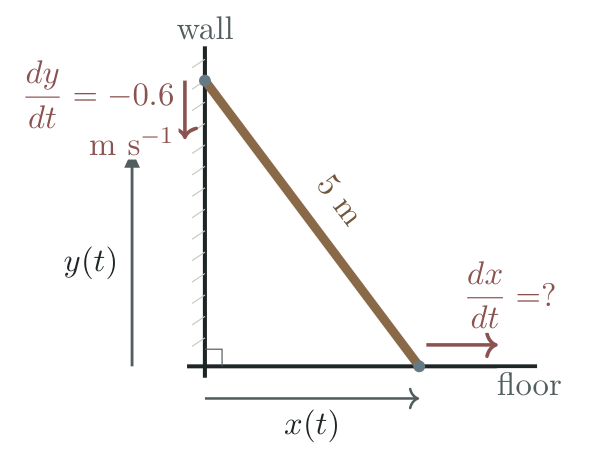
A \(5\) metre ladder rests against a vertical wall. The top of the ladder slides down the wall at a rate of \(0.6\text{ m s}^{-1}\).
Question. How fast is the base of the ladder sliding away from the wall when the top of the ladder is \(4\text{ m}\) above the ground?
We are not being asked for a length here — we are being asked for a rate.
Why this is a related-rates problem
The two distances \(x(t)\) and \(y(t)\) are both changing, but they are linked by the fixed ladder length. Their rates of change are therefore connected too. To find the unknown rate, write an equation connecting the distances and differentiate it with respect to time.
What is a related-rates problem?
A related-rates problem is a calculus problem in which two or more quantities are changing with time and are connected by an equation. Instead of asking for a value such as \(x\), \(y\), \(r\) or \(V\), the question asks for a rate such as
The chain-rule idea
If \(x\), \(y\), \(r\) or \(V\) is changing with time, then it should be thought of as a function of time. For example, \(x=x(t)\), \(y=y(t)\), \(r=r(t)\) and \(V=V(t)\). Therefore,
This is the chain rule in action. In related-rates problems, it is usually applied through implicit differentiation.
A reliable 5-step method
Draw \(\rightarrow\) Connect \(\rightarrow\) Differentiate \(\rightarrow\) Substitute \(\rightarrow\) Interpret
Draw and define. Draw a clear diagram where useful. Define the changing quantities as functions of time, such as \(x(t)\), \(y(t)\), \(r(t)\), \(V(t)\).
Connect the variables. Write an equation connecting the quantities. This might use Pythagoras, area, volume, trigonometry or similar triangles.
Differentiate with respect to time. Differentiate the whole equation with respect to \(t\), using implicit differentiation and the chain rule.
Substitute the instant values and rates. Substitute only after differentiating, because the variables are changing.
Solve and interpret. Solve for the required rate. Include units and explain the sign: positive means increasing, negative means decreasing.
Common trap
Do not substitute the instant values too early. In a ladder problem, if you write \(3^2+4^2=25\) before differentiating, then differentiating gives \(0=0\), which has lost the changing relationship. Keep \(x\) and \(y\) as variables until after differentiation.
Worked example 1: sliding ladder
Example 1
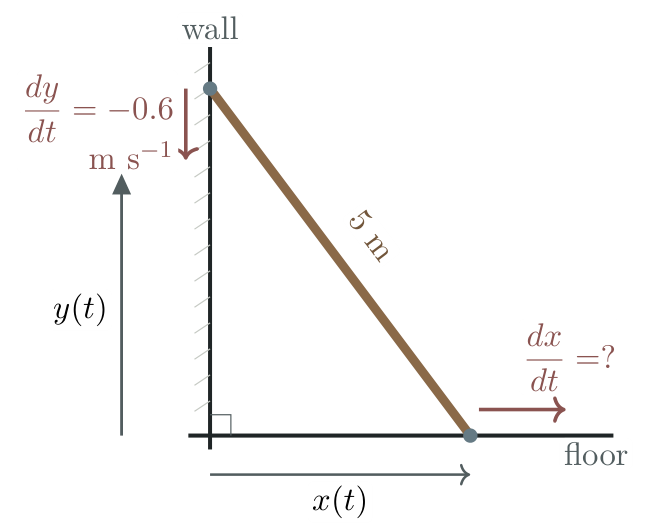
A \(5\) metre ladder rests against a vertical wall. The top of the ladder slides down the wall at a rate of \(0.6\text{ m s}^{-1}\). Find the rate at which the base of the ladder is sliding away from the wall when the top of the ladder is \(4\text{ m}\) above the ground.
Solution
Step 1: Draw and define. Let \(x(t)\) be the distance of the base from the wall and let \(y(t)\) be the height of the top of the ladder.
Step 2: Connect the variables. The ladder length is constant, so Pythagoras gives
At the instant described, \(y=4\), so
Step 3: Differentiate with respect to time.
Step 4: Substitute the instant values and rates. Since the top slides down, \(\dfrac{dy}{dt}=-0.6\):
Therefore,
Step 5: Interpret.
Answer: The base of the ladder is sliding away from the wall at \(0.8\text{ m s}^{-1}\). The answer is positive because \(x(t)\) is increasing.
Worked example 2: balloon being inflated
Example 2
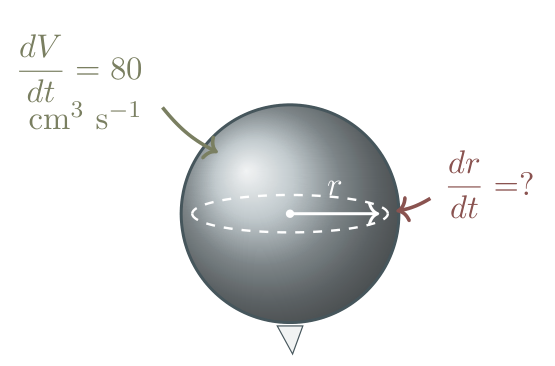
A spherical balloon is inflated using a pump that adds air at a rate of \(80\text{ cm}^3\text{ s}^{-1}\). Find the rate at which the radius is increasing when the radius is \(5\text{ cm}\).
Solution
Step 1: Draw and define. The radius \(r=r(t)\) and volume \(V=V(t)\) are changing with time.
Step 2: Connect the variables. For a sphere,
Step 3: Differentiate with respect to time.
Step 4: Substitute the instant values and rates.
Therefore,
Step 5: Interpret.
Answer: The radius is increasing at \(\frac{4}{5\pi}\text{ cm s}^{-1}\), approximately \(0.255\text{ cm s}^{-1}\).
Useful relationships to recognise
Common models in related rates
Pythagoras: \(x^2+y^2=L^2\)
Circle area: \(A=\pi r^2\)
Sphere volume: \(V=\dfrac{4}{3}\pi r^3\)
Cylinder volume: \(V=\pi r^2h\)
Cone volume: \(V=\dfrac{1}{3}\pi r^2h\)
Distance: \(s^2=x^2+y^2\)
Trigonometry: \(\sin\theta\), \(\cos\theta\), \(\tan\theta\)
Similar triangles: use ratios to remove an extra variable.
Before differentiating
If an equation contains too many variables, try to use a constraint first. For example, in a conical tank problem, similar triangles can often be used to express \(r\) in terms of \(h\), so that the volume equation contains only one changing length.
Practice
Try these without looking at the answers first
A \(10\text{ m}\) ladder rests against a wall. The top slides down at \(0.5\text{ m s}^{-1}\). Find the velocity of the base when the top is \(8\text{ m}\) above the ground.
A \(13\text{ m}\) ladder rests against a wall. The base is sliding away from the wall at \(0.4\text{ m s}^{-1}\). Find the rate at which the top slides down when the base is \(5\text{ m}\) from the wall.
The radius of a circle is increasing at \(0.4\text{ cm s}^{-1}\). Find \(\dfrac{dA}{dt}\) when \(r=12\text{ cm}\).
A spherical balloon is being inflated at a rate of \(500\text{ cm}^3\text{ s}^{-1}\). Find \(\dfrac{dr}{dt}\) when \(r=8\text{ cm}\).
A spherical object is melting so that its volume decreases at \(24\pi\text{ cm}^3\text{ min}^{-1}\). Find \(\dfrac{dr}{dt}\) when \(r=3\text{ cm}\).
A point moves on the curve \(x^2+y^2=100\) in the first quadrant. If \(\dfrac{dx}{dt}=2\), find \(\dfrac{dy}{dt}\) when \(x=6\).
A plane flies horizontally at an altitude of \(1\text{ km}\) away from an observer at \(0.25\text{ km min}^{-1}\). How fast is the distance from the observer to the plane increasing when the horizontal distance is \(3\text{ km}\)?
A conical tank has height \(9\text{ m}\) and top radius \(3\text{ m}\). Water depth is rising at \(0.25\text{ m min}^{-1}\). Find \(\dfrac{dV}{dt}\) when the water is \(4\text{ m}\) deep.
Challenge. A \(13\text{ m}\) ladder slides with its base moving away from the wall at \(0.7\text{ m s}^{-1}\). Let \(\theta\) be the angle between the ladder and the ground. Find \(\dfrac{d\theta}{dt}\) when the base is \(5\text{ m}\) from the wall.
Answer key
Solutions
Let \(x\) be the base distance and \(y\) the height. Then \(x^2+y^2=100\). When \(y=8\), \(x=6\). Since \(\dfrac{dy}{dt}=-0.5\),
\[\begin{gathered}2x\dfrac{dx}{dt}+2y\dfrac{dy}{dt}=0 \\\quad\Rightarrow\quad 12\dfrac{dx}{dt}+16(-0.5)=0.\end{gathered}\]Hence \(\dfrac{dx}{dt}=\dfrac{2}{3}\text{ m s}^{-1}\). The base moves away from the wall.
\(x^2+y^2=169\). When \(x=5\), \(y=12\). Since \(\dfrac{dx}{dt}=0.4\),
\[\begin{gathered}2(5)(0.4)+2(12)\dfrac{dy}{dt}=0 \\\quad\Rightarrow\quad \dfrac{dy}{dt}=-\frac{1}{6}\text{ m s}^{-1}.\end{gathered}\]The top slides down at \(\dfrac{1}{6}\text{ m s}^{-1}\).
\(A=\pi r^2\), so
\[\begin{gathered}\dfrac{dA}{dt}=2\pi r\dfrac{dr}{dt}\\=2\pi(12)(0.4)\\=9.6\pi\text{ cm}^2\text{ s}^{-1}\end{gathered}\].
\(V=\dfrac43\pi r^3\), so \(\dfrac{dV}{dt}=4\pi r^2\dfrac{dr}{dt}\). Therefore
\[\begin{gathered}500=4\pi(8)^2\dfrac{dr}{dt} \\\quad\Rightarrow\quad \dfrac{dr}{dt}=\frac{125}{64\pi}\text{ cm s}^{-1}.\end{gathered}\]\(\dfrac{dV}{dt}=-24\pi\). Since \(\dfrac{dV}{dt}=4\pi r^2\dfrac{dr}{dt}\),
\[\begin{gathered}-24\pi=4\pi(3)^2\dfrac{dr}{dt} \\\quad\Rightarrow\quad \dfrac{dr}{dt}=-\frac{2}{3}\text{ cm min}^{-1}.\end{gathered}\]
Solutions 6–9
When \(x=6\), \(y=8\). Differentiate \(x^2+y^2=100\):
\[2x\dfrac{dx}{dt}+2y\dfrac{dy}{dt}=0.\]Hence
\[\begin{gathered}2(6)(2)+2(8)\dfrac{dy}{dt}=0 \\\quad\Rightarrow\quad \dfrac{dy}{dt}=-\frac32.\end{gathered}\]The \(y\)-coordinate is decreasing at \(1.5\) units per unit of time.
Let \(x\) be the horizontal distance and \(s\) the distance from the observer. Then \(s^2=x^2+1\). Differentiate:
\[2s\dfrac{ds}{dt}=2x\dfrac{dx}{dt}.\]When \(x=3\), \(s=\sqrt{10}\), so
\[\begin{gathered}\dfrac{ds}{dt}=\frac{x}{s}\dfrac{dx}{dt}\\=\frac{3}{\sqrt{10}}\cdot\frac14\\=\frac{3}{4\sqrt{10}}\text{ km min}^{-1}.\end{gathered}\]Similar triangles give \(\dfrac{r}{h}=\dfrac{3}{9}=\dfrac13\), so \(r=\dfrac{h}{3}\). Then
\[V=\frac13\pi\left(\frac{h}{3}\right)^2h=\frac{\pi}{27}h^3.\]Therefore
\[\dfrac{dV}{dt}=\frac{\pi}{9}h^2\dfrac{dh}{dt}.\]At \(h=4\), \(\dfrac{dh}{dt}=0.25=\frac14\), giving
\[\begin{gathered}\dfrac{dV}{dt}=\frac{\pi}{9}(16)\left(\frac14\right)\\=\frac{4\pi}{9}\text{ m}^3\text{ min}^{-1}.\end{gathered}\]With ladder length \(13\), \(\cos\theta=\dfrac{x}{13}\). Differentiate with respect to time:
\[-\sin\theta\dfrac{d\theta}{dt}=\frac{1}{13}\dfrac{dx}{dt}.\]When \(x=5\), the height is \(12\), so \(\sin\theta=\dfrac{12}{13}\). Thus
\[\begin{gathered}-\frac{12}{13}\dfrac{d\theta}{dt}=\frac{0.7}{13} \\\quad\Rightarrow\quad \dfrac{d\theta}{dt}=-\frac{0.7}{12}\\=-\frac{7}{120}\text{ rad s}^{-1}.\end{gathered}\]The angle is decreasing.