IB Mathematics: Analysis and Approaches SL/HL — Topic 5 Calculus
Integration by Substitution
Recognise the inside function and its matching derivative, then change variable completely so the integral becomes standard.
Learning goal
Recognise the SL 5.10 product pattern, define \(u\), form \(du\), rewrite the entire integral in \(u\), then integrate and complete the answer correctly.
Syllabus link
SL 5.10 Integration by substitution and reverse chain rule.
Big idea
Substitution is a change of variable. Integration by inspection is the same mathematical method carried out mentally.
Target pattern
\(\displaystyle \int k\,g'(x)f(g(x))\,dx\).
What kind of integral is this method for?
At AA SL, the integrand is a product of two functions: a function of an inside expression \(g(x)\), and \(g'(x)\) or a constant multiple of it.
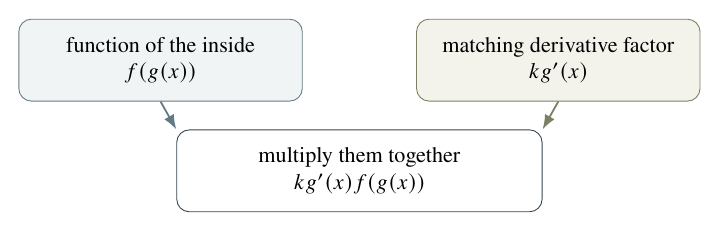
For example, \(\int2x(x^2+1)^4\,dx\) contains \((x^2+1)^4\) and the derivative of its inside expression, since \(\dfrac{d}{dx}(x^2+1)=2x\).
Important precision
Not every product is a direct substitution integral. In \(\int xe^x\,dx\), neither factor is the derivative of an inner expression inside the other factor. Integration by parts, an AA HL method, is appropriate here.
The product may also be hidden:
Why “integration by changing the variable” is a better description
We are dealing with \(\int2x(x^2+1)^4\,dx\). The repeated inside expression is \(x^2+1\). Define the new variable clearly:
The variable of integration has genuinely changed: the original integral is written entirely in \(x\), while the new integral is written entirely in \(u\).

The language of the method
We still use the standard names integration by substitution and u-substitution. Remember what they mean: we change the variable of integration from \(x\) to \(u\).
The practical method
The five-step u-substitution method
- Define the new variable. Let \(u\) equal the repeated inside expression.
- Differentiate. Find \(du/dx\), then write \(du=g'(x)\,dx\).
- Rewrite completely. Replace the inside expression and the matching differential factor so that no \(x\) remains. For a definite integral completed in \(u\), also change its limits to \(u\)-values.
- Integrate with respect to u. Use the relevant standard integral.
- Complete the answer. For an indefinite integral, return to \(x\) and include \(+C\). For a definite integral completed in \(u\), evaluate with the new \(u\)-limits and do not include \(+C\).
Worked example 1: the exact SL 5.10 product pattern
Find \(\int2x(x^2+1)^4\,dx\).
Solution
Rearrange the factors and identify exactly what each part becomes:
U-substitution Video 1
Use this tutorial after learning to identify the inside expression, form \(du\), and change the integral completely into \(u\).
When the matching derivative differs by a constant
The derivative factor does not need to match perfectly at first. A constant can be taken outside the integral or absorbed into \(du\).
Worked example 2: adjusting a constant factor
Find \(\int4x\sin(x^2)\,dx\).
Solution
Worked example 3: an exponential composite
Find \(\int3x^2e^{x^3-2}\,dx\).
Solution
Do not leave a mixture of x and u
After changing variables, \(\int2xu^4\,du\) is not valid progress: the differential is \(du\), but the integrand still contains \(x\). The whole integral must be written in one variable.
The logarithmic pattern
Indeed, let \(u=g(x)\). Then \(du=g'(x)\,dx\), so
Work on an interval where \(g(x)\ne0\).
Worked example 4: using the logarithmic shortcut and the five-step method
Find \(\int\frac{\sin x}{\cos x}\,dx\).
Solution
Quick method: use the logarithmic pattern.
Let \(g(x)=\cos x\), so \(g'(x)=-\sin x\). The numerator is \(\sin x=-g'(x)\). Therefore
Now use the full five-step method to obtain the same result.
Write the quotient as a product, then replace both factors:
Why the shortcut is useful
The five steps explain why the result works. Once the logarithmic pattern is familiar, identify \(g(x)\), compare the numerator with \(g'(x)\), and adjust any constant or sign.
Worked example 5: a hidden product and a constant adjustment
Find \(\int\frac6{3x+2}\,dx\).
Solution
Write the quotient as \(6\left(\dfrac1{3x+2}\right)\).
Integration by inspection is still u-substitution
Sometimes the pattern is so clear that we can write the answer immediately. This is called integration by inspection or using the reverse chain rule. For example,
Technically, let \(u=x^3+1\), so \(du=3x^2\,dx\). This change of variable is still the mechanism; inspection carries it out mentally.
The central connection
Reverse-chain-rule inspection is a shortened form of changing the variable.
| Integral | New variable | Result by inspection |
|---|---|---|
| \(\int2x\cos(x^2)\,dx\) | \(u=x^2\) | \(\sin(x^2)+C\) |
| \(\int5e^{5x-1}\,dx\) | \(u=5x-1\) | \(e^{5x-1}+C\) |
| \(\int\frac1{3x+2}\,dx\) | \(u=3x+2\) | \(\frac13\ln|3x+2|+C\) |
U-substitution Video 2
Further examples, hidden product structures and less immediate reverse-chain-rule patterns.
Looking ahead: changing limits in a definite integral
Link to SL 5.11. Definite integrals are developed in the next section. When using substitution, the limits may be changed from \(x\)-values to their corresponding \(u\)-values.
Worked example 6: two valid routes for a definite integral
Find \(\int_0^1\frac{2x}{x^2+3}\,dx\).
Solution
Before choosing either option, identify the two replacements:
Option 1: change the limits and complete the calculation in u
| x | u = x² + 3 |
|---|---|
| 0 | 3 |
| 1 | 4 |
Once the limits are changed to \(u\)-values, there is no need to change back to \(x\).
Option 2: return to x, then use the original x-limits
You may instead obtain an antiderivative in \(x\) before applying the original bounds.
Temporarily write the integral without limits:
Since \(u=x^2+3>0\), the antiderivative is \(\ln(x^2+3)+C\). Therefore
Both options are correct. Option 1 changes the limits and remains entirely in \(u\); Option 2 returns to \(x\) before the original \(x\)-limits are used. There is no \(+C\) in the final answer to a definite integral.
Do not mix the two routes
Use one route consistently. Do not put the original \(x\)-limits on an integral written in \(u\), or use new \(u\)-limits with an antiderivative that you have changed back to \(x\).
Definite integrals with u-substitution
Compare evaluating entirely in \(u\) with returning to an antiderivative in \(x\) before using the original limits.
How to define the new variable u
A useful definition of \(u\) normally satisfies three tests:
- \(u\) is a repeated or clearly nested expression.
- The derivative of \(u\) appears elsewhere as another factor, perhaps multiplied by a constant.
- After substitution, every \(x\) disappears and the new integral is simpler.
| Integral | Let | Reason |
|---|---|---|
| \(\int7x(x^2-4)^9\,dx\) | \(u=x^2-4\) | The derivative \(2x\) matches \(7x\) up to a constant. |
| \(\int\cos x\,e^{\sin x}\,dx\) | \(u=\sin x\) | The derivative of \(\sin x\) is \(\cos x\). |
| \(\int\frac{x^2}{x^3+5}\,dx\) | \(u=x^3+5\) | The derivative \(3x^2\) is present up to a constant. |
Common mistakes and a final check
Common mistakes
- Defining \(u\) but failing to replace every occurrence of \(x\).
- Forgetting the constant needed to match \(du\).
- Treating \(dx\) as decoration.
- Forgetting to return to \(x\) and add \(+C\) for an indefinite integral.
- Adding \(+C\) to a definite integral.
- Writing \(\ln(g(x))\) instead of \(\ln|g(x)|\) when sign is unknown.
The quickest reliable check
Differentiate your final answer. The chain rule should reconstruct the original product:
Differentiation uses the chain rule; integration reverses it by changing the variable.
Practice
A. Identify the change of variable
Complete a statement “Let \(u=\cdots\)” and write \(du\).
- \(\int8x(4x^2+1)^7dx\)
- \(\int\cos x\,e^{\sin x}dx\)
- \(\int\frac{x^2}{x^3+5}dx\)
- \(\int\sin(3x)dx\)
B. Evaluate
- \(\int8x(4x^2+1)^7dx\)
- \(\int\cos x\,e^{\sin x}dx\)
- \(\int\frac{x^2}{x^3+5}dx\)
- \(\int6x\cos(3x^2)dx\)
- \(\int\frac{2x}{(x^2+4)^2}dx\)
- \(\int3x^2\sqrt{x^3+1}dx\)
- \(\int e^{2x+1}dx\)
- \(\int\frac{\sin x}{\cos x}dx\)
C. Explain
- Why is \(\int xe^x dx\) not a direct SL 5.10 substitution integral?
- A student lets \(u=x^2+1\) in \(\int2x(x^2+1)^4dx\), then writes \(\int2xu^4du\). Identify the error.
Answer key
Show answers 1–14
A
- \(u=4x^2+1,\ du=8x dx\)
- \(u=\sin x,\ du=\cos x dx\)
- \(u=x^3+5,\ du=3x^2dx\)
- \(u=3x,\ du=3dx\)
This integral can also be evaluated by inspection.
B
- \((4x^2+1)^8/8+C\)
- \(e^{\sin x}+C\)
- \(\frac13\ln|x^3+5|+C\)
- \(\sin(3x^2)+C\)
- \(-1/(x^2+4)+C\)
- \(\frac23(x^3+1)^{3/2}+C\)
- \(\frac12e^{2x+1}+C\)
- \(-\ln|\cos x|+C\)
C
- Letting \(u=x\) does not simplify \(xe^x\), while letting \(u=e^x\) does not directly remove the remaining \(x\) factor. It is not a direct matching-derivative integral of the SL 5.10 form; integration by parts is needed.
- \(du=2x dx\), so the whole factor \(2x dx\) must be replaced: \(\int2x(x^2+1)^4dx=\int u^4du\).
Quick reference and related tutorials
One-minute summary
- Look for a function of \(g(x)\) multiplied by a constant multiple of \(g'(x)\).
- Let \(u=g(x)\), then replace \(g'(x)\,dx\) by \(du\).
- The transformed integral must contain only \(u\) and \(du\).
- For an indefinite integral, integrate in \(u\), return to \(x\), and include \(+C\).
- For a definite integral, either change the limits and remain in \(u\), or return to an antiderivative in \(x\) before applying the original \(x\)-limits.
- Reverse-chain-rule inspection is the same change of variable carried out mentally.
- U-substitution Video 1 — identifying u, forming du and changing the variable completely.
- U-substitution Video 2 — further examples and hidden product structures.
- Definite integrals with u-substitution — both valid routes for definite integrals.