IB Mathematics: Analysis and Approaches SL/HL — Topic 5 Calculus
Definite Integrals — Evaluation and Properties
Evaluate definite integrals analytically, then use reversing limits, interval splitting, linearity and symmetry efficiently.
Learning goal
Evaluate definite integrals using antiderivatives and the Newton–Leibniz formula, then exploit the main structural properties of definite integrals.
Syllabus link
SL 5.11 Definite integrals and their properties.
Big idea
A definite integral is an accumulation with limits. Unlike an indefinite integral, it evaluates to a number and has no arbitrary constant.
Key formula
If \(F'(x)=f(x)\), then \(\displaystyle\int_a^b f(x)\,dx=F(b)-F(a)\).
Definite Integrals Part 1 — Evaluating Definite Integrals
Use the full Radford Mathematics lesson to review the handout. Pause after each example, try the next line yourself, then check the solution.
Definite integral notation
After learning about antiderivatives, we now introduce definite integrals. A definite integral has limits and gives a single value.
How to read the notation
Read this as: the definite integral, from \(a\) to \(b\), of \(f(x)\), with respect to \(x\).
| \(a\) | lower limit; the value used in \(F(a)\). |
| \(b\) | upper limit; the value used in \(F(b)\). |
| \(f(x)\) | integrand; the function being integrated. |
| \(\,d x\) | tells us that the variable of integration is \(x\). |
Focus of this handout
This first set of notes is about how to evaluate a definite integral. We are not yet focusing on its interpretation as a signed area.
The Newton–Leibniz formula
If \(F\) is an antiderivative, or primitive, of \(f\), then \(F'(x)=f(x)\).
Newton–Leibniz formula
This is also called the evaluation theorem. The order matters: upper limit first, then subtract lower limit.
The two-step method
Step 1. Find an antiderivative \(F(x)\) of the integrand \(f(x)\).
Step 2. Evaluate \(F(b)-F(a)\).
For definite integrals, you do not need to include the constant of integration \(C\) in the final evaluation line. It cancels when calculating \(F(b)-F(a)\).
Worked examples
Worked example 1: constant of integration cancels
Question. Evaluate
Solution
First find an antiderivative:
Now use the Newton–Leibniz formula:
Answer: \(10\)
Notice that the constant \(C\) cancels. This is why we usually omit \(+C\) when evaluating a definite integral.
Worked example 2: polynomial integrand
Question. Evaluate
Solution
Answer: \(\dfrac{14}{3}\)
Worked example 3: trigonometric integrand
Question. Evaluate
Solution
Since \(\dfrac{\mathrm d}{\mathrm dx}(-\cos x)=\sin x\), an antiderivative of \(\sin x\) is \(-\cos x\).
Answer: \(2\)
Radians
For calculus with trigonometric functions, angles are in radians unless stated otherwise.
Worked example 4: expand first
Question. Evaluate
Solution
There is no simple product rule for integration, so first expand:
Then evaluate:
Answer: \(\dfrac{41}{6}\)
Worked example 5: exponential integrand
Question. Evaluate
Solution
Answer: \(e-1\)
Exact answers
Leave \(e-1\) exact unless the question asks for a decimal approximation.
Common mistakes checklist
Wrong order
Use \(F(b)-F(a)\), not \(F(a)-F(b)\).
Missing brackets
Subtract the entire lower-limit value, especially when it is negative.
Adding \(+C\) at the end
A definite integral has a number as its answer, not a family of functions.
Product expressions
For expressions like \(x(x+3)\), expand first if no substitution method is being used.
Quick self-check
After evaluating a definite integral, ask:
Did I integrate before substituting?
Did I subtract lower from upper?
Did I use brackets around the lower-limit substitution?
Did I leave the final answer as a number, without \(+C\)?
Essential properties at a glance
| Property | Meaning |
|---|---|
| Zero-width interval | \(\int_a^a f(x)\,dx=0\). There is no horizontal width, so there is no area. |
| Reversing limits | \(\int_a^b f(x)\,dx=-\int_b^a f(x)\,dx\). Changing direction changes the sign. |
| Splitting an interval | \(\int_a^c f(x)\,dx=\int_a^b f(x)\,dx+\int_b^c f(x)\,dx\). Area can be added in pieces. |
| Linearity | \(\int_a^b(\lambda f(x)+\mu g(x))\,dx=\lambda\int_a^bf(x)\,dx+\mu\int_a^bg(x)\,dx\). Constants can be pulled out and sums separated. |
| Even symmetry | If \(f\) is even, \(\int_{-a}^af(x)\,dx=2\int_0^af(x)\,dx\). |
| Odd symmetry | If \(f\) is odd, \(\int_{-a}^af(x)\,dx=0\). |
Zero-width intervals and reversing limits
Zero-width interval
No matter how complicated \(f\) is, the interval from \(a\) to \(a\) has width zero.
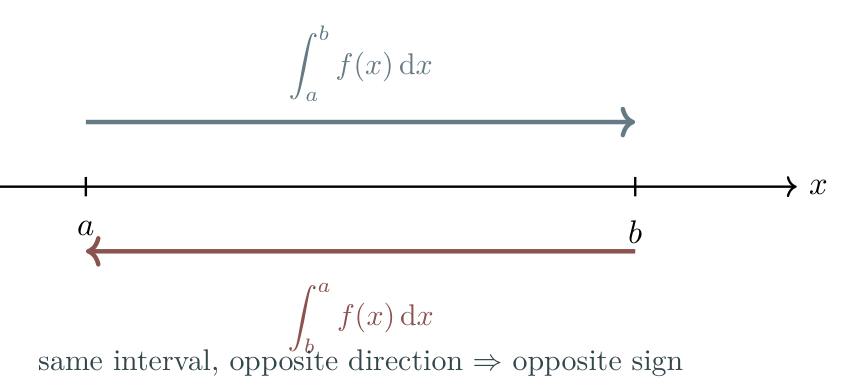
Reversing the limits
The same signed area is being measured in the opposite direction.
Splitting intervals
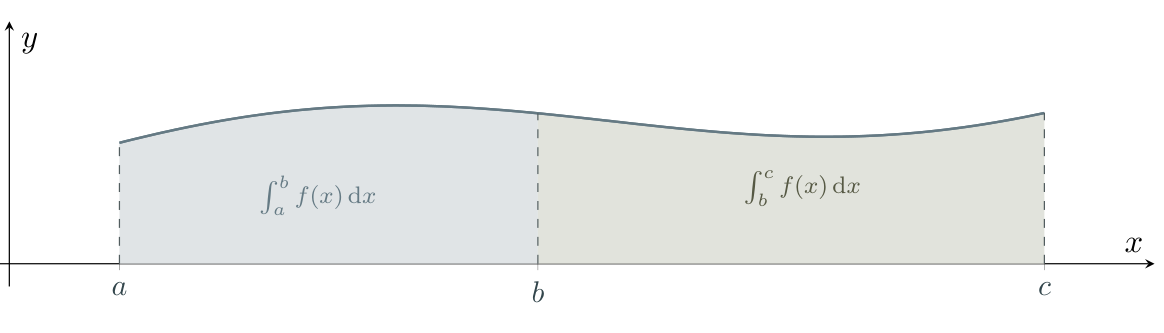
If \(b\) lies between \(a\) and \(c\), then
This is one of the most useful properties in IB questions because it allows you to break a problem into simpler pieces.
IB exam habit
When the graph changes sign, or when the upper curve changes in an area-between-curves question, split the interval at the relevant point.
Linearity and constant multiples
Linearity lets us work with sums, differences and constant multiples:
Worked example: using linearity
Suppose \(\int_1^4f(x)\,dx=7\) and \(\int_1^4g(x)\,dx=-2\). Find \(\int_1^4(3f(x)-5g(x))\,dx\).
Solution
Common mistake
You may split sums and constant multiples, but you may not split products in the same way:
Symmetry properties
Symmetry can make integrals much faster, especially over intervals of the form \([-a,a]\).
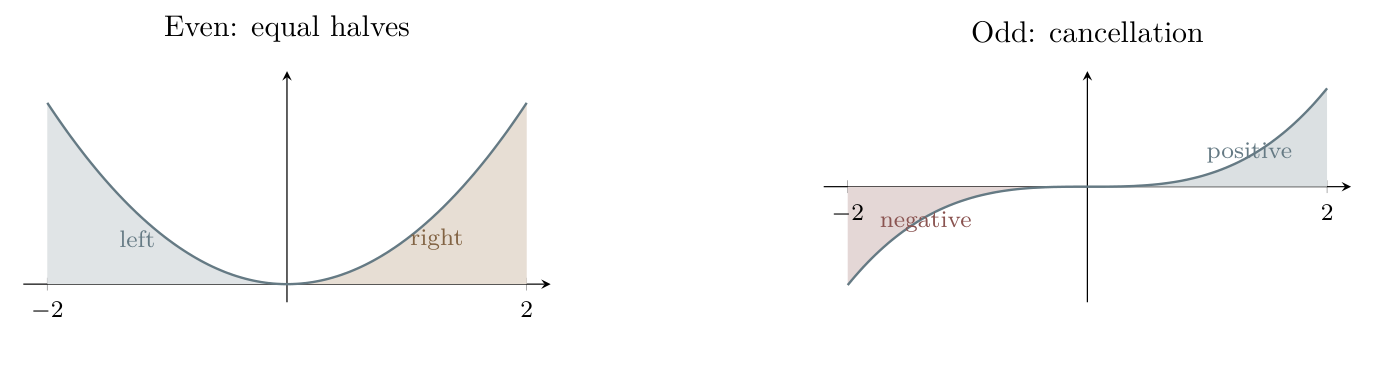
Even functions
If \(f(-x)=f(x)\), the graph is symmetric about the \(y\)-axis.
Odd functions
If \(f(-x)=-f(x)\), the graph has rotational symmetry about the origin.
Worked example: a mixture of odd and even functions
Evaluate \(\int_{-2}^2(x^3+2x^2)\,dx\).
Solution
Split the integrand into an odd part and an even part:
The function \(x^3\) is odd, so \(\int_{-2}^2x^3\,dx=0\). The function \(2x^2\) is even, so
Answer: \(\boxed{\frac{32}{3}}\).
Worked examples using properties
Example 1: reversing limits
If \(\int_2^5f(x)\,dx=11\), find \(\int_5^2f(x)\,dx\) and \(\int_2^2f(x)\,dx\).
Solution
Reverse the limits to change the sign; an interval of zero width gives zero.
Example 2: splitting an interval
Suppose \(\int_0^6f(x)\,dx=18\) and \(\int_0^2f(x)\,dx=5\). Find \(\int_2^6f(x)\,dx\).
Solution
Substitute the two known values:
Example 3: analytical evaluation
Evaluate \(\int_0^2(3x^2-4x+1)\,dx\).
Solution
Example 4: kinematics interpretation
A particle has velocity \(v(t)=t^2-4t+3\) metres per second for \(0\le t\le4\). Find its displacement from \(t=0\) to \(t=4\).
Solution
Displacement is signed area under the velocity–time graph:
The displacement is \(\boxed{\frac43\text{ metres}}\). This is not the total distance travelled; for total distance, split where \(v(t)=0\) or use \(\int_0^4|v(t)|\,dt\).
IB-style checklist
Before calculating, ask yourself:
- Are the limits in the correct order?
- Can the interval be split into useful pieces?
- Is the question asking for a signed integral or a total geometrical area?
- Does the function cross the \(x\)-axis?
- Can I use linearity to simplify the integrand?
- Is the interval symmetric, such as \([-a,a]\)?
- Is the integrand even, odd, or a mixture of both?
- In context, what are the units of the integral?
Common mistakes to avoid
- Forgetting that reversing limits changes the sign.
- Treating signed area as total area.
- Failing to split when the graph crosses the axis.
- Pulling apart products as if integration behaved like multiplication.
- Giving an area answer with the wrong units in an applications question.
Practice questions
Part A — Evaluation
Try these first without looking at the answers
Evaluate each definite integral.
\(\displaystyle \int_0^4(3x+2)\,d x\)
\(\displaystyle \int_1^2(x^2+2x)\,d x\)
\(\displaystyle \int_0^\pi \cos x\,d x\)
\(\displaystyle \int_1^3x(2x-1)\,d x\)
\(\displaystyle \int_0^2 e^x\,d x\)
\(\displaystyle \int_{-1}^{1}(x^3+x)\,d x\)
\(\displaystyle \int_1^9 \frac{1}{\sqrt{x}}\,d x\)
Find \(k\) if
\[\displaystyle \int_0^2(kx+1)\,d x=10\].
\(\displaystyle \int_1^e \frac{1}{x}\,d x\) (AA extension)
A machine produces items at a rate \(r(t)=3t^2+2\) items per hour. Find the total number of items produced from \(t=0\) to \(t=2\).
Part B — Properties
- Find \(\int_3^3 f(x)\,dx\).
- If \(\int_1^4f(x)\,dx=10\), find \(\int_4^1f(x)\,dx\).
- If \(\int_0^6f(x)\,dx=18\) and \(\int_0^2f(x)\,dx=5\), find \(\int_2^6f(x)\,dx\).
- If \(\int_{-1}^3f(x)\,dx=4\) and \(\int_{-1}^3g(x)\,dx=-2\), find \(\int_{-1}^3(3f(x)-2g(x))\,dx\).
- Evaluate \(\int_0^2(3x^2-4x+1)\,dx\).
- Evaluate \(\int_{-2}^2x^3\,dx\). Explain your reasoning without using an antiderivative.
- Use symmetry to evaluate \(\int_{-3}^3(x^2+1)\,dx\).
- Explain why \(\int_{-1}^1(x^2-1)\,dx=-\frac43\) is not the total area between \(y=x^2-1\) and the \(x\)-axis on \([-1,1]\). What is the total area?
- A velocity function is \(v(t)=2t-6\), measured in metres per second, for \(0\le t\le5\). Find the displacement over this interval.
Answer key
Part A — Evaluation
Worked answers
- \[\displaystyle \int_0^4(3x+2)\,d x=\left[\frac{3x^2}{2}+2x\right]_0^4=\left(24+8\right)-0=32.\]
- \[\displaystyle \int_1^2(x^2+2x)\,d x=\left[\frac{x^3}{3}+x^2\right]_1^2=\left(\frac{8}{3}+4\right)-\left(\frac{1}{3}+1\right)=\frac{16}{3}.\]
- \[\displaystyle \int_0^\pi\cos x\,d x=\left[\sin x\right]_0^\pi=\sin\pi-\sin0=0.\]
First expand: \(x(2x-1)=2x^2-x\).
\[\int_1^3x(2x-1)\,d x=\left[\frac{2x^3}{3}-\frac{x^2}{2}\right]_1^3 =\left(18-\frac92\right)-\left(\frac23-\frac12\right)=\frac{40}{3}.\]- \[\displaystyle \int_0^2e^x\,d x=\left[e^x\right]_0^2=e^2-1.\]
- \[\displaystyle \int_{-1}^{1}(x^3+x)\,d x=\left[\frac{x^4}{4}+\frac{x^2}{2}\right]_{-1}^{1}=\left(\frac14+\frac12\right)-\left(\frac14+\frac12\right)=0.\]
- \[\displaystyle \int_1^9x^{-1/2}\,d x=\left[2\sqrt{x}\right]_1^9=6-2=4.\]
- \[\displaystyle \int_0^2(kx+1)\,d x=\left[\frac{kx^2}{2}+x\right]_0^2=2k+2.\]
So \(2k+2=10\), hence \(k=4\).
- \[\displaystyle \int_1^e\frac{1}{x}\,d x=\left[\ln x\right]_1^e=1-0=1.\]
- \[\displaystyle \int_0^2(3t^2+2)\,d t=\left[t^3+2t\right]_0^2=8+4=12.\]
The machine produces \(12\) items in total.
Part B — Properties
- \[\int_3^3 f(x)\,dx=0.\]
The interval has zero width.
- \[\int_4^1 f(x)\,dx=-\int_1^4f(x)\,dx=-10.\]
By splitting,
\[\int_0^6f(x)\,dx=\int_0^2f(x)\,dx+\int_2^6f(x)\,dx.\]Hence \(18=5+\int_2^6f(x)\,dx\), so \(\int_2^6f(x)\,dx=13\).
By linearity,
\[\int_{-1}^3(3f(x)-2g(x))\,dx=3(4)-2(-2)=16.\]- \[\int_0^2(3x^2-4x+1)\,dx=[x^3-2x^2+x]_0^2=2.\]
\(x^3\) is odd and the interval is symmetric about zero. Therefore \(\int_{-2}^2x^3\,dx=0\).
\(x^2+1\) is even, so
\[\int_{-3}^3(x^2+1)\,dx=2\int_0^3(x^2+1)\,dx=2\left[\frac{x^3}{3}+x\right]_0^3=2(9+3)=24.\]On \([-1,1]\), \(x^2-1\le0\), so the signed integral is negative. The total area is
\[\int_{-1}^1|x^2-1|\,dx=-\int_{-1}^1(x^2-1)\,dx=\frac43.\]Displacement is signed area:
\[\int_0^5(2t-6)\,dt=[t^2-6t]_0^5=25-30=-5.\]The displacement is −5 metres. The final position is 5 metres in the negative direction from the starting point.