IB Mathematics: Analysis and Approaches SL/HL — Topic 5 Calculus
Limits and the Derivative
Approach a value numerically and graphically, then use the same limiting idea to understand instantaneous gradient and rate of change.
Learning goal
Estimate limits from tables and graphs, then interpret a derivative both as the gradient of a curve and as an instantaneous rate of change.
Syllabus link
IB Mathematics AA SL/HL: SL 5.1. Informal understanding of limits and the derivative; formal analytic methods for evaluating limits are not required.
Big idea
A limit describes what a function is approaching. A derivative describes what a gradient or quantity is doing at an instant.
Key relationship
\(f'(a)=\displaystyle\lim_{h\to0}\frac{f(a+h)-f(a)}{h}\) connects secant gradients with the tangent gradient.
Approaching a value: the idea of a limit
A limit is about nearby behaviour. We ask what value the output is approaching as the input gets closer and closer to a chosen number.
Limit notation
This reads: “as \(x\) approaches \(a\), \(f(x)\) approaches \(L\).” The value of \(f(a)\) itself may be different from \(L\), or \(f(a)\) may not even be defined.
At AA SL/HL, the emphasis is on understanding limits from tables, graphs and the idea of approaching a value. We are not trying to build a formal algebraic theory of limits.
Estimating a limit from a table and from a graph
Worked example 1: estimating a limit numerically
Estimate
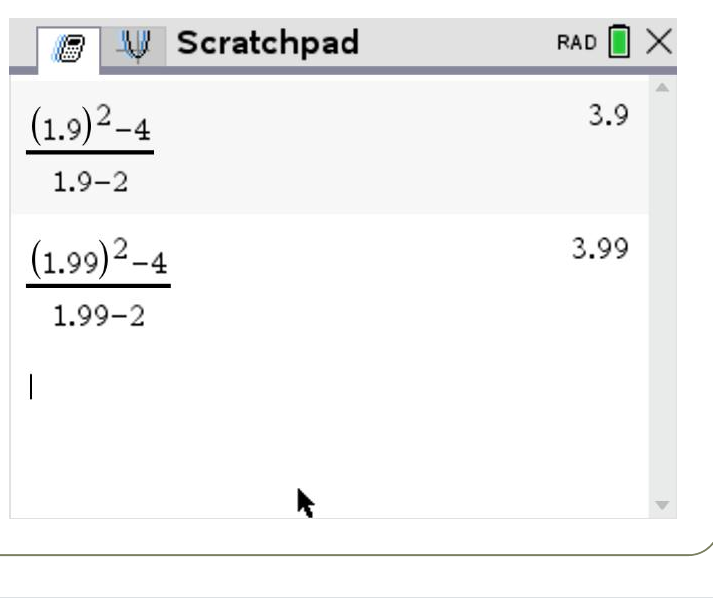
Substituting \(x=2\) gives \(\frac00\), so instead we look at values of \(x\) very close to 2 from both sides.
| \(x\) | 1.9 | 1.99 | 1.999 | 2.001 | 2.01 | 2.1 |
|---|---|---|---|---|---|---|
| \(\frac{x^2-4}{x-2}\) | 3.9 | 3.99 | 3.999 | 4.001 | 4.01 | 4.1 |
The values approach 4 from both sides, so
A limit need not equal the function value
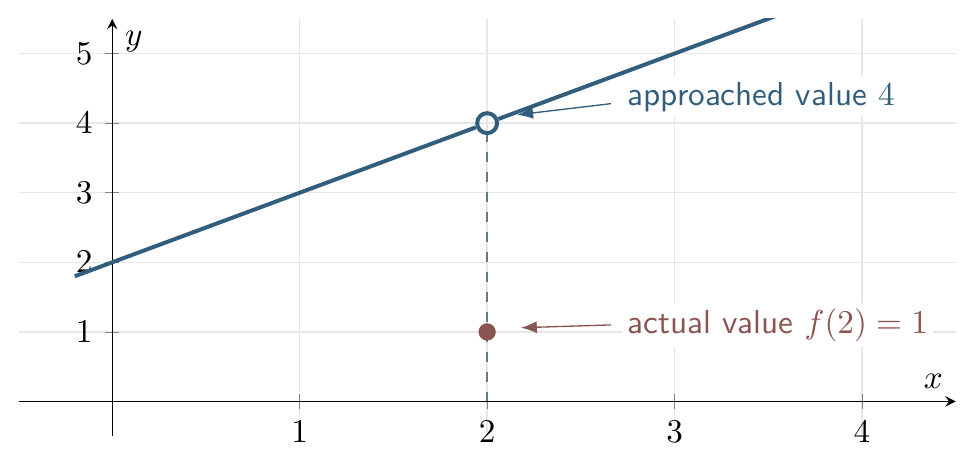
Suppose the graph approaches \(y=4\) as \(x\to2\), but the filled point at \(x=2\) is at \(y=1\). Then
The limit describes what nearby outputs approach; the function value describes the actual output at the point.
When a two-sided limit does not exist
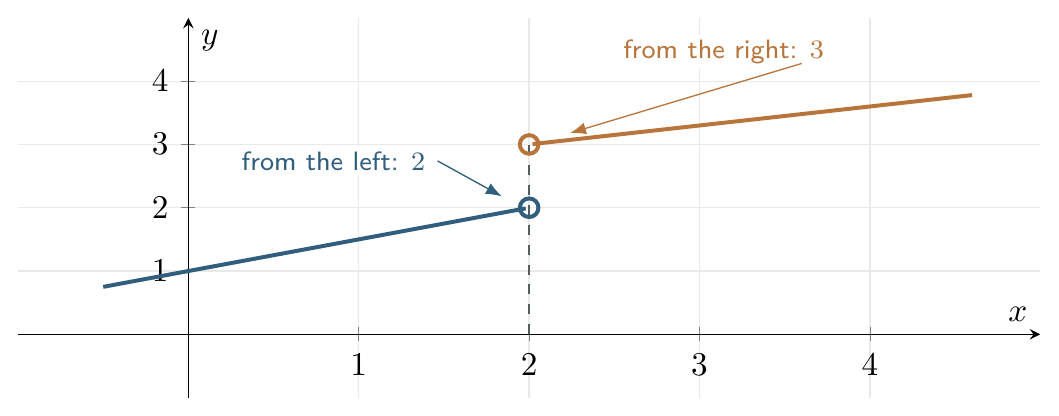
A two-sided limit exists only when the function approaches the same value from the left and from the right.
Different one-sided behaviour
If the left-hand values approach 2 while the right-hand values approach 3, there is no single number that the function approaches from both sides. Therefore the two-sided limit does not exist.
From straight-line gradient to the gradient of a curve
The derivative answers a new question: how steep is a curve at one particular point?
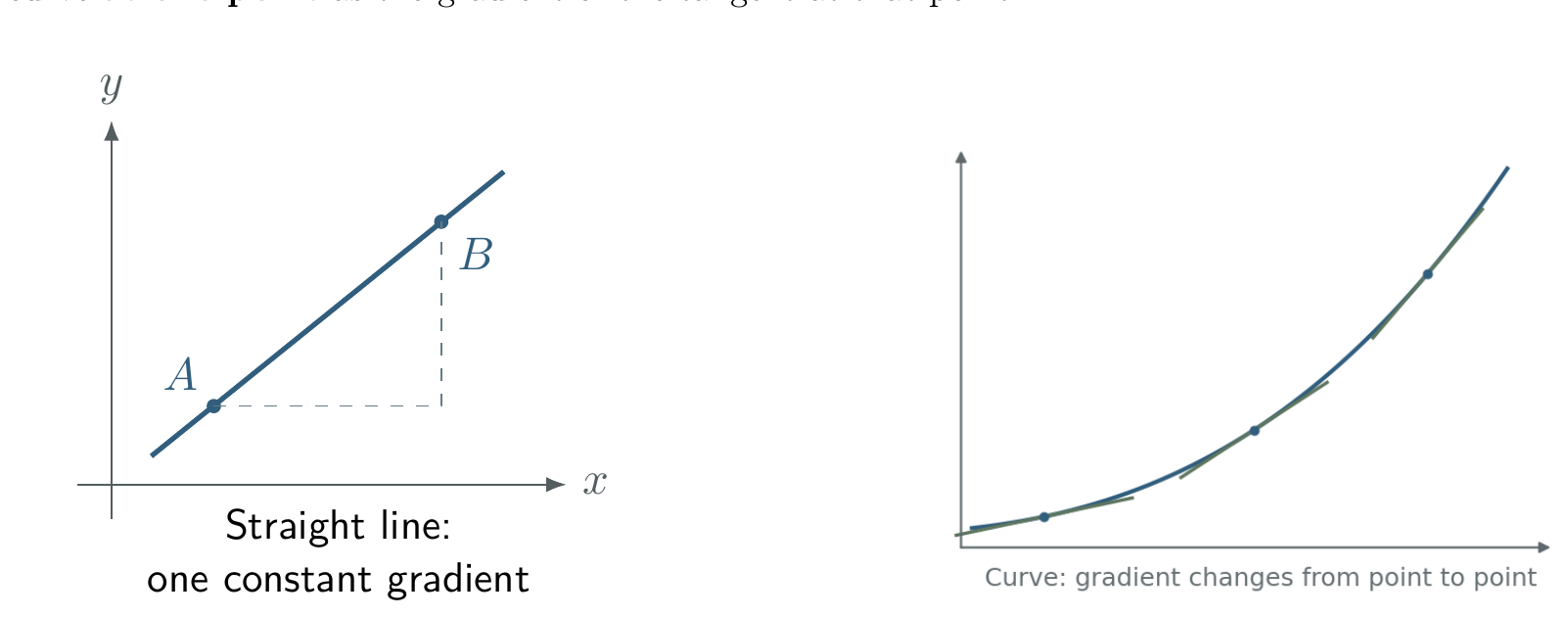
For a straight line, the gradient is constant:
For a curve, the gradient changes from point to point. At one point we measure the gradient of the tangent to the curve.
Derivative at a point
\(f'(a)\) is the gradient of the tangent to \(y=f(x)\) at \(x=a\).
The derivative as a gradient function
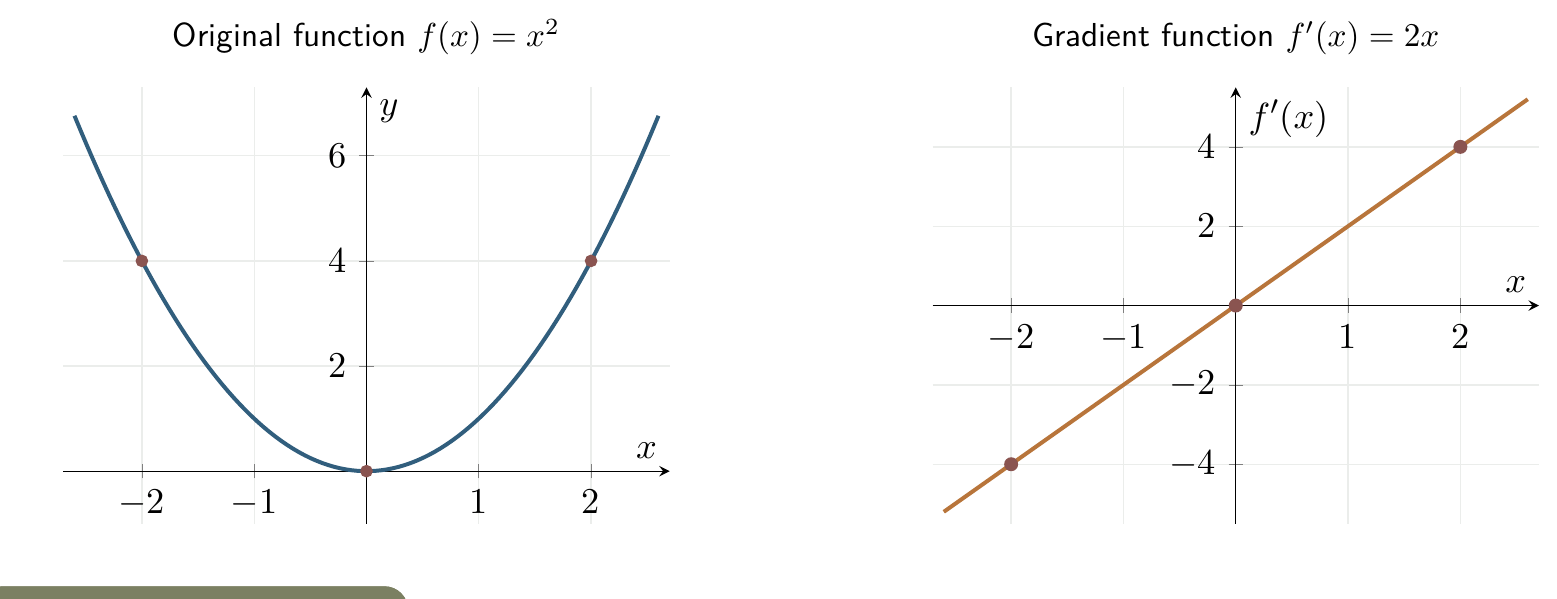
The derivative is not just a single number. If we differentiate a function, we obtain a new function that tells us the gradient everywhere.
Worked example 2: using a derivative function
For \(f(x)=x^2\), the derivative is
Therefore:
| Point | \(x=-2\) | \(x=0\) | \(x=3\) |
|---|---|---|---|
| Gradient \(f'(x)\) | -4 | 0 | 6 |
The derivative graph \(y=f'(x)=2x\) records the tangent gradient of \(y=f(x)=x^2\) at every \(x\)-value.
Limits connect secants to a tangent
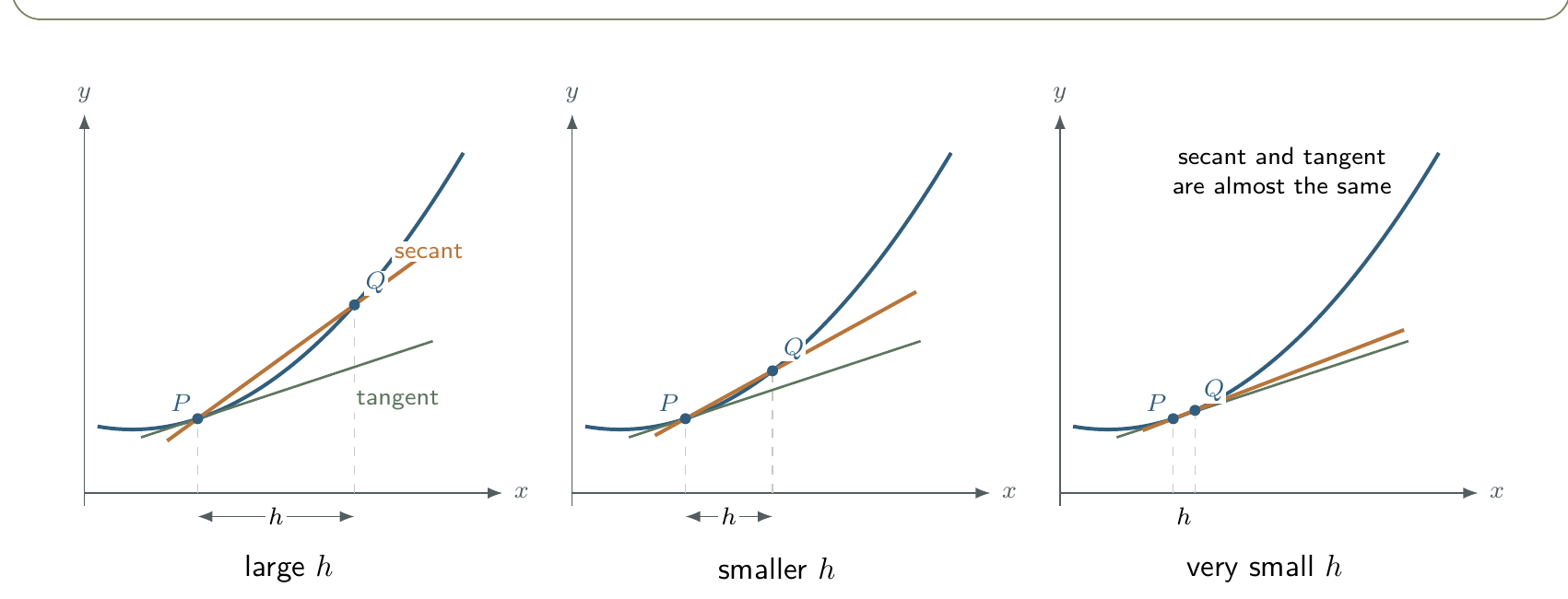
To estimate a curve's gradient at \(x=a\), start with a second nearby point at \(x=a+h\). The line joining the two points is a secant.
As \(h\) becomes smaller, the second point moves towards the first. The secant approaches the tangent, so the secant gradient approaches the derivative:
Worked example 3: estimating the gradient of \(f(x)=x^2\) at \(x=1\)
Use the secant-gradient expression with \(a=1\):
For smaller positive values of \(h\), the gradients become:
| \(h\) | 1 | 0.5 | 0.1 | 0.01 | 0.001 |
|---|---|---|---|---|---|
| Secant gradient \(2+h\) | 3 | 2.5 | 2.1 | 2.01 | 2.001 |
The values approach 2, so \(f'(1)=2\).
Video: What is a derivative?
Use this lesson to revisit the visual journey from secant gradients to the gradient of the tangent and the meaning of the derivative.
Finding a derivative at a point with the TI-Nspire CX
Technology can be used to evaluate a numerical derivative at a stated point. On calculator-allowed work, the TI-Nspire CX can evaluate \(f'(a)\) directly; on non-calculator work, use the derivative information or differentiation rules available in the question.
Calculator method
- Define or enter the function.
- Use the numerical derivative command or derivative tool.
- Evaluate the derivative at the required \(x\)-value.
- Interpret the numerical result as the gradient of the tangent, with appropriate units when the variables have units.
Video: Derivative at any point on the TI-Nspire CX
The calculator tutorial demonstrates three practical ways of obtaining a derivative value and connects the output back to the tangent gradient.
The derivative as a rate of change
The same derivative idea applies whenever one quantity changes with respect to another. Gradient becomes a rate.
Simple rate model
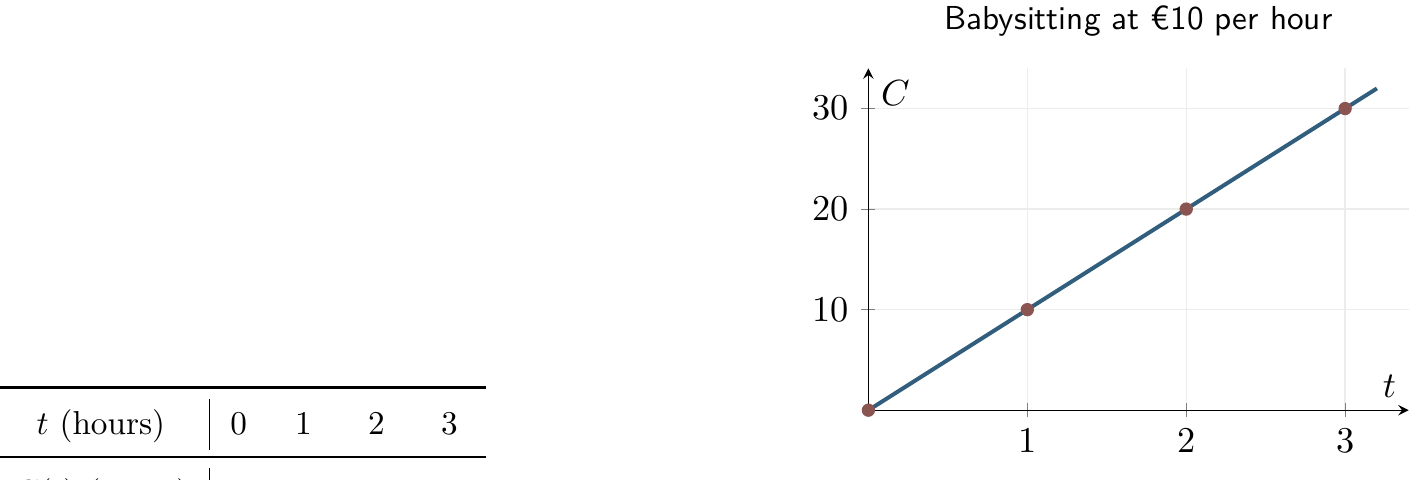
If a babysitter's total charge after \(t\) hours is \(C(t)=10t\) euros, then
The derivative has units euros per hour, so the charge is increasing at a constant rate of €10 per hour.
Worked example 4: average velocity approaching instantaneous velocity
A particle has displacement \(s(t)=t^2\) metres. The average velocity from \(t=3\) to \(t=4\) is
Now shorten the time interval:
| Interval | [3,4] | [3,3.5] | [3,3.1] | [3,3.01] | [3,3.001] |
|---|---|---|---|---|---|
| Average velocity | 7 | 6.5 | 6.1 | 6.01 | 6.001 |
As the second time approaches 3, the average velocity approaches \(6\text{ m/s}\). Therefore the instantaneous velocity at \(t=3\) is
Derivative notation and units
The derivative can be written in several equivalent ways. The notation often reflects the variables in the problem.
| Function or context | Derivative notation | Meaning |
|---|---|---|
| \(y=f(x)\) | \(f'(x)\) or \(\frac{dy}{dx}\) | change in output per unit change in \(x\) |
| Displacement \(s(t)\) | \(\frac{ds}{dt}\) | velocity |
| Volume \(V(r)\) | \(\frac{dV}{dr}\) | change in volume per unit change in radius |
| Cost \(C(q)\) | \(C'(q)\) or \(\frac{dC}{dq}\) | change in cost per unit change in quantity |
Units of a derivative
Derivative units are
For example, if volume is measured in \(\mathrm{cm^3}\) and radius in cm, then \(dV/dr\) has units \(\mathrm{cm^2}\).
Worked example 5: interpreting a derivative in context
Suppose \(V(t)\) is the volume of water in a tank, in litres, after \(t\) minutes, and
The negative sign means the volume is decreasing. The magnitude gives the rate.
Interpretation After 12 minutes, the volume of water is decreasing at \(3.5\text{ L/min}\).
Two-part lesson summary
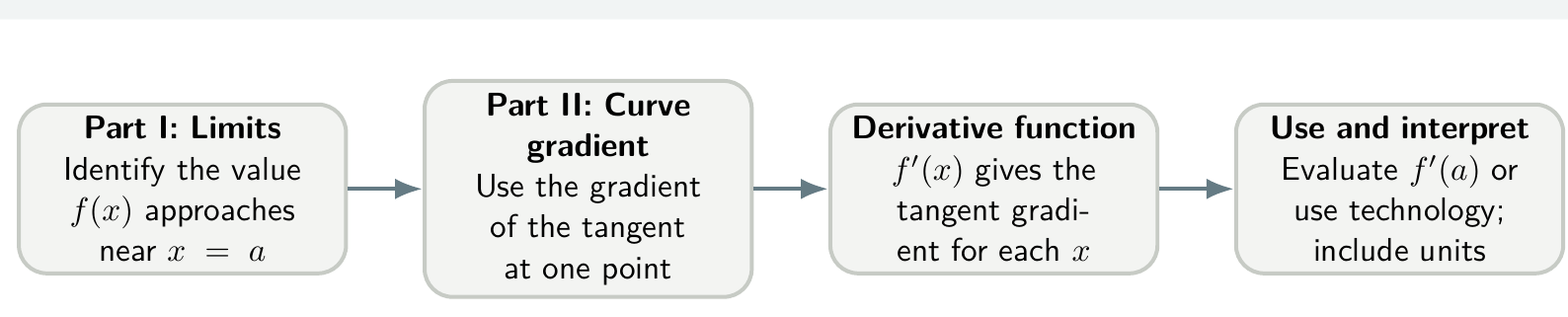
Part I: limits
- A limit describes what outputs approach near an input value.
- Approach from both sides for a two-sided limit.
- The limit can differ from the actual function value.
Part II: derivatives
- \(f'(a)\) is the tangent gradient at \(x=a\).
- \(f'(x)\) is the gradient function.
- Derivative units are output-units per input-unit.
Practice
These questions follow the progression of the handout: limits first, then derivative meaning, secant gradients, calculator use and contextual interpretation.
A. Limits from tables and graphs
- A table of values for \(g(x)\) near \(x=3\) approaches 5 from both sides. State \(\lim_{x\to3}g(x)\).
- As \(x\to4^-\), \(f(x)\to-1\), while as \(x\to4^+\), \(f(x)\to2\). Does \(\lim_{x\to4}f(x)\) exist? Explain.
- A graph has an open circle at \((2,6)\) and a filled point at \((2,1)\). State \(\lim_{x\to2}f(x)\) and \(f(2)\).
- Use nearby values to estimate \(\displaystyle\lim_{x\to1}\frac{x^2-1}{x-1}\).
B. Derivative and gradient
- A graph passes through \((3,7)\), and the tangent at that point has gradient \(-2\). State \(f(3)\) and \(f'(3)\).
- Given \(f'(x)=3x-4\), find the gradients of \(f\) at \(x=-2\), \(x=0\) and \(x=5\).
- Explain the difference between \(f(4)\) and \(f'(4)\).
- For \(f(x)=x^2\), find the gradient of the secant joining the points with \(x=2\) and \(x=2.5\).
- For \(f(x)=x^2\), secant gradients from \(x=2\) to \(x=2+h\) approach 4 as \(h\to0\). Estimate \(f'(2)\).
- Use a TI-Nspire numerical derivative to estimate \(g'(2)\) for \(g(x)=x^3-2x+1\). State the geometric meaning of your answer.
C. Rates and units
- A car has displacement \(s(t)\) km, where \(t\) is in hours. Explain the meanings of \(\frac{s(5)-s(3)}{5-3}\) and \(s'(4)\).
- \(V'(8)=12\), where \(V\) is volume in litres and \(t\) is time in minutes. Interpret the statement.
- \(T'(15)=-0.7\), where \(T\) is temperature in °C and time is in minutes. Interpret the statement.
- If \(V\) is measured in \(\mathrm{cm^3}\) and \(r\) in cm, give the units of \(dV/dr\).
- Revenue \(R(t)\) is measured in dollars and \(t\) in hours. Give the units of \(R'(t)\), and explain what \(R'(t)>0\) means.
Concise answer key
1. 5
2. No; the one-sided limits are different.
3. Limit = 6; \(f(2)=1\).
4. 2
5. \(f(3)=7\), \(f'(3)=-2\).
6. \(-10,-4,11\).
7. \(f(4)\) is the output; \(f'(4)\) is the tangent gradient.
8. 4.5
9. 4
10. \(g'(2)=10\); the tangent gradient is 10.
11. Average velocity from 3 h to 5 h; instantaneous velocity at 4 h, both in km/h.
12. Volume increasing at 12 L/min.
13. Temperature decreasing at 0.7 °C/min.
14. \(\mathrm{cm^2}\).
15. $/h; revenue is increasing.