IB Mathematics: Applications and Interpretation SL — Topic 5 Calculus
Limits and the Derivative
Approach a value numerically and graphically, then use the same limiting idea to understand instantaneous gradient and rate of change.
Learning goal
Estimate limits from tables and graphs, then interpret a derivative both as the gradient of a curve and as an instantaneous rate of change.
Syllabus link
IB Mathematics AI SL: SL 5.1. Informal understanding of limits and the derivative; formal analytic methods for evaluating limits are not required.
Big idea
A limit describes what a function is approaching. A derivative describes what a gradient or quantity is doing at an instant.
Key relationship
\(f'(a)=\displaystyle\lim_{h\to0}\frac{f(a+h)-f(a)}{h}\) connects secant gradients with the tangent gradient.
Approaching a value: the idea of a limit
A limit is about nearby behaviour. We ask what value the output is approaching as the input gets closer and closer to a chosen number.
Limit notation
This reads: “as \(x\) approaches \(a\), \(f(x)\) approaches \(L\).” The value of \(f(a)\) itself may be different from \(L\), or \(f(a)\) may not even be defined.
At AI SL, the emphasis is on understanding limits from tables, graphs and the idea of approaching a value. We are not trying to build a formal algebraic theory of limits.
Estimating a limit from a table and from a graph
Worked example 1: estimating a limit numerically
Estimate
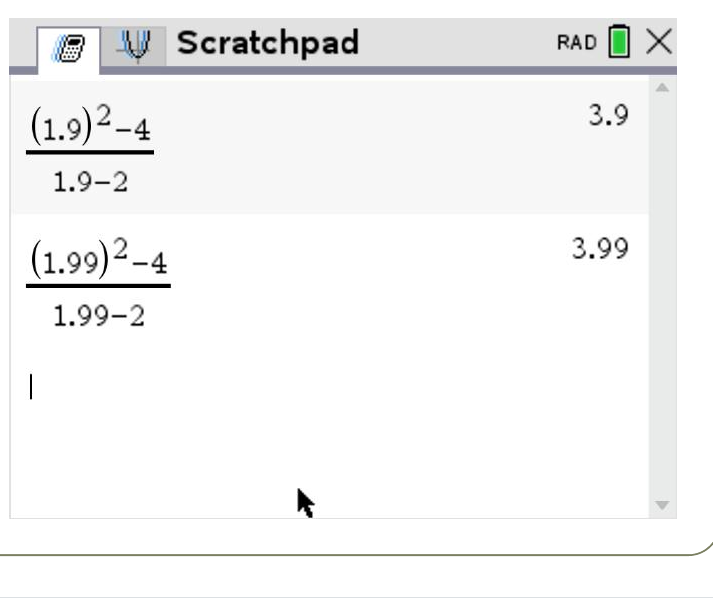
Substituting \(x=2\) gives \(\frac00\), so instead we look at values of \(x\) very close to 2 from both sides.
| \(x\) | 1.9 | 1.99 | 1.999 | 2.001 | 2.01 | 2.1 |
|---|---|---|---|---|---|---|
| \(\frac{x^2-4}{x-2}\) | 3.9 | 3.99 | 3.999 | 4.001 | 4.01 | 4.1 |
The values approach 4 from both sides, so
A limit need not equal the function value
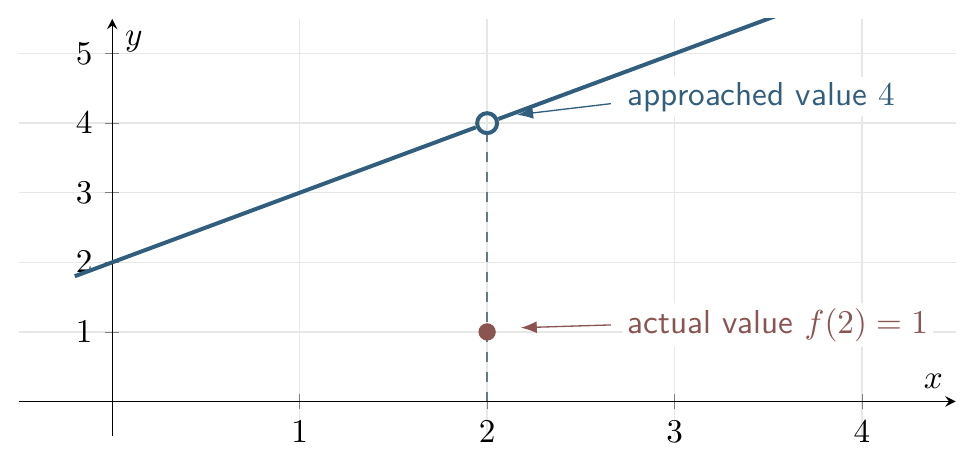
Suppose the graph approaches \(y=4\) as \(x\to2\), but the filled point at \(x=2\) is at \(y=1\). Then
The limit describes what nearby outputs approach; the function value describes the actual output at the point.
When a two-sided limit does not exist
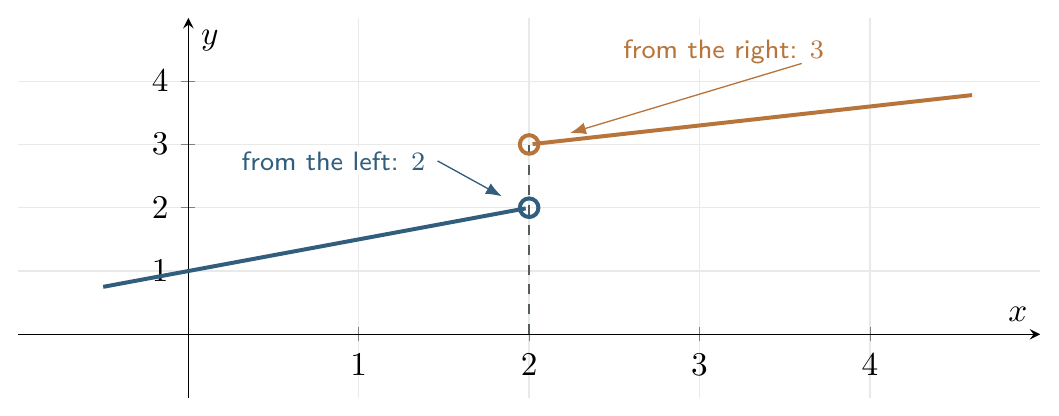
A two-sided limit exists only when the function approaches the same value from the left and from the right.
Different one-sided behaviour
If the left-hand values approach 2 while the right-hand values approach 3, there is no single number that the function approaches from both sides. Therefore the two-sided limit does not exist.
From straight-line gradient to the gradient of a curve
The derivative answers a new question: how steep is a curve at one particular point?
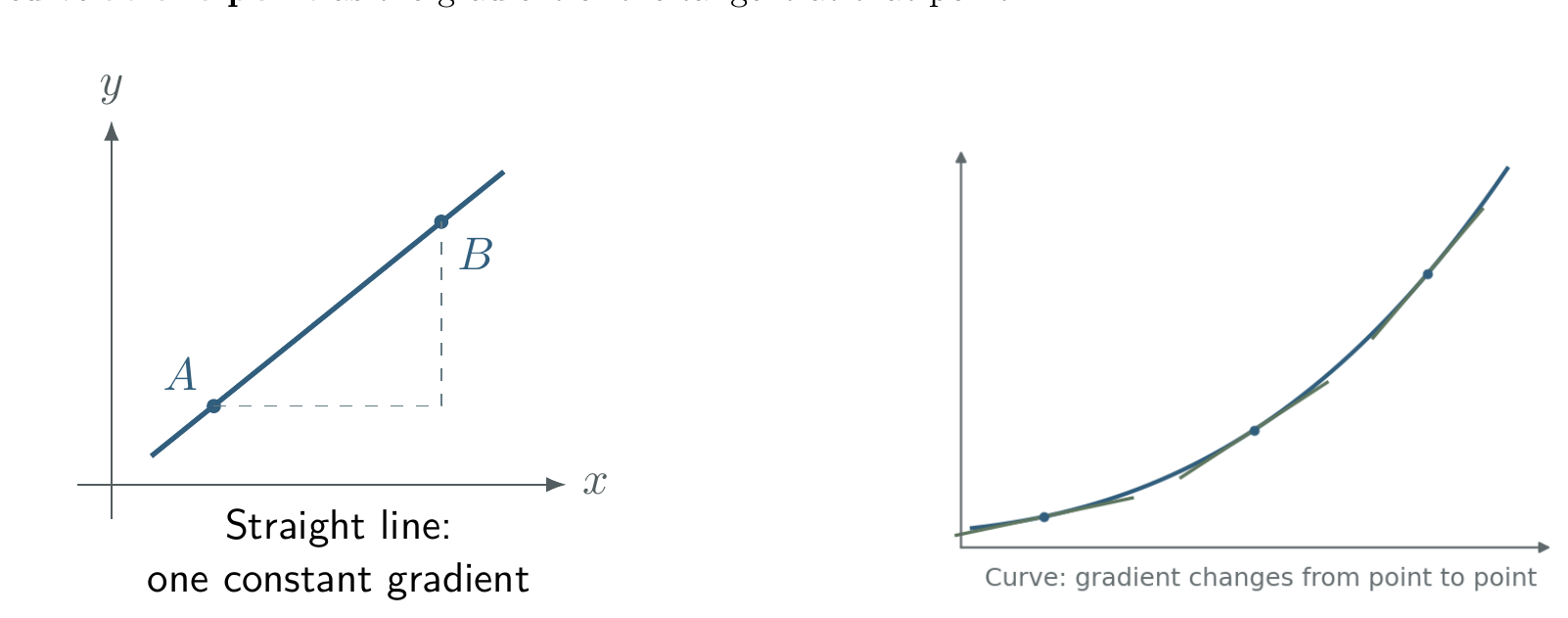
For a straight line, the gradient is constant:
For a curve, the gradient changes from point to point. At one point we measure the gradient of the tangent to the curve.
Derivative at a point
\(f'(a)\) is the gradient of the tangent to \(y=f(x)\) at \(x=a\).
The derivative as a gradient function
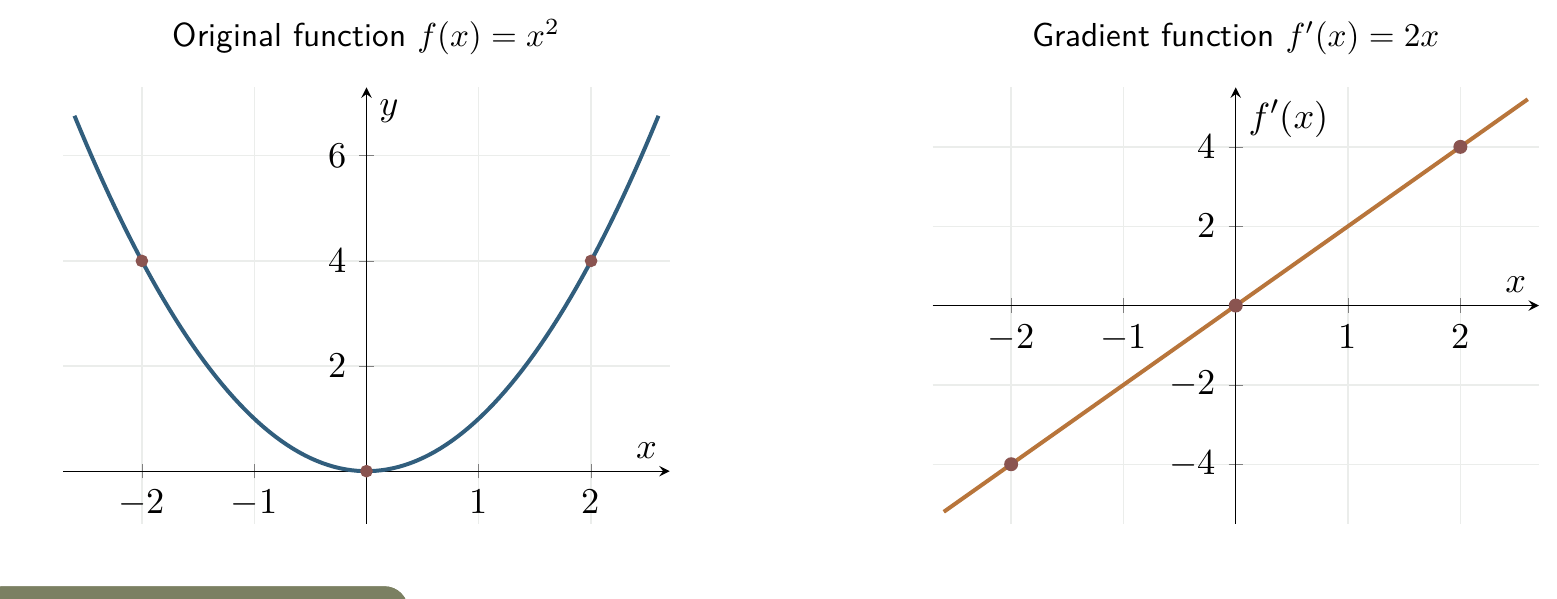
The derivative is not just a single number. If we differentiate a function, we obtain a new function that tells us the gradient everywhere.
Worked example 2: using a derivative function
For \(f(x)=x^2\), the derivative is
Therefore:
| Point | \(x=-2\) | \(x=0\) | \(x=3\) |
|---|---|---|---|
| Gradient \(f'(x)\) | -4 | 0 | 6 |
The derivative graph \(y=f'(x)=2x\) records the tangent gradient of \(y=f(x)=x^2\) at every \(x\)-value.
Limits connect secants to a tangent
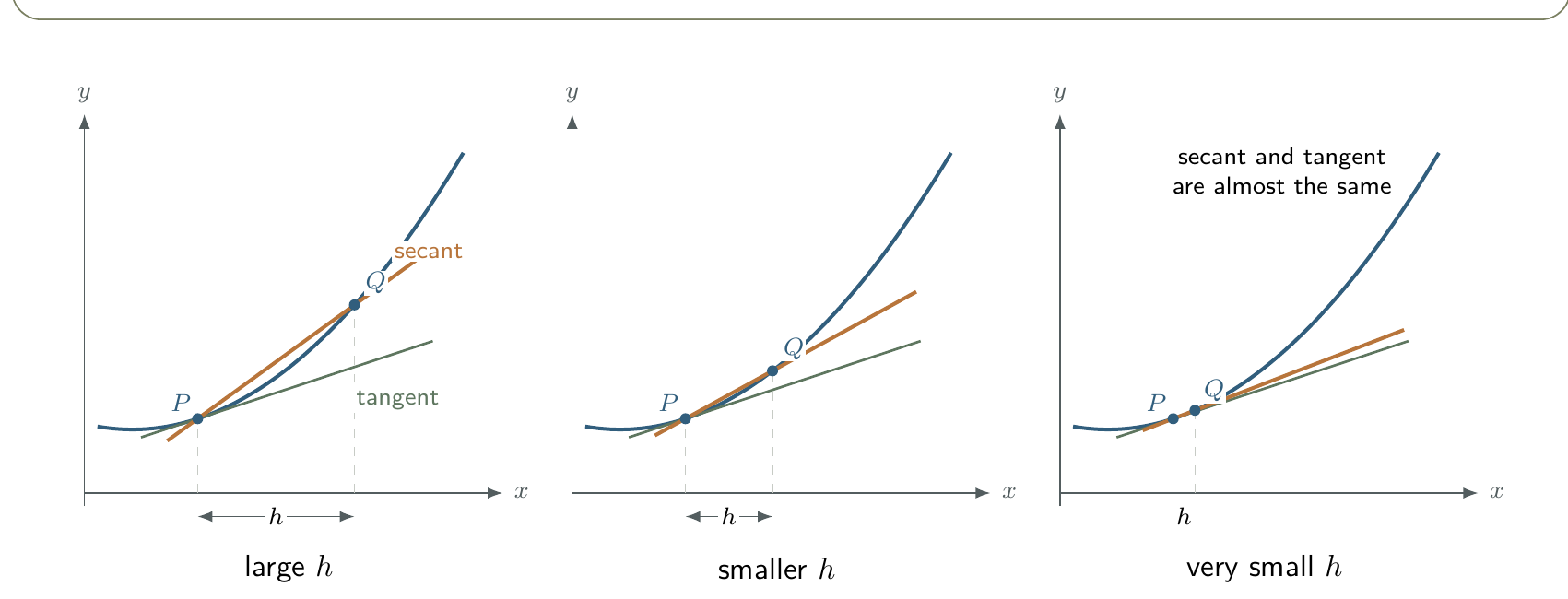
To estimate a curve's gradient at \(x=a\), start with a second nearby point at \(x=a+h\). The line joining the two points is a secant.
As \(h\) becomes smaller, the second point moves towards the first. The secant approaches the tangent, so the secant gradient approaches the derivative:
Worked example 3: estimating the gradient of \(f(x)=x^2\) at \(x=1\)
Use the secant-gradient expression with \(a=1\):
For smaller positive values of \(h\), the gradients become:
| \(h\) | 1 | 0.5 | 0.1 | 0.01 | 0.001 |
|---|---|---|---|---|---|
| Secant gradient \(2+h\) | 3 | 2.5 | 2.1 | 2.01 | 2.001 |
The values approach 2, so \(f'(1)=2\).
Video: What is a derivative?
Use this lesson to revisit the visual journey from secant gradients to the gradient of the tangent and the meaning of the derivative.
Finding a derivative at a point with the TI-Nspire CX
AI Mathematics makes deliberate use of technology. When a numerical derivative is required, the calculator can evaluate \(f'(a)\) directly.
Calculator method
- Define or enter the function.
- Use the numerical derivative command or derivative tool.
- Evaluate the derivative at the required \(x\)-value.
- Interpret the numerical result as the gradient of the tangent, with appropriate units when the variables have units.
Video: Derivative at any point on the TI-Nspire CX
The calculator tutorial demonstrates three practical ways of obtaining a derivative value and connects the output back to the tangent gradient.
The derivative as a rate of change
The same derivative idea applies whenever one quantity changes with respect to another. Gradient becomes a rate.
Simple rate model
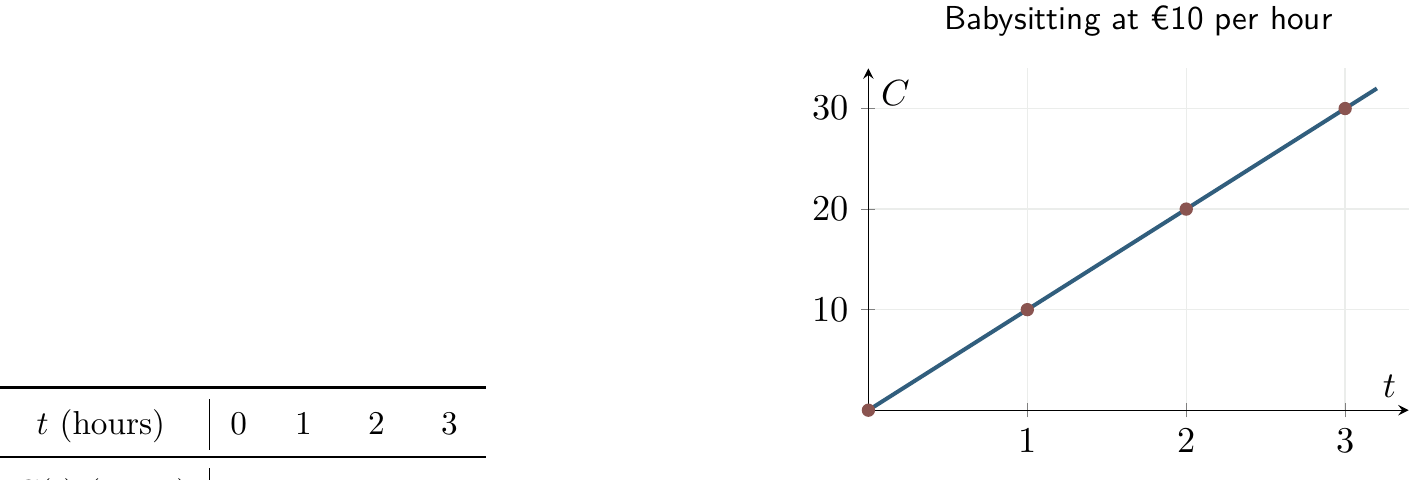
If a babysitter's total charge after \(t\) hours is \(C(t)=10t\) euros, then
The derivative has units euros per hour, so the charge is increasing at a constant rate of €10 per hour.
Worked example 4: average velocity approaching instantaneous velocity
A particle has displacement \(s(t)=t^2\) metres. The average velocity from \(t=3\) to \(t=4\) is
Now shorten the time interval:
| Interval | [3,4] | [3,3.5] | [3,3.1] | [3,3.01] | [3,3.001] |
|---|---|---|---|---|---|
| Average velocity | 7 | 6.5 | 6.1 | 6.01 | 6.001 |
As the second time approaches 3, the average velocity approaches \(6\text{ m/s}\). Therefore the instantaneous velocity at \(t=3\) is
Derivative notation and units
The derivative can be written in several equivalent ways. The notation often reflects the variables in the problem.
| Function or context | Derivative notation | Meaning |
|---|---|---|
| \(y=f(x)\) | \(f'(x)\) or \(\frac{dy}{dx}\) | change in output per unit change in \(x\) |
| Displacement \(s(t)\) | \(\frac{ds}{dt}\) | velocity |
| Volume \(V(r)\) | \(\frac{dV}{dr}\) | change in volume per unit change in radius |
| Cost \(C(q)\) | \(C'(q)\) or \(\frac{dC}{dq}\) | change in cost per unit change in quantity |
Units of a derivative
Derivative units are
For example, if volume is measured in \(\mathrm{cm^3}\) and radius in cm, then \(dV/dr\) has units \(\mathrm{cm^2}\).
Worked example 5: interpreting a derivative in context
Suppose \(V(t)\) is the volume of water in a tank, in litres, after \(t\) minutes, and
The negative sign means the volume is decreasing. The magnitude gives the rate.
Interpretation After 12 minutes, the volume of water is decreasing at \(3.5\text{ L/min}\).
Two-part lesson summary
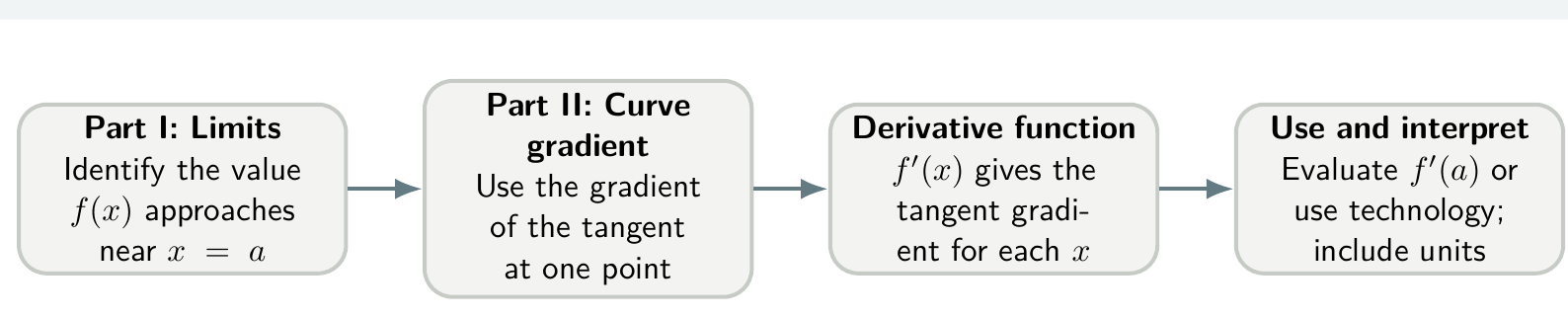
Part I: limits
- A limit describes what outputs approach near an input value.
- Approach from both sides for a two-sided limit.
- The limit can differ from the actual function value.
Part II: derivatives
- \(f'(a)\) is the tangent gradient at \(x=a\).
- \(f'(x)\) is the gradient function.
- Derivative units are output-units per input-unit.
Practice
These questions follow the progression of the handout: limits first, then derivative meaning, secant gradients, calculator use and contextual interpretation.
A. Limits from tables and graphs
- A table of values for \(g(x)\) near \(x=3\) approaches 5 from both sides. State \(\lim_{x\to3}g(x)\).
- As \(x\to4^-\), \(f(x)\to-1\), while as \(x\to4^+\), \(f(x)\to2\). Does \(\lim_{x\to4}f(x)\) exist? Explain.
- A graph has an open circle at \((2,6)\) and a filled point at \((2,1)\). State \(\lim_{x\to2}f(x)\) and \(f(2)\).
- Use nearby values to estimate \(\displaystyle\lim_{x\to1}\frac{x^2-1}{x-1}\).
B. Derivative and gradient
- A graph passes through \((3,7)\), and the tangent at that point has gradient \(-2\). State \(f(3)\) and \(f'(3)\).
- Given \(f'(x)=3x-4\), find the gradients of \(f\) at \(x=-2\), \(x=0\) and \(x=5\).
- Explain the difference between \(f(4)\) and \(f'(4)\).
- For \(f(x)=x^2\), find the gradient of the secant joining the points with \(x=2\) and \(x=2.5\).
- For \(f(x)=x^2\), secant gradients from \(x=2\) to \(x=2+h\) approach 4 as \(h\to0\). Estimate \(f'(2)\).
- Use a TI-Nspire numerical derivative to estimate \(g'(2)\) for \(g(x)=x^3-2x+1\). State the geometric meaning of your answer.
C. Rates and units
- A car has displacement \(s(t)\) km, where \(t\) is in hours. Explain the meanings of \(\frac{s(5)-s(3)}{5-3}\) and \(s'(4)\).
- \(V'(8)=12\), where \(V\) is volume in litres and \(t\) is time in minutes. Interpret the statement.
- \(T'(15)=-0.7\), where \(T\) is temperature in °C and time is in minutes. Interpret the statement.
- If \(V\) is measured in \(\mathrm{cm^3}\) and \(r\) in cm, give the units of \(dV/dr\).
- Revenue \(R(t)\) is measured in dollars and \(t\) in hours. Give the units of \(R'(t)\), and explain what \(R'(t)>0\) means.
Concise answer key
1. 5
2. No; the one-sided limits are different.
3. Limit = 6; \(f(2)=1\).
4. 2
5. \(f(3)=7\), \(f'(3)=-2\).
6. \(-10,-4,11\).
7. \(f(4)\) is the output; \(f'(4)\) is the tangent gradient.
8. 4.5
9. 4
10. \(g'(2)=10\); the tangent gradient is 10.
11. Average velocity from 3 h to 5 h; instantaneous velocity at 4 h, both in km/h.
12. Volume increasing at 12 L/min.
13. Temperature decreasing at 0.7 °C/min.
14. \(\mathrm{cm^2}\).
15. $/h; revenue is increasing.