IB Mathematics: Applications and Interpretation SL — Topic 5 Calculus
AI SL Optimisation
Modelling, calculus, technology, domains and interpretation.
Learning goal
Solve AI SL optimisation problems by identifying the quantity to maximise or minimise, building a one-variable model, using calculus and/or technology as required, respecting the relevant domain, and interpreting the result in context.
Syllabus link
IB Mathematics AI SL: SL 5.7. Optimisation problems in context, including maximising profit, minimising cost and maximising volume for a given surface area. AI SL 5.6 supports this through solving \(f'(x)=0\), local maxima/minima and technology.
Big idea
Build the model first, then follow the wording of the question: show calculus when expected, use the GDC when instructed, and always check that the result fits the domain and the context.
AI SL habit
Use technology to obtain, check and interpret results — but when calculus is requested, the GDC checks the working rather than replacing it.
A first question
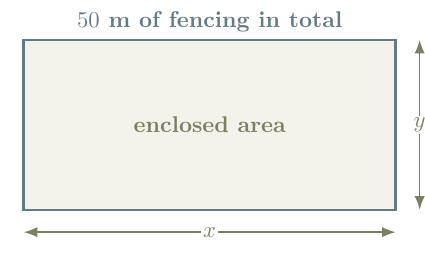
A farmer has 50 m of fencing to make a rectangular enclosure. All four sides of the enclosure must be fenced.
What is the maximum possible area of the enclosure?
A very long, narrow rectangle uses the available fencing but encloses little area. A shape that is too short and wide also encloses less area. Somewhere between these extremes is the rectangle with the largest possible area.
We will solve this opening problem after Worked Example 1, once we have seen the four-step method in action.
What is an optimisation problem?
An optimisation problem asks for the largest or smallest possible value of a quantity, under one or more restrictions. In the opening question, the target is the largest possible area and the restriction is the 50 m of available fencing.
Target quantity
The target quantity is what is being optimised: area, volume, cost, profit, time, fencing length, and so on.
For the opening problem, if the side lengths are \(x\) and \(y\), then \(A=xy\).
Constraint
The constraint links the variables and limits the possible designs.
so the area can be written \(A(x)=x(25-x)\).
State or infer the relevant domain.
Use calculus and/or technology as required. Respect the domain and endpoints, then interpret the result in context.
Worked examples
Worked example 1: pen against a wall
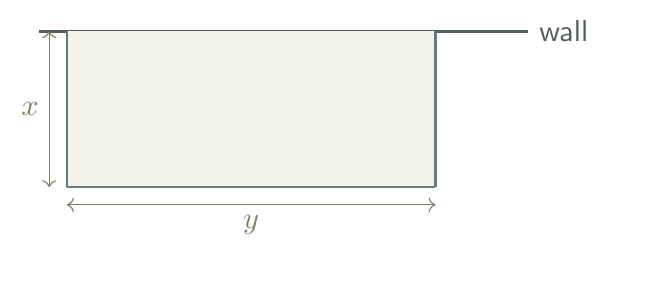
Question. A farmer uses 80 m of fencing to make a rectangular pen against a straight wall. No fencing is needed along the wall. Find the dimensions that maximise the area.
Solution
Step 1: Identify the target and constraint. The target is the area; the constraint is that 80 m of fencing is used for the three exposed sides.
Step 2: Write the equations. Let \(x\) be each side perpendicular to the wall and \(y\) the side parallel to it:
Step 3: Write the target in one variable.
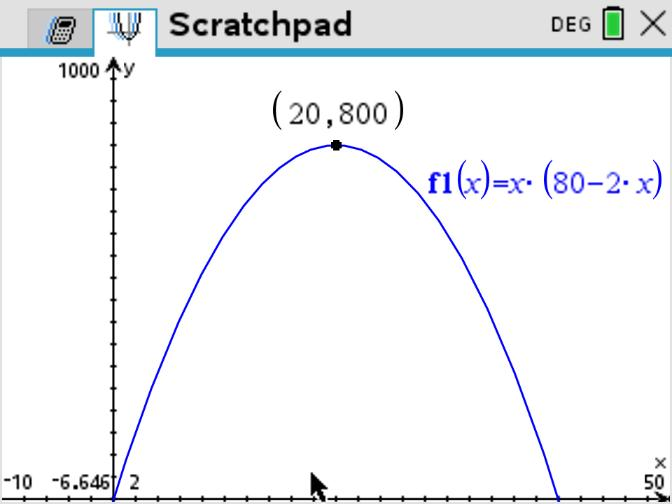
Step 4: Use calculus to optimise, then check with the GDC.
Set \(A'(x)=0\):
Then \(y=80-2(20)=40\) m and \(A(20)=800\text{{ m}}^2\).
Answer The maximum area occurs when the pen is 20 m by 40 m, with maximum area 800 m².
AI SL habit: use the calculator to check your calculus
After calculus gives a candidate maximum or minimum, graph the target function over the meaningful domain. Check that the stationary \(x\)-value appears at the expected maximum or minimum and check the corresponding target value. If the question asks for calculus, the GDC is a check, not a replacement for the working.
Return to the opening fencing problem
Question. A farmer has 50 m of fencing for all four sides of a rectangle. Find the maximum possible area.
Solution
Step 1: target \(A=xy\); constraint \(2x+2y=50\).
Step 2: rearrange the constraint:
Step 3:
Step 4:
Then \(y=12.5\) and \(A(12.5)=156.25\text{{ m}}^2\).
Answer The enclosure is 12.5 m by 12.5 m and the maximum area is 156.25 m².
Worked example 2: largest rectangle under a curve
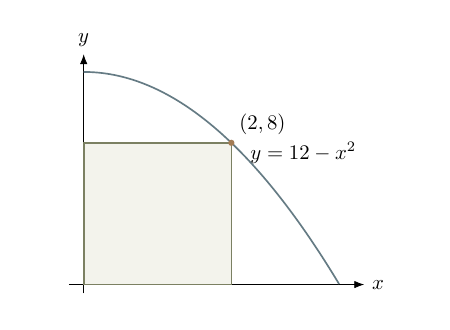
Question. A rectangle has one vertex at the origin, sides on the coordinate axes, and its top-right corner on \(y=12-x^2\), with \(0\le x\le\sqrt{{12}}\). Find the maximum possible area.
Solution
Step 1: target area; constraint \(y=12-x^2\).
Step 2: \(A=xy\).
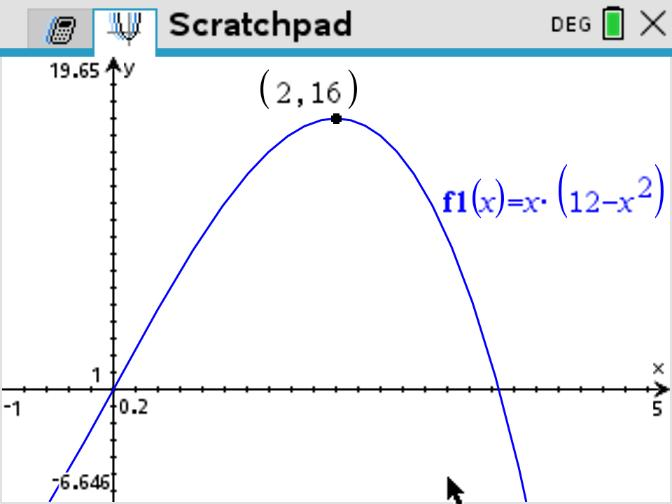
Step 3:
Step 4:
where the positive value is used because \(x\) is a length. Then \(y=8\) and \(A(2)=16\).
Answer The maximum area is 16 square units, produced by a \(2\) by \(8\) rectangle.
Worked example 3: a maximum at an endpoint
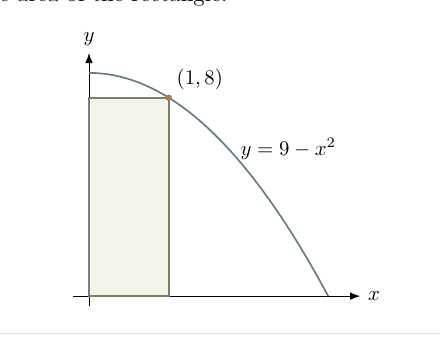
Question. A rectangle has one vertex at the origin, sides on the coordinate axes, and its top-right corner on \(y=9-x^2\), with \(0\le x\le1\). Find the maximum possible area.
Solution
Step 1: target area; the curve gives \(y=9-x^2\), and the width is restricted to \(0\le x\le1\).
Step 2: \(A=xy\).
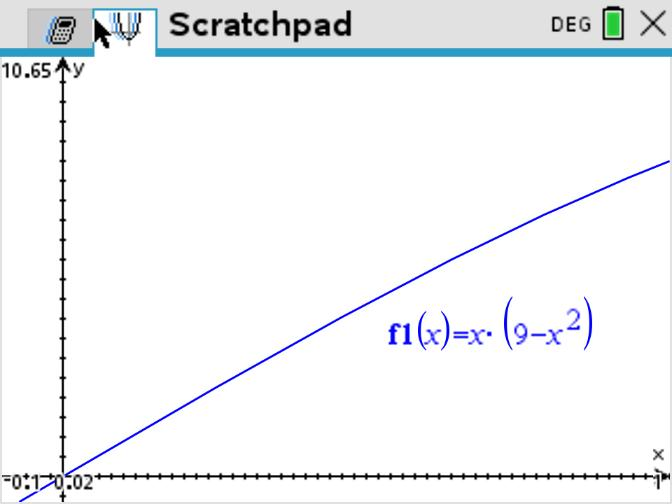
Step 3:
Step 4:
But \(\sqrt3\notin[0,1]\), so there is no stationary candidate inside the allowed interval. Check the endpoints:
Answer The maximum possible area is 8 square units, at the endpoint \(x=1\), where \(y=8\).
Why the domain and endpoints matter
A maximum or minimum on a restricted interval does not have to occur at a stationary point. It can occur at an endpoint. On a closed interval, compare stationary candidates with endpoint values. The stated domain is part of the mathematics.
Worked example 4: maximising profit
Question. A company sells \(x\) items. The price per item is \(p(x)=60-0.2x\) euros and the production cost is \(C(x)=12x+150\) euros. Find the number of items that maximises profit.
Solution
Step 1: the target is profit.
Step 2: revenue is price × quantity and profit is revenue minus cost:
Step 3:
A meaningful domain is \(0\le x\le300\), because the price model reaches zero at \(x=300\).
Step 4:
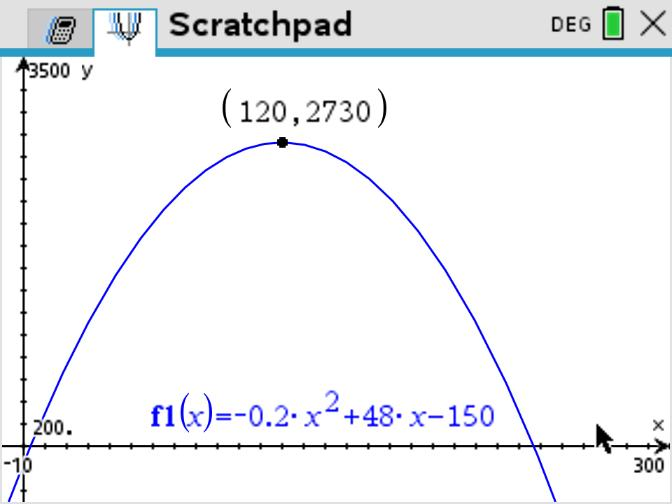
Answer The profit is maximised at 120 items, with a modelled maximum profit of €2730.
When the variable must be a whole number
If a variable represents a count — for example, people, items or boxes — a continuous optimum may be a decimal. Check the nearby feasible integer values and choose the one giving the best target value.
Worked example 5: minimum surface area of a cylinder
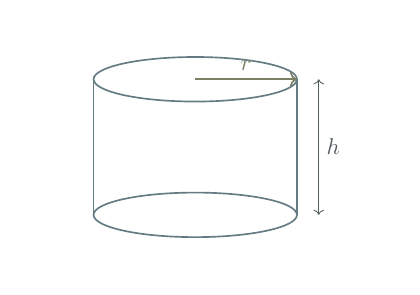
Question. A closed cylinder has volume \(250\pi\text{{ cm}}^3\). Find the radius and height that minimise its surface area.
Solution
Step 1: target surface area; constraint fixed volume.
Step 2:
Step 3: from the volume constraint, \(h=250/r^2\), so
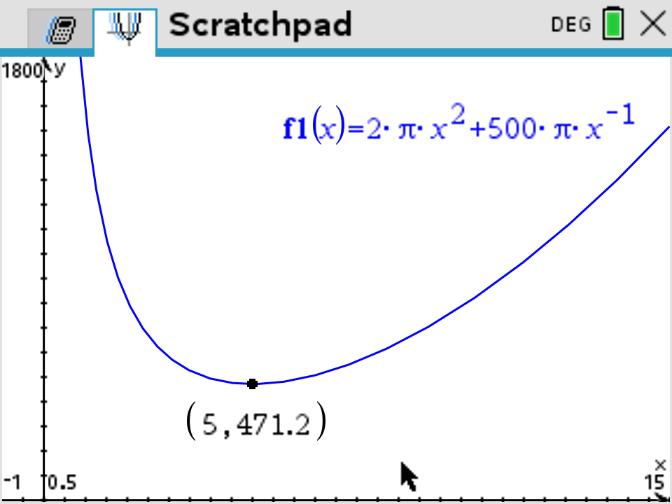
Step 4: write with powers and differentiate:
Set \(S'(r)=0\):
Then \(h=250/5^2=10\text{{ cm}}\).
Answer The surface area is minimised when \(r=5\text{{ cm}}\) and \(h=10\text{{ cm}}\).
How the four steps appear in IB AI SL questions
The wording matters. IB questions often reveal the four steps gradually across several parts. Read the whole question first so that you know which method must be shown. If the question says “find \(f'(x)\)” and then “hence”, show the calculus and stationary-point reasoning. If it says “use your graphic display calculator”, use the GDC as instructed while still stating the target function, relevant domain and interpretation.
Annotated IB-style question: three garden plots [11 marks]
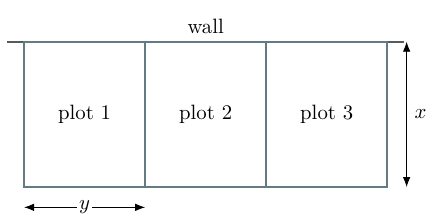
Three identical rectangular plots are placed side by side against a straight wall. No fencing is needed along the wall. Each plot has depth \(x\) metres and width \(y\) metres. The total area is \(192\text{{ m}}^2\).
(a) Write down an equation connecting \(x\) and \(y\). [1]
(b) Let \(L\) metres be the total fencing required. Show that \(L=4x+\frac{{192}}{{x}}\). [3]
(c) Find \(\frac{{dL}}{{dx}}\). [2]
(d) Hence find the values of \(x\) and \(y\) for which the total fencing is a minimum. [3]
(e) State the minimum total length of fencing. [1]
(f) Use your GDC to check that your value of \(x\) corresponds to a minimum of \(L\). [1]
Solution
Step 1: target total fencing \(L\); constraint fixed total area.
Step 2:
Step 3: from \(3xy=192\), \(y=64/x\), so
Step 4:
Set \(L'(x)=0\):
Then
The minimum fencing is
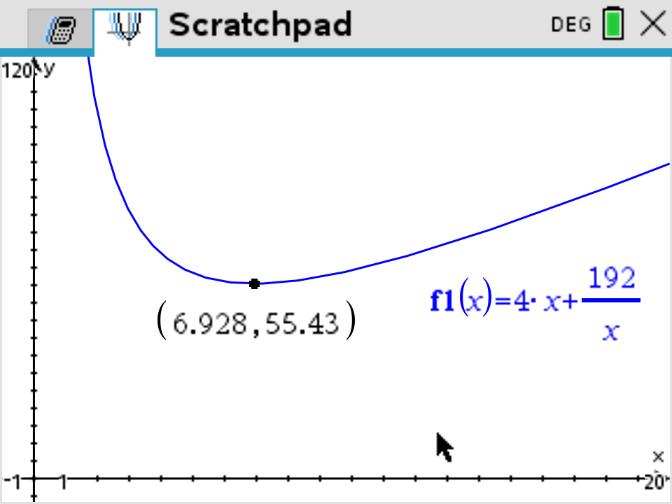
Answer Each plot should be \(4\sqrt3\) m deep and \(\frac{{16\sqrt3}}{{3}}\) m wide. The minimum fencing is \(32\sqrt3\text{{ m}}\approx55.4\text{{ m}}\).
AI SL exam habit
Match the method to the command. If the question asks for a derivative or says hence, show the calculus. If it says use your graphic display calculator, show the function and the relevant calculator result. When time allows, use the GDC to check a calculus answer before moving on.
Practice questions
For each question, first identify the target quantity and the constraint or model. Follow the command wording, check the relevant domain and interpret the result in context.
- A rectangle has one vertex at the origin and its top-right corner on \(y=9-x^2\), \(0\le x\le3\). Find the maximum possible area.
- A closed cylinder has fixed surface area \(150\pi\text{{ cm}}^2\). Its volume is \(V(r)=\pi r(75-r^2)\), \(0<r<\sqrt{{75}}\). Use your GDC to find the value of \(r\) that maximises the volume. Hence find the height and maximum volume.
- A closed cylinder has volume \(128\pi\text{{ cm}}^3\). Find the radius and height that minimise its surface area.
- The profit, in euros, from selling \(x\) items is \(P(x)=-0.5x^2+70x-800\), \(0\le x\le140\). Find the number of items that maximises profit and determine the maximum profit.
- A rectangle is placed under \(y=16-2x^2\), \(0\le x\le2\sqrt2\), with sides on the coordinate axes. Find the maximum possible perimeter.
- A rectangle has area \(100\text{{ cm}}^2\). Find the dimensions that minimise its perimeter.
- The preparation time is \(T(n)=18+\frac{{45}}{{n}}+1.5n\), where \(n\) is the integer number of cooks and \(1\le n\le20\). Determine the integer number of cooks that minimises preparation time.
- A closed rectangular box has width \(w\) cm, length \(1.5w\) cm and volume \(12000\text{{ cm}}^3\). Find the dimensions that minimise its surface area.
Answer key
1. Rectangle under a curve
Set \(A'(x)=0\) to obtain \(x=\sqrt3\). Then \(y=6\) and \(A_{{\max}}=6\sqrt3\approx10.4\). A GDC graph confirms the maximum near \((1.73,10.4)\).
2. Maximum cylinder volume for fixed surface area
Graph \(V(r)=\pi r(75-r^2)\) on \(0<r<\sqrt{{75}}\). The GDC maximum tool gives \(r=5\text{{ cm}}\) and \(V_{{\max}}=250\pi\text{{ cm}}^3\approx785\text{{ cm}}^3\). From \(2\pi r^2+2\pi rh=150\pi\), \(h=10\text{{ cm}}\).
3. Minimum surface area of a cylinder
Set \(S'(r)=0\): \(4r^3=256\), so \(r=4\). Then \(h=8\). The GDC graph confirms the minimum.
4. Profit
Set \(P'(x)=0\) to obtain \(x=70\). Then \(P(70)=1650\). Sell 70 items; maximum profit €1650.
5. Maximum perimeter under a curve
The stationary point is \(x=0.25\); then \(y=15.875\) and \(P_{{\max}}=32.25\).
6. Minimum perimeter with fixed area
The minimum occurs at \(x=10\), so \(y=10\). The rectangle is \(10\text{{ cm}}\times10\text{{ cm}}\) with minimum perimeter \(40\text{{ cm}}\).
7. Integer decision after continuous optimisation
Check the nearby integers: \(T(5)=34.5\) and \(T(6)=34.5\). Thus the model gives the same minimum preparation time for 5 or 6 cooks.
8. Closed rectangular box
From \(1.5w^2h=12000\), \(h=8000/w^2\). For a closed box, \(S=2(lw+lh+wh)\), so
Set \(S'(w)=0\): \(6w^3=40000\), so \(w\approx18.8\text{{ cm}}\). Hence \(l\approx28.2\text{{ cm}}\) and \(h\approx22.6\text{{ cm}}\).
Summary checklist
Before you finish an AI SL optimisation problem, check:
- What quantity am I maximising or minimising?
- What restriction or relationship links the variables?
- Have I written the target quantity as a function of one variable?
- What values of the variable are meaningful in context?
- Have I followed the command wording: calculus when expected, or a GDC method when instructed?
- If I used calculus, is each stationary candidate inside the meaningful domain, and do I also need to compare endpoints?
- Have I used the GDC appropriately to obtain or verify the required maximum/minimum?
- If the variable is discrete, have I checked nearby integer values?
- If the calculator disagrees with my calculus, have I rechecked the model, derivative, equation and domain?
- Have I interpreted the final result correctly and included units?
Final AI SL habit
Use technology throughout the topic to obtain, check and interpret results. When a question expects calculus, show the calculus; when it explicitly asks for the GDC, follow that instruction directly. In both cases, the model, domain and interpretation still matter.